IN THE FIRST PAGES of All Fours, Miranda July’s second novel, the unnamed narrator confesses to collecting intimate ephemera from her friends’ relationships. But the “artifacts”—“screenshots of sexts, emails to their mothers,” recordings of conversations—never add up to something substantial. Her impulse to acquire these relics is “like trying to grab smoke by its handle,” she says before wondering, “What handle?” July’s spacey, tender art chases the same evanescence across multiple media (film, fiction, dance, and performance). Her work aims to take hold of, and hang tight to, the ineffable attractions and connections that constitute a life. All Fours may be her most successful grasping yet. By its end, the phrase “hideously affecting” came unbidden to my mind.
I’m ethically bound to disclose that I have much in common with its narrator, an emotionally immature, eccentrically libidinous, perimenopausal married woman with a past in sex work who is perpetually panicking about aging into undesirability and, consequently, celibacy. Though she has many close female friends, the narrator yearns for the immersive intimacy most associated with romantic passion. She toys with the idea of connecting with her aloof husband, Harris, but she can’t commit to the pursuit—or even decide if she likes him. Together, they are “formal, like two diplomats who aren’t sure if the other one has poisoned [their] drink.” She enjoys the weekly sex she forces herself to initiate once it’s set in motion, but afterward, she withdraws into her “native state,” which involves “dreading the next time.” The obstacle is him—or who they are together—because, alone, she is sexually voracious, full of extravagant fantasies, and prone to bouts of compulsive masturbation that last for days. When Harris gives her a look that says, “We could be as one right now, if you really wanted that,” her eyes respond with nothing. “Certainly, sex would reconnect us,” she thinks after she neglects her dutiful routine, “that was the problem.”
It doesn’t take long (about forty pages) for our narrator to find a fixation for her restless and relentless craving: Davey, a younger married man she meets at the start of a promptly aborted cross-country road trip from California to New York. Like July, the narrator is also “a minor celebrity” appreciated by a cohort of indie-film enthusiasts, readers of the New Yorker, and fellow artistically inclined free spirits. As her own boss, there are few absolute demands on her time. Usefully, her art generates enough disposable income for her to indulge in expensive whims, like redoing the interior of the motel room where she settles at the start of her journey. And she’s just famous enough to worry about how her elevated status might influence a new relationship. The narrator suspects Davey is too ordinary to recognize her—he works at a Hertz on the outskirts of Los Angeles—but after days of building a charged friendship, she learns that he knows exactly who she is, and she is ashamed. “My fame neutered me,” she thinks, dismayed. Rather than wanting to be with her because she’s “a great beauty” or “so magnetic and witty,” Davey is no more than a fan, impressed by her modest cachet.
With stunning accuracy, July captures the inner vacillations of a woman trying, and failing, to convince herself of her sexual obsolescence. This type of falsely authoritative self-negation is one of the ego’s maneuvers when it anticipates looking foolish or being rejected, and its correlation with reality is tenuous. No matter how many times the narrator tells herself she is “too old,” her desire for Davey and the intensity of union he represents is irrepressible and has the power of a prophecy. After a week of tentative, platonic encounters, Davey reveals that he does want her. (“I jerk off after every time I see you,” he says.) Contrary to popular wisdom, she is still fuckable, still lovable, at forty-five years old, even if Davey’s marital ethics won’t permit him to fully indulge.
The narrator issues a similar series of experimentally definitive decrees throughout the process of falling in love with him. One moment, he’s not a serious romantic prospect because he’s “dumb,” checks Instagram too much, and is not talented; the next, he is the most transcendent dancer she’s ever seen and the only person capable of understanding the very core of who she is. When she watches him perform a dance choreographed for her, she thinks she is “entirely known”: “This is the happiest moment of my life.” The ambiguities of romantic obsession tend to bring on such grandiose and melodramatic thinking; the slow-filling outline of the newly beloved lends itself to idealized projection. But other people’s permanent opacity also means we can’t ever be sure that a lover’s degree of attraction is the same as our own. When Davey says the limitations placed on their relationship by his marriage are “as bad” for him as they are for her, the narrator is dubious: “I would have loved to have seen a graph of the relative badness.”
The intensity of her yo-yoing feelings—and her unconsummated craving for Davey’s “huge cock”—is depicted with such meticulous accuracy that an almost unbearable momentum builds for the first third of the book, an energy destined to shatter into diffuse agony when she goes back to her family. Returned to her real world, she is “too much a soul,” unequipped to deal with domestic chores and the requirements of raising her adored child, Sam. The narrator’s subsequent flailing brings on a major reckoning in her marriage, after which she and Harris decide to see other people.
THE CROSSHATCHED SIGNIFICANCE that emerges between strangers is a July hallmark as well as one of her great charms, and sex is her preferred arena of incident. She is fascinated by what sex, and physicality more generally, can achieve, namely surprise, revelation, and connection. Her depiction of sexual curiosity and mutability is regularly a source of relief for me, an implicit repudiation of the dour, limited way sex is treated socially and culturally. In her first film, 2005’s Me and You and Everyone We Know, I was exhilarated by the two teenage best friends who experiment with their sexual power by provoking an adult neighbor into writing explicit reveries about them on posters displayed in his window and who bully a peer into evaluating their respective blow job techniques. Past the halfway point of All Fours, the narrator and her husband embark on a poignant, hilarious role-play that helped me understand what might have united these people in the first place, and I began to root for them to stay together. But the second half of the book flags as the narrator starts canvassing friends about menopause, taking hormones, and figuring out the shape of her newly open marriage. Once Davey recedes into the past, she takes up with an artist named Kris, a character who remains vague and who “happily”—or so the narrator says—doesn’t come close to replicating Davey’s vibrant urgency.
July is extremely funny, which makes her narrator good company, but without the catalyst of intense desire, she can meander into less dynamic self-involvement.And her dedication to sexual unpredictability can work against the coherence of her distinctive characters, who sometimes feel shoehorned into the wrong plot. This was the case in her 2020 film, Kajillionaire, in which the gorgeous, vivacious Melanie pursues the awkward, prickly Old Dolio despite myriad discouragements of considerable magnitude. It also happened in July’s debut novel, The First Bad Man, when two women’s vicious physical fights eventually yield to sex. In All Fours, this engineered import comes when the narrator has sex with a woman connected to Davey’s past. The setup has a certain logic—if you can’t sleep with someone directly, one degree of separation is the next best thing—but in place of chemistry, there’s only antagonism and irritation. “There was no attraction between us,” the narrator says. “Her agenda seemed more self-help than sexual.” Why, then, do they do it? Because the author wanted them to.
Thanks to her frank, appealing voice and earnest appreciation for interpersonal weirdness, July’s failures are often more engaging than less ambitious writers’ successes, and when she pulls off her smoke-grabbing, it’s unforgettable. (What a poorer world we’d be in without the “pooping back and forth” motif from Me and You and Everyone We Know.) I didn’t mind the missteps in All Fours because I’d rather the risk be taken than declined. No one in July’s work is ever wasted. Everyone has the potential to be important, and that potential is usually fulfilled. Ten chapters after her first appearance, an antique seller met in passing is revealed to be a figure of crucial relevance. The narrator sees an artist’s name on a card in her sculptor friend’s studio and ends up sleeping with that artist’s ex-girlfriend. Everything could become something; everyone could become someone. (“What, you having a strangely intimate interaction with a stranger?” the narrator imagines her husband saying to her at one point.)
The wackiness of the narrator of All Fours is mild when compared to July’s character Christine in Me and You and Everyone We Know, a grown woman who puts socks on her ears in a department store while trying to court a shoe salesman, and the protagonist of The First Bad Man, a woman who telepathically communicates with strangers’ babies and, for a year, hosts her employers’ abusive daughter as a houseguest. But like those earlier projects—both of which I enjoyed—All Fours still suffers, at points, from artificiality.
The book’s end, even more so than the aforementioned sex scene, struck me as contrived. But that didn’t keep me from crying, and I won’t soon forget it (as, in truth, I forget so many novels that are more strictly realistic). The specificity of emotion—and the flourish with which it’s rendered—seeps beyond the boundaries of the book and stains the reader. “I could always be how I was in the (motel) room,” the narrator realizes; the “full soul” she felt in possession of while lost in love with Davey is not a moment with a beginning and end, nor something he bestows or withholds. The narrator comes to understand this through dance, not in spite of the form’s separation from so-called real life but because of it. Art’s elevation and estrangement facilitate the transmission of truth. If life is the smoke, art is the handle. What handle? The best, and the only, one we have.
Charlotte Shane is a cofounder of TigerBee Press. Her new book, An Honest Woman: A Memoir of Love and Sex Work, will be published in August by Simon & Schuster.
The new reissue of photographer Richard Billingham’s RAY’S A LAUGH (MACK, $80) declares itself a “director’s cut” and clearly embraces the spirit of that form. The original edition, published in 1996 by the now-defunct imprint Scalo, featured a tight edit of fifty-five wry snapshots, taken by a twenty-six-year-old within the confines of his family’s dingy, overdecorated flat. The book had no essays, no forewords, no information at all, really, save for a few lines from the artist and a punchy blurb by Robert Frank on the back. But it became an instant classic, and consecrated an unknown, working-class kid from England’s Black Country as the next big fine-art photography star. Billingham had “never looked at photo books before 1994,” lived with his parents, and worked at his local Kwik Save; within a year of Ray’s a Laugh’srelease, he was included in the Museum of Modern Art’s New Photography exhibition, awarded the Citibank Private Bank Photography Prize, and given the January 1997 cover of Artforum. His inclusion in the famed Sensation exhibition at the Royal Academy of Art that same year added the young British artist to the roster of the Young British Artists. He soon quit his day job.
Nearly three decades later, Billingham is a bit more conversant in photography books, and has some misgivings about his first. Comparing Ray’s a Laugh old and new, he laments that the “first one doesn’t flow. It’s one image after another, put together in a very calculated way.” While this new version might still sequence one image after another, it shows a markedly different approach to the same body of work, assembled under very different circumstances. The first was superintended by two industry pros, Daily Telegraph photo editor Michael Collins and the photographer Julian Germain; Billingham was, of course, at the editors’ mercy. Now, MACK books has let Billingham take the wheel, and his new edit includes many more variations on the theme, with thrice the images of his family’s drunk and disorderly antics. It fleshes out the day-to-day of their poverty and alcoholism, trading the original’s coy précis for total candor. “I wanted everything in one place, I guess,” the artist tells the writer Liz Jobey, “once and for all.” Jobey edited a companion reader to the new volume, RAY’S A LAUGH: A READER (MACK, $25), and her introductory essay adopts the same tell-all, show-all ethos, building a bildungsroman out of Billingham’s early career. Her chronicle of the “relationships, and the conflicts, that brought the [first] book about” is equal parts diligent and dishy. Jobey unfurls the power dynamic among Collins, Germain, and Billingham, whose photographs they first discovered littered across his college studio’s floor, being used as studies for paintings. The nascent artist is airlifted to success, but these things are never not devil’s bargains. I won’t spoil the rest, but it shouldn’t come as a surprise that Billingham and Collins are no longer on speaking terms.
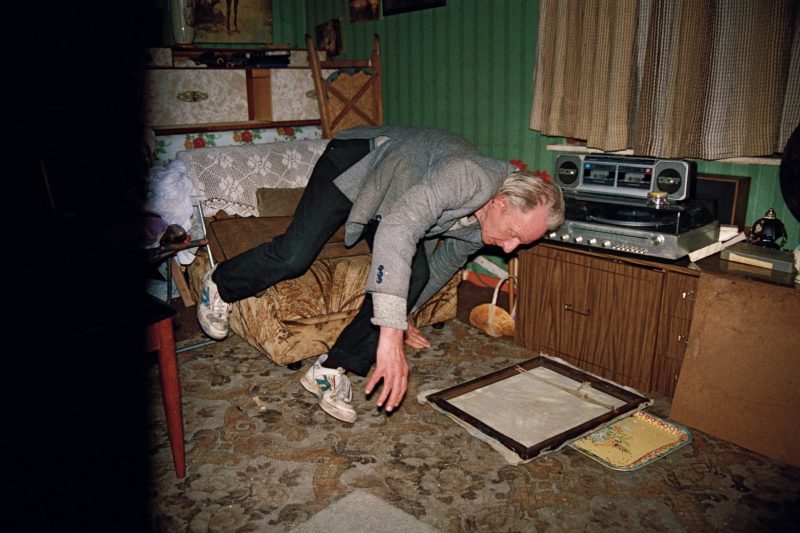
Richard Billingham, from Ray’s a Laugh (MACK, 2024). Courtesy of the artist and MACK.
If you’ve ever cherished Billingham’s images of his down-and-out dad Ray, chain-smoking mom Liz, delinquent brother Jason, and their sizable troupe of pets, it can be thrilling to encounter previously deleted scenes of these characters, drinking and dawdling and squabbling amid the mess that they made back in the mid-1990s. The body of work’s brilliance lies in its ability to dispense misery and mirth in tandem without skewing too sentimental or—worse—sociological. Comedy and tragedy coexist under Billingham’s flash: Ray sporting a shit-eating grin as he unscrews the cap of a liquor bottle, shirtless in front of a green, grease-splattered kitchen wall; Liz eating dinner on the couch, her large figure wrapped in a pink polyester blouse and a Royal Stewart tartan skirt, holding a large piece of pork in her left hand as she fends off an encroaching cat; Jason leaning against the linoleum counter as he licks the lid of a generic Kwik Save yogurt cup. Ray and Liz fighting, Ray and Liz kissing. Ray falling out of his chair. Ray passed out on the carpet. Porcelain knickknacks crowded into glass cabinets, and chintzy, “oriental” masks arranged high up on another dirty wall, like dollar-store versions of Doctor T. J. Eckleburg’s all-seeing eyes. They, too, keep their vigil, while Billingham’s gaze maintains its own “peculiar intensity,” never looking away from his family already fallen.
Some shows need to be watched in small doses, and binging the entire book does invite some fatigue. In the first edition, vulgarity was counterweighted by determined restraint—the editors knew how to dole out enough images to get a buzz going while still leaving us wanting more. In the new issue of Ray’s a Laugh, one can sense that Billingham is keen to give it all away—to be done with the subject matter, as he put it, “once and for all.” And who could blame him? It’s been almost thirty years since he was first plucked from his university program by two elders and let them turn his pictures of Ray’s cloudy home brew into liquid gold. Freedom is everything to an artist, and there’s great liberty to be found in letting go. —Juliana Halpert
The membrane between the work and life of artist Barbara T. Smith is so thin that naming its themes—food, sex, spirituality, technology—hardly glimpses the hard-won manner with which she blended all of them into myriad forms of nourishment gathered under the aegis of “art.”
In 1966, Smith, then a thirty-five-year-old Pasadena, California, housewife with a flipped bob, leased a Xerox 914 copy machine and placed it smack-dab in her dining room, whence, in her words, “It immediately took over my life.” She photocopied everything around the house: her kids’ toys, her body, her face, her hands. She wrote on the glass with lipstick, adding stickers and bits of imagery from magazines and assorted mail. The Xerox constituted a break in her life and work that would be the catalyst for their fusion. This explosion of self is sweetly embodied in a small paper work, Just Plain Facts (1966–67), a Xerox portrait of the artist, her face smooshed up against the glass, all lentigines and smiles. Between thumb and forefinger, she holds a watch face. In the tangle of her hair is the image of a house. In the lower right corner, a paper cutout of a cat, perhaps filched from one of her childrens’ books. Her radiant visage dwarfs these oblique symbols of proscribed female fear (cat lady) and desiderata (youth, real estate).
It is no wonder the curators of Proof, Smith’s 2023 retrospective at the Institute of Contemporary Art, Los Angeles, chose Facts as the cover image for its catalogue. The pleasures of BARBARA T. SMITH: PROOF (Gregory R. Miller & Co./Institute of Contemporary Art, Los Angeles, $50) lie in the thick edit of Smith’s ephemera: everything from high school homework to performance notes, plus copious process imagery. Curator Pietro Rigolo’s essay on the personal nature of Smith’s archive could have been a toothless exculpation of a gendered theme, but he gets right into analyses of various works with a specificity that bears in mind the thinness of the life/art membrane with great care, like a rare textile conservationist tending a web. Soon after her Xerox breakthrough, Smith would divorce, enroll at UC Irvine alongside Chris Burden and Nancy Buchanan, and press her body against other bodies, not just glass. She would go on to pioneer a uniquely West Coast strain of what would, by the 1970s, be designated “performance art.” Guest curator Jenelle Porter has thanked Smith profusely and publicly for being a devoted archivist of her own work. Smith’s output is so prolific in degree and catholic in scope, that the bulk of the catalogue is organized chronologically, with text and image entries for nearly every year of her life, starting in 1931. For any other artist, such a presentation might seem conventional. For Smith, we’re all still catching up. —Christina Catherine Martinez
I call her “Saint Eva,” sometimes “Patron Eva” or “Lady H,” such is the hold Eva Hesse has on my material and formal psyche—her heavy tangles of ropes and wires, her pendulous lead-filled nets, her translucent fiberglass boxes and cylinders, her raucous paintings that sometimes sprout thick cord-covered steel tendrils, her latex hangings so fragile like flayed skin, like they are about to dissolve, like evidence of how fine and porous the line between art and life really is. As the artist said in a 1970 interview with art historian Cindy Nemser, “In my inner soul, art and life are inseparable.”
I opened EVA HESSE: EXHIBITIONS, 1972–2022 (Hauser & Wirth Publishers, $60), edited by Barry Rosen (who also put together the big, beautiful 2016 volume of her diaries), on May 29, exactly fifty-four years after the artist’s untimely death, age thirty-four, from a brain tumor. Happenstance, no doubt, and any day should really be a day to revisit Hesse’s work—the thrust behind this new tome, which charts and contextualizes five decades of posthumous exhibitions. Hesse made sui generis, uncategorizable art that she described variously as “absurd,” “not painting, not sculpture,” “non-work,” and “non art, non connotative, non anthropomorphic, non geometric, non, nothing, everything, but another kind, vision, sort.” What, you might ask, does that leave, exactly? “It is something, it is nothing,” she said gnomically of how her art strove to reach beyond preconceptions and conventional logic.
It is perhaps for this yearning, restless, revolutionary reason that Hesse is such an artist’s artist, as well as a lodestar for art historians who have variously contended with “making an exhibition out of uncertainty,” as Briony Fer describes in one essay about a process-oriented show she worked on at the Fruitmarket Gallery in Edinburgh, 2009. The collected retrospective accounts of sixteen exhibitions by their organizers cover vast terrain: Hesse’s place in Minimalism and post-Minimalism; the later recognition of her paintings and drawings; the almost prohibitive fragility of the work; her use of textiles, seriality, and repetition; and the ethical considerations of biographical interpretation. In essays that plot the traverse of her oeuvre across the United States and Europe (including Hamburg, the place of birth she departed in 1938 on the Kindertransport), curators and scholars describe it as surprising, sublime, infinite. For some, it was a distillation of Jewish life in postwar America; for others, an archival challenge; for others still, a lesson in “mistrust of the perfect and the beautiful.” Helen Cooper’s essay about the 1992 show at Yale University Art Gallery begins, “I wasn’t expecting to fall in love”—a shared sentiment and a reminder that no art or life, no matter how truncated, is ever static. —Emily LaBarge
In the beginning, the women are practically interchangeable—tall, leggy, barely clad, and wholly depraved. This is the busy, lurid world of Hilary Harkness, and this is her early work, channeling Hieronymus Bosch, Helmut Newton, and Richard Scarry, in which rapacious female desire plays out in the male realms of battleships and submarines. Hallways, tunnels, galleys, infirmaries, and bathroom stalls teem with sex and violence. In virtuosic miniaturist detail, Harkness’s figures defile each other with staggering ingenuity. That the painter constructs these tableaus of plunderous sapphic desire as cutaways—essentially, vast peepholes—heightens the thrill. Imagine if Balthus made Advent calendars, every day a new debauch.
Hilary Harkness, Shore Leave, 2000, oil on canvas mounted on plywood, 11 13⁄16 × 15 13⁄16″. Courtesy of the artist, the Whitney Museum of American Art, New York; and P·P·O·W, New York.
EVERYTHING FOR YOU (Black Dog Press, $49), a lush monograph of the artist’s work with essays by Lynne Tillman and Ashley Jackson, charts the evolution of Harkness’s work, as the anonymous pillaging mannequins give way to figures with actual names, history, and the capacity for connection, specifically Gertrude Stein and Alice B. Toklas, along with Josephine Baker, Henri Matisse, and the disembodied head of Ernest Hemingway. Here, the military-industrial complex has been supplanted by absurd and tender vignettes of domesticity, but thankfully, no lesbian-bed-death jokes necessary. Harkness is much too playful, much too generous for that cliché.
One woman stands at the center of Harkness’s most recent work,“The Arabella Freeman Series,” envisioned as “a love letter, or bedtime story,” for the artist’s wife Ara, who is Black. Inspired by Winslow Homer’s 1866 Prisoners from the Front, Harkness composed a fictitious Civil War narrative about a prosperous, Black landowning family in Virginia. If her early paintings are studies of frenetic sexual compulsion, this is an exercise in voluptuous devotion and rapture, from the rippling brushstrokes in the bark of the trees to the consummation of forbidden desire between Arabella and a white Union general, complete with a gender-reveal twist. In this verdant pastoral fantasy of a queer, anti-racist past, bodice ripping is inevitable. And in Harkness’s world, it’s the general who surrenders. Free the nipple, indeed. —Liz Brown
Postcards from a Daydream Nation beach, Tony Caramanico’s MONTAUK SURF JOURNALS (Damiani Books, $55) is a painstakingly casual collection of collaged journals that make forty years of time fly by and stand still at the same time. Given just enough bare-bones context by editor Zack Raffin to get your bearings—or at least orient your disorientation—you will find page after funky page of oceanic washes of ink, scribbled notes, lists, reminders (take Fuzzy to the vet), ads large and small, labels, stamps, TV Guide listings, record sleeves, photos of surfers galore, travel brochure covers, snapshots of friends and strangers, clothing tags, and business cards. Headlines break up the pages like submarines surfacing out of a clear blue sea: “A Faded History of Land’s Decay.” “The Kingdom of the Wizard: CALYPSO WORLD.” “Child, 2, eaten by hyena.”
Caramanico apprenticed with the photographer Peter Beard—lived on Beard’s Montauk property, did odd jobs, started the journal at his request—but whatever Beard’s initial role was in inspiring, facilitating, and even coproducing these works, they took on a life of their own. Beard and Caramanico pulled all-nighters to prep “40 or 50 pages at a time for us to collage over.” It all seemed so well timed in its offhand pursuit of the sublime and the cheesy. The specter of a thirteen-year-old noodling in his notebook while tuning out sociology class is ever-present. Yet these are real-life testaments of a journeyman surfer—a mustachioed dude whose look at any given year slides along a beach-lizard scale from Harry Reems to Sam Elliott—who not only walked the walk but drifted the drift from the Bahamas to Borneo (where he dropped acid and ran into the jungle) to Tobago (where he made a second home).
The publisher’s website says: “These legible journals provide a unique window into the day-to-day of a traveling surfer.” But legible isn’t the mot juste. Barely decipherable scruffiness is the point. Maybe the portmanteau “pyroglyphics” would fit the bill. Would that suggest a charmed amateurishness, dappled light playing off a sturdy board with journal images baked into it? —Howard Hampton
León Muñoz Santini and Jorge Panchoaga’s OMEN: PHANTASMAGORIA AT THE FARM SECURITY ADMINISTRATION ARCHIVE, 1935–1942 (RM/Gato Negro Ediciones, $50) features images by Russell Lee, Dorothea Lange, Ben Shahn, Walker Evans, Carl Mydans, Arthur Rothstein, Gordon Parks, and Jack Delano. Santini and Panchoaga selected the photos during the COVID-19 lockdown, peering at a cache of 40,000 digitized images made available by the New York Public Library, taken between 1935 and 1942 for the US federal government, which wanted a visual record of the nation’s rural devastation. As Lucy Ives points out in her accompanying essay, this is a visual record that is already, at least vaguely, familiar to the general American viewer, but in Santini and Panchoaga’s fluid refashioning and remixing of these photographs, the lie of that received record is revealed and troubled. Their editing does more than recontextualize this history, though; these images—of Black farmers and soldiers; dying and dead emaciated bodies, human and animal; children in varying degrees of awareness of their circumstances—also point forward, to a history-to-come of disastrous industrial farming practices, of cyclical economic collapse, of persistent systemic racial violence. In Omen, documentary photographs are not only imprints of something once present, now lost, but also portents of futures near and distant. Santini and Panchoaga show how, to paraphrase the theoretical physicist Brian Greene, time is not a river flowing in one direction, but a frozen lake, where past, present, and future all coexist, forever. Or maybe a tornado—a maniacal, sublime, eternal swirl. —Ania Szremski
This year Jimmy would be one hundred, though he’s been dead in the flesh for nearly forty tours of the sun. Ambivalent about whether to grieve or celebrate the landmark, we evaluate the vanities and hypocrisies of our love for him. GOD MADE MY FACE (Dancing Foxes, $40), curated by Hilton Als, is an attempt to dignify the commemorative impulse with lash and limerence, evidence of a collective yearning to be haunted by Baldwin. Within the first few sentences of his introduction to the book’s collection of photographs and paintings, Hilton calls Jimmy a “faggot” in that cruel-to-be-familiar undertone idiomatic of Jimmy’s own practice of blurring the hard R to create a softer translation from slur to slang, nigga or otherwise, guttural and elegant. He could use the two versions of that contested term in unison, with his impeccable elocution, and we cannot ascertain which way he would transcribe his spoken use of it on any given day. It likely depended on his mood and his audience. When he sat under the bright scream of television-studio lighting and announced, You’re the nigg(aher) baby, it isn’t me, he called you both. Hilton names this ability to carry shade without being shady, to court the shadow and the light as ensemble, “high-faggotry.” This is an instance of the lash, the love tap, the devotion that pretends to be preoccupied with identity to subdue its intensity, its unrequitable love. And in that sense it’s beautiful, like a scar worn just right. Also outrageous, like when I was at a party a few weeks ago and a man who had met Jimmy called him ugly, bluntly as a punchline, as if he’d landed on a clever revelation cleaving the famous writer from his reputation. Imagine that to be loved you have to overcome being half-dismissed as an ugly faggot by associates, half-cherished for the same reason. And all this even after you’ve thrown yourself at them verbally in every manner available, begging to be taken in and considered. This is where the masochism of Baldwin’s stunning beauty retaliates, as armor and mercy and silence, against indulgent speculation about his private mannerisms in life or on the page.
Jimmy employs pain as a great silencer, the way Miles Davis, who was a friend of his and often visited him in the south of France, uses the mute of his trumpet. When Jimmy plays the low tones, he’s rebutting triumph and its attendant scrutiny to invent his blues, the version of him he swears nobody knows or loves. In search of this version and our ability to love it, all black writers seem to go through a phase where we need to discover and proclaim something about James Baldwin that we imagine he didn’t apprehend about himself. We borrow his own epiphanies from him, deconstruct them, and return them disinherited. It’s a rite of passage, a funny valentine, which is what this book pantomimes, a disaffected love note brimming with anxiety of influence.
These essays become love letters plucked from under the skin of scars on the ego, attempts to romance Jimmy into alignment with the collective inability to overcome liberalism. Hilton points out that Jimmy learned how to write as if he was singing, in gospels turned jazz and blues. Darryl Pinckney remembers reading Giovanni’s Room on a family road trip to Disneyland. Jamaica Kincaid recalls being a “servant in a household” where Baldwin was an esteemed guest before she had read his work. Later she’s inspired by him to write. Finally, she finds herself wishing that he could focus on dreams and surrealistic inventions instead of martyring his gifts to sociopolitical nightmares. It’s Jamaica who sends us to the mirror. Jimmy didn’t dash off to France or Turkey as some of us might get to, for residencies or on a work assignment; he was running for his life. He was not a black liberal aspirant, even if his deeply interior radicalism was often belittled as affect. Photos and paintings and ephemera with him as muse or model tell us what cannot be admitted in words in this tome made of writers trapped between tender envy, ecstatic love, and patricide—that James Baldwin was too beautiful to behave like the symbol many now ask him to be. He possesses too much dimension, spills beyond our limits and swarms us with the parts of him we wish to deny. He’s more alive than most of the living writers we know, his torch is still lit and cannot be passed. Nevertheless, we keep going to meet him, we keep letting him down from the pedestal just to send him back up there alone like our perfect black Sisyphus. What we say about him reveals us. —Harmony Holiday
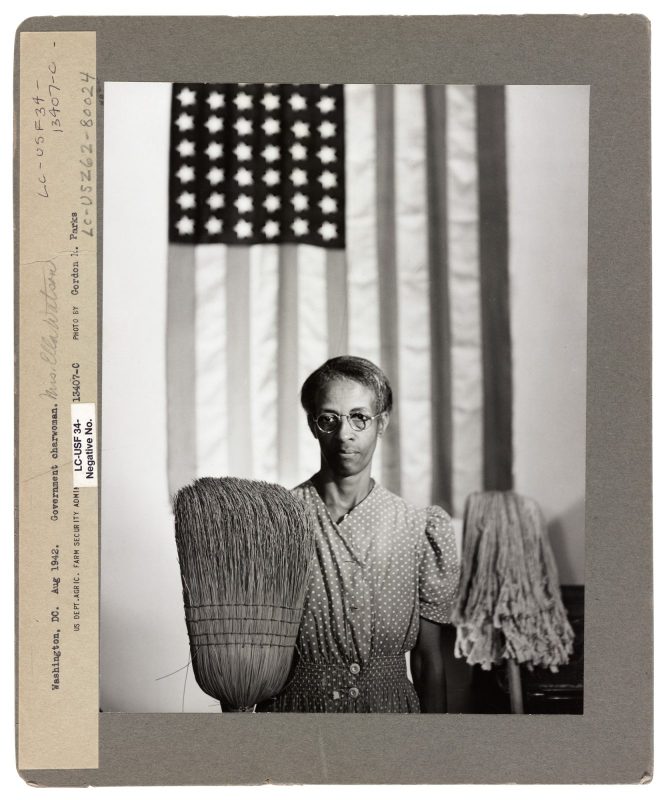
Gordon Parks, Washington, D.C. Government charwoman, (American Gothic), 1942, gelatin silver print 24 x 20″. Image: Courtesy of Steidl, The Gordon Parks Foundation and the Minneapolis Institute of Art.
IN 1942, ELLA WATSON WAS A GOVERNMENT CLEANING WOMAN. Gordon Parks was a photographer for the Farm Security Administration (FSA). That summer, they met and collaborated on a photo essay that produced one of the twentieth century’s most striking images, Washington D.C. Government Charwoman (later renamed American Gothic). It was a breakthrough for Parks, who went on to become an influential writer, filmmaker, and photographer, as comfortable in Vogue as in Life and with at least one genre-defining Hollywood blockbuster, 1971’s Shaft,to his name. In a 2006 obituary, Greg Tate summarized Parks in seven felicitous words: “dapper, debonair, perpetually down for the cause.”
The cause: Parks said his camera was a “weapon against poverty and racism.” He meant that literally (taking pictures was how he got out of Minnesota) and figuratively, as works like TheRestraints: Open and Hidden, a 1956 Life photo series about Jim Crow Alabama, became an armament against injustice. When he and Watson created their corollary to Grant Wood’s sourly folksy farm couple, Parks was still figuring out how to wield that weapon. As American Gothic: Gordon Parks and Ella Watson shows, Watson played an important role in that education. The book presents more than fifty images from the series alongside archival documents and six illuminating essays. We see Watson at work, at home, in church, and around her neighborhood. She was a stalwart in her community and an important influence on how Parks came to depict Black life in the American capital.
It’s relatively easy to show poverty and racism, but root causes usually remain out of frame. In the case of the American Gothic photo, it helps to know the backstory, which this new volume helpfully describes: Watson and a white woman began working at a government building at the same time. Watson was passed over for a desk job; the white woman got it; Watson cleaned the white women’s office from then on. So Watson and Parks staged a series of photographs in that flag-bedecked office. The book presents alternate snaps from that session, but they feel tentative, as the photographer and subject search for their angle. Then Watson looks at us straight on, her face resigned but with a hint of conspiratorial joy; she knows the room is rightfully hers. Your average FSA photographer might frame Watson from a lower angle, like a propaganda poster. But Parks didn’t need compositional cheats for this steadfast shot, which carries an acerbically elegant social critique. When Parks renamed the photo American Gothic, it became a double exposure; there’s a ghost image of America’s best-known painting of whiteness. Parks conjured root causes, even as he and Watson created a highly specific and very personal portrait.
CHARLOTTE TILBURY LAUNCHED ITS KIM K lipstick in 2016: a vibeless, neutral, basic bitch pink. Kim was in on it, of course. As Phillipa Snow writes in Trophy Lives, her riveting new illustrated essay about fame and art, Kim is “not only a perfectionist but one who never stops working on her art, which is herself.” As a cultural critic, Snow mines the extremes of pop culture and high art; her last book, Which as You Know Means Violence, was a study of art and pain that name-checked both Jackass and Chris Burden. Here, she contemplates the idea of the mega-pop personality as an artist’s muse. She draws on a wide net of references—ranging from James Baldwin to Gaston Bachelard—as she coolly deconstructs celebrity spectacle in the white-cube world. Trophy Lives works in multiple registers: Snow offers a surprisingly tender reading of the “existential vulnerability” of Lindsay Lohan and Lady Gaga’s sacrificial effigy alongside the middlebrow performance art of Marina Abramović and Amalia Ulman. Like dolls, they all have angelic faces, the kind worth yearning for.
Basic comes in only one shade. Variation is a weakness, not a strength. Celebrities must be “just like us” even as they’re the sirens and titans that dog our dreams. Through buzzy, referential readings of artists like Maurizio Cattelan and cover girls like Kate Moss, Snow lays bare our bald desire for transformation, exploring the porous boundary between the worlds of art and commerce: Cattelan’s infamous nude statue of a collector’s wife, Ulman’s mimicry of mainstream femininity, Kim K’s bland, white McMansions where McDonald’s is a guilty pleasure and eating hamburgers is a whole personality.
Snow reminds us that the “art world” is really the “money world” and how fickle our attraction to fame really is. We can always smell a fake; in the museum, gold roses often smell like shit. Snow argues that Paris Hilton closes the cosmic gap between creator and creation: a master of set decoration, voice modulation, and made-for-television airhead antics. But Hilton was also so reviled that she was hired to die in a horror movie like a slutty Christ on the cross. “Didn’t Warhol himself say, anyway, that good business was the purest form of art?” Snow asks.
Even when celebs stand before a Rothko, they perform the act of “Hot Woman Has Brains,” Snow deadpans. This performance is more than just “mixed media”—it’s life itself. The famous woman must empty herself out to take in the world and become a martyr to the masses. Indeed, Warhol’s own Marilyn Diptych eerily erases a woman whose book smarts were eclipsed by her Betty Boop voice and marvelous body. For Warhol, Monroe was both iconic and disposable—merely one in a long line of pretty blondes. The great thing about plastic limbs is that they’re interchangeable.
IF THE MEASURE of a debut is how capably it shits on the pieties of its literary forebears, then Honor Levy’s funny, provocative My First Book is an unqualified success. The fact that I, an Elder Millennial, found it largely inscrutable proves the point.
Though nominally fiction—at least according to the metadata—the sixteen pieces collected here could as easily be called prose poems, personal essays, or rants, though their author would likely find all of these classifications “cringe.” The book opens with “Love Story,” which details the online courtship between a guy in his “fall of Rome era” and a young woman “giving damsel in distress.” Sample sentence: “He was kamikaze mode, pumping iron, all Sun and Steel sending hearts <3 <3 <3 to his Saint Wilgefortis, darling, starving, hily hikikomori virgin femcel holed up in her Serial Experiments Laincore bedroom.” Still with me?
Not everything in My First Book has such a high barrier of entry. “Good Boys,” a vignette about young people smoking on a Paris rooftop, recalls the early work of Levy’s fellow Bennington College alum Bret Easton Ellis. Like Ellis, Levy achieved notoriety at a young age for both her writing and her public persona; the New Yorker published “Good Boys” when she was twenty-one, and the New York Times, The Cut, and Vanity Fair have anointed her a “darling” and “It Girl” of the downtown scene, a loose coterie of artists and writers who coalesced around the Lower East Side’s quasi-mythical Dimes Square during the pandemic to snort ketamine, stage amateur theater, say “retard”with impunity, and con PayPal founder Peter Thiel into funding small-circulation literary journals—or so it’s been said. Until recently, Levy cohosted Wet Brain, a self-described “post-canceled” podcast that gave airtime to heterodox thinkers such as the neo-feudalist start-up founder Curtis Yarvin and the novelist-turned-raw-milk-evangelist Tao Lin. Levy’s cohost, Walter Pearce, has described her as a “Quirked Howard Stern.”
Thankfully, despite her entrenchment in it, Levy has little interest in writing about the downtown scene, a subject that has received more than its share of spilled ink already. In fact, “Good Boys” is one of the few pieces in My First Book with a primarily offline setting. Elsewhere, we follow Levy’s alter egos Sad Girl and Internet Girl through the looking glass of their LCD screens:
When I was eleven it was spelled with a Big I. That was how I was taught it. How autocorrect corrected it. Like god to God. It was a place to visit. A proper noun. The Internet. The thinspo forums and videos of Saddam’s execution and the pics from that bat mitzvah I wasn’t invited to. I could go there and I went there that day after school on my clunky white laptop. I went there and I never came back. . . . It was like coming a long way through a dark tunnel and turning around to look at the speck of light from which I came, but there was no light. . . . The tunnel was and always will be my world.
As this passage makes clear, Levy’s work isn’t about the internet so much as it’s sprung from a consciousness so shaped by the internet that no imaginative act exists beyond its influence. Each story in My First Book opens with ASCII art on its title page, and some include “links” to sites such as honor.baby/lovestory, a small repository of curated content including a sped-up version of MGMT’s “Little Dark Ages” and a time-lapse GIF of a rotting fox. Almost all are written in present tense, and time is nonlinear, often jumping between decades from one sentence to the next: “I’m twenty-one. I’m eleven. I’m on the internet. I’m twenty-one.”
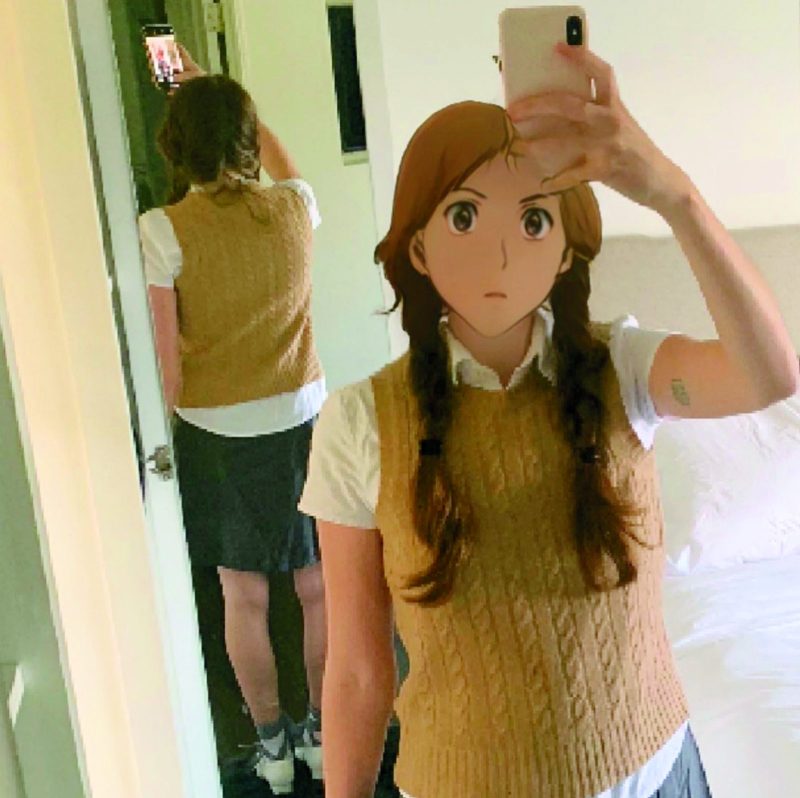
Selfie from Honor Levy’s Instagram, 2020.
For her “normie” readers, Levy has graciously included “Z was for Zoomer,” a fifty-six-page glossary beginning with “Autism,” which apparently afflicts “all the hot-art-world-adjacent millennial girls.” Later, under “Edgelord,” she cites the glossary’s “Autism” entry as an example of “a total edgelord move.” As in Douglas Coupland’s 1991 novel Generation X: Tales for an Accelerated Culture, in which quickly outdated neologisms like “ethnomagnetism” were defined in the margins, Levy’s glossary points to the mutability of language and to the fundamental impossibility of catching a zeitgeist, especially one that moves at 5G speed, and freezing it in the amber of the printed page. Note the past tense in the piece’s title, and in her introduction to it: “These are some words that briefly built a world I briefly lived in.”
Levy, of course, is not the first writer to try to capture the texture of a tap and scroll existence; Patricia Lockwood, Joshua Cohen, and Mark Doten have explored similar territory in recent work. But Levy is more than a decade younger than these writers, a generation gap that’s felt in her command of Gen Z vernacular and also in her restlessness. Often, Levy starts off in the ballpark of the traditional short story—i.e., the kind with characters and scenes—and then digresses and never returns, leaving the initial frame of narrative open like a forgotten browser tab. “Hall of Mirrors” begins with an after-school teacher letting a child sit on her lap—she’s entranced by the boy’s “anime blue eyes”—but quickly veers into a passage that reads like a Wikipedia entry on the history of mirrors, which leads to a didactic riff on the dangers of PFOAS—The End. Other pieces don’t even bother with the pretense of a frame. “Brief Interview with a Beautiful Boy,” the title of which nods to David Foster Wallace, isn’t a story so much as a pile of declarative statements: “He’s drunk as fuck and maxing out his credit cards. He’s trying not to scare the hoes, but it’s hard. He’s a spoiled brat. He absolutely despises liberals. He can’t even do a single pushup.”
On Wet Brain, Levy frequently contended that there’s no longer a difference between irony and sincerity, “based” and “cringe.” Asserting this may be another edgelord move, but to her point, it isn’t only an edgelord move. Just as these “crazy unprecedented beginning and end times” have blurred the borders between on- and offline, and between avatar and self, Levy seems to be suggesting that language has become so debased and inescapably referential that there’s no longer such a thing as single-entendre speech. Her story “Cancel Me” begins: “It’s 2019. Max is canceled. Oliver is canceled. Kian is canceled. Rob is canceled. Bryce is canceled. Carter is canceled.” Each repetition dilutes meaning until no meaning remains.
By her own definition, this worldview would make Levy a “Doomer,” someone who’s swallowed a “catastrophic black capsule of apathy, denial, nihilism, fatalism, and defeatism.” There are moments of glib humor in My First Book that support this conclusion, such as a joke about teen girls wanting to be “Dachau liberation day–skinny.” But herstrongest stories find Levy attempting to peel back the layers of irony in search of something buried beneath them.
In his 2017 n+1 “In Memoriam” for Denis Johnson, the writer Justin Taylor squares the bleakness of Johnson’s fiction with the author’s Christian faith by suggesting that, for Johnson, “evil is a symptom of suffering, which is to say estrangement from the sacred.” I’d imagine that Levy, an “ethnically Jewish” convert to Catholicism, would concur. The difference is the tenderness with which Johnson treats the sinners and losers who populate his work. As Taylor writes, “He does not damn his souls to stay lost. He believes in the possibility, perhaps the promise, of their redemption.” I kept looking for a similar tenderness—and a similar promise—in My First Book. Occasionally I found it, such as in “Cancel Me,” when the narrator looks across the room at a party and “can see everyone holding their Red Solo cups and hurting.” A small moment of empathy, it sticks out in a collection whose author’s default stance is a gently sardonic sneer.
But maybe empathy’s the wrong thing to look for in this kind of book; certainly Johnson is the wrong point of reference. A better one might be the experimental novelist Mark Leyner, a ’90s cult figure now largely remembered as the primary target of “E UNIBUS PLURAM,” David Foster Wallace’s 1990 polemic on television’s deleterious influence on American fiction.
While Wallace concedes that Leyner is “dazzlingly creative” and “extremely funny,” he scolds Leyner’s “amphetaminic eagerness to wow the reader” and concludes that his work is ultimately “doomed to shallowness by a desire to ridicule a TV culture whose mockery of itself and all value absorbs all ridicule.” As readers of Infinite Jest are aware, Wallace had a tortured relationship with the concept of “entertainment,” and I’ve always taken his assault on Leyner as a projection of anxiety over his own reader-wowing pyrotechnics. Regardless, it’s a fundamental misreading of Leyner’s project—which was not to ridicule TV culture but to radically repurpose sitcom clichés and ad-speak into something ecstatic and alive. I’m wary of similarly misreading Levy. Despite her insistence that “everything’s a copy so let me paste from Wikipedia,” the stylized eccentricity of her best work reads like an act of resistance against the algorithm’s assault on the imagination. If she sometimes resigns herself to the futility of that resistance, who can blame her? These are bleak times. A bromide from the early days of social media was that you had to separate the static from the noise. A generation later, My First Book exposes the fallacy of such a distinction. It’s all static. It’s all noise.
Adam Wilson is the author of three books, most recently the novel Sensation Machines (Soho, 2020).
MICHEL LEIRIS WAS A SMALL, polite French man who stayed alive for most of the twentieth century and wrote a deliciously dense memoir in four bricks called The Rules of the Game. The final chunk—Frêle Bruit, whose title has been translated by Richard Sieburth as Frail Riffs,rather than the more straightforward “faint noise”—is now finally available in English. This memoir project spans the years 1948 to 1976, which is roughly the middle of Leiris’s writing career. There were, in fact, memoirs published before and after this project, and a massive set of journals (only available in French as of now) that stretch across his life from young adulthood right up to death. Taken in sum, almost all of Leiris’s writings qualify as what he called “essais autobiographiques.”
Leiris often reminds me of artists like Chris Marker who work across disciplines and scatter their thoughts hither and yon, poets who put their work into different containers precisely to fight against a quick summary of their intentions. Leiris gestures at least once to the fact that this memoir—“too waxed, too polished”—is as much an act of poetry as it is a form of reporting. “There are afflictions that nothing can cure and that only poetry can help you come to terms with,” he writes. There is no sustained argument or narrative to Frail Riffs, which deals as much with childhood as it does advancing age, and cycles through Leiris’s interests without feeling a need to connect them all. Fans of Romeo and Juliet will enjoy this riff, which appears in one of the many stand-alone entries: “Scandalous Mercutio, talker of nonsense, antihero animated by no spirit of sacrifice nor by any devotion to a cause however just or unjust, but willing to risk it all for the mere hell of it.” There is the recurring sense that the pain of writing is also a secondary gain for him, and the drama of the process is partly the point:
Sort out, caress, marry the words together; at times dissect them, twist them, break them apart. Not to seduce them or mock them, but as a way—needless to say, an illusory way—of appeasing, of turning around, of putting a stop to something inevitable. As a way—despite all its weaknesses, all its blemishes, all its lacunae—of conveying the fact that somewhere within ourselves it still might be possible to get a grip on things.
As his longtime translator and champion Lydia Davis told me recently, Leiris is “seeing something that we’re not seeing and he is telling the truth as he sees it.” Riding along with Leiris is nothing like reading the contemporary autofictionalist, in that the self disappears into a process of minute sensing and detailing that the self happens to be the steward of. “It’s self-centered, literally,” Davis said. “But it’s not egotistical in a bad sense, partly because he is so modest, really, and he’s regarding himself almost objectively as an object of interest.” What distinguishes The Rules of the Game—especially the intense fragments of Frail Riffs—from the other Leiris work is how distinct and dissimilar the various pieces are, and how unexpectedly cheerful it all is.
Its poetic torque, how it pulls the reader into a constantly regenerating consciousness with a psychedelic alternation of clauses, turns language into something like a tonal field. Leiris scholar James Clifford described Leiris’s sentences as “elaborate, careful, self-limiting performances,” while Davis called them “deliberate overload.” The slow cadence and constant deferment in Leiris’s language embodies the nature of his thinking, which can be obscure even when the observation itself is not. The Leiris sentence is very much about the time it takes to reach the end. Along the way there are many thoughts. The way these thoughts are chained together into one sentence is as important as the thoughts themselves, indicating that this is how thoughts lived inside Leiris, and any attempt to shorten or recombine those thoughts would make it someone else’s thoughts. This is one from Fibrils, volume three of Rules of the Game, about his Aunt Claire’s house:
Apart from its exterior, which I did not think, incidentally, I would remember well enough to recognize it right away, what I recall about this house is reduced to very little: the calm and order that reigned in the parlor, whose candy-box preciosity did not conform very well with the robust beauty of its inhabitant, who was created on the scale of the lyric-theater stages on which she appeared; the presence, in a good spot in this excessively mincing parlor, of a glass-fronted cabinet where my aunt kept objects of which I would be incapable today of drawing up an inventory—even if limited to general categories—but of which I know that several at least related to her life in the theater.
LEIRIS WAS BORN in 1901, into a bourgeois family and had brief professional aspirations that were drowned out by the siren calls of jazz and Surrealism. He became a poet and an active member of André Breton’s Surrealist group in Paris. His first book, Simulacre, was published in 1925, a collection of poems illustrated by one of his mentors, André Masson. Leiris rarely leaves the heart of bourgeois comfort, which complicates his commitment to the larger idea of revolution—more specifically, to the people of Cuba and the students at the heart of the May 1968 actions in Paris. (As he puts it in Frail Riffs, “I’m just a poor devil and hardly a guerrillero when it comes to moving from the plane of ideas into the rugged terrain of action.”) In 1926, Leiris marries Louise “Zette” Gordon, presented as the sister of prestigious art dealer Daniel-Henri Kahnweiler, though she is eventually revealed to be Kahnweiler’s wife’s illegitimate daughter.
In 1929, Leiris broke with the Breton gang and joined the upstart Surrealist journal Documents, founded by Georges Bataille, Georges Henri Rivière, and Carl Einstein. (Though recently compiled in a handsome two-volume French edition, Documents remains largely untranslated into English.) It is in the office of Documents that Leiris makes a decision that changes his life completely, if also somewhat casually. He meets the ethnographer Marcel Griaule, who invites Leiris along on a mission to Dakar and Djibouti as a stenographer and documentarian of sorts. Though he has absolutely no training, Leiris likes the idea, saying later that he became “weary of the life of literary Paris between 1925 and 1930.”
In an essay published in Documents at the end of 1930, titled “The Eye of the Ethnographer,” Leiris offers some explanation for why he is taking off on this particular adventure, in a sentence that hints at the rock-climbing walls of clauses he will be building.
A research trip undertaken in accordance with the standards of ethnography—such as the expedition from Dakar to Djibouti in which I am planning to take part, under the direction of my friend Griaule—should help to dissipate no small number of these errors and, consequently, to undermine a number of their consequences, including racial prejudice, an iniquity against which one can never struggle enough.
Leiris records 647 diary entries during the years of the excursion across several African countries and makes thousands of index cards to describe each of the artifacts the team is bringing back, whether they have the moral or legal right to do so. Phantom Africa was published in 1934, much to the displeasure of those who brought him, as well as to the French government. Leiris makes no strong ethnographic claims and spends as much time doubting the project as he does describing his time among the Dogon people, who he knows will never accept him. “The life we are leading here couldn’t be more flat and bourgeois. The work is no different in essence from work in a factory, firm, or office. Why does ethnographic inquiry often make me think of a police interrogation?”
Michel Leiris in his office at the Musée de l’Homme, Paris, France, 1984.Photo: Wikicommons/Charles Mallison.
Despite his skepticism and friction with Griaule, upon his return to Paris, Leiris became the codirector of the Département de l’Afrique noire at the Musée de l’Ethnographie (renamed the Musée de l’Homme in 1938). In 1943 he was officially named to the CNRS (Centre National de recherche scientifique), which pays some of his salary at the museum; he is further promoted as a researcher affiliated with the CNRS in 1961. After his important fieldwork is over (notably in Martinique, Guadeloupe, and Haiti), during the period when he is writing Frail Riffs, he is primarily concerned with “museology”—in 1967 he publishes (with Jacqueline Delate) Afrique noire, La Création plastique, on which he has been working for eleven years. The same year he organizes (again with Delate) an exhibition at the Musée de l’Homme, Arts primitifs dans les ateliers d’artiste. This is followed by the exhibition (conceived in May 1968, opening in the fall) on Passages à l’âge d’homme. His most important writings of the late ’50s and ’60s were published in Cinq études d’ethnologie in 1969. He officially retired from the Musée de l’Homme in 1971, but they let him keep his basement office.
For the outside literary world, his ethnographic work doesn’t really appear as the topic of his books again. In 1939, he published what is technically his first memoir, Manhood, though the index cards and diaries of Phantom Africa have become part of his standard practice. It is this book that makes his name in France, though it is years before the Anglophone world discovers it. The book inspires both Sartreand Walter Benjamin, and remains a model of fragmentary revelation. Its main characteristic, much more surprising in 1939 than now, was Leiris’s frankness about his failings and a sort of ambient anxiety, often around sexual energy.
After explaining that whorehouses and museums are linked by a common “frozen quality,” he reveals that a childhood penis inflammation has complicated his sexual life ever since: “I am incapable of distinguishing this morbid turgescence from my earliest erections, and I believe that initially the erection frightened me because I took it for another outbreak of the disease.” There is a lot of this generalized erotic terror as well as memories of his brother threatening to remove his appendix with a corkscrew. When he begins The Rules of the Game in the ’40s, with Scratches, he is resetting his tone a little. He increases the lexical weight of the project but also strips it of its pathos. For someone who had a generally pessimistic bent, and talked so often of his intermittent impotence, Leiris becomes more sanguine as he ages, almost against his own tendencies. By the time he reaches Frail Riffs, he has become a dealer and a shuffler of cards, presenting 167 individual entries, some complex essays, others short and silly poems that use words all beginning with the letter P.
The density of a Leiris text is both an obstacle for impatient readers and the prominent condition of its rewards. Lydia Davis, who translated the previous three volumes of Rules, writes in the intro to Fibrils, that one of Leiris’s main “preoccupations” was language “as the raw material of poetry; the mysteries of language; the sounds of words, taken in themselves; the elusive and personal meanings of these sounds and of words themselves; private language versus shared language; language as connection to others; the discoveries possible through language; the failure of language.”
Sometimes, Leiris rummaging through words is a private enough affair that the reader has trouble joining him. Recalling names of imaginary characters he invented with his brother, Leiris parses “Bob Singecop” and “Elephantinonde” at length, analysis that leaves me stranded. Did Leiris love his brother? Resent him? Sometimes choosing to discuss a “bizarre syllable” feels less like an investigation and more like an evasion. When Leiris writes that “Elephantinonde” is “nothing but a word” that also “remains an entire world unto itself,” he recalls the other famous French pilot of rapid metonymy, Proust. But Leiris is less interested in emotion than Proust, which leaves some of his glosses feeling more technical than revelatory.
You may have noticed that Davis did not list “narrative” or “story” as one of the Leirisian preoccupations, which is probably why Leiris is less likely to be found on syllabi than Proust, who Davis has also translated. The two are intimately related for Davis, who told me that Leiris’s “syntax actually did prepare me for translating Proust’s elaborate syntax.” Nobody, not even Proust, has been able to slow down the spin of time like Leiris, who is able to slowly scrub the needle of language back and forth across moments until they crumble like the wax of his father’s cylinder gramophone. This monomaniacal pursuit of consciousness through language itself has obvious limits, in that Leiris writes in such a way that you can only identify people through the language, rather than character or setting or personal quirks. I know little about how the people in his life moved or looked or behaved or sounded. Sieburth, as gifted a medium for Leiris as Davis, wrote in 1993 that The Rules of the Game had taken “the literature of confession beyond narrative, beyond its residual affinities to the novel, and moved it toward the condition of music.”
One of the absolutely most delightful and Leirisian pieces ever is his long entry here on the nature of “the marvelous,” a winding and thick meditation that refuses to act much like an essay, in that Leiris has no intention of building anything as pedestrian as a definition. Instead, he simply accrues a series of people and artworks and “examples” that summon the marvelous for him. After many pages of trying to determine how far from the marvelous the “supernatural” really is, Leiris turns abruptly to Che Guevara. If you are wondering why you might want to sift through all the juvenilia and puzzle pieces of Frail Riffs, I would suggest that sentences like this make it more than worth it: “In his clearheaded and feet-firmly-on-the-ground fashion, breathing in the air of his times despite his asthma, Che Guevara was certainly not thinking of the marvelous when he spoke of how the extraordinary could one fine day be transformed into the everyday.” There has been little discussion in this essay on the political, which lurks closer to the surface with Leiris than you expect. But the actions of May 1968 are both ghost and presence here, and Leiris tells us that “the marvelous of the Revolution” has the ability to demonstrate “the sudden feasibility of a series of accomplishments previously thought to be lunatic.”
After several of the most bourgeois pages imaginable are spent on the topic of where he and Zette will lodge their dog, Puck, when they go on vacation, Leiris comments on the slogans of May ’68. He approves of “NO MORE CLAUDELS,” a strike against the French sculptor he describes as a “mammoth gymnast of eloquence, this pride of the bourgeois status quo.” One wishes there was a Leiris column now on the encampments, not least because of how he begins this entry, with the slogans of his own: “Let nothing petrify. Let nothing freeze. Protest without end.”
Sasha Frere-Jones is a writer and musician from New York. His memoir, Earlier, was published by Semiotext(e) in 2023.
IN HARI KUNZRU’S NOVELMy Revolutions (2007), which starts in Britain in 1998, the narrator, a fifty-year-old named Michael Frame, receives a visit from an old friend, Miles, the only person who knows that he is a former violent radical living under an assumed identity. To the delight of Michael’s younger wife and late-adolescent stepdaughter, Miles reels off stories of the good old days, a vanilla version of what occurred. After he slips up on a detail, mentioning a university education written out of the cover story, Michael quickly intervenes and finds himself drawn into the yarn-spinning, “a confection of swinging London and San Francisco flower-power, as phoney as one of those television nostalgia shows where they soundtrack archive footage with old Top 40 hits.” These candy-colored reminiscences are ideally matched to the preconceptions of their audience. Michael’s wife invokes “the sixties milieu” as something ossified, remote, like the Battle of Waterloo or the Spanish Armada, while his stepdaughter’s primary reference for that period was “probably Austin Powers.”
My Revolutions uses Michael’s own detailed reminiscences of that time, which form the bulk of the novel, to reveal the reality beneath the tales served up to Michael’s family as well as the sort of write-ups that turned one of Michael’s comrades into a “cardboard cut-out” of a hippie, shrouding his true character behind a “haze of Byronic bullshit.” Kunzru’s new novel, Blue Ruin, also has a middle-aged male narrator who is prompted to recall a twentysomething London existence defined by hopes dashed and love lost. Yet here it’s the retrospective episodes that bring to mind the uneasy role-play in Michael’s living room—an Austin Powers retelling of the hipster ’90s, all late nights and loft spaces. And though it’s hard to be sure, as in any first-person narrative, that the account is to be taken at face value, as sacrosanct or wholly dependable, we are given no firm reason for doubt, no clear point of contrast or more nuanced alternative, no skeptical commentary elsewhere within the fictional world pointing to evidence of holes or cracks, cardboard or bullshit.
As its title suggests, Blue Ruin is a follow-up to Kunzru’s previous books White Tears (2017) and Red Pill (2020), completing a loose trilogy devoted––in part––to contemporary America, a conceit derived from Kieślowski’s Three Colors sequence (1993–94), where the flag in question was the Tricolore. (A graduate student in an earlier Kunzru novel dazzles her future husband with talk of Henry James, Marrakech, the Kosovo War, and “the films of Kryzstof Kieślowski.”) The novel’s present-day setting is pandemic-time New York State, where an Englishman, Jay Gates, is living hand to mouth as a courier. Delivering groceries to a cottage on a vast wooded compound, he encounters his former girlfriend, Alice, living in seclusion with her husband, Jay’s old best friend, Rob, now a celebrated artist, and another couple, the gallerist Marshall and his girlfriend. Jay collapses and, while recovering in a barn, starts thinking back to a time when he and Rob, just out of art school and on the verge of success, fell in with the aspiring curator Alice—dazzling, fearless, wealthy, French—and started putting together shows and installations as a collective named after the disused factory that served as their base, Fancy Goods. (There was a similar central hangout in My Revolutions, Free Pictures.)
From the start, the novel appears at ease with the creakiest devices of period evocation. “Back then,” we are told, “East London was cheap. A combination of Victorian industry and the Luftwaffe had created a streetscape full of weird gaps and hidden places, alleys and railway arches, yards and courts and terraces.” The memories often descend into, or half disguise, a list: “a room at the back of a kebab shop where you could drink room-temperature beer out of cans at four in the morning . . . pubs with lunchtime strippers . . . a bar in someone’s front room . . . a bar where you could buy drugs through a metal hatch by the cigarette machine . . . a Jamaican bar with a glitterball turning over a little dancefloor.” A reference to involvement with “all the intersecting causes of the nineties left” prompts more itemizing: “the Zapatistas, corporate branding, globalization, the predatory behavior of the International Monetary Fund.” Everything is left in its congealed state, with stereotypes neither questioned nor restored to a validating original context. Alice gives Jay an art theory book, and he tells us that he underlined “phrases about the reification of social relations, and spaces of intersubjective connection.” It resembles the description at the start of The Corrections, when Chip Lambert sells off his library and recalls the books’ long-ago promise of “a radical critique of late-capitalist society,” except in this case the ideas are crucial, not a fleeting source of parody. Yet we aren’t told what these concepts amounted to, where they came from, how they influenced Jay’s own practice. At one point, Jay recalls that he and Rob “were in love with painting’s mess and machismo, and we were young enough not to know what a cliché it all was.” He never expresses the same concern about his own reminiscences, nor his presentation of Rob.
Kunzru tries to offset the nostalgia-doc atmosphere by withholding titles. Sometimes the device is explained, as when Jay says he cannot remember the name of the British TV comedy about a “discontented suburban businessman” in which a title sequence depicted the central figure running along a beach removing his suit and tie before plunging naked into the sea (The Fall and Rise of Reginald Perrin). We can’t be sure whether he knows that the “TV show about teenagers with superpowers” he passes out in front of following an argument with Alice is called Buffy the Vampire Slayer.There’s even a bit about a song that made the Top 40 (in fact, top 2), though the reluctance to name it produces a somewhat tortuous syntactical effect: “Rob once joked unkindly that the song was about her, the indie pop hit about the art-school girl who wants to do whatever common people do” (Pulp’s “Common People”).
Hari Kunzru, 2017.
It’s hard to get a handle on the novel’s attitude to reference. Instead of dropping a litter of names, whether real or invented or composite, Kunzru, or Jay, refers to a “famously conservative art critic,” “one of the famous Young British Artists,” “London’s most famous collector.” “A famous Chinese artist was to send some kind of pyrotechnic dragon down the Thames.” At an awards ceremony where he is nominated, Jay sits through an elaborate dinner and makes “halting conversation with a famous film director.” During an inventory of the kitchen in the cottage, Jay notices “a messy figurative painting that even in my dissociated state I recognized as the work of a famous nineteen-eighties Neo-expressionist, an artist whose work I’d only ever seen in museums.” The college where Jay and Rob meet is identified only as an institution “famous” for “disdaining traditional ideas about medium and craft.” But there’s also a heavy reliance on the explanatory power of familiar cultural reference points. In consecutive sentences Alice is likened to a Franz Kline and the darkness described as “Dickensian.” We also read: “like a character in a New Wave film,” “Brideshead persona,” “a Blakean heaven,” “like a scene from some Swinging London comedy,” “a sort of Valkyrie,” “a science fiction quality,” “like a cocktail in Star Trek.” It seems that Kunzru, or Jay, is implying that description is now unavoidably secondhand, that celebrity culture and our postmodern habits of mind have defeated realist representation. But then on other occasions, we get the comp and the full-fat rendering too. The words “like a set for a French house video” are followed by: “underfloor checkerboard lighting, space age retro furniture and a massive chandelier hung dramatically from the ceiling.” Opportunities for shorthand are rejected. When Jay and Alice arrive at “a tiny country station” in rural France, there are “flowers in hanging baskets and a dog sleeping on the platform.” Then Jay sits down at a metal table and orders two bottles of Orangina.
The one thing overtly dismissed as “bullshit” within the novel, the claim that the “delivery guy” happens to be an “old friend from London”—a scenario that Marshall compares to the “script of a porno”—turns out to be true. Or strongly appears to. There are hints that a COVID-addled Jay has imagined the entire thing. He calls Alice “the mistress of some fairy-tale kingdom” and recounts a long dream, which itself contains a dream. It’s notable that he shares a nickname (or adoptive name) and a pair of initials with one of the best-known fantasists in literature. Like James Gatz, aka Jay Gatsby, Jason “Jay” Gates believes he can rekindle a long-lost romance with a rich girl now living in upstate New York with an unfaithful and unworthy husband. (Both characters spend time working on the yacht of a rich American—Jay as “deckhand,” Gatsby as “steward, mate, skipper, secretary.”) But Gatsby, though daft and even delusional, wasn’t quite hallucinating. Marshall’s aggressive questioning of the coincidence hardly strengthens the sense of dream logic.
AS THE STORY OF A LOVE TRIANGLE and tripartite character study––along with pandemic-era drama and historical portrait, the novel’s other generic identities—Blue Ruin presents a strikingly similar scenario to Luca Guadagnino’s recent film Challengers, but with the art scene replacing the tennis circuit, and a pointed pandemic setting instead of a necessarily pre-pandemic one. In novel and film alike, a man reduced to sleeping in his car has an unexpected encounter in New York State with an old girlfriend married to, and managing, the former best friend and colleague with whom he met her, a dominant figure in his field whose best days, to the wife’s gall, appear to be behind him. Both stories begin in the present, with the coincidental reunion, before unfolding an intermittent flashback structure that eventually brings us back to the present.
Like Challengers, Blue Ruin suffers from a basic lack of clarity—over the initial couple’s breakup and the woman’s preference for the best friend, and over the question of why the one who lost out is reduced to his current lowly status. Kunzru makes more of an effort than Justin Kuritzkes and Luca Guadagnino, the writer and director of Challengers, to outline the relational dynamics. Alice tells Jay that it was “really hard being around your self-hatred. You were so unsatisfied with everything, and so proud and humiliated and angry about being humiliated.” In Jay’s own telling, the main source of humiliation during the time he knew Alice was her growing closeness with Rob. Alice’s use of that word to describe her own experiences also comes in relation to sexual betrayal; Rob’s name, we learn, has appeared on a spreadsheet devoted to “problematic art men, something like that.”
How are we to assess Jay’s personality?He explains that he was the only child of an English mother and a Jamaican father he never knew. As a kid, he emulated his white peers, dressing as a goth, listening to synthesizer bands, talking “like a taxi driver.” Spending time with Black groups during his foundation year at art school, he knew he emitted “out-group signals.” But race doesn’t appear to form a crucial part of his self-image. The first allusion of any kind comes on page forty-eight, with a reference to “hostile white barbers”—the word “Black” is used just once—and Jay’s feeling of alienation is generally cast in existential or psychological terms. When he describes himself as a “rank outsider,” his references are to unspecified “faults” obvious to other people. We learn that after his mother and stepfather had twins, he went to live with his Nan, and the implication is that he was destined for exclusion, doomed to play third wheel. Yet when recalling what attracted him to Alice, he doesn’t reinforce the idea that he was seeking out rejection. He says only that he would “chase after very beautiful girls . . . because they were the ones other people seemed to want.” Then, after charming them, he struggled to sustain his interest. But that isn’t what transpires in his relationship with Alice, the instance he is describing.
Jay’s account of his decline is no more coherent. He claims that when he learned that Alice and Rob had moved to New York, it convinced him “to do something drastic . . . to copy her by leaving behind the person she had left, to break myself and begin again.” But he had already retreated from the art world on ethical grounds. He hated “collectors” and was appalled by the commercial calculation of Rob and Alice, the hypocrisy of peddling a sale show as “seeking a relational exterior to capitalist modes of exchange.” Jay didn’t want “to make statement objects for the rich.” His degree show, a performance involving a painting occluded from view that he then destroys, is “a refusal, a way to separate myself from all the other artists who were jostling at the money trough for a chance to dip their snouts.” So: Are his actions noble and self-assertive, a defense of integrity, or merely a reflex, a product of a lifelong inability, which he calls “a sort of failing on my part,” to become a part of anything?
It’s possible that Kunzru is deliberately undermining a consistent interpretation of Jay as man, moral agent, partner, artist, and narrator. Imagery of drifting and driftwood recurs in various connections. Kunzru’s first novel, The Impressionist (2002), was about a Zelig-like shape-shifter in Asia, Europe, and Africa in the 1920s. In My Revolutions, Michael Frame, whose real name is Chris Carver, notes: “Nothing is permanent. Everything is subject to change.” At the end of Red Pill, a man who has suffered a breakdown returns to his Brooklyn apartment and finds that everything is both the same and different. Promoting My Revolutions, Kunzru said that he had a “nasty feeling” that he would find himself repeatedly asking the same question about whether the self is grounded or contingent, innate or context-specific—whether, in fact, we break ourselves and begin again with almost every action. Kunzru’s friend and younger contemporary Zadie Smith recently argued that the idea of shifting personas is “very deep in ’90s cultural logic. . . . The point was variety. It’s a weird aesthetic tic.” But Kunzru’s presentation of variety is too varied. As with the pattern of details relating to dreaming or imagining, it is difficult to track the argument—to be sure there is an argument—about change serving as the only constant.
BLUE RUIN IS A PERSISTENTLY FRUSTRATING EXPERIENCE, at once predictable and inscrutable, certainly the least intricate and engaging of Kunzru’s seven novels. The title itself points to an essential lack of focus, urgency, and definition. White Tears and Red Pill risked seeming on-the-nose, naffly topical, but they reflected Kunzru’s ambition, his desire to offer the last—or longest—word on a prevalent conceptual and epistemic theme. Blue Ruin isjust a phrase, not far from a cliché, seemingly pulled out of the air because he needed a two-word tag including that color.
It seems strange that Kunzru has chosen to set his ’90s novel among a version of the Young British Artists, familiar terrain to an English readership and hardly revelatory to an international one, when his own experience of that time was so distinctive, and ripe for explication. In 1993, two years after completing his degree, he went to do postgraduate studies in philosophy and literature at the University of Warwick, a college on a Brutalist campus in the West Midlands, and fell in with a gang of aggressively future-minded theorists, led by Nick Land and Sadie Plant and later known as the Cybernetic Culture Research Unit (CCRU). He had always been drawn to oppositional impulses. Growing up in Essex, the son of a Kashmiri Hindu father and an English mother, he discovered Bowie and science fiction and the “almost unreadably abstruse meanderings” of the British music press. As an English student at a left-leaning Oxford college, he was being taught what a student with more traditional tutors called “Red English” (implying Marxist): protested apartheid, the poll tax, and fees for higher education; got into rave culture; and sought out a graduate student with whom he could study postcolonial literature. Land and Plant were an ideal fit. A list of their favored topics—culled from the many accounts of the CCRU’s activities—includes biohacking, dance music, e-cash, feminism, matrices, open-source software, and virtuality. An emphasis on the multiple was welcome to the child of mixed ethnicity. But to Kunzru, all the resulting ideas were linked by an emphasis on freedom from constraint—reveling in the autonomous zone of the dance floor as a sort of corporeal counterpart to surfing the net.
When Kunzru left Warwick, his sole marketable skill was that he could explain “why you would connect a phone line to a computer.” Plant introduced him to the editors of the British arm of a successful newAmerican tech magazine. A bio note that appeared shortly afterward says he “does something quite important, though nobody is sure what. Mostly, he plays loud techno music in the offices of Wired UK.” YouTube has some amusingly mad footage, from 1996, of Kunzru standing in the London nightclub Heaven and attempting to conduct an interview by video link with the novelist and inventor Arthur C. Clarke, who was at home in Sri Lanka. He remained at Wired UK until its closure in early 1997, at which point he started writing travel pieces for newspapers and music reviews for the lifestyle monthly Wallpaper, did some DJing, presented a TV show, and started working on The Impressionist, a comic picaresque about an Anglo-Indian that received a wild advance and was published in 2002.
In many of his preoccupations, Kunzru is highly characteristic, even the exemplar, of a certain kind of nerdily cerebral, outward-looking Englishman born between 1968 and 1970 who now dominates British cultural output at home and abroad. The best-known instances are Thom Yorke and Christopher Nolan. Other prose writers include Tom McCarthy, David Mitchell, and—fleetingly—Alex Garland, and TheGuardian journalist and political historian Andy Beckett. They have all shown a marked interest in travel, science fiction, the contemporary—future-minded—themes that preoccupied the CCRU, and the pop culture of their childhoods. Kunzru wrote a story with a title from Simple Minds, “New Gold Dream,” while Beckett named his book about the early ’80s Promised You a Miracle. Mitchell, who wrote a novel about a prog-rock band, Utopia Avenue, has said that Kunzru “got me into Brian Eno.” In recent months, the prominence of this micro-generation has been hard to miss. Yorke released a second album with his new band, The Smile. Nolan won his first Oscar, for Oppenheimer. Garland––who stopped publishing fiction twenty years ago and is now, like Nolan, essentially an American studio director––has made his biggest film, Civil War. Mitchell is on a tour to mark the twentieth anniversary of Cloud Atlas. Beckett has just brought out The Searchers, about the left wing of the modern Labour Party, following books about Britain’s relationship with Chile and histories of the ’70s and early ’80s. And Kunzru has completed an ambitious conceptual trilogy.
There are certainly broad distinctions between these novelists. Mitchell has said of Kunzru that he’s “a deeply intelligent, highly read, politically engaged man, and I know I’m not like that.” Kunzru and McCarthy are more engaged with, and involved in, contemporary art; Garland and Mitchell are more populist and work on movies, initially collaborating with teams behind key works of the ’90s(Trainspotting and The Matrix, respectively) and adapting theirbest-known novels (The Beach and Cloud Atlas). One thing they share is an indifference or disdain toward the writer most commonly heroized by writers younger and older, Martin Amis. He is mentioned nowhere in McCarthy’s essays or Garland’s interviews. Mitchell sent him up in Cloud Atlas and The Bone Clocks. Beckett, in a recent interview, described him as seeming “quite an ’80s kind of figure.” Kunzru has noted that his work is “full of class anxiety.” The allegiance among English novelists was to a writer already celebrated when they came of age, J. G. Ballard. When the philosopher Simon Critchley noted that Kunzru, Mitchell, and McCarthy are “great writers and really clever people” but haven’t really shaken the form of the novel, the claim points to their fidelity to the concept-first approach adopted by Ballard, who, with the exception of the seventeen-part collage The Atrocity Exhibition, was content to work on a moderate scale, using a thriller-ish plot as a courier of social and scientific theorizing, and a male narrator or close third person.
There was also the example of another unlikely—even less likely—resident of the English Home Counties, Stanley Kubrick. 2001 is a clear influence on Gods Without Men (Clarke’s source novel provides the epigraph), Nolan’s and Garland’s films, and Yorke’s music. The film’s command of scientific fact is praised in McCarthy’s most recent novel, The Making of Incarnation. A crucial factor was that Ballard and Kubrick offered stories of war in Southeast Asia during the mid-to-late ’80s, a boom time for the modern mythology of that region. Kunzru has written about Thailand and touched on the Second World War and the Vietnam conflict. Garland’s debut The Beach begins with an uncredited quotation from Full Metal Jacket—he also recalls a school-days trip to see Platoon—and owes a narrative debt to Empire of the Sun.
The closest that Blue Ruin comes to reflecting the richness of Kunzru’s formative influences is a few passages about Jay floating around Asia, that fleeting reference to intersubjective connection, and a description of an art project in which Jay erases his digital footprint. During a recent appearance on New Moves, a podcast dedicated to politics and technology, Kunzru noted the greater relevance of “other things that I have done.” The belief that the self is “a multiplicity”––fortified by cyberculture and Nick Land’s work—served as the theme of The Impressionist. Its immediate successor, Transmission (2004), about a computer virus, drew directly on his Wired days. His engagement with electronic music underpinned the sly, original, and ingeniously developed White Tears, which mutates from a satire of cultural appropriation to a ghost story about racial violence. (It has substantial overlap with Percival Everett’s recent—less mordant––The Trees.) The preoccupation with subcultures, superstition, and utopian possibilities found expression in Kunzru’s richest novel to date, the stunning Gods Without Men, which explores the tendency to seek pattern in both chaos and emptiness. In nine narratives taking place between 1778 and 2009, all converging on the Mojave desert, the novel depicts UFO sightings, finance capitalism, substance abuse, the tabloid press, religious faith. The central story concerns a relationship between a Hindu man and a Jewish woman whose differences are underscored first when they have a son and then, after he is kidnapped, by a potentially extraterrestrial force. (This couple, Jaz and Lisa, are clear antecedents of Jay and Alice in Blue Ruin.)
When Gods Without Men appeared, it risked seeming old hat. The structure associated with the systems novel, perhaps above all with Gravity’s Rainbow—though Kunzru’s touchstone may have been another canonical instance, Ursula K. Le Guin’s Always ComingHome—was by that point fully domesticated, having provided the basis for perhaps the two most visible literary novels of the early twenty-first century, both to some degree family sagas, White Teeth and The Corrections. There were also inevitable comparisons to Cloud Atlas, no doubt abetted by David Mitchell’s praise for Kunzru’s book, though the closer precedent was Mitchell’s first novel, Ghostwritten, which also compiles a story in nine strands. (They share an interest in Le Guin and also Kieślowski, whose films offer a dreamier art-house counterpart of the systems perspective.) Yet looking back, Gods Without Men alsoanticipatedthe portrayal of mystically endowed spaces in McCarthy’s Satin Island, Jeff VanderMeer’s Annihilation (which Alex Garland adapted), Everett’s Telephone, and George Saunders’s Lincoln in the Bardo.
IF GODS WITHOUT MEN IS THE WORK that best illustrates Kunzru’s strength as thinker and storyteller, the novel that offers the clearest contrast to the procedures of Blue Ruin is its immediate predecessor, Red Pill. Of his time at Warwick, Kunzru has said, “I was supposed to be reading German Romanticism and thinking about the noumenon”—the thing in itself. Then, after he discovered the work of Land and Plant, all that “went out the window.” This is more or less what occurs to Kunzru’s nameless narrator, a half-Indian, half-English liberal humanist who arrives in Berlin for a residency at the Deuter Center for Social and Cultural Research, founded––like Warwick, in fact––by local industrial interests. He intends to research German poetry and the lyric self. He reads about Kleist’s struggle to find the truth beneath the surface of things, “the famous Ding an sich, the thing in itself.” It wasn’t quite true that for the twenty-four-year-old Kunzru the noumenon went out the window. What happened was that his studies at Warwick introduced him to a different way of approaching or appropriating eighteenth- and nineteenth-century thought—with different conclusions about the true nature of what lies beyond sensory stimuli, not a transcendental aesthetic but a hellscape. In the retelling offered by Red Pill, the narrator becomes obsessed with a violent network-TV cop show, Blue Lives, sort of The Shield meets True Detective, in which he identifies allusions to the Counter-Enlightenment conspiracist and protofascist Comte de Maistre––one of Isaiah Berlin’s “six enemies of human liberty––and a “subtext” of dog-eat-dog millenarianism, a reading corroborated when he falls in with the showrunner. (He has the same surname, Bridgeman, as Miles in My Revolutions.)
Red Pill explores what Kunzru considers the central lesson of the cyber age––that divergent images of society and the self might have a shared lineage and symbolic coordinates. At the time, he felt convinced that the ideas he was deriving from Deleuzian cyberculture and rave culture—about deterritorialization and “lines of flight,” horizontal networking and cross-border universalism—were destined to “lead leftwards.” This was the basis, at least in part, of the thinking developed by another Warwick postgraduate, a founding member of the CCRU and self-described “student of electronic culture,” Mark Fisher, in his book Capitalist Realism (2009) and the blogs and essays posthumously collected as k-punk (2018). It turned out that the liberationist potential recognized or foreseen by Kunzru and Fisher and Sadie Plant was not the only possibility, leftward the only direction. For a start, there was an industry, growing every second, devoted to selling hardware and software. While Kunzru was working at Wired UK, he was also part of the collective running Mute magazine, which was far more skeptical about the internet’s power to escape co-optation and exploitation. But even before that, Kunzru had evidence that this would be the case. He has recalled trying to talk to Nick Land about the potential of these converging phenomena and found that he was “clearly not . . . invested in the same way.” Land’s later work was concerned with the futility of social progress, the obsoleteness of democracy, and the superiority of the white race. (His writing was collected as Fanged Noumena.) Red Pill allegorizes Kunzru’s own naivete, moving his disillusionment from the mid-’90s to the mid-2010s, compressing years into the term of a writer’s residency.
In Blue Ruin, the enmeshed contraries of Kunzru’s previous work have been replaced by stark polarities. Even if Jay’s account of the art scene was accurate, and a declinist narrative inescapable, the scenario is not sufficiently complex to engage Kunzru’s rare analytic gifts, his ability to temper his taste for polemic with a feeling for paradox. Jay’s memories—and the scene he is recalling—do not yield the unexpected affiliations at which Kunzru has excelled. He clearly sees, or experienced, the art scene as a simpler tale than tech culture or the appropriation of Romantic thought. “In the early ’90s,” Kunzru wrote in 2012, Damien Hirst “seemed like a breath of fresh air, a rave-era blast against the terrible, starchy politeness that characterised the British art scene.” But he ended up as “house artist to the 1%,” and running a sort of sweatshop. The urge to create––a pure, free act––was sullied by rapacity and excess. Jay describes a party in Hackney Wick “before gentrification crept out that far,” where “a feral ecosystem was thriving just beyond the grasp of the developers who were beginning to line the canals with glass boxes and plastic-clad towers.” The “lock-in”––an after-hours session––where he and Rob meet Alice occurs “before” the scene-y Shoreditch pub was “converted into flats.” Jay recalls taking the 55 into central London and looking out for “spiky” and “humble” sculptures placed on the roofs of bus shelters along the route. The experience was complete without knowing “the name of the maker.” Only “later” was anonymity viewed as “a kind of death.”
The old days aren’t perfect. The Hackney factory was divided into “firetrap studios,” and the pub lock-in would have been “hard on the neighbors.” (And presumably it was someone’s job to clean or maintain the bus shelters.) But in revealing what followed, there is no sense of a genealogy, catalyst, or even basic causal process. “I loved painting,” Jay recalls, “but I began to feel that there was also something rotten about it, something shallow and corrupt.” That isn’t quite right. The “it” isn’t painting itself but the scene and, more precisely, the market. Something rotten is done to painting. Jay never hints at an inherent flaw, that, say, the machismo of painting could germinate a territorial instinct in the collector, that love of art cannot help but curdle into desire for ownership, that the exercise of imposing their vision on reality and other people might be compatible with the aggressive or acquisitive. Kunzru’s previous novels depicted all manner of controlling activities,by lobbyists, hackers, planters, market mystics, prime-time propagandists. If there was a kick-yourself moment, a moment where what-might-have-been was lost or botched, it came at least as long ago as the Enlightenment. The late-twentieth and early-twenty-first century didn’t invent the human capacity for corruption and depravity, self-adulation, self-destruction—only revealed it in a thousand brand-new ways.
Leo Robson is a freelance writer. His first novel, The Boys, will be published in the UK next spring.
THIS IS A GOTHIC TALE. In the summer of 2002, a professional illustrator and single mom in Chicago went to her fortieth-birthday bash, a gypsy-themed affair that her young daughter told her not to attend. A premonition? At the party, a mosquito bit her. Perhaps she slapped it dead; maybe it stayed attached, vampirically feasting. The result was no mere itch, but a health spiral. She had contracted West Nile disease, in a city very far from either side of that river, plus meningitis and encephalitis, paralyzing her lower body. Her drawing hand no longer worked: her livelihood was at stake. She moved in with her mother, whose dining room could accommodate her hospital bed and wheelchair, and enrolled in the fiction writing program at the Art Institute of Chicago. There were stories she wanted to tell. Maybe she’d revisit an abandoned screenplay from the ’90s, about “a werewolf lesbian girl being enfolded in the protective arms of a Frankenstein trans kid.”
She also took a comics class, falling hard for Art Spiegelman’s Maus. (She used to love cartoons, and would copy strips from the paper with alarming facility; why had her interest waned?) At her daughter’s urging, she forced her muscles to relearn how to draw, duct-taping a quill pen to her afflicted hand. In time her powers came back. She started a graphic novel, turning her little lycanthrope into a freakishly charismatic narrator-illustrator: ten-year-old Karen Reyes, uptown Chicagoan and magical thinker. She has an absent dad (depicted as the Invisible Man, bandages around a head-shaped void), a dying mom (loving, Catholic, homophobic), and a brother named Deeze, for Diego Zapata. Their apartment building is stuffed with colorful characters: a one-eyed ventriloquist, a mobster and his oversexed wife, and a jazz drummer married to Anka (“the most beautiful woman I ever saw”), who survived the Holocaust in body but not spirit. Anka’s violent death early in the story sets Karen in gumshoe mode. Drawing herself as a wolf-girl in a trench coat, she considers possible suspects (including Deeze) and listens to a tape recording of Anka vividly relating (to whom?) a bleak childhood as the daughter of a prostitute in Berlin and the soul-killing way she escaped from a Nazi death camp. The chapters are punctuated by the lurid covers of the horror magazines that Karen reads—lovingly imagined counterfactuals with names like Ghastly and Tales of the Eldritch and the Arcane. These seem even more alive than the real-world speculative fiction of Planet of the Apes, seen on a theater marquee.
A misfit artist attracted to girls, Karen draws herself as fanged and hairy, à la Lon Chaney Jr. in the 1941 horror classic The Wolf Man. She has so internalized the myth of monsters that she dearly hopes one will bite her and/or her ailing mother, making them undead—keeping her mom alive. In real life, had the artist, too, transformed? (“I live like a mole in a hole,” she would later say.) The partying mosquito was her version of Peter Parker’s radioactive arachnid, except instead of turning her into Spider-Man, it bestowed the comix powers of Spiegelman and Alison Bechdel and Charles Burns all at once. For six years, fueled by free coffee from bank lobbies, she thought big and worked small, using the humblest materials—Bic ballpoints, college-ruled notebooks—to evoke the squalid, shadowy, sometimes glorious late-’60s Chicago of her youth. Her supple layouts blurred the lines between urban blight and childlike fantasy. The soft blue lines of the paper and even the three holes in the margin became as much a part of the book as her wizardly cross-hatching, grounding Karen’s flights of fantasy in schoolgirl reality.
But what was the book? On a calling card to entice potential publishers, she drew a three-eyed Lovecraftian beastie and wryly dubbed her epic “an unholy amalgamation . . . a type of monster in itself,” comprising “20% memoir, 10% humor, 5% urban grit, 38% mystery, 15% historical fiction, 5% romance.” It didn’t matter. Scores of editors turned the book down before Fantagraphics acquired it, for a Halloween 2016 release. In a diabolical twist, the final copies were en route from the Chinese printers when (per the artist’s GoFundMe) “IT WAS BOTH LOST AT SEA AND THEN ‘ARRESTED’ BY THE PANAMANIAN GOVERNMENT.” The shipping company had just gone bankrupt.
On Valentine’s Day 2017, the graphic novel titled My Favorite Thing Is Monsters finally appeared, to unanimous acclaim. The artist, Emil Ferris, was unknown in comics circles, but the sheer power of her debut made most contemporary cartooning look like cocktail-napkin doodles. Instead of another anemic, digitally futzed-with comic—the kind that seems composed directly on a tablet—Ferris renders tender and shocking images that seem to breach the third dimension. It’s an unruly graphic novel that wants to be everything everywhere all at once. For four-hundred-plus pages, Ferris braids murder mystery and Holocaust narrative, queer coming-of-age story and creature-feature fan-fic, Greek myth and drug trip, art history and underworld noir.
The only hitch was that the story didn’t end when the book did. Readers arrived at a cliffhanger in which Karen seems to meet a ghost from her family’s past in a dream. According to the lore, the artist had originally delivered a complete manuscript, a much longer book stretching to six hundred pages; Fantagraphics proposed to put it out in two volumes, with a brief interim. As of a February 2017 interview with Comics Journal, Ferris sounded optimistic that the concluding book would appear that October.
Fans waited. And waited. The plaintive Reddit thread “My Favorite Thing Is Monsters—Will We Ever See Book Two” noted a string of phantom release dates from 2018 to 2023; as a bimonthly comics critic during part of that time, I salivated over the first such announcement, only to see the title quietly drop off the slate. Behind the scenes, a dispute was emerging over missed deadlines, the nature of the cut pages from the ur-manuscript, and whether the publisher was even entitled to put out a second volume at all, culminating in the dispiriting Fantagraphics Books, Inc. v.Ferris. Was Book One merely a monstrous abbreviation of a project that would never see completion? Was the whole thing . . . cursed?
MIRACULOUSLY, BOOK TWO IS HERE, and it picks up the plot right after the last page of its predecessor, with no bad vibes—a profound statement or sly joke about the timeless nature of the strongest art. It’s still 1968; Rosemary’s Baby (another cursed work) hits theaters; anti-war protests erupt in Hyde Park. Anka’s blood-soaked fate lingers over these pages, and Karen hears a final harrowing recording about her beloved late neighbor’s life in Germany. A dreadful secret from Deeze’s childhood comes to light, and his dual role as vicious thug/gifted magazine illustrator makes him a true art monster. Yet this follow-up is more freewheeling, less claustrophobic. It gives ample airtime to intriguing tertiary players from the first act, such as Franklin (the black “Frankenstein trans kid” Ferris dreamed up long ago) and Jeffrey “The Brain” Alvarez, a conspiracy theorist who writes unpublished science fiction and keeps a watchful eye over Karen as Deeze sinks further into his life of crime. Ominous figures and details—born-again cultists, eerie architecture, a cloaked druid who tails Karen early on—turn out to be red herrings. Ferris delights in underground passages, insane tchotchkes, a room decorated with garish clown paintings. Deeze expertly dissects Edward Hopper’s Nighthawks, explaining how the word fragment “PHI” on the diner’s facade alludes to the golden mean, the secret principle behind the painting’s magic. Embedded in Ferris’s more-is-more aesthetic, we sense, are hidden engines that animate Monsters on a subliminal level.
With her hard-nosed snooping and kid’s-level view of the urban landscape, Karen has drawn comparisons to Harriet the Spy. Author Louise Fitzhugh was a lesbian (Ferris has described herself as bisexual), and eleven-year-old Harriet has become a queer icon. Karen Reyes struggles with her queerness in Book One; here, more happily, she meets Shelley, a like-minded monster-mad girl, and the two start a religion-of-two called EGOTBU, for Eternal Guild of the Benevolent Undead. (Bonus: Shelley has a key to the cashboxes of all the pay toilets in the city, giving them easy access to loot.) After watching The Picture of Dorian Gray with Shelley, Karen takes her to view the gruesome titular painting, showing what suave D.G. really looks like. It was done for the 1945 film by Ivan Albright, and he kept adding to it over the years as it hung on the museum’s wall. Ferris reproduces the festering canvas in multicolored ink: the secret self, made visible.
In 2019, after the success of Book One, Ferris contributed a comic to the groundbreaking anthology Drawing Power: Women’s Stories of Sexual Violence, Harassment, and Survival, edited by the late Diane Noomin. Doing press for Book One, Ferris was repeatedly asked why it took her so long to produce her first comic, at age fifty-five. (“It was a mystery!”) She recalls her early love for everything from horror comics and Mad magazine to Batman and Aubrey Beardsley. Why had that obsession suddenly vanished? Then Ferris hits on a screen memory, in the Freudian and literal sense. On a long-ago trip to visit relatives, she excused herself to watch a Mr. Magoo TV special. Someone came in and closed the folding door—a “person who had repeatedly subjected me [and other cousins] to sly, sexually oriented brutalities.” On that day, her association to all comics was “poisoned.”
“The simple expressive lines that I’d once loved became fused with betrayal and cruelty,” she writes, under a phallic close-up of the vision-impaired Magoo’s nose. They were “deceptive ciphers resembling pain.” She recounts that when creating Monsters, “I found myself using a cartoonier style when I needed to talk about difficult things . . . especially those revelatory moments when a character confronts abuse, fear and shame.” Ferris muses that, in creating My Favorite Thing Is Monsters, she was either building a bridge back to her early, pure love of comics—that time before the screen—or else comics itself had “scritchy-scratched” its way back to her.
Her Drawing Power comic defines love as a “monster,” depicting a fanged Ferris-as-Karen sweetly embraced by a manticore, safe at last. The ending of Book Two, after a frantic chase and shocking family revelation, initially felt hasty to me, as though Ferris had hit fast-forward, ushering Karen into whatever existence awaits off the page. But her stunning last words are the title itself: My favorite thing is monsters. They ring true, for Karen is Ferris, and this eight-hundred-page saga—once her endlessly reworked portrait, then the exact trigger for the return of the repressed—has become her way to cast out demons she forgot she even had.
Ed Park is the author of Same Bed Different Dreams (Random House), a finalist for this year’s Pulitzer Prize.
IN THE AUTUMN OF 2019, art critic Peter Schjeldahl learned that lung cancer had whittled all but about six months between him and oblivion. (Immunotherapy promised nothing but gave him three years. He died in October 2022 at the age of eighty.) Attention, as performed by Schjeldahl, had always been a live art form, his reviews not merely assessments of prowess or value but near-rhapsodic accounts of his experiences of art, of looking. Perhaps this is how, and why, he chose to see the hourglass as half full. As he told his friend, writer-curator Jarrett Earnest: “I want to do everything I would do anyway, with more appreciation.” And so, despite his diagnosis, the critic got back to work.
The Art of Dying: Writings 2019–2022 gathers the forty-six pieces Schjeldahl wrote for the New Yorker in the wake of his death sentence. Throughout, mortality doesn’t loom so much as it acts as his Virgil, leading him through the world now unfolding and receding before his eyes. In the earliest pages of the collection, Schjeldahl confesses that he was once given a Guggenheim grant to write a memoir but never got around to finishing it. “I don’t feel interesting,” he explains. “I don’t trust my memories (or anyone’s memories) as reliable records of anything—and I have a fear of lying.” While criticism is not memoir, it is a record of a mind in a moment in time. Following four terrific collections of Schjeldahl’s writings that were published over his lifetime—including The Hydrogen Jukebox: Selected Writings of PeterSchjeldahl 1978–1990; The 7 Days Art Columns1988–1990; Let’sSee: Writings on Art from The New Yorker (a selection of pieces from 1998 to 2008); and Hot Cold Heavy Light,100Art Writings 1988–2018—The Art of Dying might be read as the final volume of an autobiography refracted across that strange profession, art criticism, but also as an exquisite, aching ode “to the flow of sensation and reflection that constitutes a life in art.”
Criticism is rarely, if ever, taught in schools, its practitioners largely stumbling sideways into it from some other literary ambition. Schjeldahl wanted to be a poet, but a paycheck was a paycheck, no matter how measly. As he later mused: “I thought it was normal for poets to write art criticism.” When he arrived in New York in 1962 at the age of twenty, his hero, John Ashbery, had long been publishing reviews in Art News alongside Barbara Guest and James Schuyler, who was also a contributing editor. Frank O’Hara—one of Schjeldahl’s most cherished idols—wrote his much-lauded LunchPoems (1964) while working at the Museum of Modern Art. (Also a Poet: Frank O’Hara, My Father, and Me, written by Schjeldahl’s daughter Ada Calhoun, tenderly chronicles the afterlife of Schjeldahl’s unfinished biography of the great New York Schooler.)
By 1965, Schjeldahl was wringing his nickels writing single-sentence reviews for Art News; the following year he was hired (and fired) by the Village Voice. (It would be the first of his three stints at the weekly.) Meanwhile, he immersed himself in the downtown scene, making quite a name for himself. His work was included in the compendium The Young American Poets: A Big Table Book (1966) alongside Louise Glück, Ted Berrigan, Bill Berkson, and others. Voice dance critic Jill Johnston caught him in the act during an afternoon program organized by the Language poet Hannah Weiner that same year. As Johnston recalled:
I asked Hannah Weiner how her twenty-one poets qualified as poets. She said she just knew them as poets who also did things. But Peter Schjeldahl, I asked, did he ever do anything? No he didn’t. At Longview’s, Peter’s two-minute event featured himself shaving while several friends shot at him with cap pistols. Beautiful poem. I’m serious.
It’s form’s job to organize a mind, sort out what thoughts go where and the ways in which they should be expressed. But minds are feral, and writing can be a wild ride. Schjeldahl continued to compose poems while contributing reviews—to the New York Times, Art News, Art International, Art in America, and elsewhere—but he didn’t always keep the two in their respective lanes. In “Great Poet,” a prose poem from his 1973 collection Dreams, he conjures a scene in which poet Ron Padgett asks whether his latest work is any good. Schjeldahl responds with his characteristic enthusiasm, a critic even in reverie:
The poem is not only good, it’s incredible! It is hilarious and at the same time very moving and full of profundity. I note passages whose brilliance and grandeur remind me of “The Wasteland” and “The Duino Elegies.” I read it aloud, finally, laughing and weeping with joy and admiration.
In the late ’70s, Schjeldahl gave up poetry. “Or poetry gave up on me,” as he laments in “The Art of Dying,” the collection’s opening essay as well as its bellwether, “because I didn’t know what a poem was any longer and had severed or sabotaged all my connections to the poetry world.” His devotees might argue that column inches became his constraint. Like a poet, he deployed language for its motley rhythms and precise potencies and rarely wrote at great length. David Remnick, the New Yorker’s editor in chief, would remember Schjeldahl as “more a sprinter than a miler” when it came to word count, but that kind of accounting doesn’t take the measure of his sentences, which, by the critic’s own demand and design, contained at least one idea each. (No small feat, ask any writer.) Up against his stately, brutish elders (Clement Greenberg and Harold Rosenberg), certain of his powerful predecessors (Time magazine’s Robert Hughes and the New Republic’s Hilton Kramer), and his Ivy-beleaguered peerage (the October School), Schjeldahl ranked dead last in advancing aesthetic theories, pummeling political agendas, and general hauteur. Where he smoked them all was in pure literary prowess.
Installation view of Andy Goldsworthy’s Storm King Wall, 1997–98, Storm King Art Center, NY, 2020.Flickr/Stanley Zimny.
Initially published in the New Yorker under the title “77 Sunset Me” on December 23, 2019, “The Art of Dying” was written in the weeks following Schjeldahl’s terminal diagnosis. A lifelong writher under deadline, he crowed to his readers that the piece had poured out of him, “my muse being, I guess, the grim reaper.” If, for fifty years, the critic wrote about the products of other minds, this time he turned his pen on himself. Possessed of a bracing candor, full of feeling yet utterly free of sap, the essay is a bona fide tour de force that should by all rights be framed and hung in the critic’s beloved Frick Collection alongside Rembrandt’s self-portrait of 1658, which Schjeldahl once estimated to be “the best painting in the museum if not the world.”
Schjeldahl begins with a nod to his end. “Lung cancer. Rampant. No surprise,” he tells the reader from point-blank range. Thereafter, his memories tumble before us like glittering shards in a kaleidoscope. He shares choice details of his growing up in Minnesota, “a kid crazy about language and an omnivorous reader” and the oldest of five children. He recounts his youthful debaucheries, a rough bout with depression, and his long game with alcoholism. He alludes to the love affairs that sent him reeling until, in a near-whiffed stroke of luck, he met actress Brooke Alderson, his wife and coconspirator of almost fifty years. “Meeting Brooke, having Ada, and getting sober are my life’s top three red-letter days.” His gratitude outweighs his melancholy. He regrets nothing, not even smoking, and admits, without the slightest sting of guilt, to having relished every hour he spent away from his family, in the company of “my lifelong lover: you, reader.” If this courtliness from Schjeldahl was familiar—his grand erudition was always warm, made friendlier via the magic of a Midwestern gee whiz-ardry—his admission of intimacy was new.
In early 2020, he picked up his New Yorker column again, only to decamp with Alderson to his home in the Catskills when COVID-19 descended weeks later. As other art critics scrabbled for what to cover and how, Schjeldahl wrote “Out of Time,” published on April 13, 2020. Certain of his own fate, he now faced the uncertain fate of the world, trying to find value, or at least the comfort of precedent, in what may come. “Why does the art of what we term the Old Masters have so much more soulful heft than that of most moderns and nearly all of our contemporaries?” he asks, then answers: “I think the reason is a routine consciousness of mortality.” Like any great artist, Schjeldahl deploys light and shadow to give his subject depth, dimension. He tells the reader about the trip he took to the Prado in Madrid that December to visit Diego Velázquez’s Las Meninas, “the best painting by the best of all painters.” (Don’t tell Rembrandt.) There, he stood in front of the work for the better part of two days, not just for a last look—too indolent, too self-indulgent, one assumes, by his standards of engagement—but to crack open its mysterious composition once and for all. He does so, much to his own delight, then explains that, this many months later, what he now apprehends in that painting is grief. “This sort of reevaluation can happen when events disrupt your life’s habitual ways and means,” he explains. “You may be taken not only out of yourself—the boon of successful work in every art form, when you’re in the mood for it—but out of your time, relocated to a particular past that seems to dispel, in a flash of undeniable reality, everything that you thought you knew.”
Although his reviews were, as ever, propelled by a radiant intellect and a seemingly unflagging enthusiasm for art and artists, Schjeldahl’s eye seemed to refresh itself, his platinum connoisseurship at once invigorated and challenged. “Diego [Rivera] keeps looking better in retrospect,” he writes, adding, “I prefer [Frida] Kahlo myself, though by a narrower margin now.” He recants his distaste for Andy Goldsworthy’s Storm King Wall, which he blames on his prior exhaustion with “back-to-the-land schmaltz,” and concedes that he was slow to warm to Philip Guston’s move to figuration from abstraction, though those are the paintings of his that have “outlasted, in authenticity and quality, that of every other American painter since.” Which isn’t to say that Schjeldahl went completely starry-eyed. He doesn’t take to the pulped Pop of KAWS, and, to the horror of some, finally comes clean about his deep-rooted dislike of Paul Cézanne. Artworks don’t change, but contexts do, minds do, as Schjeldahl well knew. In what would be his last art review—on Wolfgang Tillmans’s retrospective at the Museum of Modern Art—he makes room for the inevitable shifting of tides. “The man is a genius,” he declares, all but off-gassing euphoria, at one point comparing the photographer to Einstein. Later, the critic briefly pauses his swooning to wonder whether Tillmans will continue to make such works in the future. His verdict: “That’s to be seen.”
Jennifer Krasinski is a writer, critic, and frequent contributor to 4Columns and Bookforum.
BEFORE READING GABRIEL SMITH’S DEBUT NOVEL BRAT, I did the normal thing and googled him. I thought I remembered seeing his name on my Twitter feed: in February, Smith had posted a screenshot of a hoax email from Charli XCX, in which she divulged that she was “a HUGE fan” of his writing and asked permission to use the title of his book for her new album (which is indeed called Brat). Charli XCX was prompted to engage, if only to disavow the email. The Guardian found this newsworthy; Smith told the reporter that the post was meant to be “hilariously egotistical” and said he enjoys “making fun of how insanely, deludedly self-important novelists often act.” With regard to this and various other pranks he’s pulled: “I get off on provoking people and if you grew up posting online then obviously you’ve heard it all before.”
It can be hard to discern an insanely, deludedly self-important novelist from someone lampooning one, but yes, I’ve heard it before; it’s a little funny and totally harmless. I wasn’t provoked, either, by a note he posted about how critics are “small children, desperate to be placated, entranced, or even loved by art, in place of their parents,” with an exhortation that critics “Come to Daddy”; “BRAT may soothe you.” It’s defensive—if you don’t like the book, you’re the brat—but it’s not really offensive. Publishing a book is scawy. As the writer Greta Rainbow recently observed of debut author Honor Levy, whose book, like Smith’s, was originally acquired by indie press New York Tyrant: “The most earnest thing you can do is get a book deal. The most irony-pilled, reactionary cope is to shitpost.”
I’ve broken the fourth wall and indulged in this backstory in order to confess that I approached Smith’s book feeling less than optimistic. While shitposting might work to get attention for your book, it doesn’t really work as a book, and due to my experience as a person who reads both books and the internet, I braced myself for the likelihood of this convergence. Separate the art from the artist, I muttered as I squinted at the title page. For the first sixty to eighty-ish pages, I got more or less what I anticipated: flat prose, mildly provocative characters, a sort of boring benzo realism descended from alt lit 1.0. I’m not particularly thirsty for earnest or florid “literary fiction,” I just get a little dehydrated when I sense that an author is hedging against being evaluated according to conventions like character complexity or plot development; for instance, when the most the narrator divulges about his feelings is that he has “bad feelings,” and the description is restricted to, e.g., “I went out onto the balcony for a while. The sun was setting gray.”
But after the first quarter to a third, Brat twists around and gets weirdly good, even great. The text is increasingly ruptured by “found” texts—virtuosic experiments that complicate the plot—and the story eventually amounts to a surreal, tender portrayal of family dynamics in the wake of grief. In retrospect, the flat first part comes to feel justified as a formal choice. I’m tempted to say that Smith tricked himself into writing a good book, but if I’m going to assume authorial intent, as an adult critic should do, he tricked me into reading a good book. Touché, Brat.
We meet the narrator, a young British man named Gabriel, in a doctor’s office, possibly concussed, and afflicted by what looks like a touch of eczema. His father has just died, his girlfriend has left him and their London flat, and he’s numb and lashing out—most recently he’s picked a fight with his teenage nephew. Later, after the funeral, he attacks a family friend for complimenting the deceased. “Listen, you stupid purple bitch,” he says to her, “shut the fuck up about my dad.” The next day, his brother assesses Gabriel’s face: “She made you look like a little bitch.” His brother’s wife agrees: “You are a little bitch.” Later, they both tell him, separately: “You’re retarded.” Of their mother, who has dementia and lives in a care home, Gabriel suggests to his brother: “Maybe we should just kill mum.” In these first sections, which rely a lot on dialogue, it’s hard to discern whether the characters are assholes or whether they’re lampooning assholes.
Gabriel moves into his parents’ now-empty house under the pretense of clearing it out for sale. His brother and his wife need the money, but Gabriel’s listlessness and sentimental attachment to the home prevent him from completing the promised task. He also happens to be a writer struggling to make good on a £55,000 advance. Instead of tidying or writing, he drinks, smokes, self-medicates, and searches the house for—what? For the antidote to grief, for the essence of who his parents were, for his own origin story. Meanwhile, the house is rotting and coming apart. The walls are “peeling away from themselves,” the roof shingles are falling off, and mold is spreading everywhere.
Also, Gabriel’s skin is coming off his body in sheets. What the doctor on page one identified as a patch of eczema turns out to be a malady of a different order. When Gabriel grasps at the flaking skin on his chest it comes away painlessly in a “thick and translucent white flap.” He describes the process with bemused detachment. At the outset, this reads like a heavy-handed metaphor, but as Gabriel’s molting becomes more extreme, the whole novel sloughs realism like skin, edging body horror. When he pulls the skin from his hand, it comes away “like a glove of myself”; when he tries to masturbate, his whole penis dermis loosens and sheds. Perhaps uncertain what’s beneath all the layers, he burrows his thumb deep into his thigh, finding only more of himself. The wound festers. (See: mourning versus melancholia.)
Traipsing around his childhood home with a sense of mild foreboding, he discovers enigmatic artifacts: a manuscript on his mother’s desk, a screenplay on his father’s desk, a VHS tape in the attic. The manuscripts—in addition to two stories published by his ex-girlfriend and pages of a book his grandmother is writing—are excerpted and embedded in the book, allowing Brat to spill far beyond the confines of the voice of the autofictional writer-dude with which it begins, subverting our (my) expectations.
The discovered texts destabilize Gabriel’s assumptions about his life—and reality. His mother’s manuscript appears to be an autofictional account of an alternate version of her life, but each time he returns to read more of it, the story changes. In his dad’s page-turner of an unfinished television script, a group of university students discover a VHS tape of a 1970s sitcom called The Best Years of Our Lives, which also changes every time they watch it. The teens speculate that this has to do with “relativity,” that the sitcom may be “some kind of link to other universes.” The VHS tape from the attic—which, yes, changes each time Gabriel watches it—has footage of his young mother with a man who is not his father, and of her holding two children he doesn’t recognize.
Back in what used to be stable reality, Gabriel meets a teenage brother-sister pair outside a gas station who seem to have emerged from one of the branching stories in his mother’s book—or maybe they’re the other kids in the footage, or in the script? Did his mother have another family? Are his parents his parents? Is anything he remembers real? Does it matter? His charming grandmother, a successful novelist, delivers evasive, cryptic lines about parallel universes and the fallibility of memory, yet she insists she doesn’t have “the answers.” “I know it’s all so upsetting,” she tells Gabriel. “But I do have Pink Panthers, or Custard Creams.”
With his father gone and his mother’s memories becoming blank pages, Gabriel has lost his life’s two central witnesses. Yet he constantly remarks that he feels like he’s being watched, as if he both fears and desires to be haunted—or for his dad’s death to have been a cruel prank. Eventually a costumed watcher, identity never revealed, does emerge from the garden shed: “The man was dressed in a horrible mud-covered brown costume. The costume had its own fur. The fur was full of dried mud and attached plant matter, leaves, twigs, matted. And on his head he had a mask of a deer face. A woman deer, without antlers. Covering his whole head.” The literalism of the book’s uncanny events is what makes them so successful. Although it’s true that he’s drunk or high for the majority of the book, Gabriel doesn’t come across as unreliable. He’s not lying or hallucinating: these things are just happening. Maybe Gabriel’s grief is powerful enough to warp the whole world.
This isn’t to say that everyone sees what he sees—as his brother puts it, Gabriel is “grieving very weirdly.” When the brother arrives at the house to demand Gabriel get his shit together, Gabriel convinces him to read their mother’s morphing manuscript . . . but now it’s just hundreds of title pages. The VHS tape glitches. Brother does not find these tricks amusing: “You need to see a fucking head doctor.” As they banter, it becomes obvious that the bitchy talk from the early section is part of their family lexicon, in which “Hey, fuck your mother,” or “Your dad’s a finook” are terms of endearment. Cruelty gives way to intimacy, or shows how these are twinned, and the siblings bond in their shared grief. Of the family overall: generically disaffected characters now seem lovable in their disaffections. Just as the characters reveal their provocations to be endearments, so does the book. It becomes earnest, even sentimental, in the best way: it expresses something conventional yet true.
The many overlaps between the plot and the plots-in-plot have sinister edges, but while Gabriel’s galaxy brain expands and expands, he never becomes a red-yarn-style conspiracist. He’s too depressed to act like a detective; on some level he knows that there probably isn’t any buried family secret to uncover (much less the existence of a parallel universe). Finding mysteries—or inventing them—has been a way of keeping his father’s story alive. But death remains the irreducible, unsolvable mystery. There’s nothing to find out; that’s what’s so horrible about it. Part of the struggle in its aftermath is to stop hunting for answers and relinquish the need to remember everything. “People want their memory to be the real one,” his grandmother says, but “history is the opposite of memory.” The lack of payoff means that some of Smith’s efforts at manufacturing suspense molder in vibey territory, but Gabriel’s personal evolution is entirely rewarding.
The book’s title comes from a T-shirt that Gabriel’s ex left behind, perhaps on purpose. At the end, the ex calls and tells him to grow up, and he kind of does. He gives most of his advance to his brother’s family and begins writing his book—incidentally, the very book the reader has just finished. In a satisfying move, it ends by repeating its first line; the story-within-a-story structure is complete. Of course this prompted me to circle right back to the start of the book. Had I arrived prejudicial or had the text really been repellant? Well, I did find the opening prose as juvenile as I had the first time, yet this time I read it with admiration and anticipation. Smith has pulled off a peculiar bildungsomething, in which the book grows up with the character.
Elvia Wilk is the author of the novel Oval (2019) and the essay collection Death by Landscape (2022; both Soft Skull Press).