IS THIS WHAT IT FELT LIKE, living through 1975, the months before everything came apart? Or fell into place, depending on—relative to the chess pieces, people’s lives—your position. That year, a leftist politician named Maarouf Saad was assassinated in Saida, the northernmost tip of southern Lebanon, while leading protests against a scheme to monopolize the country’s fish trade. Less than two months later, a bus full of Palestinians were slaughtered in Ain el-Remmaneh, in Beirut. After that, gunmen exchanged fire, shells volleyed across neighborhoods, checkpoints dammed up the flow of people east and west—all of this added up until the country found itself engulfed in a civil war. Classically, inanimate objects act; where men do appear we are uncertain who is who. Muslims against Christians, although this is not quite true. Left against right, although this is not very precise. Those for and against the liberation of Palestine, although those experiencing it acutely might not have articulated it like this—not, at least, while they were in it.
Beirut Fragments, by the Palestinian scholar Jean Said Makdisi, was written as she lived through Lebanon’s civil war, which ended in 1989. The memoir was first published in 1990, less than a year after the Taif Agreement that stopped the fighting was ratified. At the time, Makdisi was in Beirut with her husband and three boys. In the book, she recalls a friend commenting at a dinner party that someone should record “this madness.” She decided to try her hand at keeping some kind of score. She was “relieved” at dinner to find “no political discussion of causes, effects, and apportionment of blame.” Similarly, what follows is a score that doesn’t take a side, not really. “Sides” matter for the historical record. For Makdisi, history means “the tragic smashing of individual lives by its cruel hands and the scattering of bewildered people reeling from its blows.” History is out of the hands of “ordinary people.” Makdisi’s concern is to convey with acuity the feeling of being trapped, as history happens to you.
A writer can relate to sitting down and wondering, initially, what shape the words should take. “How to write,” she asks herself, “what form to choose. I tried to force the experience into a comprehensible shape. . . . Clarity, reason, justice, symmetry, tradition, decorum—those were the tools I brought and they were as easily defeated as if I had tried to contain a pool of blood with a picket fence.”
She trials a diary entry for the reader:
Heard new sounds. . . . Suddenly there is a tremendous crash. . . . Collect children from playground, where I see to my relief Samir has turned up too, and all of us go to underground parking lot. . . . Children all want to go to the bathroom. (If truth be told, so does everyone else.) No bathroom to go to. Create a pissoir in a corner; the little boys enjoy themselves briefly with their rival streams. I catch the eye of MS, who looks at me sheepishly and shrugs his shoulders. Last night, over a drink, he had carefully analyzed the political and military situation and had proved beyond any doubt . . . our area was absolutely safe.
The passage is breathless. But it would have been impossible to write any of it down, she explains, on the day it happened to her. She was too scared, “too shaken, too disoriented.” And, more practically: “I did not have a notebook. It was lost in the rubble somewhere.” She was “too busy calming the children” and navigating the move to her mother’s house. Instead of diary entries, what follows is part memoir, part glossary, part anecdote, part poetry, whatever works to give this particular chaos a container.
At points it is hard to keep track of where we are, temporally—to appreciate how much time has passed. Time is almost suspended, because we are so caught up in the now of fight or flight, or because we are inside our author’s head, mulling a generalized deflation, with sentences like, “Ceasefires come and go; the battles rage on. Nothing is accomplished.” If it often feels like we are moving in circles, accompanying Makdisi and her family to and from the makeshift bomb shelter, debating if life should hold its breath or exhale, taking walks to de-stress, greeting neighbors, eating with friends, wondering whether to stay or to go—and, more often, wondering whether the decision to stay was the right one—oscillating between sharp emotional poles, it is because fifteen years is a long time. In a chapter called “Crisis, with a Glossary of Terms Used in Times of Crisis,” Makdisi compiles the “new language which Beirutis on all sides adapted to life-saving use . . . loaded with profound emotion.” She instructs the reader on how they might have learned to communicate, were they in her shoes. A sampling:
shu fi? What’s going on?
fi shi? Anything wrong?
fi shi Something
ma fi shi Nothing
These phrases together, she writes, “represent a body of experiences” that nonetheless can “only hint at this extraordinary aspect of the war”—how words’ meanings take on new, evolving weight—“and provide a skeletal guide to those who wish to understand.” This “body of experiences” also brings one closer to understanding the experiences of war through the body. Members of my own family survived the war; some have shared over the years what they remember. With her glossary, Makdisi tries to capture something like ubiquity. This road is salika wa amina, she recalls hearing on the radio, informing citizens a path was safe to take. Years ago an uncle of mine recalled this same phrase; he could still hear it, he said, in the broadcaster’s voice.
Two more items from Makdisi’s glossary:
Sihtak bil dinya Your health is worth everything in the world
Tiyyarat Airplanes
This first expression (sahtak bid-dinya is how it sounds to the ear) is spoken when someone has been robbed or lost their home or business to bombing or something else, to reassure the person they still have what matters most—and to help orient them toward gratitude for what’s left, which is often materially little. The phrase tiyyarat, she explains, “invariably” means Israeli airplanes, announced “by a couple of sonic booms followed by the thunder of antiaircraft fire with a rattle of machine guns thrown in for good measure.”
MAKDISI WRITES WITH A PARTICULAR AUDIENCE in mind: “I was educated by Englishmen and Americans, absorbing their culture and values along with those handed down by my own Arab ancestors. I was tossed about in the gales the two worlds blew at each other.” A chapter called “Mirrors, or Contradictions: A Self-Portrait” opens, “I was born in Jerusalem, grew up in Cairo, aged in America, and died in Beirut.” (If this sounds familiar, the reader might note that Makdisi’s maiden name is Said, that she had a brother named Edward.) In “Mirrors, or Contradictions,” she recounts traveling to the United States for college, where she encounters a bit of a culture shock.
One day she is asked to participate in a panel about women’s experiences in our region. She expects to amuse friends with anecdotes about her childhood under Arab patriarchy; instead, she finds herself cornered with questions on Israel and Palestine, about which, at that time, she knew only what she had perceived.
“Why do you hate Jews?” “Why do you want to throw all the Jews into the sea?”. . . They brandished clippings from the New York Times; they quoted, or claimed to quote, from a hundred books and articles by people whose names I had never heard; they twisted statements made by Gamal Abdel Nasser and thrust them, smelly objects now, at my face; they took the history that I had lived and which I knew from the living of it only, turned it upside down and trampled on it.
She had a sense of the immense injustice committed against her people, but only through her family, the sunken faces of those ethnically cleansed from their homes, the way they paced around spaces, waiting, the new permission her mother gave her father to smoke cigarettes—once passed furtively—out in the open.
But she did not know the history. “I had no dates, no names, no maps, no newspaper clippings with which to parry theirs.” So, she went to the library and read and read and read. Finally, she “understood what had happened in Palestine” and could argue her position with confidence. Quickly she realized her own naivete: “I believed that my failure had been mine alone and that, if only I had been better prepared, they would have understood everything.” Who among us, Arabs living in the United States and committed to both Palestine and an earnest belief in the goodness of people, has not had this experience, and the chilling realization that follows: “In spite of the knowledge I acquired of dates and names and places . . . I was no better off in later arguments. This kind of hostility, it seems, is not vulnerable to proof or argument.”
Makdisi understands both the power and the limits of equipping a person with their history. Still, when she writes about us, she writes generally—about “acts of hatred” against which, “as against violence, there is no use in argument, only in flat out rejection, and refusal.” Perhaps this goes back to the people for whom she was writing, who—like that reporter who interviewed the Palestinian author and militant Ghassan Kanafani all those years ago—believe, as children do, that fighting is bad, no matter what. Reading Beirut Fragments, I found myself wanting more, for Makdisi to write instead to me, to take a material side, and to tell us why.
My favorite chapter is the one about the Israeli siege of Beirut. In 1982, Israel invaded Lebanon in an operation called Peace for Galilee, and besieged the western part of the city, where the Palestine Liberation Organization (PLO) was based at the time. Before this, Israel was in and out of southern Lebanon, although like today those farther north felt this presence less—until the siege. In a chapter called “Summer 1982: The Israeli Invasion,” Makdisi tells us where she was when it began: at the edge of a soccer field, waiting for her youngest son, age eleven, to receive an award. Israeli fighter jets streaked the sky with white lines. As they had done by then for years: after bombing somewhere in the south, Israeli pilots might in a terrorizing twofer continue north to break the sound barrier over Beirut. As boys argued over whether the plane overhead was an F-15 or a Phantom or something else, Makdisi observed that this time the air raids seemed different.
It started with an assassination attempt against the Israeli ambassador to London, for which Israel blamed the PLO. Instead of reading it like this, however, as one might in a history book, Makdisi shows us schoolboys speculating about what might explain the attacks while taking cover, noting the news from a few days prior as a possible Zionist pretext. Next, the foreigners were told to leave, and then there would be no school for the boys, and then the power went out, and soon after the Israelis advanced to Saida. The Red Cross asked the Israelis for a truce, and then visitors arrived at her door, and people waited for information, anything at all, about their families in between news broadcasts, when “messages of reassurance [were] sent by individuals” as well as, “more poignant, requests for reassurance from people who had totally lost touch with loved ones.” And then the Israelis reached Beirut.
Where Israel is concerned, Makdisi is more willing to allocate blame. Every day, she listened “angrily to news reports of debates in the United States about whether or not the wide use by Israel of cluster bombs was defensive and therefore legal.” As the bombs continued to fall,
For once I found myself in agreement with rhetoric that had previously irritated me, and the accusatory word genocide no longer seemed exaggerated. There was no doubt in my mind that the Israelis wished to destroy not just an organization or just an army but to stamp something out entirely: principally, the idea of Palestine in the minds of Palestinians and their supporters.
Because hers is an experiential account, Makdisi does not often mention the south, which was then occupied by Israel. Among the few times she does, she and her boys are watching a scene on TV; initially she thinks to turn it off, to shield them, but then she decides she has “no right to censor even war’s ugliest realities” from her children. A plane has crashed and the body of an Israeli pilot is in the hands of the people he had moments prior been trying to kill. “They were beating it, kicking it, cursing, their faces distorted in rage.” The boys watch with a sort of “morbid curiosity.” Once it is over, the mother and her children argue about the response. “What would you do if we had been killed?” her sons ask her. “What if you had lost everything in an air raid?” “‘I hope,’ I said, ‘I hope I wouldn’t do that.’” She will revisit this moment for months. “Who was I sitting comfortably in Beirut, to disapprove their reaction?” Still, despite what she sees, on principle she maintains her stance against violence as such.
She recalls standing there at the start of the Israeli invasion, “mesmerized” by the sight of fighter jets. There was, she writes, “a peculiar relationship between Beirutis and the Israeli planes: If one dared, one might almost call it romantic.” Sentences like these appear sporadically, to perform something like tension, an in-betweenness compelling at the level of the sentence, that “strange commingling of repugnance and desire, alienation and belonging, intimacy and coldness.” It appeals, I think, to the same tastes that might push someone from the diaspora to write about feeling out of place, from neither here nor there. I understand the sentiment. Still, I don’t know anyone who lived in Beirut during the siege—or anytime—who has mixed feelings where Israel is concerned, who met the sounds and signs of the jets there to destroy their lives, with anything like intimacy, with anything less than repugnance. (This may have something to do with where I’m from: missing from my social circles is anyone who would call themselves a “Beiruti,” even after living in the capital for decades. They are jnoobi, from the south—this comes with its own sensibilities.)
MAKDISI WONDERS IF, WHEN THE END OF THE WAR IS REACHED, she will recognize it. An adjacent question: How to know when you are in it? I texted a friend the other day that I feel like I’ve been holding my breath for two years. I wondered when the great war would finally happen. I clicked send and then thought, what if this is it? The reissuing of Beirut Fragments this year coincides with what feels like a long middle, the extended brink of a renewed civil war. How did we get here?
Following the Taif Agreement, a general amnesty law was passed in 1991 that pardoned nearly everyone, and many were eager to shed memories that would not benefit a fragile national coexistence. Today, Lebanese schoolchildren’s history books stop after our French colonizers withdrew, around 1943. There is no Nakba in 1948, no US Marine landing in 1958, no Israeli invasion in 1978 or ’82, no liberation in 2000, no July war in 2006. And there is no account of the civil war, because there is no consensus around blame. The party that carried out the Sabra and Shatila massacre—killing thousands of Palestinians and Shia Lebanese—remains a power in Lebanese politics, supported by the United States and Israel. Where there is no accountability, no consequences, there is no chance for things to change.
If one cannot articulate who did what to whom, and why, something like Beirut Fragments becomes the only way to write about what happened. That its subtitle is simply “A War Memoir” nods at Makdisi’s genuine attempt to represent all Beirutis. In excluding what might alienate some, she risks losing what gives us a sense of commitment. And, in cohering a story’s identity around Beirut, she excludes the country’s south where, especially after the withdrawal of the PLO, the sides and stakes and motives were and remain clear.
Reading Makdisi’s memoir alongside others helps complete the picture. Soha Bechara, who in 1988 attempted to assassinate the leader of a proxy force assisting Israel’s occupation of the south, and was for this imprisoned for the subsequent decade, also wrote a civil war memoir of sorts. In 2003, a few years after her release from the Israeli torture camp Khiam, she published Resistance: My Life for Lebanon. She observes, initially, that “war is madness,” guided by a “skewed and perverted logic.” On this she and Makdisi agree. She sees the “kidnappings on all sides, the checkpoints springing up everywhere, the city split in two as we looked on, stupefied.” Still, as she looks, she keeps in mind that “Lebanon has only one real enemy, one occupying power: the state of Israel. To my mind, the civil war was just a consequence of that situation.” I don’t think she and Makdisi disagree on this point, either. Rather, where Makdisi chooses to dwell on the consequences, for Bechara history happens through as much as to people. And despite Bechara’s own visceral aversion to violence, her country is occupied. As a young Christian woman, she is less suspect; as such, she can be useful in helping to end it.
For Makdisi, “the worst danger of all, in this bloodbath into which we have been plunged, is not the loss of life, but the loss of faith. I don’t mean loss of faith in God: I mean loss of faith in humanity and in each other.” In a country as geo-strategically significant as Lebanon, part of the work of a civil war—or, what is perceived as such—is this: to erode your trust in the people around you, such that you misconstrue your enemy.
Today we still do not know, not definitively, who killed Maarouf Saad in Saida, although people have their suspicions. We do not know who fired the shots at off-duty Phalange members while at church—what prompted the Ain el-Remmaneh massacre as revenge. We do know the assassins’ car bore an obvious PLO logo, which makes it exceedingly unlikely they did it. The question is, who would benefit from cartoonishly framing the PLO? Who is staging framings similar to these, today?
I am reading Beirut Fragments while in Beirut, where besides the occasional hum of drones, things seem to be mostly OK. As people go about their lives, in the south every day paramedics are killed in double- and triple- and quadruple-taps while attempting to rescue people from the rubble of their homes, Israelis detonate whole residential blocks, and the people of the land continue to resist.
Maybe thinking about this moment as a brink is incorrect: we are already fighting a war. I do not know anyone from the south who has not lost someone. Were the violence to extend to parts of Beirut (beyond the Dahiyeh, the suburb to which southerners were in the ’70s and ’80s, as a result of Israeli invasions, displaced), maybe then some would call it a civil war. Still, it would be a continuation of the struggle left unresolved at the end of the last round of fratricide—Zionism, its inherent expansionism, and a country divided over whether to endorse or refuse it.
The sides are clearer today than then. The introduction to the new edition of Beirut Fragments, by the writer Angela Flournoy, moves between civil-war-era Beirut and the current genocide in Gaza. While she is right to draw a temporal line, she skips the bridge: in Lebanon, the path to Palestine is through its south.
SOMETIMES IT FEELS LIKE THERE ARE THREE TRUE OUTCOMES FOR MILITANTS. You run, you’re imprisoned, or you die. Sometimes it’s all three. The Weather Underground (WU), perhaps the most notorious of the late-1960s American radicals, met all these fates—including, most famously, accidentally blowing up three of their own.
Born locally out of the violent splits in the Students for a Democratic Society (SDS), and internationally in the wider context of “global ’68,” the Weathermen announced themselves in Chicago in 1969. They broke from the larger student movement after getting fed up with the apparent futility of every legal mechanism of protest. In the words of Weather Underground member David Gilbert, “We petitioned, we demonstrated, we sat in.” From 1966, when Gilbert and his comrades had joined SDS, until 1969, when the WU broke from it, nothing material had changed about the issue the Weathermen thought mattered most: extraordinary, inhuman violence at home and abroad.
These two fronts—the racist violence in the streets of the United States and the American War in Vietnam—would condition the core politics of the WU, with the idea that the Black Panther Party (BPP) was the vanguard that should lead the way. WU cofounder Bernardine Dohrn argued for a “fucking white revolutionary movement” to perform concerted aid, drawing heat away from their comrades. Dedicated to what they called “Bringing the War Home,” the WU began a program of “extreme vandalism,” making a spectacle out of property destruction, including the bombing of the Capitol and Pentagon buildings. For many of the Weathermen, this meant enduring the consequences of their commitment: living on the run, and going, as it were, underground.
Around the time most members hit age thirty in the mid-’70s, with the American War in Vietnam finally over but racism no less entrenched at home, the children of the revolution found love in a hopeless place. They partnered, and many had children of their own. One by one the women of these interlocked but distinct groups—the Weathermen and the Panthers—got pregnant, giving birth to the “Weather Kids and Panther Cubs.”
Tupac Shakur, born to Panther parents Afeni and Lumumba Shakur, is the most famous of these children (Billy Garland, another Panther, was later discovered to be Tupac’s biological father). Assata Shakur and Kamau Sadiki decided to have a baby when they were held together in prison. Jennifer Dohrn, Bernardine’s sister and the aboveground spokesperson for the WU, was next; when she visited Assata, held behind prison glass, both were eight months pregnant. With both his parents locked up, Kathy Boudin’s son, Chesa, was raised by Underground comrades Bernardine Dohrn and Bill Ayers. He later returned to the legacy of his grandfather—a civil rights lawyer who had represented Fidel Castro—becoming a progressive district attorney for San Francisco (as if that’s not a contradiction in terms). The Weather Underground was a family, and it was more than family.
Some of these new parent-revolutionaries decided they didn’t want to be underground anymore. They felt that their tactics no longer worked or mattered and made plans to come up for air. Others had no choice but to stay inside; they were captives of the state. The most committed kept at it: yes, they had not succeeded in changing the material reality of racial capitalism, but that meant there was still work to do. Many of these remaining militants formed new groups from the splinters of the old and the new sparks lit along the way: the Black Liberation Army, the May 19th Communist Organization (M19CO), and Prairie Fire. Form followed content: all of these groups placed a primacy on feminist inclusion of parents in radical activities and on children as a site of revolution, providing collective childcare at events, making children’s coloring books, and offering other forms of child-centered popular education and organizing initiatives.
This chapter of radical history—from SDS to the Underground, from M19CO to Prairie Fire—has been retold time and time again: as an icon of when it all went from groovy and hopeful to scary and criminal, or in heroic portrayals of the collective in which white student militants put their money where their mouths were. The cycle commenced with the 1976 documentary Underground, before it was digested in Hollywood as the 1988 film Running on Empty, itself immediately followed by Thomas Pynchon’s Vineland (which was adapted as One Battle After Another last year). Long after the final, painful, violent instances of WU tactics, or perhaps because of them, the WU retained a kind of charisma in the American public imagination. Perhaps, as the militants aged, got locked up, and died, it was finally safe to celebrate them.
This time, our guides to the underground are not the children of the revolution but the children’s children. Now grown up, their parents either dead or freed, they’re writing new books on what it is to be raised for a revolution. This past May, just two weeks apart, Zayd Ayers Dohrn, son of Bernardine Dohrn and Bill Ayers, published Dangerous, Dirty, Violent, and Young: A Fugitive Family in the RevolutionaryUnderground, an extension of his beloved podcast Mother Country Radicals, and Harriet Clark, daughter of WU and M19CO member Judith Clark, published, after a decade of work, her debut novel, The Hill. Both address the meanings of collective solidarity and its possible limits, of who and what should be called “family.”
THE WU MADE THEIR DEBUT in June 1969 with the leaflet “You Don’t Need a Weatherman to Know Which Way the Wind Blows,” taking the title from Bob Dylan’s “Subterranean Homesick Blues.” Little did these young activists know that, within a year, they would be living underground. Or perhaps they did know. Bill Ayers once said to a room full of college-age protesters, “Bring the revolution home. Kill your parents.”
No patterns hold in the stories of the members’ early lives; there is no psychical algorithm for radicalization. Some members, like Ayers Dohrn’s parents, Bernardine and Bill, were the children of right-wing, even McCarthyite parents. Others were the children of leftists who just went further than their parents had. Two at least were born red diaper babies: Kathy Boudin, a child of civil rights lawyers, and Judith Clark, the daughter of Communist Party USA (CPUSA) veterans, whose father was an early contributor and editor at Dissent. (Some of these parents had left the Party in ’56 and ’57 after the revelations of Stalin’s crimes.) This form of vertical inheritance—negative or positive—was, sometime in the late ’60s, exchanged for the welcome influence of the horizontal. Comrades became family. This is most obvious in the case of the chosen surname of Shakur, which many of the New York chapter of the Panthers took, and in the Black Liberation Army’s becoming known simply as “The Family.” The WU had this kind of filial piety, too: to each other, to their comrades more broadly in the movement, and to their aims.
To arrive at this level of devotion, they had to be battle tested, first from without and then from within. Even in June 1969, when the WU formalized, it was clear the police had gotten around to bringing the war home first. In 1967 the FBI began monitoring and infiltrating the Black Panthers; as soon as the Weathermen announced themselves, they too were put under surveillance.
As the Panthers fractured into factions under the strain of constant COINTELPRO interference and horrific, often fatal, state violence, the Weathermen were repeatedly arrested and stalked in their homes, pistol-whipped, dangled from windows, and interrogated while cops held loaded guns in their mouths. One of the most active and far-left members, Terry Robbins, decided it was time to escalate. He and his comrades checked out a pertinent textbook and got to work. Their first bomb tore the Haymarket Affair memorial to the police in two. The Days of Rage, in which the Weathermen took to the streets of Chicago, facing off with the police, soon followed. Shortly after, Panther Fred Hampton was assassinated by those same police. Hampton had been the Panther comrade—and friend—of Dohrn and the other Underground members. The WU decided to escalate further.
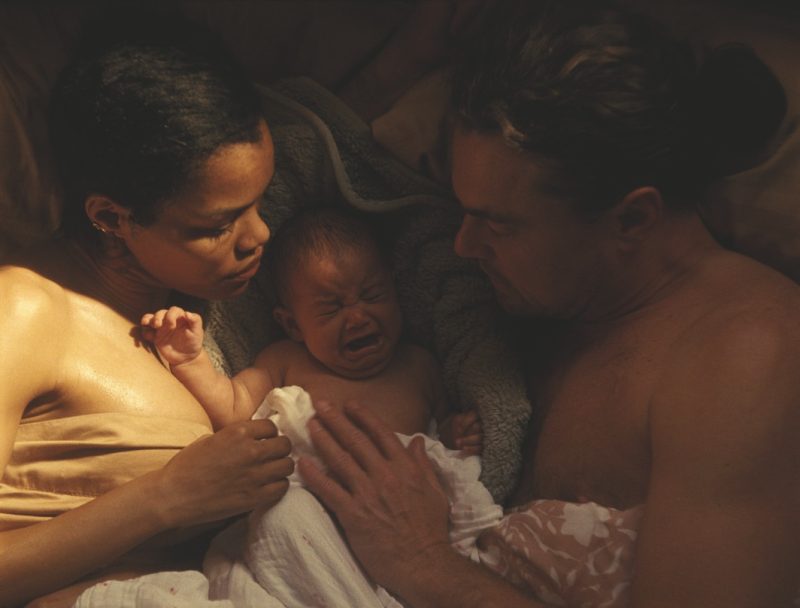
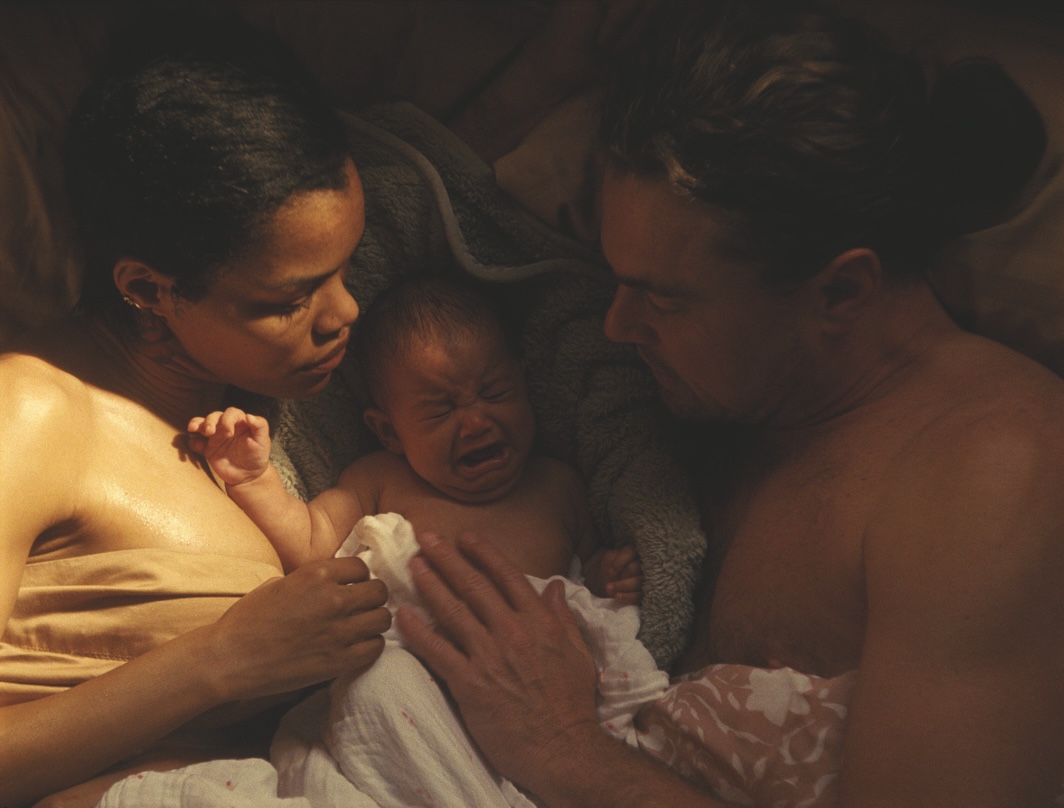
Paul Thomas Anderson, One Battle After Another, 2025, 35 mm, 162 minutes. Teyana Taylor and Leonardo DiCaprio as Perfidia Beverly Hills and Bob Ferguson. Image: Warner Bros. / Ghoulardi Film Company / Album.
For Christmas 1969, many of the Weathermen traveled home to see their parents for what they presumed would be the last time. Ayers Dohrn recounts these meetings between his mother, down to visit her parents in Florida, and his father, back home in Chicago. In a way, this is the moment his life begins, even if he was nine years away from being born. Or perhaps it’s fairer to say that in saying goodbye to their families of origin, his parents, still years from getting together romantically, said hello to their new family: the recently renamed Weather Underground Organization. From their homes around the country, one hundred Weathermen descended on Flint, Michigan, for their “War Council” in a ballroom where a nightclub shooting had just taken place. After an ultraleft orgy to celebrate the New Year (both calendrically and politically), they left Flint and scattered across the nation: Bernardine to California, Bill to Detroit with his then-girlfriend Diana Oughton, and, fatefully, Cathy Wilkerson, Kathy Boudin, Terry Robbins (Bill’s best friend), and several others to New York City. There they stayed at Cathy’s family’s town house while her father was on vacation (she pretended she had the flu and needed to recover at his digs). Ayers Dohrn tells us that Terry and Bill began a long-distance contest—part political, part competitive best friendship—to see who could bring the war home first. Bill almost succeeded, planting a bomb at a Detroit police station. When the bomb failed to go off, the Midwest office dispersed into the wind.
In New York, Terry’s crew began to plot an attack on Fort Dix’s dance for soldiers and their girlfriends. With spring break coming to an end, the New York Weather Underground had to get out of the town house and clean it up (Ayers Dohrn comically compares this to kids trying to hide the keg before mom and dad return home). The group also had to finish their self-assignment: building a bomb that might actually go off. They succeeded, but too soon. Terry was in the subbasement when the explosion occurred, dying immediately with Diana and Ted Gold (a Columbia University pal of David Gilbert) next to him. Upstairs, Kathy Boudin was in the shower; Cathy Wilkerson was ironing sheets. These two survived and fled the house.
In Ayers Dohrn’s hands, this is the story of his father’s trauma before he was born: both Ayers’s girlfriend and his best friend perished in that bombing. His father made him go annually to place a rose at the town house location, even while they were still underground. It was also a collective trauma for the group: The Weather Underground Organization, having gone, by their own estimation, too far and having failed, would now need to develop a program that kept the spectacle and pyrotechnics of bombings but with none of the death. They put the nation on notice by taping a Declaration of a State of War. On June 9, 1970, minutes after a warning was called in giving notice for evacuation, a police station blew up. The next day, the Underground claimed responsibility. The following six months saw target after target hit, all following this same pattern of warning, evacuation, and explosion. The WUO continued to evade capture, learning a technique they had picked up from the FLN in Algeria: send in a woman, dressed as a secretary, have her place the bomb, get out, and then send the warning call.
By fall 1970, Bernardine Dohrn was America’s Most Wanted, alongside Angela Davis and H. Rap Brown. The Feds made the notorious individuals of the group famous, not yet seeming to understand that a WANTED poster would produce, in the counterculture, a WELCOME sign. And indeed, as Ayers Dohrn points out, the Underground could only stay so successfully hidden because the overground blended with and aided those below. Rather than only being a spectacular aberration on the left, they were an edge of it, protected by it, hidden by it.
Alongside the bombings, the Underground learned the art of the prison break—first on behalf of Timothy Leary, who had been busted with a small amount of pot and sentenced to twenty years in California. In exchange for $25,000, Dohrn agreed to break Leary out; Ayers Dohrn tells us that, though she did not appreciate Leary’s politics, she hoped that it would teach the Underground how to free the political prisoners they actually cared about. (Later, when Leary was arrested again, he would turn on the Weather Underground Organization and provide information to help the Feds build their case against them.)
The revolutionary art of the bomb was only deployed more spectacularly thereafter, and often in direct solidarity with the Black Panther Party turned Black Liberation Army. Ayers Dohrn understands that the WUO’s story cannot be told without that of the BPP and the BLA. From Ayers Dohrn’s embedded perspective, we quickly learn that this is not just the story of two political families (“The Family” and the Underground), but of their families of blood and affinity who aided them for more than a decade. It is telling that leftists use the sibling formation (brother, sister) interchangeably with comrade—comrades are siblings, but sometimes siblings (and parents) can be comrades, too.
Soon, the babies started to arrive, or else activists joined the movement with kids in tow. These children had uses in the underground. One child Ayers Dohrn knew, Delia, aka Sunflower, would walk alone as the adults observed her, making sure she and they weren’t being followed before collecting her. She sometimes served as a beard, to make a pair of scouts seem like “an All-American Family, just out for a stroll.” Delia made Bernardine want a baby, and the times, they were a-changing: it was 1975. Soon, the United States would withdraw from Vietnam. If the two cornerstones of the Underground’s politics were to stop the war abroad and stop the war on Black people at home, the first had become somewhat obviated. Although the Underground kept bombing, the spectacle those bombs created was diminished.
ANOTHER OUTCOME FOR THE REVOLUTIONARY IS NORMALIZATION. Normalization can happen slowly (history stops happening, and you become history) or all at once, as a decision made, as in becoming a snitch. Both paths were open to the members of the Underground and both were taken.
As Ayers Dohrn tells it, across 1976, the Underground began to fracture, while his mother decorated his nursery with images of Che and Ho Chi Minh. Eventually, Bernardine Dohrn and Bill Ayers were extruded from the group they had helped build for supporting an “inversion plan” to surface from the Underground, which was deemed counterrevolutionary. Within four months, those who were still Underground were mostly captured.
With the WUO seemingly at their backs, and normal family life as their future, Bernardine, who had just given birth, and the family left the San Francisco scene. Ayers Dohrn remembers his mother, from the jump, as profoundly unhappy. He doesn’t think she had postpartum depression but “postrevolutionary” depression. She had been kicked out of the group she had started and, in the process, turned on many of her comrades, self- and other-denouncing. The Ayers-Dohrns broke up for a time; eventually they came back together. Along the way, Zayd was trained for life on the run.
Being on the run makes, apparently, easy sense to a child: “We were part of a rebel alliance, like Luke Skywalker and Han Solo, fighting an evil empire. . . . We were bandits and outlaws, stealing from the rich and giving to the poor, like Robin Hood.” Ayers Dohrn’s parents drew on the culture of the very empire they were fighting to impart the particular political education they had to give their child—not just the whys but the hows of being on the run: “In our circle, pretty much everyone we knew was a fugitive.” That his mother changed names at least six times, that his parents changed cars and jobs, that Ayers Dohrn himself knew how to identify undercover cops and lose them before most children know how to read was, in essence, unremarkable.
These stories are, for those who have wanted to find them, largely known, but Ayers Dohrn still might have contributed to a deeper understanding of childhood on the left as it was lived. But he falls short by adjudicating the WU members’ errors—as parents and militants. Like Lady Justice, he weighs the purported success of their actions over and against the strain on their domestic life. Ayers Dohrn reminds the reader, periodically, from his liberal-progressive vantage, not to have too much fun with the charismatic stories of his parents: there were costs. Fair enough. Those costs become the emotional core of the book.
Because the book is not a history but a son’s chronicle, there are moments when the telling seems by turns proud and disapproving—the way many grown kids might feel about the activities of their own parents’ youths. Ayers Dohrn isn’t trying to analyze his parents on the couch of this double genre, but he does want to make sense of what he experienced as a fundamental betrayal: his parents’ dual loyalty to their children and to the revolution. Ayers Dohrn wonders if this duality is even possible to negotiate. Often, it seems the answer is no.
If, as Ayers Dohrn asserts, the Weather Underground is his inheritance, he certainly did not inherit their politics. Instead, he took the so-called revolution personally. With the reversal of that famous axiom, he has turned to the lives of his parents and their comrades, which were determined by a devotion to insurrection, to make sense of his own life, but his own politics remain uninterrogated. At the height of the George Floyd uprisings (which he glosses as marching against violence in Charlottesville and in Ferguson, which were three and six years before, respectively), he began interviewing his parents, scared rightfully by the specter of COVID (soon Bernardine Dohrn would be diagnosed with Alzheimer’s). The following year, Ayers Dohrn and his father debated the relationship between insurrectionary groups like the Weather Underground and the fascists that stormed the Capitol building—the same place his mother bombed—on January 6, 2021. Bill describes these two formations as having opposing politics; Ayers Dohrn sees them as united by violence. During another such interview, Bill offers that they are now living through an insurrectionist “peak,” and Ayers Dohrn again expresses ambivalence: “revolutionary change just brings us back around to where we began. . . . If nothing ever truly changes, what’s the point of fighting at all?”
IN 1979, AYERS DOHRN’S FAMILY SETTLED IN HARLEM, now getting ready for Malik, Bernardine and Bill’s second son, to be born. Bill worked at Zayd’s preschool under a false name. Bernardine was a salesclerk at a bougie Upper West Side children’s boutique. That’s when the BLA came calling asking for aid, as did clandestine members from a Weather quasi-offshoot, associated with what was now called the M19CO. Kathy Boudin, herself pregnant with her first son, Chesa, would visit with Bernardine, and take all the information of the expectant and young mother customers from her at work to forge fake IDs for her comrades. In turn, those IDs were used to rent a series of cars deployed in bank robberies and heists in the tristate area.
As the BLA and armed clandestine organizations associated with the M19CO began to perform principled expropriations of assets, these IDs helped them avoid capture for a while. No one thought that the rental cars connected to these rich new mothers could possibly have anything to do with bank robberies conducted by what M19CO called “the white edge” of a panracial resistance. Meanwhile, Bill Ayers was tapped for driving one of the getaway cars in the 1979 prison break of Assata Shakur, who was liberated without a single casualty. After this success, the M19CO and the BLA would soon be back on the front page, but this time for a spectacular, violent failure: what is simply referred to as the Brink’s robbery. On October 20, 1981, the BLA, with the M19CO acting again as the white edge, stopped a Brink’s armored truck carrying cash. For the first time, one of these expropriation attempts ended in death. First, that of the Brink’s security guard, and then later, when the M19CO getaway drivers were stopped, two police officers in Nyack, New York. Sam Brown, who had only recently connected with the BLA, long-standing WUO members David Gilbert and Kathy Boudin, and M19CO organizer Judith Clark were arrested before an hour had passed. Soon, two more BLA members were pursued, with one dying as he fled the scene and the other surrendering. The police tortured all political prisoners but saved the worst violence for the members of the BLA. This was only the beginning: many others were arrested—including Bernardine Dohrn. For seven months, Dohrn refused to testify against her comrades. Eventually, she was released. She was one of the few lucky ones. When she got out, she adopted the child of her comrades, Chesa Boudin, and raised him as her own. This itself might be a lesson of the revolutionary family.
The Brink’s robbery left nine children orphaned—and many of the children of the revolutionaries now had incarcerated parents. This included Chesa, who had just been left with a babysitter for the day; Bernardine Dohrn, who had aided but not abetted, was home with her two sons, who soon lost their mother for nearly a year. And Judith Clark, too, left her baby daughter Harriet at home, before walking out, never to return, or at least not for nearly forty years. As historian Dan Berger puts it in his masterful book, Outlaws of America: The Weather Underground and the Politics of Solidarity, “To say that it is difficult to write about ‘Brinks’ is like calling the Grand Canyon a pothole. . . . People died that day, and three days later, and others received long prison sentences. Personally, politically, it was a disaster.”
Rather than take on the Brink’s robbery, or the militant activities of her mother, it is that decades-long separation that becomes the backdrop for Harriet Clark’s stunning debut novel, The Hill, which is told over a decade of visits between Suzanna and her mother (whom we can take to be a fictionalized Judith Clark), in a women’s prison called Hillcrest (a fictionalized Bedford Hills, where Clark and Boudin were held). From the beginning, the novel—flush with minute particulars—is invested in offering up an individual not for its own sake but to further solidarity with political prisoners in the United States and with the children separated from them by the state.
Clark opens her novel with a catalogue of those who get out “in strange ways. No stranger, I suppose, than the ways they got in.” Likewise, she notes those who stop being visited, and thus disappear, the guards who change jobs, the babies wrested from their mothers, and even the stray cats who are there one day and gone the next. Suzanna observes, “To stay or to go, that is a question. But on the Hill it wasn’t a question. Anyone who could leave left.” “To stay or go” is the revolutionary’s question of nerve, before that nerve lands you in jail; on the Hill, that question is in the past tense for the incarcerated. For those who climb the Hill, the live question is how to maintain a family when the state tries to make it impossible.
Suzanna becomes a child-ethnographer of a place she has grown up visiting to see her mother (her father is absent and basically never discussed). Raised by her grandparents, former CPUSA members, Suzanna is highly attuned to the fact that visiting is a collective endeavor: children cannot get up the Hill without aid. At first, supervising these visits falls to her grandfather, who takes Suzanna weekly. While his daughter and granddaughter visit, he sits and waits nearby. Suzanna’s grandparents have disavowed their own daughter’s actions. Suzanna is finally told, in a roundabout way, what her mother did one day as she and her grandfather drive away from the prison:
A misguided attempt, he called it, to steal from the rich and give to the poor. Then an elaborate explanation of the insurance mechanisms of banks and further clarification that many people had money in banks, not just the rich. When this lecture got into the weeds, he shifted gears into another, regarding imperialism, racism, militarism, also materialism—all the things, he said, that he and my mother opposed, and that, he assured me, I opposed as well.
Three generations agreed politically, but only one took up arms. As the grandfather puts it glumly, “She took it too far.” Although he preserves the link between his daughter and his granddaughter, his wife (Suzanna’s grandmother) refuses to support the visits to the Hill. The grandfather covers their visits in meaningless errands; the two drive and run out the day. Clark writes,
when he could think of nowhere else to go, we pulled off the road and I climbed into the trunk and pretended to be locked in. . . . I could hear him say, “Now where did she just go? Wasn’t she just here?” and “Oh Suzanna, why won’t you come to me?” This used up a fair amount of our time together: simulations of my disappearance and reappearance, simulations of his concern and great relief.
This is the fort/da game of the child whose mother is incarcerated for driving a getaway car. As Suzanna literally pretends to be smuggled, to go underground, or to vanish from family, grandfather and granddaughter playact the very disappearance of Suzanna’s mother. The car, formerly the scene of the crime, becomes the conduit of connection and the space of playing through the separation toward repair (after all, Suzanna’s last name is Klein, perhaps after Melanie, that great theorist of repair).
Once Suzanna’s grandfather dies, she no longer has a ride. Suzanna’s grandmother declares: “What’s done is done and can never be undone,” and refuses to visit. What remains undoable is the Brink’s robbery, and before that the radicalization of her mother. Suzanna’s unwavering commitment to her mother and to the ritual of visiting her on the Hill is both filial devotion and a site of her own resistance to a state that would keep her apart from her mother. To make sense of it, the child turns to mythological and biblical allusion. Clark writes, “At the prison considerable fanfare surrounded departures. But to not depart, it struck me then, was as great a feat as any. To stay by choice, not by curse. To return each week and rise again, to do this forever and ever. This was a feat I saw nowhere applauded and this was the challenge I set now for myself.” One must imagine Sisyphus as a mother and child.
Suzanna’s grandmother attempts to break this vow, not just by declining to drive her granddaughter to the prison but by trying to horrify Suzanna out of wanting to visit at all. Her grandmother takes her to the scene of the mother’s bank robbery under a strange pretext: depositing checks from a network of elderly CPUSA veterans. Suzanna is told to gather all the checks she can find (most are issued by dead comrades from the CPUSA). She drops Suzanna off and leaves her there. Eventually, when she returns, the grandmother unleashes her anguish:
I’d help her get any job—she knew that. All the time I said, “You have a baby now, no more fucking around, no more revolution. How will you eat? How will you afford a doctor?
What about piano lessons?” Like I was an idiot, a joke. That’s how she looked at me when I asked about piano lessons. You were only a baby, but still. One day you wouldn’t be a baby, you’d be you, and then what?
The “and then what” is Suzanna’s life. Her mother did not get a job, did not give her piano lessons. She refused to have mothering separate her from her work as a revolutionary—and she and her daughter and her parents paid the price. Suzanna’s life is marked by this constitutive absence: how one is shaped by someone who is there, and then someone who isn’t, but also by what it means to fight that absence, to find presence where one is instructed to relinquish it. In her grandmother’s telling, that absence is also an instruction in what it means to fight injustice. Soon, the grandmother delimits Suzanna’s world further, blocking her visits and pulling her out of school: “I became for my classmates what I’d become for my mother: someone who was there, then wasn’t.”
Suzanna finally gets back to that cohort, that ever-shifting collective of child visitors, and back to her mother. She does so via yet another devoted collective: the nuns who ferry children up and down the Hill to see their mothers (so it is at the real Bedford Hills as well). The sisters too have taken up vows, ones that the grandmother similarly belittles. These nuns come and go, as do the service dogs that her mother eventually trains while Suzanna grows from child to teenager (Suzanna is ambivalent about her mom’s dog; it draws from the limited reservoir of attention). Suzanna learns that the only people who stay right there on the Hill are the incarcerated, and sometimes their children, even when they move from the special children’s room to the normal, surveilled space of adult visitation.
As Suzanna gets absorbed into her grandmother’s world, she is able to study two generations of militants. She learns that this missing generation—her mother’s—only comes to “terrible woes.” This was the dropout generation—dead by misadventure or their own hands. Suddenly, it makes sense why Suzanna is the only grandchild among the aged communists.
Suzanna’s present-tense life narrows: less school, fewer friends. Instead, we see the expansion onto the forever past (of the prison, which holds you to the person you were for eternity) and the dying future (the sickbed, the plans the widows make with their pensions). All Suzanna has that is properly her own is the present tense of observation, a tense, she admits, with which she has never “been particularly enthralled.”
The future comes to the now. Her grandmother, dying, demands that Suzanna burn all of her effects. A letter comes from the prison, a final attempt to reunite before death. But this is not to be: the grandmother seeks to erase herself, to destroy time, to undo the chain of generational evidence and, thus, the very inheritance left for Suzanna. Now, her grandmother hopes, she will be only herself. On their little balcony, history is what burns.
After the grandmother dies, Suzanna can’t imagine a future lest it take her from her first vow: to visit her mother and never stop inhabiting the dailiness of family within the carceral context. Clark writes, “There were times still when the prison was extraordinary to me but my mother and I were ordinary to each other and if I left, we wouldn’t be.”
Suzanna soon goes to see her mother for a two-night visit, their first overnight since Suzanna was a baby. Clark is at her very best in these scenes: the story of someone rolling back time, making breakfast for a grown child, watching that child sleep, enjoying the banality of the childcare of which she was deprived. The mother says to her daughter, “I never know what I did to you and what’s just you.” This statement is both so ordinary—what many parents feel when looking at their children—and immense. What the mother did was more than mothering: she acted against the state and ended up in prison, there and not there. Annoying, cloying, exasperating—as mothers tend to be to teenagers—but only on Saturdays and only in an observed room. One day, the train fails to take her there. Like all infrastructure, it announces itself in disrepair. Not long after, another, greater breakdown: the prison is closed. Her mother is reduced to a letter, sent to prison after prison in the middle of the country she tried to end.
ALL CHILDREN ARE COMRADES, but children, once grown, may not remain so. Zayd Ayers Dohrn writes, “Over and over, you can see this same pattern, repeated: asked to choose between solidarity and family, revolution and romantic or familial love, my parents and their comrades chose the cause every time.” This would be unremarkable if he too were on the inside of it, but Ayers Dohrn is ambivalent about this; “it still bothers me,” he writes, “as a son and as a father.” But, like a good progressive, he also understands, from the revolutionaries’ point of view, that the revolution was also for all children everywhere. And we can understand why, from the near side of revolution, this might hurt a child: to have sibling rivalry extended past one’s brothers, biological and adopted, to every real and abstract child on the planet. To lose a parent—by choice—rather than for that parent to lose a comrade.
Losing your parents—even momentarily—is a pain no child should experience. So is losing a child. The Underground fought to stop the latter and accepted that their own children would suffer the former. For some children contending with that result, joining with their parents politically would be a way out of this ambivalence and the wound beneath it. The Hill is a clear-eyed defense of the collective that won’t suppress the pain of separation, the violence of the state in keeping children apart from their parents, but Clark does not spectacularize her own fate, even in fictionalized form. If most political writings focus on the doing—the clandestine meeting, the bomb—and stop the action at the point of splinter, death, or capture, The Hill chooses to tell the story of the unhappily ever after when one becomes a political prisoner, tracking radicality through its consequences and the demands they make on everyone involved, by choice and by birth.
For Ayers Dohrn, despite invoking and speaking to the many other children of the underground, the focus remains decidedly on what he and his brothers went through in its specificities. Every childhood memory seems to be doubled—an early camping trip with cousins was really a stakeout at the Federal Prison Camp at Alderson, where Assata Shakur was held after her confrontation with the police that left the author’s namesake (Zayd Shakur) dead. These events—what he thought was happening, and what was also happening—are not simply evidence of an adult revising his own personal history in the light of new facts. Instead, they express a conjunction of the domestic and the insurrectionary that the author sees as a betrayal. In researching the book, Ayers Dohrn discovered that while his parents had said they were done fighting the government after his birth in 1978 (although necessarily still underground due to their status as wanted fugitives), this was an outright lie. He had accompanied them to perform the earliest labor that led to jailbreaking Assata. He glosses this as “Bill and Bernardine were still desperate to be part of something larger than themselves. Larger than their relationship. Larger, even, than our family.”
These concentric circles of commitment extend too far: Ayers Dohrn had been told that his parents had settled down when he was born, but “my brother, my friends, and I were not just born into the underground, but into the midst of an ongoing guerilla war.” One imagines that enough time has passed to give some level of detail (without saying everything) about political actions of the preceding century, although there is no statute of limitations on arson in the first degree: property is king. But the immense pain of those actions for the author crystallizes around the time Bernardine Dohrn served; however comparatively brief her sentence, it was too long for a child. That pain extends also to his adoptive brother Chesa, who was not reunited with his parents until he was fully grown. Ayers Dohrn’s book is about struggling to understand how his mother and her friends could love the struggle as much as or more than their kin. We might hear Ayers Dohrn’s early description of writing up his family’s history anew: “My own little rebellion—petty and insignificant, maybe, compared to theirs, but still primal and painful, still potentially destructive.” Ayers Dohrn tries to have it both ways: to make this a personal recounting of growing up on the run and a political accounting of the Weather Underground—did they succeed enough in their aims to justify their commitment to trying (itself an ouroboros)? Given how we’re living now, and what we’re up against, there’s something almost perverse about this question, which implies that only the ends justify the means rather than the moment justifying a wide swath of tactics.
The Hill gets out of this trap—not because Suzanna, as a fictional proxy for the child of the political prisoner, didn’t suffer, but because the novel is ultimately for all children of all prisoners in the United States. As of this writing, that’s something like 14 percent of all children in the nation. By going to structure, by understanding where the violence is, Clark’s political novel never loses sight of what, rather than who, caused the pain.
Revolution and reproduction are often held out as antonymic. There is no good reason for this, even as the proximity of children (“innocents”) to calculated acts of violence or expropriation might make some queasy, to say the least. For many revolutionaries, there are no “strangers”: loving someone you don’t know is an extension of loving those you do, and vice versa. Children in Vietnam witnessed mass destruction and were killed. Children in the United States witnessed their parents being gunned down or arrested. The Weather Underground and the M19CO saw how these fates were connected. This is what is meant, most basically, by solidarity. And yes, that cost was borne by their own children, who could not and did not elect into their politics.
The stories of the Weather Underground are often told as fringe, without wider support, born and then dead by the middle of the ’70s. We know that is not the case: that it takes a whole movement to protect its edge. Today, saboteurs and arsonists have returned to these tactics, once again bent on stopping the war at home and the colonial genocide abroad. As with the Underground, many are meeting the hardest edge of repression, are captured, on the run, or dead. From Prairie Fire to Prairieland, it may be time to go back underground, and to sit, however uncomfortably, with the costs and contradictions of the revolutionary moments behind this one.
Hannah Zeavin is an associate professor of history at UC Berkeley. She is at work on her third book, All Freud’s Children: A Story of Inheritance for Penguin Press, for which she won a 2026 Guggenheim Fellowship.
TOWARD THE END of his life, Edward Said liked to call himself the last Jewish intellectual. It is an excellent and, I’m tempted to say, quintessentially Jewish joke. I have thought of it often since October 7, 2023, as I’ve watched the unfolding of the most intense and urgent propaganda war over the question of Palestine to take place in my lifetime, commensurate with the scale of the terrorist attack that took place on that day and that of the genocidal slaughter in Gaza that has followed during the subsequent nine hundred.
According to his biographer, Timothy Brennan, what Said meant by it is this: For almost two millennia Jews were the paradigm of the stateless, diasporic people. As such, they were in a special position to perceive the inconsistencies and shortcomings of the societies in which they lived, to be skeptical of official justifications for unequal distributions of power and resources, to articulate their critiques of them in universalist terms, and to extend solidarity to other persons and peoples based on their shared experience of exile and persecution, from the Jewish-Roman Wars to the Holocaust. In the nineteenth and twentieth centuries, this social position helped produce the intellectual flowering in Europe and North America that Enzo Traverso has called “Jewish modernity,” which included a number of philosophers and literary critics who would influence Said. Following the establishment of the state of Israel as a Jewish homeland, however, exile, and the perspective that often goes along with it, was forcibly transferred to the 750,000 Palestinians who were ethnically cleansed by Zionist militias between 1947 and 1949, among them Said’s family, who fled Jerusalem for Cairo.
The 1967 War—in which Israel conquered East Jerusalem, the West Bank, Gaza, the Golan Heights, and the Sinai Peninsula—saw opinion among the Jewish diaspora swing overwhelmingly in favor of the occupying power; in the case of the largely Jewish New York intellectuals, with whom Said was then associated, it often occasioned a drift toward neoconservatism as well. For the next thirty-six years, until his death on September 30, 2003, Said was a tireless and, at first, lonely advocate in the United States for Palestinian rights and self-determination. Aside from “the workers should seize the means of production,” it is difficult to think of a less popular position. “Ironclad” support for Israel, as the cliché has it, was shared by Democratic and Republican politicians in all branches of federal, state, and local government; by progressive Jews in coastal cities and Christian fundamentalists in the heartland; by the national security state and Hollywood; by the Federalist Society and the Anti-Defamation League; by the news media and significant parts of the professoriat. With assists from AIPAC and the International Media Branch of the IDF Spokesperson’s Unit, this extraordinary degree of elite consensus translated into an extraordinary degree of popular consensus, which, in turn, was maintained with deliberate distortions of both the historical and contemporary record that would have impressed Big Brother. Said called criticism of Israel “America’s last taboo.”
In such an atmosphere, it was not only difficult to get a hearing for a factual account of Israel’s state-formation or its decades-long occupation, it could be dangerous to try. Throughout his career, Said was smeared as an “anti-Semite” and a “terrorist.” The details of his personal biography were called into question. He regularly received death threats, and was monitored by the FBI and groups like Daniel Pipes’s Campus Watch. His colleagues at Columbia tried to get him fired. Pro-Israel donors to The Nation complained to his editors about his bylines. Attempts were made to cancel and disrupt his speaking engagements. Aside from that of the president of the university, Said’s office at Columbia, which was broken into and firebombed, was the only one with bulletproof windows and a security button. It’s a good reminder that Zionism was an earlier crucible of deplatforming and cancel culture than wokeness, and was practiced by some of the same cynics who would go on to make media careers out of denouncing the “campus left” for its supposed hostility to free speech. Said never tired of observing how curious it was that the “politically correct” label always seemed to be stuck on those who objected to being called racist, sexist, or homophobic slurs, but never on those who complained, say, about having to hear a system in which people were accorded different rights to political participation, fair trials, property ownership, and travel on the basis of their ethnicity called “apartheid.”
All that has changed, changed utterly. According to a recent Gallup poll, support for Palestine in the United States is at a historic high; a University of Maryland poll conducted last September found that for the first time Americans are more likely to sympathize with Palestinians than with Israelis. Most of this change has taken place on the American center-left, but skepticism toward Israel has also sparked an ideological civil war on the far right. Axios has reported that the DNC’s election autopsy is currently being suppressed because it concluded that the Biden administration’s financial and diplomatic backing of the genocide in Gaza was a major factor in the party’s defeat in 2024. Meanwhile, democratic socialist Zohran Mamdani’s principled stance on the issue was one of the reasons he was elected the first Muslim mayor of New York City in 2025. The ideologemes of Israeli hasbara—“a land without a people for a people without a land,” “the only democracy in the Middle East,” “the most moral army in the world,” “there is no partner for peace,” “anti-Zionism is anti-Semitism”—no longer compel the same measure of unthinking belief that they once did.
In part, this is due to the savagery of the Israeli bombing campaign on hospitals, schools, refugee camps, newsrooms, and other civilian infrastructure in Gaza, which has killed at least 75,000 Palestinians, many of them children, a figure that does not include the thousands who have starved to death because of Israel’s blockade, or the civilians who have been killed in concurrent Israeli operations in the West Bank, Lebanon, Syria, Yemen, and now Iran. In part, it is because of the heavy-handed responses of both the Biden and Trump administrations to global and domestic dissent, which has included blocking UN resolutions, sanctioning members of the UN and the International Criminal Court, introducing unconstitutional resolutions on anti-Semitism, withdrawing federal funds from universities and putting the Middle Eastern studies department at Columbia under state receivership, allowing pro-Israel moguls to take over media platforms where people could see what was happening in Gaza, and deploying riot police and federal agents to brutalize, disappear, or deport protesters. But most of all, it is due to work done by journalists, poets, novelists, comedians, filmmakers, and historians in Palestine and the diaspora, and their allies, all of whom have risked their safety and livelihoods, and hundreds of whom have lost their lives, to press the Palestinian case with the intelligence, wit, skepticism, moral clarity, and physical courage that over thirty years ago Said argued were the hallmarks of genuine intellectuals. Given the horrific scale of destruction and suffering in Gaza, it is scant consolation, but they have definitively won the argument.
SHORTLY AFTER FINISHING his doctoral dissertation on Joseph Conrad in 1966, Said planned two major books he would never complete. The first was a study of Jonathan Swift; the second was a study of intellectuals. Two chapters on Swift would find their way into The World, the Text, and the Critic (1983), but the figure of the intellectual would function as a leitmotif in nearly everything he would go on to write, from his paradigm-setting bestseller Orientalism (1978) and its sequel Culture and Imperialism (1993), to Covering Islam (1981) and several of the essays collected in Reflections on Exile (2000). His most sustained treatment of the topic would appear in a somewhat unusual venue: “Representations of the Intellectual,” the six Reith Lectures he gave for the BBC in 1993.
Said later told a friend that “it was crazy to accept” the BBC’s invitation to participate in its prestigious annual lecture series, inaugurated by Bertrand Russell in 1948, and not just because he only had a little over a month to prepare. It was a tumultuous period in Said’s life, starting with his chronic lymphocytic leukemia diagnosis in 1991. Along with teaching at Columbia, filing essays for the London Review of Books, and overseeing the publication of his collection The Politics of Dispossession, he was putting the finishing touches on Culture and Imperialism and writing the first pages of his childhood memoir Out of Place. It was also the period of Operation Desert Storm and the Madrid Conference. Despite his unquestionable talents as a global advocate for the Palestinian cause, Said found himself increasingly marginalized at the Palestinian National Council, the legislative branch of the Palestine Liberation Organization, on which he had served as an independent member aligned with the left-wing Democratic Front since 1977. Around the same time the lectures were being broadcast in London, Yasser Arafat was conducting meetings in Oslo, on the verge of making one of the worst diplomatic blunders in recent history. When the terms of the Oslo Accords were revealed to the public in September 1993, Said did not hold his tongue. He said that they represented nothing less than “the end of the peace process” and compared the Palestinian Authority that had been created by the agreement to Vichy.
Published in book form a year later, Representations of the Intellectual has now been rereleased by Fitzcarraldo, with a new foreword by the British-Palestinian novelist Isabella Hammad. Representations is an excellent introduction to the rest of Said’s work, especially for those who know it only through the syllabus staple Orientalism, where he is at his most polemical, or only by reputation, which has always been subject to bad-faith distortions, caricatures, and simplification. Those who think of Said as the American representative of French theory may be surprised to discover that his prose in Representations is impeccably clear and free from specialist jargon, the constraints of the radio format requiring him to be “precise, accessible, and as economical as possible.” Others, who are aware that one of his important accomplishments was to help introduce political context—particularly the imperial context—into the study of nineteenth-century European literature then dominated by apolitical, formalist methods, may be surprised to hear him say that although his readings are “spurred by commitments that go beyond his professional career,” he never introduces these “in the classroom.” Yet others, who associate postcolonial studies, the discipline he helped found, with cultural relativism, may be surprised to find him arguing in Representations for a far more subtle position, in which attention to “the local, the subjective, the here and now” is balanced against the need to “uphold a single and universal standard” for judgments of human behavior, especially where these concerned “freedom and justice.”
Orientalism was instrumental in showing how the discourses of universality and objectivity were constructed by European intellectuals as justifications for their nations’ subjugation of Africa and Asia. But Said’s insistence on a single standard for freedom and justice makes perfect sense in a world in which there is a de facto “Palestine exception” to human rights. He was also, it should be mentioned, a critic of identity politics on these grounds in Representations and in essays like “The Politics of Knowledge.” As a good reader of Frantz Fanon, Said understood that identity politics was a kind of “defensive nationalism”—a reasonable if, in his view, counterproductive response to oppression. Whether in the inter-national context of imperial conquest, or in the intra-national context of structural racism and patriarchy, the blame for the existence of identity politics ought to fall on those who subordinate people on the basis of their identity—in other words, as with political correctness and cancel culture, with many of the same people who complain most loudly about it. Whether they were movements of national self-determination, racial justice, or gender equality and sexual freedom, the best strategy, as Said argued in Representations, was not to retreat into particularism, but to “universalize the crisis, to give greater scope to what a particular race or nation suffered, to associate that experience with the suffering of others.”
REPRESENTATIONS OF THE INTELLECTUAL is a group portrait of “everyone who works in any field either connected with the production or distribution of knowledge.” It discusses their self-conceptions as members of a class, caste, cause, or guild; their social function and the social conditions of their formation; their relationship to states, professional institutions, national communities, and media apparatuses; their literary and performance styles; and their assumptions about truth. But the titular phrase has two other meanings. Representation, first of all, is simply what intellectuals do. Thinking, writing, speaking, debating, doubting, giving reasons, making judgments: these are all activities that involve representing ideas in language. Second, like a congressperson or a member of parliament, the question for everyone who engages in these activities is what constituency and whose concerns they represent with them. This choice of constituency, in turn, goes a long way toward defining what kind of intellectual they are.
On one side Said places the group Julien Benda called “clerics,” Antonio Gramsci called “organic intellectuals,” and I will simply call the intelligentsia. These are the professional knowledge workers—analysts, managers, technicians, consultants, lobbyists, pundits, and academics—whose functions, size, and social status have expanded significantly in all advanced industrial nations following World War II. Employed by institutions like political parties, NGOs, think tanks, corporate firms, foundations, and universities, the audience the intelligentsia produces and distributes knowledge for is a relatively narrow one, consisting largely of colleagues and bosses, or the “special interests” that the institutions with which they are affiliated represent.
The ethos of the intelligentsia is “professionalism,” which Said describes as “thinking of your work as an intellectual as something you do for a living, between the hours of nine and five with one eye on the clock, and another cocked at what is considered to be proper, professional behavior—not rocking the boat, not straying outside accepted paradigms or limits, making yourself marketable and above all presentable, hence uncontroversial and unpolitical and ‘objective.’” The intelligentsia values expertise, a process of institutional socialization and credentialization that enables members to control who is allowed to speak on a given topic, and specialization, which involves the cultivation of highly technical methods and sociolects that are often used to distinguish members from nonmembers, and to forestall scrutiny and criticism of the former by the latter. The “accommodating” and “fawning” attitude shown by certain members of the intelligentsia toward the wealthy and the powerful is matched only by their condescension toward the general public, not to mention the vicious and often petty competitiveness frequently on display in their interactions with their fellow knowledge workers. For their services—which range from conferring “authority” to making public opinion more “conformist” to “spew[ing] propaganda against official enemies”—they stand to be handsomely rewarded with promotions, publishing contracts, prizes, fellowships, sabbatical leaves, and further access to the wealthy and powerful.
Public intellectuals, by contrast, are incorrigible amateurs, in the original sense of the word. These knowledge workers are “concerned members of society” whose activities are “fueled by care and affection” for ideas, and a “love for the larger picture” rather than by “profit or by narrow, selfish specialization.” Just as every public intellectual is necessarily embedded in a national and a linguistic community with its own traditions, Said acknowledges that independence from institutions like the university or the media, the two with which he was most closely affiliated, could only ever be relative; after all, the price of total independence is no audience. Whether they are an academic or a “bohemian essayist,” he thought that the intellectual’s autonomy would be best preserved by trying to appeal to as wide an audience as possible in the “uncertain” terrain of the public sphere, whose venues in Said’s time were newspapers, magazines, lecture halls, and television studios, and have come in the past decade to include a broad range of new digitally networked textual and audiovisual media.
Public intellectuals are also resolutely “secular” as opposed to “religious” thinkers, a distinction Said introduced in The World, the Text, and the Critic. When dealing with social and political questions—the Late Latin saecularis means “worldly”—universal principles cannot be grounded in scientific objectivity or a totalizing philosophical system, to say nothing of the revealed truths of a sacred text, “which brook no disagreement.” Nor is there any a priori “rule” to determine when one should apply a universal principle to a situation, and when one should instead emphasize historical and cultural context. Secularism entails an awareness that judgments are always “fallible,” and making them is simply one of the “risks” of being a public intellectual. Others he mentions include selling out, co-optation, and choosing to be silent on political matters that might affect one’s career, but also “hardening into an institution” oneself and becoming an “automaton acting at the behest” of one’s own methodologies, positions, or alliances. Consequently, public intellectuals should always approach their tasks with “a space in the mind open for doubt,” a good dose of “alert, skeptical irony (preferably also self-irony),” and an “uncompromising” support for “freedom of opinion and expression.” For the genuine public intellectual, Said says, there ought to be “no solidarity before criticism.” This primary loyalty to thinking itself is surely one reason, as Raymond Williams observed, that the word “intellectual” connoted negatively in English until well into the twentieth century, and why the gadfly-like figure has been a source of irritation to people of all political stripes ever since Socrates squared off with the sophists.
Said was allergic to the notion of the critic-as-artist that was fashionable during the theory craze of the ’70s and ’80s. “I am not an artist!” he emphatically told Brennan. Yet he often describes the public intellectual in aesthetic terms. Public intellectuals have the sense of the “dramatic” and the “insurgent” in their “social performances,” whose effectiveness rests, in no small part, on their “wit,” “image,” and “mannerisms” as well as on their “sense of an important personal stake” in their arguments, their “will to say things,” and their “quite peculiar, even abrasive style of life.” (He may have been thinking of Sartre and to a lesser extent Adorno, but he could have just as easily been describing James Baldwin or Susan Sontag.) He goes on to quote C. Wright Mills, who sounds not unlike Viktor Shklovsky when he says that intellectuals and artists were two of “the few remaining personalities equipped to resist and to fight the stereotyping and consequent death of genuinely living things” with the weapons of fresh modes of perception and expression. Many of the public intellectuals Said admired acquired these capacities through their experience of exile, but “even if one is not an actual immigrant or expatriate, it is still possible to think as one,” by adopting the “metaphorical condition” of exile as an outsider to the dominant structures of thought in and received opinions of one’s own society. Just as immigrants and expatriates cross the territorial borders set up by the nation-state, the public intellectual should cross the borders of thought set up by experts and specialists. Unlike the “professional supplicants” in the intelligentsia, Said says, their ethos can be summed up in the motto James Joyce borrows from Milton’s Satan to give to Stephen Dedalus: Non Serviam, I Will Not Serve.
ONE CRITICISM LEVELED at Said’s Reith Lectures was that he did not devote enough consideration to right-wing intellectuals. In his introduction to Representations, he protested that he had opened them with a discussion of Julien Benda, but Benda’s appearance, along with stray references to Wyndham Lewis, William F. Buckley Jr., and the “extreme right-wing” magazine The New Criterion, are the exceptions that prove the rule. Like his view that the university was a “quasi-utopian space” for reflection and research, Said could take for granted in the early ’90s that the public intellectual was primarily a left-wing figure. Regrettably, this is no longer the case. For some time now, on nearly every issue, with the notable and somewhat ironic exception of Palestine, the intellectual and even countercultural energy in the United States seems to be on the right. (This, I hope it goes without saying, is not a judgment on the quality of the thought generated by this energy, which often makes the right-wing thought of Said’s day seem profound by comparison.)
A brief survey of the current American intellectual landscape would include ivory-tower post-liberals and Silicon Valley neo-reactionaries who want to turn the republic into a corporation or a monarchy, downtown Manhattan edgelords, effective altruists and accelerationists, exitarians and transhumanists, Christian nationalists and Catholic integralists, tradwife and manosphere influencers, so-called race realists and gender-critical feminists, and all those classical-education ideologues whose fealty to the “Westernness” of the canon exceeds their familiarity with its contents. Their podcasts, videos, online manifestos, little magazines, and coverage in legacy media have allowed them to achieve impressive degrees of cultural diffusion, in many instances with the material support of the tech oligarchs whose businesses are increasingly integrated into the state and who have also come over the past decade to own large swaths of what in Said’s time could still be called the “public” sphere.
What ultimately distinguishes right-wing intellectuals (RWIs) from left-wing intellectuals (LWIs) are their respective attitudes toward distributions of political power, economic resources, and social status within and between nations. Simply put, RWIs believe these should be distributed according to a particular hierarchy, whereas LWIs believe that they should be distributed equally. If an RWI’s favored hierarchy is currently in place, their task is to legitimate its continued existence, and they are conservatives; if, however, their favored hierarchy has been displaced, their task is to argue for its restoration, and they are reactionaries. Reactionary intellectuals are, in other words, always an incipient intelligentsia, which just happens to find itself on the wrong side of elite circulation. One of their cleverest tactics has been to stoke popular resentment against the egalitarian projects of the left by conflating them with the bureaucratic procedures or the discursive shibboleths of the liberal intelligentsia, whose position in the cultural hierarchy they would like to reclaim. After all, universities and the media establishment—where, until recently, many members of the liberal intelligentsia have enjoyed a rather complacent hegemony, having deluded themselves into believing that their personal ascent up these hierarchies is tantamount to dismantling them—are institutions with large amounts of symbolic capital, but very little material power. Making such institutions their primary targets for critique has allowed RWIs to pass themselves off to the credulous as daring insurgents against the status quo, when they are in fact nothing more than servants of a more powerful sector of it. To give a concrete example, you will almost never hear an RWI who considers DEI initiatives in university admissions, corporate hiring, or federal appointments to be unacceptable affronts to real meritocracy criticize legacy preferences, nepotism, or cronyism.
Whatever their theological commitments, RWIs are almost always “religious” in Said’s sense. Generally, they attempt to argue that their preferred hierarchy is divinely ordained or natural. The purpose of this, according to Said, is to convince people that the hierarchy is “unchangeable, permanent, irreversible”—hence RWIs’ insistence on such things as the existence of God, racial distributions of IQ, biological sex difference, essential national character, and/or the propensity of human beings to resource competition, profit-maximization, and the formation of nuclear families. (Ironically, an extremely popular variant of this point—since power is what constitutes the subject, resistance to power always turns into a new regime of control—originates with the left-wing historian Michel Foucault, which is why Said, who was as responsible as anyone for introducing his work to American audiences, broke with him in the ’80s.) A more sophisticated version does attempt to justify the hierarchy by arguing that it makes people who are subordinate to it happy, or at least happier than they would be if equality prevailed. Historicizing—showing how hierarchies and ideologies have “come to be that way” as the “result of a series of historical choices made by men and women, as facts of society made by human beings”—is positively fatal to both lines of argument. If hierarchy made all people genuinely happy, no one would have wanted to change it in the first place; and if it was natural, they wouldn’t have been able to. Needless to say, when RWIs argue that contingent social norms are objective truths, they are also trying to place them beyond the reach of critique, challenge, and doubt. This is what makes so many of them, in the words of Said’s friend Fredric Jameson, “anti-intellectual intellectuals.”
WHO, THEN, FORMS THE CONSTITUENCY that the public intellectual represents? Said’s answer: “the under-represented” and “the unrepresented.” The public intellectual’s main task is to “speak truth to power” on behalf of “all those people and issues that are routinely forgotten and swept under the rug.” Said’s use of the famous slogan is interesting, and not merely because in Representations he criticizes sloganeering. The point of speaking truth to power is not immediately obvious to me. The story we often tell ourselves is that in a democratic society, the point is to change the “hearts and minds” of citizens, who can then apply electoral pressure on politicians to change policy, or to hold their colleagues responsible for gross violations of the law, morality, or the public trust. Despite the fact that this has sometimes occurred, the United States is not a democratic society, and has not been one for some time; in the domain of foreign policy, with a few exceptions, it has never been one. Should the intelligentsia fail to manufacture consent for the state, the state can always dispense with justification altogether, in favor of brute force and distraction. The latter has been a particularly effective tool: since the US-brokered ceasefire between Hamas and the Netanyahu government went into effect last October, Israel has violated it more than 1,500 times, killing more than six hundred people, but this, along with the aid that is still blocked from entering Gaza and escalating settler violence in the de facto annexed West Bank, no longer makes front-page headlines in the international press.
Speaking truth to power cannot therefore simply mean the process of exposing lies, debunking falsehoods, or bringing suppressed facts to public attention—though these are critical components of an intellectual’s task. Sometimes Said comes perilously close to suggesting that it is an end in itself, or primarily beneficial to the person doing the speaking—both of which would be legitimate if still somewhat unsatisfying outcomes. “The goal,” he writes in Representations, “is mainly to project a better state of affairs and . . . trying to induce a change in the moral climate.” Elsewhere, in his essay “Permission to Narrate,” a review of Noam Chomsky’s book The Fateful Triangle, Said argued that truth must be situated in a larger narrative framework for speaking it to be effective, giving intellectuals whose training in the production or analysis of storytelling a special role to play. The Israel-Palestine conflict is fundamentally a conflict about land, but as he wrote in Culture and Imperialism, the right to live, work, and travel in a space is “reflected, contested, and even for a time decided in narrative.”
Narrative, at least, gives us our best clue as to why so many people around the world are so deeply invested in events that take place in a territory the size of New Jersey, with a total population the size of Buenos Aires. Understandably, the investment expresses itself differently depending on where you are viewing it from. Many in Ireland and South Africa, for example, symbolically identify with Palestinians on the basis of their respective experiences with colonialism and apartheid. By contrast, in the particularly pathological case of Germany, identification with Israel has become something like a semi-official state religion, serving various interested parties as an ideological salve for Holocaust guilt, as a means of maintaining the centrality of German history to current events, as an opportunistic screen for expressing Islamophobia, or as a model for once-taboo forms of militarism and ethno-nationalism.
Before we get to the United States, it is worth remembering that the founding of the state of Israel in 1948 took place between two other important events, the independence of India and Pakistan from the British Empire and the establishment of the People’s Republic of China, an event known in US foreign policy circles as “the loss of China.” Israel thus represents the reassertion of European-style settler colonialism at the very moment the global tide seemed to be definitively turning against it, and the longest-standing exception to the legal principle, enshrined in Article 2 of the UN Charter, that forbids states to acquire territory by force. In addition to Israel’s function as a garrison state for American power projection in West Asia, to the financial influence AIPAC exercises over political campaigns and media, and to the staggering 30 percent of Americans who believe that a Jewish state is the domino that will knock into Armageddon and the Second Coming, among them the candidly titled Secretary of War, there is the question of who gets permission to narrate the story of the late twentieth and early twenty-first centuries. Is it a latitudinal narrative about the triumph of liberal-democratic capitalism over fascism and communism, as Francis Fukuyama thought, or the triumph of that composite fiction known as “Western civilization” under the financial, military, and cultural hegemony of the United States over putative competitors like the “Islamic World” or the “Sinosphere,” as Samuel Huntington argued? Or is it a longitudinal narrative about the self-determination of peoples of the Global South from their five-hundred-year-long domination by the nation-states of the Global North? These latitudinal and longitudinal narratives cross at the Null Island of Jerusalem.
Said was as aware as he was wary of the parallels between the Jewish and Palestinian narratives of displacement, exile, persecution, and return. But he astutely observed that whereas Zionist thought mirrors its origins in late-nineteenth-century European ethno-nationalism, state idolatry, and colonialism, the Palestinian experience is informed by a different cultural milieu—the former Ottoman Empire—and a different historical moment: mid-twentieth century decolonization. That is why he hoped it would be possible for Palestinians to “universalize the crisis” of the Nakba and tell a different story of group belonging that is inclusive, fluid, pluralist, and egalitarian. The name he gave to this story is Palestinianism, and he never lost faith in that it would one day, against all odds, be realized. When he was asked whether he thought the situation in Palestine was hopeless, he was blunt: “Where cruelty and injustice are concerned hopelessness is submission, which I believe is immoral.”
Ryan Ruby is the author of Context Collapse: A Poem Containing the History of Poetry (7 Stories Press, 2024). He lives in Berlin.
FATHER DANIEL BERRIGAN TURNED FORTY-NINE WHILE HIDING FROM THE FBI IN THE SPRING OF 1970, though pictures from that time suggest the playfulness of a younger man. In shots taken by civil rights movement photographer Bob Fitch, Berrigan mugs at the camera from under a rat’s-nest wig and sombrero, a lampoon of disguise. Beanie-clad, he grins in a parking lot while holding a Coke, takes a comically large step in sparse woods, smiles in a daylit diner booth at someone out of frame. At Cornell University’s Freedom Seder, part of a multiday festival thrown in his honor, he flashes a peace sign from the stage, sunglasses pointlessly and conspicuously on. He’d planned to surrender himself there, then decided not to, and escaped.
He analogized going underground to dying, to “closing the lid of a tomb,” and wrote of the loneliness that came with the necessary separation from family, especially his hospitalized mother. Yet “what fun!” he thought after he evaded the FBI at Cornell in, famously, an oversize puppet costume. As a wanted man, he released public missives, granted interviews, even spoke from the Sunday pulpit, and so humiliated the federal agents in flat-footed pursuit. (Time called him “a modern Pimpernel.”) He made fugitivity look social, invigorating, the closest a lifelong celibate could come to being a rock star. “I am thriving to the point of obscenity,” he wrote to his brothers two months in. Three more months would pass before he was captured on the verge of eating an apple in theologian William Stringfellow’s Rhode Island home.
He was sentenced to federal prison for burning draft-board files in Catonsville, Maryland, a crime committed in 1968 alongside eight other Catholic peace activists, one of whom was his younger brother Philip, also a priest. In footage recorded by the press they’d summoned to the event, participants take turns stating their purpose, affirming their mutual culpability, and explaining how they made the napalm they used as an accelerant. “We were all part of this,” one of the men says as each person sparks and then drops a match onto the already flaming pile.
Daniel was last to join the group that rallied to Philip’s vision, and therefore never meant to play spokesperson. But his statement during their trial defined the group’s action, and probably still constitutes his most famous lines: “Our apologies, good friends, for the fracture of good order, the burning of paper instead of children, the angering of the orderlies in the front parlor of the charnel house. We could not, so help us God, do otherwise.”
Catonsville was a formative rupture for Daniel, who’d been forging a path of religious rebellion since the nuclear bombing of Japan inflamed his misgivings about Catholicism’s complicity in war. Three years before, in 1965, Daniel’s Jesuit superiors exiled him to Latin America after he gave a homily for Roger LaPorte, a twenty-two-year-old Catholic Worker who self-immolated in front of the United Nations building in protest of the war on Vietnam. The church deemed LaPorte a suicide and therefore ineligible for a funeral mass. Berrigan legitimized the service with his presence, but that provocation paled in comparison to his sermon, which likened LaPorte’s death to Christ’s (“a gift”) and decried a populace, including the priesthood, that abdicated peacemaking. Supporters fasted, demonstrated, and petitioned for Berrigan’s return to the States with a full-page New York Times ad, which brought his name to a wider public. The superiors relented after four months. “I came home,” Berrigan wrote in his 1987 autobiography, To Dwell in Peace, “worse than ever.”
Berrigan landed at Cornell, where the students were restive, and school administrators, along with a majority of the faculty, were as vindictive and obstructionist as the church. It was 1967, two years into the draft’s dramatic increase, with roughly half a million American men deployed in Vietnam. Philip, a soldier before he entered the Josephite order, began to plan the destruction of selective service files in Baltimore, but Daniel wasn’t ready for such decisive intervention. He saw himself as a supporter of those directly engaged, not someone who thrust his own wrench into the state’s murderous gears. Six months later, after a trip to Hanoi, this—he—changed.
“I knew that he felt, after coming back from North Vietnam, that somebody had to cry out in the streets,” recalled Berrigan’s travel companion, Howard Zinn, in the 1970 film The Holy Outlaw. (The two were tasked with representing the American peace movement as they collected and escorted home three captured air force pilots.) Hours after they landed in Hanoi, they received an American welcome when they were jarred from sleep by an air-raid siren. The men spent a good portion of their trip sharing bomb shelters with the peasants under attack.
“It is a bit like Selma,” Berrigan wrote. “We are only safe among the victims. A law of history? Who was ever safe among executioners?” Amid the devastation his country inflicted on their homeland, Berrigan was shaken to his pacifist core by the Viet Cong hosts’ dignity and “astonishing” sense of purpose. They articulated a near-indisputable vision of the good life: individuals were given what they needed to thrive, dialogue was integral to decision-making, hierarchy was minimal, and women and children had the same rights as men.
When shown the darts, traps, and homemade guns of earlier Vietnamese revolutionaries, Berrigan rejected them as “not for me, any more than the planes and missiles of the Americans.” Yet he was inexorably compelled by Ho Chi Minh, from the leader’s fortitude in prison (“it seems to me only a true revolutionary would keep a diary in the form of poems”) to his devotion to his people. Berrigan could not imagine a pope or American president conducting himself with such an unfailing commitment to the poor, but it wasn’t easy to wed Ho’s Christlike qualities with the museum-showcased weapons. Could “moral superiority” ever belong to someone willing to harm other human beings, or was this “the old lie in a new guise”? He ventured no answer or endorsement but confessed that “the society here gives me more hope for the control and integration of violence than does our public experience at home.”
Two certainties towered above his ambivalence. First, the United States was enacting a wanton, rapacious genocide, “in violation of every international convention from The Hague in 1907 to Geneva in 1929 and 1949.” Second, the United States would continue to brutalize people within its own borders unless the “enormous, deformative power of militarism and nationalism” was interrupted. Though he saw Christians as especially negligent, he thought that Americans of all creeds refused the responsibility incumbent upon them, treating even modest protest—like marching—as a distraction from real life, a moral “extra,” and resigning themselves “to endure a great worsening and rotting of the public fabric.” This sickness of soul could not be healed by habitual behavior, political or otherwise. The moment required nothing short of conversion, a profound and complete change of heart. “An act of faith by modern man,” he wrote, “might begin by not asking for a clearer situation than the one he is in.”
Zinn and Berrigan’s Hanoi trip took place in February 1968. In March, President Lyndon Johnson authorized a troop surge in Vietnam. In April, Martin Luther King Jr. was assassinated. Countrywide riots ensued, bringing injuries, death, and Johnson’s invocation of the Insurrection Act to deploy the military in Washington, DC, and Chicago. Before the month was out, Columbia University called in the NYPD to tear-gas, beat, and arrest over seven hundred students protesting the school’s militarism and racism. In May, when Philip again approached his brother about destroying draft files, Daniel agreed.
Berrigan wrote steadily, indefatigably, from the 1960s until his death in 2016, and published more than fifty books of poetry, conversations, and prose. But the insights recorded during this spate of intense activity—Hanoi, Catonsville, Danbury prison (where he served eighteen months of his three-year sentence before release)—remain especially electric. Some of this lasting resonance can be attributed to imperialism’s recursivity; pages and pages of his Vietnam-era analysis map seamlessly onto the genocide in Gaza and prestigious universities’ barbaric response to protesters. “The Vietnam years, as I had undergone them at Cornell, had sealed the fate of the universities,” he wrote in 1987, deeming colleges “apt tools of the warmaking state.”
Primarily, though, the work’s power is in its tone, the expression of a mindset and emotional orientation that animates language the way breath animates body. During the late ’60s and into the ’70s, Berrigan, the wordsmith, managed something remarkable. He leavened his prophetic, Old Testament anger—at America’s foul, murderous past and present; at the Catholic church’s shameless centuries of bloodletting—with warmth and even sweetness.
Consider the humility and care in his message to white radicals the Weathermen, recorded when they, too, were fleeing the authorities. “I have a great fear of American violence, not only in the military . . . but also here, in me, up close, among us,” he said.
On the other hand, I must say I have very little fear, from firsthand experience, of the violence of the Vietcong or Panthers (I hesitate to use the word violence), for their acts come from the proximate threat of extinction, from being invariably put on the line of self-defense. But the same cannot be said of us and our history. We stand outside the culture of these others, no matter what admiration or fraternity we feel with them; we are unlike them, we have other demons to battle. The history of the movement, in the last years, it seems to me, shows how constantly and easily we are seduced by violence, not only as method but as end in itself.
This expansiveness was made possible by his move from anti-war commentary into illegal action. In crossing that border, Berrigan uncovered a wellspring of inherently hopeful energy that fed ambitious dreams. Liberation for him in these years included abolition of empires, nation-states, militaries, prisons, and that bastion of consumer culture, the family—which he faulted for isolating women while instilling selfishness in both parents. (“If we are talking about which structure in our society seems to offer the greatest resistance to change I would say, yes, it is the family,” he told the conservative-minded academic Robert Coles, and when Coles asked if Berrigan thought married men “lose their social compassion,” Berrigan replied, simply, “Yes.”) He engaged with the work of Eldridge Cleaver and George Jackson, cited Frantz Fanon, provided the foreword for a book called Quotations from Chairman Jesus, and wrote long, sincere letters from prison to the men who put and kept him there: Catholicism-loving Protestant J. Edgar Hoover and Danbury’s Catholic warden. “I wanted to announce the gospel,” he explained, “because they have never heard it.”
When photojournalist Lee Lockwood asked Berrigan in 1972 to respond to the criticism that he had been a “media freak” while evading the FBI, he replied, “I make no apologies to the mortician culture for playing around a bit. . . . One of the most sorrowful features of life today is that people can’t associate a kind of overflow of good humor and joy with the struggle.” Because the nature of the state is to use violence, and the nature of violence is to kill everything other than itself, “the recourse of decent men is constantly narrowing rather than widening.” Self-sacrificing creativity—an experimental act conceived in love, of which the enactor assumed full consequence and brought injury upon no other—was the corrective, a method for making possibility available in the otherwise viciously limiting present. As Berrigan said while underground, “I am more determined than ever to continue with this kind of life, for all its hazards, as long as it is possible.”
That daring, buoyed spirit endured briefly past his prison sentence, helped along, perhaps, by considerable celebrity. Daniel’s time underground lasted months longer than two other Catonsville participants who refused to report for the start of their prison terms: Philip Berrigan, caught in under two weeks during a raid on Manhattan’s Church of St. Gregory, and George Mische, captured in Chicago with agents’ guns drawn, a fact that infuriated Daniel beyond measure. Nurse Mary Moylan used a network of supportive women to stay free for an astounding nine years before she turned herself in. But it was Daniel—erudite, white, university-linked, and male—who captured the public’s interest. Postprison, teaching and speaking requests abounded.
His most infamous performance is also one of the most impressive. In a 1973 speech to the Association of Arab University Graduates in Washington, DC, Berrigan condemned at length, with rigor and sophistication, Israel’s crimes against humanity, which then as now were committed with American funding and oversight. The country had “passed from a dispossessed people to an imperial entity” and was threatening to become, in “a tragedy beyond calculating, . . . the tomb of the Jewish soul.” In Berrigan’s extensive, accomplished bibliography, it vies for the strongest offering.
“How strong is the irony of this occasion,” he reflected, with typical forthrightness, “a member of the classic oppressor church calls to account the historic victims of Christian persecution”:
Human life today, if it means anything, is meant to raise a cry against legitimated murder. Our lives are meant to be a question mark before humanity, whether we are Arab, Jew, or Christian. When a Zionist or American Catholic or an Arab Apologist loses that momentous dignity, he becomes a zero, his soul is torn in two.
Berrigan said he was indebted to and informed by “the vision Jews have taught me, of human conduct in a human community,” adding that his Christianity required that he “ask of Israel those questions which Israel proscribes, ignores, fears. Where indeed are your men of wisdom? Where are your peacemakers? Where are your prophets? Who among you speaks the truth to power?”
Scandal duly followed, stoked by coverage in The New York Times, a publication Berrigan had, for years, regarded with sublime disdain. (The article concluded with a complaint that Berrigan had given the speech to an Arab rather than Jewish audience.) Commentary magazine ran more than four thousand words condemning his “malicious invention and crude distortion” at a time “when Israel urgently needs . . . the simple human recognition of its basic legitimacy.”
Just as his early sympathy to leftist arguments still leads detractors to label him, inaccurately, a Communist, Berrigan has been maligned as an anti-Semite even after his death. He was, of course, familiar with condemnation and institutional punishment for his beliefs. But this insult, coming “from friends of long standing” who hurled it publicly, wounded him. It is one thing to be a respected gadfly, rejected by those you bedevil, and another to be a pariah, abandoned by those who once joined your chorus.
Daniel Berrigan in handcuffs, 1969. Photo: Bob Fitch / Flickr.
IN THE LATER ’70S, BERRIGAN WAS STILL, AS HE WROTE IN A LETTER TO PHILIP, “carooming [sic] around the country” on various public engagements, and writing copiously, but his health was diminished, and he suffered from problems with his back and eyesight. He provided hospice care for men with cancer and, several years later, with aids, as well as tended to his dying friend Lew Cox in what he described as “a little like a marriage—at least the closest I’m likely to get.”
Berrigan became a critic of homophobia in the church and decried women’s exclusion from the clergy, but his refusal to tolerate violence in any form, for any reason, set him apart from formerly admiring leftists and even other Catholic peace activists. At a group dinner in 1978, he was goaded by Maryknoll priest Blase Bonpane, who in Berrigan’s telling “support[ed] any + all gun-wielding Latins,” including Fidel Castro. True to his peacemaking core, Berrigan was unwilling to argue, particularly when someone wanted a fight, and so stayed silent until he couldn’t any longer. Bonpane’s final words, shouted at Berrigan’s back, were “too bad you can’t face these things.”
Another point of division arose after Roe v. Wade, when Berrigan began to speak publicly about abortion. One 1974 speech was, by his own report, “ill-received” by “a large group of women” whom he cruelly described as “wounded mothers of aborted children.” In 1977, Canada declared him an “undesirable alien” after an antiabortion speech in Ottawa, the text of which is not publicly available. In an essay from 1980, Berrigan, characteristically undeterred, reiterated his conviction that the procedure is “personally maiming” and claimed he had “yet to meet a person involved in an abortion who is not haunted by that memory.” (A foreseeable state of ignorance for a man best acquainted with other men, and nuns.) “I speak clumsily and wound many,” he confessed, adding that it was “terrible, a new defamation, to be named a hater of women.” Could he not access the former sensitivity and curiosity that might have tempered his position or at least its expression? “Anything like a revolutionary stance requires that one’s love stay stern as well as tender,” he wrote in 1968—a wise obligation he struggled to fulfill.
Writers expose themselves, inadvertently and unavoidably; prolific writers reveal even more. By the late ’70s and into the late ’80s, Berrigan’s writing suffered from incursions of bitterness and self-aggrandizement. Even as he excoriated the rottenness of his claimed institutions, he was flattered by association, proud to be a Jesuit and proud to have been at Cornell, which he routinely reminded readers is an Ivy League school. He repeatedly insisted, unprompted, that he cared nothing for society’s emoluments yet, in his writing, indulged in alternate realities of worldly success (in academia, as a writer, and as a compliant, rank-climbing priest). He claimed he conjured these could-have-beens to rest in the satisfaction of rightly rejecting them and, occasionally, this claim rings true, as when he wrote to Philip about seeing some Jesuits “pushing their golf bags ahead of them to a car. . . . I thought, there but for you, went I.” More often, there is a sourness to his later writings, a dishonesty—the ongoing struggle with pride denied yet evident on the page.
Nowhere is this more apparent than in his massively disappointing autobiography To Dwell in Peace, in which, among other frustrations, he erases Mary Moylan by claiming he “was the sole survivor” of “the undergrounders.” By 1975, fellow Catonsville participant George Mische stopped entertaining interview requests about that fateful day, explaining in 2013 that “the seeming infatuation with our event” distorted the era and marginalized hundreds of other activists. (He found the attendant mythmaking and overstatement “embarrassing.”) But Berrigan continued referencing Catonsville in his work as if it were as consequential as the bombing of Hiroshima—which, of course, in his life, it was. More so, in fact.
Berrigan’s writing to and about Philip was almost unfailingly beautiful. “Upon this single relationship has been built every other one in which my life rejoices,” he wrote in 1969. But Daniel’s greater celebrity, and what Philip perceived as his brother’s ego, caused rifts of resentment. After traveling abroad together in 1989, Philip wrote to Daniel that they “shouldn’t work together again without a better understanding,” saying he felt patronized, not listened to closely, and not treated like an equal during the trip. “I, condescending?” Daniel replied, condescendingly. “Come off it.”
The ego’s ugly comforts may have been irrefusable given Daniel’s loneliness—so intense in 1973 that he considered adopting a child—and the grueling, ongoing ordeal of harboring no illusions. Berrigan had long spoken of the Christian imperative to embrace powerlessness, calling the expectation of efficiency and productivity “debased.” Thinking in numbers and milestones, whether that be money, votes, memberships, or other “body count” metrics, risked fetishizing outcome, inevitably at the expense of means. “I don’t believe that Christians are called to win anything,” he said. They were only called to obey the teachings of Christ, to walk a path that could not be quantified.
But futility is a heavy burden, perhaps the heaviest a human being can be asked to bear. In 1980, after witnessing a child’s slow death from cancer, Berrigan gave vent to an accusation he rarely shared in earlier work. “What part does God have in such crime?” he asked—and answered. “This part. He does not intervene. He is silent. . . . I call him to account for this. . . . I will be slow to forgive.” Pages later, another dark disclosure: “One must admit the possibility, rapidly assuming the form of the probable, that things are all over for the human adventure. I have been battling this sense for some time.”
DANIEL’S FINAL DRAMATIC CRIMINAL ACTION was undertaken in September 1980, with Philip again at his side. Joined by six others, the brothers entered a General Electric facility that manufactured nuclear missiles. There, they damaged equipment with hammers and poured their own blood over documents, birthing the ongoing Plowshares movement. All eight participants were convicted but, after nearly a decade of appeals, released on time served: a slap on the wrist, by Daniel’s own formulation. Danbury would remain his sole experience in prison.
Philip, however, through dogged civil disobedience, was incarcerated repeatedly until his death in 2002. He felt called to witness in prison while Daniel didn’t, and the discrepancy threatened a friction that Philip tried to mitigate. “This is the best contribution I can offer,” he wrote to Daniel from prison in 1978. “Not so with you; you have so much more to give, or you have a wider diversity of gifts. . . . I read your stuff and say, my God! Look at my slop and look at Dan’s.” Philip seems to have divined—correctly, I think—that Daniel’s work was a source of shame for him when held against the sacrifices of his cohort.
One of the great questions of Daniel Berrigan’s life pertains to writing, not only his, but all of it, everywhere. Is it service or is it evasion, work or retreat, contribution or cowardice? Shortly after the Plowshares action, he wrote, “One had best stop playing the old academic-ecclesial game of Scrabble as though merely putting words together could make sense of moral incoherence, treachery, meandering apathy—could break that spell.” And yet he wrote; he wrote that rejection of writing, and much besides. Dozens of books came after Plowshares, including his remarkable exegeses of the Old Testament (Lamentations read in the light of 9/11; Kings through the lens of George W. Bush’s two terms). He believed in the transformative power of language almost helplessly, despite himself, which is to say he was a poet, or a revolutionary, or a prophet.
And part of his revolutionary, prophetic vision was his condemnation of the language of the powerful, which he described as a lethal pollution. “Words of corrupt diplomacy appear to me more and more in their true light,” he wrote in 1968, “as words spoken in enmity against reality. And that of course is a very old and carefully specified sin.” In an age of AI propaganda, we are reminded daily that “there is a perversion worse than evil deeds. . . . It is to misname evil as goodness, to exalt it, parade it, honor it.” It helps to read someone say so, like a gas mask for the soul.
Words are inadequate and disappointing, yet we need them. (People, too, are inadequate, disappointing, and indispensable.) Speech can be less than action, depending on what is said, or as sadistic as killing, as when it’s designed to “destroy the meaning of man’s life in the minds and hearts of others.” But it can also, as in the case of the prophets, reveal the only ground in which the seeds of worthy action can grow: the truth. The truth alone “liberates when everything else bespeaks slavery, untruth, deception, and violence.” It must be discovered, and stated, again, then again, from within and against the occluding despair.
The speech Daniel Berrigan gave in court after his Plowshares arrest is another of his triumphs, famous and oft-quoted, with good reason: “The only message I have to the world is: We are not allowed to kill innocent people. We are not allowed to be complicit in murder. We are not allowed to be silent while preparations for mass murder proceed in our name, with our money, secretly.”
But before that, integral to that, he made a confession. “The push of conscience is a terrible thing,” he said: “With every cowardly bone in my body, I wished I hadn’t had to enter the GE plant. . . . And that has been true every time I have been arrested, all those years. My stomach turns over. I feel sick. I feel afraid. I don’t want to go through this again.”
He was driven to surpass his fears by “a towering question, which has faced so many good people in history, in difficult times, now in the time of the bomb. What helps people? . . . What helps? That was a haunting question for me.”
Charlotte Shane is a writer, the founder of TigerBee Press, and the cohost of the podcast Reading Writers.
SUFFERING MAKES FOR A GOOD STORY. A certain reader likes when it feels far away. The task of the storyteller is to make it seem so. Consider a fan favorite: the drawn-out mental breakdown. At the beginning, there are all the ways I could have been you, and as I string you along my unraveling, you see yourself less and less in me, and in that gap instead appreciate a version of you that’s stable, even lucky, in relative terms. This story elicits relief in layers: I get some kind of happy ending—there was a book deal, no? And you? Well, thank god you’re not me.
Things get tricky when the suffering exceeds a singular body. Now there’s me and someone else, multiple elses, and the connective tissue keeping us together warrants an explanation. I and the score my body keeps can’t be the only problem, to be worked out via intro- or extrospection. Instead, how I present what encircles me configures where you, the reader, land. For the Western-aspiring, the problem is my people; the story arc gets us to how I overcome our backwardness. (Usually, I come over to you and affirm your decision to stay exactly where and as you are.) My narrativized suffering remains for you, the unimplicated, an opportunity for gratitude, for flexing that hypertrophied Western muscle called empathy. Another version of this story pretends to pull you in: after every American (-sponsored) war, there appear bestsellers that tell the American reader, gently, why things, albeit well-intentioned, didn’t pan out, told by either the people who lived it or the people who put people through it. We can’t, someone recently explained to me, re: America’s “failure” in Iraq, force our values on other people. Some people need saving; some people need bombing—if the bombs only worked.
Wasim Said’s Witness to the Hellfire of Genocide: A Testimony from Gaza tries something else. “Can you imagine what I’m saying!” he faces the reader, not quite asking. He has just finished recounting an encounter with a man carrying the body of his niece. It is still the earliest days of the genocide, and the man appears exhausted. The man is alone. He asks Said and his uncle for help taking the girl to the morgue. So “we carried the body for him, a small lifeless body. I trembled out of fear. It was the first time in my life that I had held a corpse.” They walk alongside the man. Said asks him, “innocently,” why he is alone, and suddenly the man “stopped and his tears rained down.” “There’s no one left,” he answers. Only he and his niece survived the attack, but then “death insisted on taking her too.” After, Said finds himself unable to eat or drink or sleep. He finds his skull “empty of thought,” except this: “What is this injustice.” The choice of punctuation—period rather than question mark—suggests that he and his reader know the answer. This is the West’s “civilizing” force—by which is meant putting the native in their place—stripped of pretext.
Said elaborates on the anatomy of this injustice, its wear on the body, how he and others around him metabolize it—the weight of brutalizing structure against individual and collective agency, a structure of its own. Said has now carried many dead bodies. The human being, adaptable for better and worse, learns to accommodate reality—here for survival’s sake, and on the condition of persistent refusal. Memoir is uniquely suited to show us this tension—between having no choice and insisting you always do, this insistence being the basis of resistance.
Many of us have, over the past two-years-plus, watched videos taken by people in Gaza that capture moments of horror, often with the recorder’s voice, or that of someone else, somewhere in the background, telling us what to see. Video externalizes the frame—we see with our own eyes, even as we’re directed. Memoir, or at least a memoir written like this, insists on interiority as the beginning of perspective. Said is showing us not only what to see but how to see it. We can’t know what it was like. That’s not the point. He guides us, over the memoir’s pages, to what is.
TWO EARLY SECTIONS, “from home to tent” and “hunger and bread,” trace Said’s forced displacement and the wear of Israel’s starvation campaign on the body, the all-consuming power of hunger, the days spent searching for food, the stripping of a person down to their instincts. He has just finished, a few pages before, telling us that his family arrived at Al-Shifa Hospital, seeking refuge, empty-handed. They arrive in batches, himself later than others. He finds his family in a furnished corner. How did they find these supplies? he asks his grandmother. She smiles and answers, “There is still good in this world. When our car arrived, the people of the neighborhood . . . competed with each other in offering help.” Later, they are at a United Nations Relief and Works Agency for Palestine Refugees in the Near East (UNRWA) shelter. As evening falls, local families come “carrying all the supplies they could. They shared everything they had: their clothes, their bedding, their food. . . . Pure generosity, incredible unity. . . . We are the children of life.” Then, we are in Said’s present, facing him: “To you, the one reading these words . . . know this: As I write now, I cry.”
Khalil Rabah, Tattoo, 1996, Hatta’ (fabric threads), 47 1/4 × 47 1/4″. Image: Courtesy of the artist and Sfeir-Semler Gallery Beirut/Hamburg.
Later, he hears of people in the north who do not stop to help the starving person shot by an Israeli sniper, people who fight over flour, people who put themselves and their families before others. He is not sure what to make of this version of the human, of his people, a version he does not recognize. Mousa, his friend who lived in the north, helps him understand. The aid trucks carrying food from south to north are instructed by the Israelis not to stop along the way, unless they wish to become targets. People gather and try to take food as the trucks pass at high speeds. One man is successful; after, he falls to the ground with his bag of flour. “‘Do you know what happened next?” Mousa asks. “The hungry people ran towards him, not to save him, but to snatch the sack of flour from his hands.’” Said finds himself “astonished.” “People from Gaza did that?!” His friend covers “his face with his hands. ‘Be quiet, Wasim. Be quiet! Hunger is bad, Wasim. When you have children crying from hunger right in front of you, you will do whatever you can so that they can eat.’”
These are not different versions of the human, only different impositions, one people bending against the genocidal pressures of a death machine, trying not to break. American media, around Israel’s starvation campaign, responded with something like glee: suddenly, there were photos of emaciated Palestinian children everywhere. This was a version of us they could recognize. Weak, dependent, their burden. Who will donate food to Gaza? The people who starved them asked each other. They shared reports of desperation, of theft, of individualism in the name of self-preservation. And in response, some on the Left, well-intentioned, retorted: no, Palestinians were the most generous people they’d ever met. This too is dehumanization. How else is a person supposed to respond to hunger? The purpose of starvation, like torture, is to shrink a person, to take away their ability to see the world around them. Your body, its needs and vulnerabilities, becomes a weapon the enemy tries to use against you.
In If This Is a Man, written in 1947, Primo Levi witnesses a man celebrating his transient exemption from the gas chambers, not seeing the others around him who were not so lucky. Levi calls this imposed shrinking of a person the “demolition of a man.” At the start of the genocide, Said receives news that his grandmother has been killed, only to learn the news is wrong. “It was as if life had been breathed into us again, but our joy did not last for long.” His father, who delivers the news both times, tempers their relief, “but in that strike, twenty-two people were martyred. Two entire families were wiped off the civil registry in an instant.”
Said’s stories radiate outward. It’s as if he must first recalibrate his senses. Once this is done, he is ready to see beyond his person again, whenever possible. “I was hearing stories,” he writes after the sections about displacement and hunger, “that made my own suffering seem like luxury. . . . I shall now talk about them. Here my story ends.” He shares the story of three young men who go to get flour for their families from what’s now known as the Roundabout of Death: all three are killed by Zionist snipers; the third, after seeing the other two fall, “froze in place in a panic—a bullet got him in the eye and exited his head, the final punctuation mark of their story.” The man who witnesses this, who recounts the story to Said so that he can get it to us, tries to make sense of the Israelis: “I don’t know what to tell you son . . . I don’t know. They are not human, they are monsters.” So incommensurate are they with what he knows a person to be, and with more pressing matters on his mind, he gives up on reconciling the two.
Another story Said shares is called, “They placed their mother’s body in the refrigerator.” A family decides to stay in an abandoned house; it is a nice house, and they are happy. A mother sits outside with her baby sleeping on her lap when a sniper’s bullet pierces through her chest. She falls to the ground. Her husband tries to take her to the hospital, but sniper fire encircles them. He and her children try, but “they failed. They remained prisoners of the house. The mother bled for long hours . . . then she was still.” Her family tries to dig a hole in the garden, but the snipers won’t allow it. The house has a large solar-powered refrigerator. “They looked at it—silence overwhelmed them.” What choice do they have? They wrap their mother’s body in plastic bags, “tied her with ropes so she would not fall [and] put her in upright,” after laying her horizontally fails; the door is too heavy. “On the first day” after, we learn, “one of her children came up to the refrigerator, opened the door a crack. ‘Yamma,’ they whispered . . . ‘why don’t you speak?’” Days later, the gunfire slows then stops, and “the father summoned all his strength and opened the refrigerator.” He finds her body blue, her features “frozen.” He and his children take her to Al-Shifa Hospital, where they dig her a small grave.
BEFORE, SAID HAD NEVER HELD A DEAD BODY. After meeting the stranger on the street, he decides to go to the hospital morgue to help carry corpses. The scene he finds is “indescribable”; he offers us fragments:
bodies with no heads,
bodies with no limbs,
limbs of children. . . .
Most bodies could not be identified.
Sections of the memoir are written like this, short phrases followed by empty spaces, thoughts with their edges left sharp. They give the reader pause, although this doesn’t seem to be Said’s primary intention. A body with no head. There’s no sense in completing the sentence—what’s left to say? What can a sentence do?
Said starts writing during the so-called Pause. Soon the pause breaks down—or rather, Israel breaks it—and now he is writing as bombs fall, bombs that work as they should. The initial fog has lifted; he knows what this is and is figuring out what he can do. His is writing with care carefully rationed, not at the sentence level, but in delivering stories entrusted to him to carry with their full weight intact, or something close. As close as words can get us. Replacing the initial blankness of shock, there is an urgency to get the thoughts down, to write to re-member, in the sense of putting a body back together, if only words could.
The final section, called “My Psychological Torment: Between Ruins and Imagination,” is not quite an ending. The genocide has “shattered the stability of my mind and infected me with a strange psychological syndrome,” he writes, one that he believes “haunts every soul in Gaza.” He sees his own crushed skull scattered, his blood saturating the pages of his books. He sees in a flash thousands of dismembered bodies outside a bakery, “their blood soaking the bread.” He sees a friend walking toward him, very much alive, and then his friend is “body parts exploding in my face,” even as his friend embraces him and asks, “Why are you crying?” He sees his mother headless. At night, the nightmares persist, and every day he is no longer sure whether he is alive, because awake, asleep, trapped in his mind, “all are the same.” The last three lines of Witness to the Hellfire of Genocide read,
This is all I could write . . .
The rest is being written now . . . in
blood.
If I stay alive, I will finish the story . . .
At a German concentration camp, Levi asks a Nazi guard why Levi, who is thirsty, cannot have the icicle hanging outside his window. “Here there is no why,” the guard responds, in place of an answer. The cruelty, they say, is the point. Of course, there is always a why, although explaining oneself to another implies shared entrenchment in an ethical framework, and the camp guard refuses to see in his prisoner a person, for whom to feel anything least of all the need to justify.
Said frequently interrupts himself to address the reader, to remind us that he is watching us watch him. Here, however, he controls the frame. Zionism’s attempt to reshape the Palestinian in its image fails; this does not mean the human being does not suffer. It means the suffering, the attempted demolition of man, is not without a why, is not senseless—for the Zionist, their cruelty is both a means of and testament to total dominance, this cruelty aimed at Palestinians with the intention of genocidal erasure. As Israel acts with precision to destroy Palestinian life, Said recounts both its effects and its limits. His father reminds him to think of others, his friend reminds him that a person can only take so much, his grandmother reminds him that human nature is good.
Distance is a feeling. “I didn’t write this to make you cry,” Said insists, dismissing the consumption of suffering as catharsis, “not for you to tell me: ‘Poor you.’” He is uninterested in tears that well from a place of pity, a place that presumes innocence. Reader, you are liable: “I write this so I can hang these words around your neck—to make you bear the responsibility of my perspective.”
In Gaza, a child carries his brother’s body in a backpack until he can bury him. He believes his family, the whole of it, has been killed in the Jewish state’s airstrike. He learns after the ceasefire that no, his parents are alive.
In Israel, a man is told by his torturers that his entire family has been killed. They tell him this as they break his body. He is released as part of a prisoner exchange in October, and as he enters his house in Gaza—a miracle, that it remains standing—he sees them. His wife and his children and his mother. He kisses his child’s feet, his mother’s hands. He holds his wife for a long time. Shock has occluded his vision; he cannot see them, and yet here they are. He has already adjusted to a world shaped by their absence when he learns that he does not have to.
In Gaza, another man, released around the same time, collapses in tears. His daughter’s birthday is in five days. He has made her a bracelet; god knows how he found the parts inside their torture chamber to make for a daughter something beautiful, something to tell her, baba was thinking about you, behind the monsters’ backs, even as they tried to shrink him, to force him to perceive nothing beyond his body. She is his world, and he focuses on his world as the monsters prey to fold him into theirs. The father makes his daughter a bracelet and carries it until he will see her again. He learns when he returns that the monsters killed his daughter and her brothers. Suddenly his world is gone. He could not protect them, could not go with them. He is here. Her birthday is five days away. He survived because his reasons to extended beyond his person. Now he will have to find new reasons. Or, he has them; he will have to remember. But what will he do with the bracelet?
WE’RE IN THE HOLYOKE MALL, and I need to go to the bathroom. Although the divorce is not so recent, some activities with my father still stretch him beyond his inclinations or means, usually both, which he devises to suit my older brother and me to make up for “it.” Shopping at the video-game store is one of them, and I know going to pee could well cost me. I can’t help it. I slip away—my father and brother talking—and hope my absence won’t be noticed. Ideally, no time will pass at all.
I run to one end of the mall, double back.
“You need help?” asks a man, short with a round face, smiling.
“I’m looking for the bathroom.”
“It’s a little confusing,” he admits. “I can take you there.”
He likes to play video games, too, he says. My dad doesn’t, I reply. Dads are like that sometimes, he chuckles. It feels good for him to agree with me. He holds the restroom door open. I pass in front, our bodies close, and head to the urinals.
Here, I feel awkward—but a familiar weirdness. I have trouble peeing around people and the block compounds the longer I can’t go. Surely a man in my proximity can hear that I’m not peeing, which of course means there’s something wrong with me. I’m girlie or gay. I also don’t want anyone seeing my penis: it’s not as big as my father’s or brother’s (even now I want to re-qualify him as older).
“I have to go, too,” the man says, saddling up.
There weren’t dividers in those days, not at the Holyoke Mall.
The man unzips, looks down at me—my hands, my penis. I can’t move, let alone pee.
“Stage fright?” he asks, shifting his weight. He opens his stance, “Maybe I can help you? If you help me?”
The restroom door swings open, and another man lumbers in. I feel my soles again and, with a flush of shame, run off. I’m back with my father and brother. They’re still talking. No time has passed. For them. My dad buys me a game; I’m lucky. I don’t recall ever peeing.
When I think of me, the man, and the Holyoke Mall, I’m young—nine or ten. But I see now that the game Shogun was released in the summer of 2000, so I was actually fourteen. I’m young in the memory because as it was being formed I’d regressed, cowering and stunned. Over the years I’ve wondered: Why did my body freeze in that restroom? Why had I trusted this stranger, even appreciated his attention? What would’ve happened if the door hadn’t opened, breaking whatever spell had been cast? Why didn’t I tell my father, anyone, about the incident afterward?
These sorts of questions inspire, animate, and confound the award-winning journalist Jen Percy’s second book. A dangerously neat title-subtitle combination, completing the argument that the book will make, Girls Play Dead: Acts of Self-Preservation follows from the premise that in moments of terror, bodies and minds are hardwired to defend themselves through reactions like immobilization or dissociation. These adaptive behaviors make evolutionary sense: prey who feign death during an attack on the savanna can disinterest predators who know not to consume dead, potentially bacteria-ridden meat. But for humans, playing dead or freezing can be less reliably effective. Dissociation is useful internally, as a short-term barricade against acute overwhelm, but Percy examines these phenomena as they play out in a social realm rife with manipulations, misread cues, and misogynistic assumptions.
In an early resonant passage, Percy writes: “There were times that I knew that I was in trouble, or I felt uncomfortable, or I didn’t want to do whatever behavior was being suggested next. But I did. I went along with it, or I didn’t say no, or I didn’t leave, or I didn’t want to be rude, or I thought I was overreacting, I didn’t want to hurt his feelings or I thought it wasn’t that bad, or I thought he didn’t really mean it.” Having found herself in these situations, vexed by how they came to pass, she later concludes: “I spent years living in the world not understanding the behaviors that rose up suddenly during or after fear. What did fear even look like? How do you tell stories about it?” Percy wrote this book to map out what fear does to a person and to tell stories about it—the fear that precedes a traumatic event, and the fearful imprint such an event leaves on the nervous system. Girls Play Dead is a documentation of the casual and caustic ways women can be betrayed by men, as well as an attempt to demystify and redeem the ways women can react, which often feel like failures, even self-betrayals.
PERCY’S FIRST BOOK, Demon Camp: A Soldier’s Exorcism, was a deeply reported work about the shape-shifting nature of post-traumatic stress disorder, told through the life of an Afghanistan war veteran named Caleb Daniels. Following the deaths of multiple men in his unit, including his best friend, Daniels becomes haunted Stateside by “the Black Thing.” Voices, apparitions, uncanny coincidences. After trying to cleanse himself in sweat-lodge ceremonies with a Lakota man and a prayer-based counseling ministry known as Theophostics, he receives an exorcism at the hands of a Baptist preacher. Enlightened, if not fully cured, and now married to the preacher’s daughter, Daniels starts to lead war-ravaged service members and troubled civilians to the shambolic retreat center in Georgia to have their own evil spirits banished. Demon Camp is strange and engrossing.
In a direct statement unusual for her book, Percy writes: “I wanted to talk to veterans and the families of veterans for the same reason that many were telling me I could not talk to them. That as soon as we say words like PTSD and trauma we have permission to ignore the problem because we think we understand it. It wasn’t so much that the familiar narratives weren’t working, it was there appeared to be no narrative at all.” Percy and her subjects share a skepticism about PTSD as a diagnosis, its failure to appreciate or contend with what’s really happening, and a respect for the various forms of madness it can assume. When asked by Vogue upon Demon Camp’s publication what drew her to this story, Percy replied, “I’m interested in aftermath, or what follows disaster—the ruins—and how one survives forever haunted by it.” Over the past ten years, Percy has emerged as a dogged chronicler of aftermath. A frequent contributor to Harper’s and The New York Times Magazine, she has written features on the mental-health crisis among Iraqis hounded by the Islamic State, an army interrogator who worked at Abu Ghraib, and two Japanese men searching for their loved ones in the wake of the 2011 tsunami, for which she received a National Magazine Award.
While Percy’s early-career reporting on America’s disastrous foreign interventions led her to examine PTSD in Demon Camp, her time as a girl and young woman inspired her to scrutinize, even more closely, the body’s responses to danger and damage in Girls Play Dead.The two books form an impressive diptych of trauma—the first mainly depicting men’s, the second, women’s—but they differ vastly in their styles.
Demon Camp is tightly focused on a core cast of characters, Daniels and those around him. Percy is present in the narrative, but she withholds much about herself. “I don’t have trauma like your trauma,” she tells Daniels, without elaboration, to which he replies, “Your trauma is just as important as my trauma.” She undergoes an exorcism and its description is visceral, but very brief. Girls Play Dead begins with a two-sentence paragraph: “There is no single anecdote. What I’m talking about is an accumulation.” Her amassing includes the man she saw smothering his crotch in public, the gynecologist who tells her to keep her motorcycle boots on, the Spaniard who won’t take no for an answer. Percy quotes from a page of Helen Garner’s nonfiction she once “earmarked” and “never forgot,” as well as a lawyer who tells her that most assaults don’t begin with the use of force. Percy’s own experiences are the establishing shot for the book, and she returns to them in jump cuts throughout many other women’s stories.
The change in Percy’s storytelling may owe something to changing times. In a long tradition of immersive works of journalism, Demon Camp was published in 2014, the same year as Anand Gopal’s No Good Man Among the Living, Anand Giridharadas’s The True American, and Beth Macy’s Factory Man. It wasn’t obvious at the time, but 2014 was something of a twenty-first-century zenith for this kind of nonfiction. With notable exceptions—Rachel Louise Snyder’s No Visible Bruises comes to mind—there’s been a slow, steady shift away from the publication of so many richly reported books by journalists that focus on little-known or anonymous subjects, taking readers deep into their worlds (a Virginia furniture-manufacturing plant, an Afghan village) and revealing how the forces of history pulse through their lives. Where one thing ebbs, another flows. That same year saw the publication of three indie hits that would help take mainstream a new current of writing: Leslie Jamison’s TheEmpathy Exams, Eula Biss’s On Immunity, and Helen Macdonald’s H Is for Hawk.
These books signaled that so-called hybrid nonfiction was a force in publishing. The loose term is generally understood as a three-part cocktail, blending memoir, reportage/research, and cultural/social commentary. Levels of each vary, but personal narrative is usually the base or through line, with resulting varieties of memoir running the gamut from “lyrical” to “reported.” (Two additional industry designations it pains me to relate: “outward-facing memoir” and “memoir plus.”) The likes of Maggie Nelson or Olivia Laing may have played on the borders of existing genres, but the child of their mixed modes is now a familiar genre unto itself. One reason it’s become so popular, in our age of diminished attention spans, within a balkanized media system that necessitates news-hook relevance to attract publicity for fiction and nonfiction alike, is that books in this multi-hyphenate category are seen as marketable to several audiences at once. It’s not just a life story, straightforward reportage, or mere criticism; it’s all three combined—and therefore an examination, an intervention, a reckoning.
As Meghan O’Rourke, author of the hybrid The Invisible Kingdom, pointed out in Bookforum’s previous issue, the publishing-landscape shift means that noncelebrity memoirists now write of their lives through the prism of “a single ordeal or theme—grief, illness, recurrent pregnancy loss.” Divorce, too. Over the past year, Lyz Lenz’s This American Ex-Wife and Haley Mlotek’s No Fault wove the stories of the authors’ own separations with statistics, film and cultural criticism, and interviews/conversations with friends. But what gets less attention is how this ascendant form has changed the way many journalists and scholars write as well, either drawn or pushed into it. Hard science or reporting can be softened by interweaving a personal story so that readers feel an intimate connection to the expert or reporter, a more vulnerable Virgil to the reader’s Dante.
There’s nothing wrong with this per se. On the subjects of gendered violence, injustice, and poverty, the journalist Sarah Smarsh’s Heartland and public-health executive Michelle Bowdler’s Is Rape a Crime? are both excellent. But hybrid nonfiction carries more risks for practitioners than its increasing ubiquity might suggest. A journalist must turn herself into a character who develops; a memoirist must leave the house and interview people; and both need to shape, build, and sustain an original argument. With those three wellsprings to draw from, the balance between depth and breadth grows more elusive. You must not only master each craft but also blend them seamlessly.
Julie Becker, The Same Room (Pines), 1993/96, C-print, 36 × 30″. Image: Courtesy Greene Naftali, New York.
HAVING SET DOWN HER BOOK’S THEMES IN THE OPENING CHAPTER, Percy writes about growing up in rural Oregon and learning wilderness survival: “In the summer, my mother and I practiced playing dead in the woods.” These scenes are fascinating. So too the relationships between Percy, her mother, and her grandmother. Nana had abandoned Percy’s mother to join a millenarian cult led by the New Age guru Elizabeth Prophet and driven off to live on the edge of Yellowstone National Park. The bunkers were twenty feet deep. When the world didn’t end on March 15, 1990, Nana returned. “I can’t believe we’re related!” her mother tells Percy. “If I ever end up like Nana, kill me!” Yet Percy’s mother holds her own spiritual beliefs—past lives, ghosts, premonitions—and, like her mother before her, and her daughter after, she was violently mistreated by men.
In a chilling passage, Percy’s mother, working her first job out of college in the Forest Service, is asked by her boss to survey trees on a scree. She knows it’s dangerous, but since she’s already almost been fired for “being distracting” as a woman, she proceeds. The loose rocks give way. She tumbles head over heels several hundred feet, landing at the bottom severely injured. When Percy tries “to remember the first time I gave up my power, my first submission,” she recalls that in fifth grade, her mother handed her the landline, saying it was for her. “It’s Sean, baby,” the man says, referring to her as Jenny. Percy knew no Seans. Mirroring the man throughout the bizarre conversation, matching his I love you at the end, she spends that evening thinking about what he looks like. On the second or third time he calls, Sean says, “I want to fill you with my cum until there’s nothing left of you.” Without knowing what he means, Percy replies, “I can’t be all cum” and hangs up in defiance. She never tells her mother what happened.
But it’s not always men. Percy recalls feeling that the first time “the boundaries of my body were being invaded” was by her fear of “inheriting Nana’s fanaticism,” the hugs she wanted to wriggle away from. I get it. My father’s mother, who we also called Nana, directly invaded my boundaries, saying afterward, “Now, you must never do that to yourself!” That’s probably why I didn’t tell anyone about the man in the Holyoke Mall: I’d learned long before to keep secrets, to understand that any untoward event would be my fault, that I was marked, that I was bad. My Nana was herself a guru, the still point of a turning wheel of spiritual seekers, whose placid faces, as they beamed like moons in our secluded house where she led satsang, haunted me for years. That is, until I saw the same expressions on the orange-clad and Uzi-wielding Rajneeshees in Wild Wild Country.
Percy’s matrilineal memories, intense and shocking, arrest our attention again and again, but they are often isolated, with ample white space setting them off from the text before or after. This enhances the immediate effect, a cliffhanger or kicker at the end of every section. Yet the tactic comes to feel too polished in its effort to convey discontinuity, and the resulting ambiguity itself risks undermining the reportage and analysis that forms the core of the book. Like still frames when we may want to see pictures in motion, even accompanied by voice-over, these scenes feel as though they’ve been put to work as exquisite compositions rather than fully worked through, creating a significance that gathers force. Percy’s relationships with her mother and grandmother, and theirs to each other, are clearly central to Percy’s self-conception, and to the development of her interest in the subject at hand. Yet there’s something fuzzy about what exactly Percy is telling us, especially in regard to how these dynamics between women and generations apply to the later stories in Girls Play Dead, which invariably center on male aggression.
In one short offset section, between a troubling memory of her father demonstrating his 9 mm’s laser sight by aiming at Percy’s forehead—it’s unloaded, her mother assures her—and a story of a high school party when she thought her date was crawling into a bed with her but it turned out to be a drunk stranger, she writes:
“My mother was born into this,” I told a friend.
“But so were you,” she said. “Weren’t you also born into this?”
The dialogue feels true, and deep, but would this elliptical passage be so haunting if the meaning didn’t remain somewhat vague? When did this chat occur, and what exactly are they referring to? Is “this” a life of guns and homemaking, of violent patriarchy, of intergenerational trauma? It could well be all three; if so, what does Percy actually make of her inheritance?
Midway through the book, she relates how she suffered from chronic pain that a massage therapist or healer helped alleviate; Percy finally realizes: “The pain was in the same location on my body as my mother’s. The same patch of flesh she bruised on impact. A memory in the shape of my mother.” End of section. Wait, what? It’s not that I doubt this: just the opposite, having had my own embodied memories that convulsed me in the manner of a demonic possession. But I yearn for her knotted point here to be, like those muscles that hold my trauma, kneaded more firmly and extensively so that there’s release, integration.
“My mother thought she could keep me safe from bears,” Percy writes at one point, returning to her early playing-dead lessons under the ponderosas, “which would translate to keeping me safe from men.” There’s simply more to be said about this incredibly complex relationship. Her mother played the bear.
Percy’s use of so many stained-glass panels of experience exemplifies a tendency in the book toward refracting an atmosphere and away from adducing a larger meaning from the material, leaving a surfeit of negative capability. It becomes apparent, as Girls Play Dead moves from Percy’s own story to her extensive reporting, that her fragmentary, lyrical approach can feel ill-suited to illuminating subjects outside the self.
THE EXTENT AND VARIETY OF PERCY’S REPORTING in Girls Play Dead is significant. Locating so many women, earning their trust, interviewing them repeatedly, and composing their stories is, on a practical and psychological level, a journalistic feat. Most of the book’s chapters are molded around different ways women respond to fear, the reportage interwoven with literature, research, and interviews with experts—and occasionally rethreaded with Percy’s own life. In a chapter on how the body can completely shut down in the wake of trauma, there’s Kim Corban, who was raped as a sophomore in college. A year later she began to suffer from horrific seizures that doctors diagnosed as PTSD-related. In a chapter on agoraphobia, defined by its nineteenth-century neologist as “a fear of fear” and by a present-day “feminist geographer” as an extreme breach experienced in the “boundaries of the embodied self,” we meet Sarah, a twenty-six-year-old sex worker who was trafficked as a minor. Now, she is compelled to employ a neighbor to retrieve her mail and take out her trash. One of the last chapters features three women incarcerated for murdering their longtime abusers. Through a 2017 Illinois law allowing new context to be taken into account for resentencing, a lawyer Percy profiles spends years assembling their petitions. One gets three years knocked off her sentence, down to twenty-seven. “The women were led to believe their stories had power, and they were given the promise of that power, and now what?” Percy asks. “What else was there? I couldn’t think of anything myself.”
The book’s thematic core is a chapter called “The Frozen Ones.” Here, we meet Lee, who was nineteen when she was raped one night during a military exercise. A literal warrior-in-training, she sums it up: “everyone imagines how they would react, and I had always imagined I would fight and get away.” But instead, Lee tells Percy, “I just froze.” When Lee’s friends found out what happened to her, they were “appalled and confused. You didn’t do anything? You didn’t say anything? You froze?” With any luck, this book will once and for all put an end to that string of questions, the appalling confusion.
What seized Lee and so many of us, Percy explains, is called tonic immobility. An ancient part of the brain, the amygdala, suspends the flight-or-fight response—seemingly in a last-ditch effort to deter perceived mortal threat posed by a predator—affecting sensory-motor capabilities, as well as the reasoning functions housed in the prefrontal cortex. Jim Hopper, a clinical psychologist Percy interviews, has been writing about the phenomenon for years and calls this impaired deliberative condition “shocked freezing” or “no-good-choices freezing.” The involuntary response, effectively severing your brainstem from your spinal cord, can make you seem, to an overly interested or intoxicated party, passive or even silently acquiescent. But if you’re scared stiff and can’t heave words into your mouth, nothing is affirmed. Does the stare of a deer in headlights signal consent to being struck by a fast-moving car?
In unspooling Lee’s story over the course of “The Frozen Ones,” speaking with Hopper, reading Ovid’s Metamorphoses, looking at Ophelia as painted by John Millais, and telling her own story of near-immobilization via a date-rape drug while in the Canary Islands with a friend, Percy delivers a chapter whose parts cohere even though they are many. There’s focus and framing. The construction of other chapters is less sturdy. Sections are welded together with phrases like “And as it happens while thinking of this topic . . . ,” “The science tells us . . . ,” or “And there’s more . . . ,” and the sheer multitude of materials she uses can render the structure unsound.
In “Rapture,” she writes about trauma-induced delusions, including a case of dissociative identity disorder; her own hallucinations following a reporting trip to Syria; the unequal treatment we afford war and rape narratives (riffing on Tim O’Brien’s famous formulation, she writes, “But who has ever said, A true rape story that never happened”); the mind-warping experience of orgasming during rape; the ecstasy of Christian mystics and saints and how near-death experiences might relate to it; how women have historically transposed their stories of assault into tales of violated animals, who generally have elicited more concern from the public; and the chapter isn’t done yet. All this is fascinating, and it’s true that the Latin rapere (“to take or seize”) is also the root for rapt and rapture. But as with entries under a word in the Oxford English Dictionary, there is some drift in meaning from where we began.
Near the end of “Rapture,” in what served as the set piece for a 2023 story for The New York Times Magazine, Percy attends a workshop hosted by a retired police chief and a retired prosecutor at a policy academy in the Shenandoah Valley. The purpose: teach CIA agents, social workers, and members of special victims units how trauma can shatter someone’s ability to narrate in a linear fashion what happened last night, how that midnight fear could have been so paralyzing that she couldn’t even speak or scream, let alone fight back. The chief asks who “remembers how many times we judged a victim because we didn’t understand their behavior? Maybe they were texting their abuser the day after the assault and saying, ‘Hey, did you have a good time?’” The room nods. He says they’re not alone: “Now I teach my mistakes.” It’s a line that evokes his regret and shame, that makes us wonder what may have happened to the victim of such a mistake, and it suggests that, perhaps, there’s progress afoot.
The chief’s quote ends a section—it ended the magazine piece—but Percy goes beyond her original reporting, rifling through the two books that apparently represent the gold standard for police interrogation, The Investigator Anthology and A Field Guide to the Reid Technique:
The manuals state that “an assault that is reported immediately is more likely to be truthful” (not true—sexual assaults are rarely reported immediately) and that cops should “look for inconsistencies in the victim’s statement about the suspect and the assault,” because they were signs of deception (not true). It instructed police to watch out for “illogical behavior during the assault.” (Illogical behavior can be a normal response to trauma.) . . . “The victim who one minute is answering questions in total control and then breaks into a crying spell and wipes dry eyes with a tissue, and within a few seconds is able to return to the interview fully composed may be feigning distress.” (Changes in composure are normal.) “If you ask the victim, ‘Why do you think that man did this thing?’ a truthful victim will say he has to be sick or a pervert. The deceptive answer is ‘I don’t know’ or ‘I really haven’t thought about it.’” (Neither one of these responses relates to truth or deception.)
This parenthetical point-by-point refutation of what constitutes the basis for law enforcement’s understanding of sexual-assault victims is devastating. Even a jaded reader can’t help but be shocked by this codification of a veritable greatest hits of rape myths. And yet—we move on. The revelation burns, then goes dark. Why bury this at the end of a chapter and not unpack it further, whether through interviews or Percy’s own sense of anger or resignation? Why devote so little space to dismantling the instrument and emblem of how the titular acts of self-preservation are still so frequently judged—or, really, outright dismissed?
GIRLS PLAY DEAD CAN FEEL AT ONCE UNFINISHED AND OVERWROUGHT, a paradox that gives certain strands of hybrid nonfiction a queasy, unsettling quality. The genre promises to be greater than the sum of its parts, like that panel of stained glass. But the leaded cames that run between the colorful pieces, what truly holds the picture together, can’t be suggestive white space or asterisks or ——, it must be the sticky self and an epoxied argument together spread evenly out. If those elements are in short supply or aren’t mixed well, the fragments are not securely affixed to one another, and juxtaposition loses its force in the glare streaming through the gaps. It becomes hard to know what you’re really looking at.
Percy’s achievement in narrating these women’s remarkable acts of survival (hers included), which for too long have been misrepresented or discounted, is a lasting one, for which she should be celebrated. I have no doubt she will be. Many readers may not care much about some missing pieces or jagged edges; and the form itself can hide its cracks by celebrating them. Still, I return to beginnings, that descriptive title and subtitle, and the opening: “There is no single anecdote. What I’m talking about is an accumulation.” There is in the end something of a catalogue to Girls Play Dead: a headlining statement of consequential and overlooked fact and a series of case histories attesting to it. The book proceeds from reaction to reaction, psychologist to police chief, Ophelia to Ovid, shifting from essayistic collage to memoir to reportage, but it lacks the kind of momentum that comes from fully developing an argument or conveying the arc of a personal awakening.
In the last paragraphs of “Rapture,” Percy writes of healing from war-reporting trauma through eye movement desensitization and reprocessing (EMDR), a therapeutic modality relying on bilateral stimulation to revisit painfully present memories and properly reshelve them in the past tense. “I saw everything in reverse,” Percy writes, “the blood returning to the body of the soldier killed in the field by the American boy who knew too little about his trigger.” A precise sentence that enacts what it describes, each preposition pulling us backward in a revelation of nouns, ending with a deadly spark of ignorance that sets everything in motion. She follows the memory to even more distant days: “The dragon guards the precious jewels, and the birds sing back to me. Christ steps off the crucifix. How far back could I go? As far back as my mother had gone to inhabit past lives to cope with the present?” She quotes Adrienne Rich on how “entering an old text from a new critical direction” is “an act of survival.” And when Percy’s friends see her after EMDR, they say, “You seem here.” To which Percy responds, in the final line of the chapter, “Well, if I’m here, then where had I been?” Here are the formidable skills at Percy’s disposal, on display throughout Girls Play Dead. And yet the very richness of the material often conceals how much could still be tapped, and her questions, while powerful in their posing, capture something within this book that remains unknown or unknowable.
Elias Altman is a partner at Massie McQuilkin & Altman Literary Agents.
JULIA IOFFE’SMotherland is a book about Russian women written for American women. The book, which identifies itself as a feminist history of modern Russia, condemns American feminism for its toothlessness, its inability to see beyond the safety that has shielded America’s women from the ordinary horrors of Russian life. Ioffe was born and raised in Russia and moved to America in adolescence and so became a woman here, a human testament to the reality of a world that her American neighbors believed impossible to endure.
In the introduction Ioffe provides an account of the educational and professional history of the women in her family. Her sister, an oncologist; her mother, a pathologist; her mother’s mother, a cardiologist; and her mother’s mother’s mother, a pediatrician. She goes on: “Our great-great-grandmothers were doctors. Another was a PhD in chemistry who, in the 1930s, ran her own lab and published scientific papers at a time when her peers in the West still needed their husbands’ permission to do much of anything. (Our other grandmother, for what it’s worth, was a chemical engineer who oversaw the lab at a water filtration plant that supplied the Kremlin’s drinking water.)”
Ioffe assumes that her American readers will surmise from this genealogical account that the women in her family are extraordinary daughters of extraordinary women. But such an assumption would be wrong, she claims; “measured against the history of their own country, the Soviet Union, the women from whom I descend were perfectly average people.” An average Russian is an extraordinary American. Ioffe will prove that sentiment to her reader over the course of five hundred pages. Pride is a constant feature of the book: even when Ioffe is disgusted by her home country, she is proud of the epic proportions of that disgust.
Ioffe’s tome reads more like a work of fiction by Gogol than a history book or a family memoir. Motherland offers a view of humanity that is terrible but also recognizable. Men with political power do kidnap and rape young women; women do trade autonomy and self-respect for the fearsome protection of male providers. Americans are less comfortable with the omnipresence of evil than Ioffe is. The substance of Ioffe’s writing is charged with life and death—readers get used to praying that each introduced character will evade a terrible death and secure a life for her children—but the language is direct. It taunts its readers with breathtaking precision and dizzying details. She does not need to ornament with adjectives—the content shrieks for itself.
Readers will ingest an astonishing mass of facts, which Ioffe draws on in her affecting historical, cultural, and political analysis. But even more mesmerizing is Motherland’s rendering of several extraordinary women. Some of those women are Ioffe’s ancestors, and—mere Americans that we are—we believe they are extraordinary because accounts of their courage and iron stomachs gleam alongside accounts of the women who managed to etch their names into the history of a brutal patriarchy.
Women carry this book on their backs. Men are mentioned in relation to the women they impact. Virtually all the figures readers come to know through Ioffe’s work are not the people who crafted the policies that entranced, shaped, and destroyed modern Russia, because women were excluded from any such power. There is no way to tell an ordinary history of the same period without hyper-fixating on the specifics and interrelations of a handful of powerful men. Motherland is refreshingly free of such fixations, which means that it does not tell the story of modern Russia by stringing together a series of salient political events. Instead, readers become acquainted with the motion of that history through the way it sways women. History, in Ioffe’s universe, is the story of how women lived and survived through a set of circumstances dictated by men with power over them.
These circumstances are brutal. One of the axioms of Ioffe’s Russia is that brutality is a constant feature, like the cold. In the febrile week during which I inhaled Motherland, I often saw the book in my dreams, encrusted in a sheet of snow and frozen blood. There are four people who now live in that space in my imagination. Their names are Alexandra, Eleonora, Yulia, and Emma.
Alexandra Kollontai. Photo: Wikimedia Commons/PD-US-expired.
ALEXANDRA
One woman more than any other was responsible for extracting the promises that the Soviet Union would go on to break to its daughters. That woman was Alexandra Kollontai, “the world’s first female cabinet minister and first credentialed female ambassador for a country that would put the first woman in space, two decades before Sally Ride.” Kollontai would not have called herself a feminist. Feminists were bourgeois hacks who wanted to “drink the blood of the revolution.” Kollontai addressed the injustices that Russian society imposed on its women through socialist means. The ultimate enemy, she insisted, was capitalism, not misogyny. But because she was the highest-ranking woman in the party, she could articulate the oppressions that capitalism imposed uniquely on women in language that her male colleagues could comprehend and then repeat. She explained that pregnancy was a form of labor that should be subsidized by the state along with health care, maternity leave, and nurseries, whether the woman was married or not. Bourgeois marriage, Kollontai taught, was a form of female sexual and financial slavery, but socialist marriage, with the proper values and framework, would redeem the institution and The Family with it (Kollontai herself had practiced auto-emancipation by leaving her four-year-old son behind with her parents in St. Petersburg while she went to join the revolution).
Kollontai believed that it was a strategic error for the party to ignore the Women’s Question. It should have been easy for them to secure the support of working-class women whose loyalty was instead snatched by feminist activists who had no interest in dismantling the existent social order. She tried to convince the Bolsheviks that it was in their interest to exert effort to appeal to women recruits, but the men refused to take her seriously. As Ioffe puts it, “The Bolsheviks may have aimed to transform Russian society, but they were also products of that society, one that was still deeply patriarchal—and patronizing.” Still, Kollontai made progress. One way of measuring the failures of the Soviet Union is to track how the institutions and policies that Kollontai designed were abandoned or perverted.
She was a central figure in Lenin’s inner circle. Kollontai and eight other members of the party voted along with Lenin in favor of a coup in October 1917. Lenin made history four days later when, as the undisputed leader of the new regime, he appointed Kollontai head of social welfare. As Ioffe notes:
Kollontai’s writings became the blueprint for Soviet family policy. Maternity leave for eight weeks before and after childbirth became standard. . . . New laws established the equality of husband and wife in marriage, divorce, and property ownership. No longer did the wife have to take her husband’s name or follow him if he moved. Moreover, the two citizens were no longer called husband or wife but were each referred to by the gender-neutral “spouse,” both in legal documents and in life. Divorce was legalized and simplified. . . .
Rights that women in Russia had sought for decades were granted to them seemingly overnight. Universities now had to accept women, and all educational institutions had to remove any specification of gender from their titles. The 1918 constitution stipulated that every citizen was required to work and to receive the same minimum wage, regardless of gender.
Kollontai’s victories were reversed with Lenin’s death and Stalin’s usurpation of power. Stalin was an efficient man and a primitive one. He flourished in the patriarchal sludge in which much of Russian history had mired its citizens, and he restored the little that had been washed away with alacrity. For example, in October 1920 the Soviet Union had become the first country to give women the right to free abortions—the Family Law of 1936 made the practice largely illegal. But more than any policy reversals, the brutality of Stalin’s reign was responsible for the pitch into which Soviet women were forced to live. The poverty, the starvation, the paranoia, and the pressure to reproduce and then raise enormous families all affected women differently than any man.
ELEONORA
Kollontai had fought for a feminist Eutopia. Her heirs—the women of the Soviet Union—lived a kind of nightmare that American women of their generation could not imagine. Hava Volovich, a Jewish Ukrainian woman, was twenty-one when she was arrested and sentenced to a decade and a half in the Gulag. In that frozen hell she thought often about the salvific hope a baby would secure for her. In 1942 she gave birth to that hope and she named her Eleonora. Hava and Eleonora had a brief period together in a bedbug-infested hut with two other mothers and their babies before the pair was transferred to a mothers’ camp. There Hava was forced to fell timber while her baby was placed in a detkombinat, literally a “child plant.” Hava bribed the women workers who ran the “plant” to permit her regular entry and so she witnessed the unmitigated misery in which her child was destroyed. She watched nurses rouse the babies from sleep each morning by punching their tiny backs, and stared as one woman with a pot of porridge fresh off the stove walked from crib to crib tying each baby’s arms behind each tiny head before forcing the scorching slop down each small throat. The last time Hava held her baby, the child beat her small fists against her mother’s face until Hava gave in and restored Eleonora to her crib. When the mother comes back a few hours later her daughter is dead.
YULIA
Motherland is a feminist history of modern Russia, but it is also a work of feminist philosophy and the fruit of a powerful woman’s particular, exacting conception of what a woman ought to be. Ioffe has an image of the perfect woman, and her closest incarnation is Yulia Navalnaya.
By the end of Motherland we have ripened; we know that there are ordinary Russian women and extraordinary ones. They are in this respect exactly like every other female population. But Ioffe has given us a framework for evaluating a woman’s worth and so we can recognize by the time we meet her that Yulia Navalnaya is all a woman should be, and through her we understand a fundamental element of Ioffe’s framework, one we could not have understood before. We had to encounter five hundred pages’ worth of horror for us to know that the most impressive strength a Russian woman can develop is steel integrity in the face of despair.
Yulia Navalnaya is famous because she was a hero’s wife and she is now a hero’s widow. In Ioffe’s telling, Navalnaya’s husband, Alexei Navalny, was the only man to ripple the ocean of hopelessness in which Russian liberals of his and every subsequent generation will now be forced to live. Readers encounter Alexei through the prism of his wife’s breathtaking strength. We already know his story. We know that he managed to convince the dormant Russian opposition that a different future was possible. Even Ioffe admits that “[she] had come to believe him. [She] had, without even noticing it, bought his promise of a post-Putin Russia.” Some years earlier, when Ioffe’s father discovers that his daughter has decided to study Russian history and literature in college, he warns her against yoking her future to a country that has none. At the time, Ioffe was a sprightly undergraduate who, against her precocious better judgment, had absorbed the bubbly bath of American optimism in which she had spent the better part of her childhood. She told her father he was wrong, but after Navalny’s imprisonment Ioffe had sobered. “Russia’s future would never be different from its present or its past.” As if to punish herself for the frivolity of her faith in Navalny’s promise, in Ioffe’s universe his murder becomes a synecdoche for Russia’s sentence to eternal savagery. And Yulia Navalnaya’s sustained strength in the face of that despair gives shape to Ioffe’s ideal.
Once, early in his political career, Navalny and a colleague were unexpectedly sentenced to years-long sentences in a penal colony. Navalnaya watched as the pair were led away in handcuffs. The other man’s wife wailed and clung to her husband’s neck and members of Navalny’s team appeared shell-shocked, tears streaming down their faces. Navalnaya did not dissolve. “These bastards will never see our tears,” she said. Years later, when her husband came out of a coma and was unable to recognize her or leave his hospital bed, Navalnaya trained herself to get through each day by breaking it into small tasks. “‘Right now, I’m doing this, and then I will do that, and after that—something else,’ she said of her mindset. ‘And then maybe later, I’ll let myself cry.’” But if she happened to start crying while on a phone call, she’d force the tears to run silent. No one, not the friend on the line, and not whoever was listening in, would know the sound of her shattered resolve.
EMMA
The intimate urgency that vibrates throughout Motherland is fueled by Ioffe’s feral loyalty to the land she left behind. That loyalty is localized in a single person, Emma, Ioffe’s maternal grandmother. Emma was seven years old when World War II broke out. Her father, Isaak, was deployed to a plane factory to churn out warplanes—a necessity in such short supply that the factory did not have time to build living spaces for their workers before arrival. Isaak slept nights in the open fields in which he worked during the day. Emma’s mother, Riva, had saved up her entire life and trained hard for a degree in pedology, but in 1936 the Central Committee outlawed the discipline—“If it were true that a child’s entire life was predetermined by biology and environment, then how could the Communist Party build a new Soviet person?” and so she had to go back to school for a second degree that she earned just before the war broke out. She spent the start of the war trading medical services for food when Isaak’s salary from the plane factory fell short. She fainted regularly from exhaustion and hunger.
Turns out they were the lucky ones—Riva’s sister and her nieces were among the roughly three thousand Jews who were slaughtered in a Ukrainian ghetto called Medzhybizh in September 1942. Decades later Emma confided to her granddaughter that she was convinced her cousins had been buried alive. Ioffe tells her readers that it is not possible for her grandmother to have known the specifics of those deaths, just as Emma could not have known the details of how her grandmother, Riva’s mother, Ethel, was murdered in a pogrom in Ukraine during the Civil Wars twenty years before World War II. Everyone in the family knew Ethel was among the seven Jews killed during a particular pogrom; one account had it she was murdered inside the town’s synagogue. Ioffe’s mother, Olga, said that Ethel and her husband, Gersh, were tied to a wagon and dragged to their death, but Emma insists that Gersh was shot and Ethel was hanged in the town square a day later.
Emma is the heart of Motherland,the pulsing link between a sepia past readers can hardly imagine, and Ioffe’s sharp, vital presence. Ioffe was born in the Soviet Union, and she lived there for her first seven years under Emma’s flashing eyes. When Ioffe’s parents decided that the Soviet Union was no place to raise two Jewish daughters, the decision pierces and Emma is the human blade that allows the reader to long for a country we have been learning to fear. When Ioffe explains that to Emma, her daughter’s desertion is a betrayal, that Russians condemn Russians who leave, we Westerners have marinated in the rich chill that produced Emma long enough to sympathize with the sting even if we cannot understand it.
And twenty years later, when Ioffe returns to the Moscow apartment in which Emma is still living, readers recognize a homecoming we cannot fathom. Ioffe has come back as a correspondent for TheNew Yorker expecting to find a country in which the extraordinary women who people her family are so common they seem ordinary. She is disappointed. Her assessment that “Women there were obsessed with men—as husbands, as sugar daddies, as inseminators”—is laced with bitter disillusionment.
The acknowledgments that close Motherland end with a pledge to Emma, the grandmother who died before Ioffe completed the book. Ioffe confides that since Emma’s death, she has given birth to a baby boy named Isaac after Emma’s husband. She assures Emma that her great-grandson will be a worthy heir. This despite knowing that her baby may never visit the city Emma loved. Ioffe tells us she dreams of Moscow almost every night, nightmares in which she gets lost in a home that has become strange and populated by strangers she cannot ask for help.
What does it mean to raise children yoked to a past that has no future? What strength and wisdom could prepare a mother for that impossible task? These are the questions that Motherland answers, and they are more relevant for American readers today than they were when Ioffe first put pen to paper. The year 2026 greets us in a world that looks increasingly like the one Ioffe conjures. Brutality is a metastasizing feature of contemporary life. We have to learn to live with that.
Celeste Marcus is the executive editor of Liberties Journal and the author ofChaim Soutine: Genius, Obsession, and a Dramatic Life in Art (Public Affairs, 2025).
WHAT DO BABIES SMELL LIKE? The correct answer is Johnson & Johnson. The company put a lot of money into creating its signature scent—which consists of more than two hundred ingredients and is among the most recognized fragrances in the world—because of the well-established hold of smell on memory and memory on behavior. In more domestic-sphere terms we might call this hold, as some Johnson & Johnson employees did at an internal meeting in 2008, an “association of the Johnson’s name with both the mother-infant bond and mother’s touch as she uses the baby products.” If this feels a bit old-fashioned, it’s because the product has been around for more than 125 years. Call it good marketing. Call it the company’s “Golden Egg,” as Johnson & Johnson does. In No More Tears, a new book by investigative reporter Gardiner Harris, the author quotes J&J calling this association “one of the company’s most precious assets.” It starts, in No More Tears, with our most impressionable years.
It’s fitting that No More Tears makes its own first impression with a perfect book cover. Imagine the branding of Johnson’s assorted baby products averaged into one image. The circle-y pledge centered at the top of the baby powder label, which on the bottle asserts “clinically proven mildness,” here reads instead, “deception corruption death.” A bit dramatic, yes, and appropriate for a book whose subtitle promises “dark secrets.”
It all started for the author with a quintessentially American scene: a burger, a beer, and a stranger publicly shouting at a TV screen. In 2004, Harris walked into a “burger joint” at the airport and noted a woman watching a midday basketball game. He sat near her at the bar. After the final buzzer sounded, they struck up the conversation that would guide his research interests for years and culminate in this book. Harris was then a drug reporter for The New York Times, and the woman was a pharmaceutical drug rep for Janssen, a drug unit at Johnson & Johnson—what Harris calls in his introduction “a quintessentially American company.”
The drug rep had stories to tell. She hesitated then didn’t: her job had been to encourage doctors to prescribe Risperdal, an antipsychotic with wide-ranging side effects and a very narrow margin of efficacy, even to patients in whom she worried the drug’s harms might outweigh its benefits. Her nephew, then ten years old, had started taking the medication after it had been prescribed to him by a psychiatrist with whom she herself had helped arrange a consultation. The sample pills the doctor gave her nephew had been provided by the drug rep herself. The drug rep recommended her sister “‘think a minute before giving him that medicine.’” She knew better than anyone what it might do. At that point, J&J was still denying the link between Risperdal and metabolic syndrome, which includes insulin resistance. Risperdal wasn’t approved for use in children, “but it hadn’t not been approved, so . . .” she marketed it to doctors who would prescribe it. Her sister watched her son gain weight; her brother-in-law stopped speaking with her. The drug rep was, when she and Harris spoke, about to quit.
Among the first products the precursor to J&J—called Seabury & Johnson, after its founders—would create was a medicinal plaster, developed around the time of the American Civil War. The men took their product to the first official World’s Fair held in the United States. There, Harris tells us, they met doctors exhibiting antiseptic products they had used to dress surgical wounds. Johnson “took careful notes.” Seabury and Johnson soon decided to add rubber to their plasters, and their wound care dressings were doing really well, largely because of the ingenuity of Johnson’s younger brothers, whom he had brought on to help. Seabury split from the brothers because of drama I won’t get into, and J&J was born. The brothers got into the business of cotton and gauze bandages, and sales ballooned.
“World’s Fair,” “rubber,” “cotton.” All words that should ring alarm bells. In some ways, they tell you everything you need to know about where J&J was headed, which is exactly where it had started. No More Tears doesn’t get into, say, where the rubber might have come from, or explain to the reader what else was going on at the World’s Fair. For its purposes, surgeons were advancing medicine. I was trying to look into J&J’s early labor practices—since the company came together after the end of the Civil War—and found a poster advertised at an online auction site as “Good Times on the Old Plantation.” It includes a caption that reads, “Red Cross Cotton From Start to Finish.” Flanking the caption on either side are depictions of the old packaging of J&J’s early wound care. A roll of white gauze bearing a red cross unspools across the sky, like a shooting star, its edge blending into the clouds. I did not know, before reading No More Tears, that J&J shares license to the red cross icon with, well, the Red Cross, a deal it struck back in 1895. After the Red Cross licensed the symbol to for-profit companies selling first-aid equipment, J&J sued the Red Cross in 2007. Today, it’s the only company (besides the Red Cross) allowed to use the logo, one that carries a lot of moral cachet.
Johnson & Johnson Baby Powder advertisement, 1988. Image: The Internet Archive.
WHAT DO YOU THINK OF when you hear J&J? I think of baby products: baby shampoo, baby powder, baby oil. If I’m honest, before reading No More Tears I hadn’t begun to appreciate the extent of the company’s global reach. I vaguely knew that J&J, a conglomerate worth hundreds of billions of dollars, makes Tylenol and Band-Aids. I had no idea that it makes the Ethicon sutures many surgeons reach for intraoperatively. Or that its products list includes the synthetic blood cell production stimulator Procrit, or antipsychotics, or contraceptives, or orthopedic hardware. The list goes on. That we don’t associate these products under a single corporate umbrella is by design, a legal and marketing fail-safe. No More Tears gathers a representative sampling of these Johnson & Johnson’s products, organized into sections that read as case studies. Each product—or product type—offers an entry point into J&J as symptomatic of the American pharmaceutical industry. Each section traces troubling histories that map onto our current moment. By the end, a pattern emerges, clear as day.
The sections are: (1) Trust from Birth, which interrogates the endurance of J&J’s pristine reputation despite decades of evidence to the contrary. The next, the book’s most extensive, is (2) Johnson’s Baby Powder. Then, (3) Tylenol, (4) Procrit—a “miracle-gro for cancer”—(5) Risperdal, (6) Duragesic, (7) Ortho Evra Birth Control Patch, (8) Pinnacle Metal-on-Metal Hip Implant, (9) Prolift Vaginal Mesh, and, finally, (10) Covid. The COVID chapter, on the vaccine J&J eventually pulled from the market, has the punny title, “A Rare Shot at Redemption.” Very good.
No More Tears’s account of J&J’s corporate history is as damning as it is thorough, especially the section on baby powder. Early on, Harris tells us, J&J decided to add talc, a soft mineral, to its baby powder. The earliest reports documenting the harms of talc powder were published in 1922. Babies were asphyxiating, sometimes fatally, after inhaling too much powder during diaper changes, because talc’s molecular properties caused alveolar damage and obstruction. J&J put warning labels on its bottles, advising parents to “keep powder away from children’s nose and mouth.” The “deeper question,” however, and one that wasn’t asked right away, “was whether chronic inhalation of [talc powder] might be dangerous.” From here, we fork into a history of asbestos, and readers find themselves wondering, since the chapter is called “Johnson’s Baby Powder,” where we’re headed. Until it clicks: in 1968, a mineralogist investigating the high rates of asbestos in New Yorkers’ lungs in autopsies, noticed that “80 percent of the women were regular users of talcum powder.” He picked up some baby powders, including J&J’s, from a pharmacy, and took these to his lab, where he looked at them under a microscope. “All were contaminated with asbestos.” By the 1960s, a possible link between talc powder and cancer, including ovarian cancer, was established. J&J knew and spent the subsequent decades working to hide the evidence. At one point, given the health risks, the Food and Drug Administration (FDA) asked J&J to remove talc from the company’s baby powder, and J&J said no. J&J hired a dermatologist at UPenn named Albert Kligman, notorious for his experiments on incarcerated people and children—not to mention his racism—to inject Black prisoners (and rabbits) with asbestos and talc and report back what happened over the coming weeks (longitudinal studies weren’t conducted). The FDA investigated J&J then released a statement contradicting its own findings, endorsing the safety of a product the agency knew to be carcinogenic.
Many have heard of OxyContin and Purdue Pharma. Duragesic is J&J’s lesser-known fentanyl patch. As it concerns the opioid crisis, Harris makes a compelling case for why J&J is worse than Purdue. For one, J&J owns the poppy fields. The company also came up with the marketing scheme Purdue later copied. And J&J launched Duragesic only after the harms of opioids were well-established. Given this, Harris wonders why so much of the bad press fell on Purdue and away from J&J. Some of it has to do with the FDA.
Harris exposes how the FDA protected the industry it should be regulating. The FDA was founded in 1906. From that year until 1992, it was funded entirely by the US Treasury. In 1992, Congress passed the Prescription Drug User Fee Act (PDUFA), which allowed the FDA to collect fees from drug manufacturers, allegedly “to fund and speed up the process” of reviewing new drugs. In practice, this has left the FDA “financially dependent on the drug industry.” Today, nearly 75 percent of the agency’s drug division budget comes from pharmaceutical companies themselves. In 2011, J&J helped coordinate funding for the organization that saved thousands of jobs for the agency. It follows that the FDA is uniquely indebted.
Despite the breadth of Harris’s account, the conclusions drawn and next steps he proposes at the end feel a bit rushed, like an editor had asked for some actionable items right before the book was sent to print. Take the very last lines of the book,
That Johnson & Johnson has gotten away with so much is a devastating indictment of the country’s for-profit healthcare model at large. Maybe it’s time it, too, underwent a fundamental change. Perhaps there is a way in which we can band together and create this greater immunity.
My eyes met the word Acknowledgments where I was hoping for a final chapter. The story stops just as we start to get at the problem. Beyond this throwaway “for-profit healthcare model at large,” we don’t really get to see J&J as part of the web that is American health care, which would be the first step in grappling with what “fundamental change” might involve. One company at a time, others have taken on Purdue, someone else can investigate McKesson and Cardinal Health. And despite how clearly Harris establishes the role of the FDA in all of this, No More Tears doesn’t grapple with the possibility that this might not be the capture of an underfunded agency by a uniquely bad actor, so much as where a health care system built like ours in a country like this one, is destined to go. Sure, J&J’s criminality is exceptional, but it remains proportional to its power and reach.
Other countries don’t have a J&J—in part because J&J operates worldwide, dominating the market around the world. And in part because other countries’ regulating bodies are driven by interests that square more neatly with that basic medical oath, to do no harm. People need medicine, corporations need profit, and a system that wields the former in service of the latter is a setup for harm. This is self-evident enough that companies like J&J feel compelled to insist otherwise, almost to a soundtrack of nervous laughter. The J&J credo, drafted in 1943, reads, “We believe our first responsibility is to the patients, doctors and nurses, to mothers and fathers and all others who use our products and services. . . . Our business partners must have an opportunity to make a fair profit.”
It’s tempting to believe that the appeal of people like Secretary of Health and Human Services Robert Kennedy Jr. reflects some sticky mix of indiscernible stupidity and conspiratorial paranoia. It’s harder to consider that many Americans are naive enough to trust our current system. But then, what choice do they have? It’s scary to think that J&J is almost certainly the tip of the iceberg, and it is simpler to call the whole thing rotten than to try to discern—without a doctorate in chemistry, and without a stipend to commit your life to investigative work, and with only twenty-four hours in a day—what works and doesn’t.
What is happening where we have some direct control? Among the questions No More Tears doesn’t really engage—because it is dissecting a company—is how so many doctors and scientists continue to go along with what they must know is harming people. Harris notes that “it’s been the sales reps—not the executives or even the scientists—who have filed almost every whistleblower case against the industry. Many have a moral foundation that their more educated and better-paid supervisors and scientific colleagues seem to lack.” Level of education doesn’t correlate with morality or ethics. And many of the people who go through with medical and legal training get good at jumping through hoops, ends justifying means. They’ll follow the rules, however arbitrary, to get where they need to be. If the rules they’re following are good, they do good things. And if they’re not, often they’ll still comply. This is more surprising than it should be. As companies expanded the role of drug reps in marketing their products to doctors (the former often “funneling money” to the latter), they stopped hiring pharmacists and others with science degrees and started hiring cheerleaders; “equally prized were West Point graduates, who almost always followed orders without question and were admired by doctors and nurses alike.”
HARRIS HAS WORKED as a reporter for the Times for a long time, and this means there are certain connections he is inclined to make, and others to ignore. This isn’t an accusation of conscious self-censorship so much as an alignment in political sensibility, a sense of prioritization that places this American life at the very top, and other people’s lives somewhere else. The connections between the medical industry and the war machine are often ignored by even the most courageous investigative reporters, in part because it is a connection our minds aren’t taught to make, and so our eyes can’t see. It’s the first place I look, because it without fail explains everything else.
Among the countries in which J&J has invested is the start-up nation known as Israel, which should surprise exactly no one, least of all a diplomacy correspondent (Harris has in recent years pivoted from drug reporting). Israel has its own vast pharmaceutical industry, and rather than compete with it, J&J invests in the settler-colony’s biotech incubators, to advance its own medical technology. The separation between medical tech and military tech is thin, the tech itself shared where it can be. The company also invests in Israeli cancer immunology research, a venture saturated in almost as much irony as blood. Bombs cause cancer. Johnson & Johnson is investing in cancer research, in a country bombing cancer hospitals and blood banks to honor its commitment to permanently end the cellular repair mechanisms of Arabs—by killing them.
All of this is par for the course. Extension of life for some, promotion of death for others. The other thing I think of when I think of J&J, since at least 2019, is ovarian cancer. When, that year, my aunt, who had used J&J baby powder for decades as an ob-gyn practicing in Lebanon, heard about the association between talc and ovarian cancer, she reached out to an American group suing J&J. She had recently had a recurrence in her ovarian cancer; we had no family history of gynecologic cancer, and she had been diagnosed initially at a young enough age that environmental factors were reasonable to suspect as contributory. She was told by the legal team that because she had used the product in another country she was not eligible to join the suit for compensation.
We see this playing out today across all facets of life within and without the United States: some of us have the right to protest the self-evident dispensability of human life, others should lie down and die. Some people can rage at TV screens at the airport over missed layups, others can’t, and many of those others besides have other things to be angry about that consume their hours: the amputated limbs of children, people who are killed before they develop a drug’s worst side effects, people denied access to food and medicine and everything else a corporation can manufacture.
Harris is right: J&J’s products have touched billions of lives around the world. The company’s investments in Israeli firms have supported the building of surveillance tech and weapons that have killed hundreds of thousands of people, starved and maimed millions of others. On the firm’s site, J&J proudly declares that for periods of the 1960s, the company was the #1 supplier of medical supplies to the US military in Vietnam. And today, J&J remains committed to enabling the US military to “bring their unique experiences and strengths to the world.” Which is an incredible way to put what the US military does better than anyone else: kill people, often in the name of oil tanks they call liberty, freedom.
Hundreds of pages later, Harris feigns shock at what he uncovers this “quintessentially American company” has been up to. It’s part of every author’s bit, of course: perform the emotion they hope for the reader. No More Tears is a conclusive indictment of not just J&J but of the tangled industries that constitute our health care system. Harris’s exposé stops somewhere between J&J and America’s current borders, which is only abrupt if you already know more. A more encompassing frame, one that is exceptionally rare, would consider the rest of us, offer up J&J as an indictment of America’s tentacular imperial reach. Johnson & Johnson is, we agree, a quintessentially American company.
WHEN SARAH SCHULMAN WALKED INTO MY APARTMENT, a month or so after Artforum magazine fired me in October 2023 for publishing an open letter in support of Palestinian liberation, her first words were, “How can I help?” I think this is the most ethical sentence in the English language. She said it like she meant it. This orientation toward the world permeates her latest work,The Fantasy and Necessity of Solidarity (Thesis, $30). It’s more than a handbook for activists; it’s a guide for staying human in hell. “The purpose of this book is to make solidarity doable,” she writes plainly, not long after she gives us the most beautiful and useful definition of the term I’ve ever read: “Solidarity is the essential human process of recognizing that other people are real and their experiences matter.”
I feel lucky to live in a world with someone like Sarah—“the Cassandra of the Lower East Side,” her friend Bryn Kelly used to call her. “Seek and learn to recognize who and what, in the midst of the inferno, are not inferno,” Marco Polo says at the end of Italo Calvino’s Invisible Cities, “then make them endure, give them space.” Sarah is the fire against inferno. For a little while one day in another apartment, a month or so before her book was published, she taught me how to scout a clearing, how to fight flame with flame.
David Velasco:Where should we start?
Sarah Schulman: Well, how did you feel reading about yourself? Let’s start with that.
I felt honored to have been thought about in this vein. Because on the one hand, publishing the open letter was very much an action of solidarity—eight thousand people signing on against genocide. But it was also disorienting because when I was fired I became a figurehead for this act that was not about me, but which of course had to do with something much larger. And I have mixed feelings about what to do with that.
In your book, I love these case studies of individuals, getting specific about where things work and where they don’t. It’s complicated. We hear a lot of people saying “It’s complicated” as a placeholder for a conversation. But you persist in believing that complexity is not an excuse to push something aside, it’s actually how we can equip ourselves to be in solidarity.
You can’t be effective if you can’t deal with complexity. And many of the individuals I talk about in the book, their projects fail a little bit. So that’s part of it. There are no heroes.
The myth of a single person standing in the face of history and making change by themselves is an extension of the same liberal myth used in our daily oppression. Every change has at least a few people. It doesn’t have to be hundreds. Sometimes a small group, maybe four—which my friend hannah baer reminds me is Thich Nhat Hanh’s minimum number for a sangha—will be more effective than a group of one thousand or ten thousand, you know? But it’s not just one.
That said, because you’re also speaking to a reader, it is useful to speak to what individuals can accomplish, and to look closely at why certain individuals do what they do.
Yeah, right motive. That pure motive is an unreasonable expectation.
And that’s the “fantasy” of the title—our attachment to the ideal of pure motive. You start by recalling a conversation with Vivian Gornick. You’re talking about solidarity that’s rooted in inequality, and how because of this cross-class texture there will be impure motivations. She says, “Isn’t solidarity like-minded people with a shared struggle?”
I think Vivian—who is unbelievable, genius, right? And has influenced all of us—she’s thinking about the mass working-class movement that she grew up in, and that’s not where we are.
You finished this book before Trump was elected?
Right.
What would you include in a version being written right now?
I don’t think the book would be published now. And I think I would have been more afraid. But now I’m feeling very fearless.
I start with a Ghadir Shafie quote, “Ask what you can do, not what you can lose,” and I’m trying to have that be my mantra. I don’t have that much at stake because I am older, I have had a great life, and it’s like if I lose my job or something, which I don’t think is imminent, I’ll deal with it. You’re dealing with your situation. These things seem cataclysmic, but you do come out the other side.
I mean, you do, but sometimes you don’t.
Let me say it differently because you’re right. Because suffering doesn’t make us better. It makes us worse. But things that feel like they’re not possible sometimes painfully become possible.
A student at a talk recently asked me, “What hope do we have?” And one of the things I’ve been trying to do is to invite my despair into the room, not cast it aside, in the same way that you might need to learn to invite people you disagree with or who you fear to the table. I think the solidarity we achieve inside ourselves is reflected in the solidarity we create with others. And I said I think we have to learn how to work without hope as we might know it. We certainly have to learn how to work with our despair.
In a time like this when we know it’s going to get worse, the main thing to focus on is maintaining your integrity. I think that’s even more important than survival on some level. Because who are the people that we look back to from other fascist periods? The people who tried to tell the truth. During the McCarthy era, people destroyed other people’s lives. They got access to things but now they’re despised, even in death. Think of Elia Kazan, the director of A Streetcar Named Desire. When he got his lifetime achievement Oscar, people did not stand up. It’s never forgotten when you betray people.
So, in a way, you’re taking in the historical horizon. You’re able to remember that this moment is not everything.
It’s an advantage of age. Tragedy, you can’t avoid it, but you have to feel like you’re a real person and that you feel good about how you’re responding. And one of the things I wanted to do is to thank people like yourself who’ve done the right thing, because there are so few. I’m looking at what’s happening at Columbia University right now and all these famous professors, they’re not saying a word! But you’ll always have that, that you’ve done the right thing, and they won’t.
It’s also liberating because now that there’s a record of what I’m about I might as well say whatever I want.
You should tell those kids. Don’t tell them to be hopeful, tell them to have integrity and feel good about how they’ve responded.
It’s true. I’m not even saying that one should be hopeless, but that hope is not a sturdy ballast for politics.
Unless you’re hoping that you’re going to be a person you can be proud to be.
Gaza Solidarity Encampment, Columbia University, April 2024. Image: Wikimedia Commons/عباد ديرانية
That’s beautiful.
In the book I reprint and rely on a document by the BDS [Boycott, Divestment and Sanctions] Movement that explains their political concept “Strategic Radicalism.” It is a call to enact strategies that can get you somewhere—even if it requires a long view. Look at the context and try to understand what is actually possible, instead of ideologically pure. And they advise against factionalism—after all Palestinian society is like every society, multidimensional. There are many points of view because people are different. Success relies on trying to avoid micro-critiques and emphasis of other people’s differences characterized as failures. It doesn’t mean anything goes, not at all. But complaints need to be actions that can make things better.
Could you tell us how you became the kind of person who does this work?
I grew up in a Holocaust family. I’m the oldest, and I had a grandmother who lived with us who was a refugee, and I was raised with this idea that the most dangerous person in the world is a bystander. And I internalized that. My mother was a social worker, and she took us on these union buses with no heat down to Washington, DC, for the big Vietnam War actions.
But my parents were profoundly homophobic, incredibly sexist, and also prejudiced against Arabs, because they saw Israel-Palestine as an extension of the Holocaust. I was a smart girl, which was a problem in my family, and then being gay was like a cataclysm—and got me pushed out. But I retained those first values and saw where my family didn’t follow through.
I came out into a lesbian community when I was sixteen that was very politicized. The heroes were like Audre Lorde and Adrienne Rich, and poetry readings were where people went and all that. My first book came out when I was twenty-four. Now I’m sixty-six. My life has been writing about the people who are reading it. And that’s a very interesting experience because they care a lot about how they’re represented, and they give you feedback, and the work is better for it. I’ve gone to see very famous straight, commercial writers read and nobody cares. It’s just entertainment, and I’ve never had that. I’ve always had a very dialogic thing and now here we are, I have my twenty-first book. So, it’s been a way of life, right? And that’s where I got my life. It’s from the community.
You describe Judaism as a dialogic religion.
It’s supposed to be. Zionism has changed that.
The hegemony of Israel relies on a homogenization of what Judaism might be.
Right, like I talk in the book about how I was accused of anti-Semitism by CUNY in 2016, which now I realize was ahead of the curve. But how can a Jewish person be anti-Semitic if it’s a dialogic religion with all these different points of view? It’s insane.
I was thinking about how this book and your larger body of work feels to me like an ethical project. It’s in many ways an education on how to engage and understand people different from yourself.
It’s funny because it doesn’t feel that way. It feels like a cri de coeur. I’m so used to writing now, it just comes out. It’s so physical. I don’t have much intention and then these things appear and I realize what I’m really struggling with.
When I was very young, I had a relationship with this avant-garde filmmaker named Abigail Child. She was much older than me, and she was very educated in the arts, and I had almost no arts education. And she turned me on to everything, experimental film and John Zorn, and that has freed me all these years to do this kind of juxtaposition. Formal juxtaposition, where you can put together pieces that are written differently, and yet there’s a cumulative—I hope—experience of reading. Because at one point, a book like this, certain editors would have wanted me to unify the tone, but then it would have lost a lot of meaning.
It’s a very ecumenical approach to style and genre and it’s successful because it doesn’t feel overthought. It’s more like, “This is what’s happening, and this is how I’m making sense of it in this moment,” and that makes it connect.
I’m very direct and relational. These kinds of books are not for everybody, and in a way, that’s good, because when you write something that’s for everybody, you lose your soul a little bit.
The book contains your New York magazine piece written very shortly after October 7.
October 16.
I remember very clearly reading that piece and struggling with how Artforum would respond in that moment. And I thought to myself, New Yorkmagazine just published this incredible piece by Sarah, it’s incumbent on every magazine to be doing something.
They also solicited it.
That’s incredible.
Based on a tweet. And that’s actually how I got this book published was that Niki Papadopoulos, who is my editor, read that and all these other doors were slamming shut. And she called me, and we had this long breakfast. There’s one point where I say, if the censorship was so strong, you wouldn’t be reading this book. So people shouldn’t think that if you tell the truth, every door is going to close.
It might open new ones. But I would just add that that piece was critical to me thinking about how to frame my own actions.
Oh, good, thank you for saying that.
Everything is connected in a chain, and you might not even know that something you did has this other effect.
I do want to say the name of the editor, Gazelle Emami. She’s the person who solicited it based on a tweet. So, it’s just having one person with integrity, whether it’s you, or her, you know, that gets this word in. Can we talk about Artforum?
Sure.
I write in my book about getting together with a friend of mine, who is this great guy, and he’s telling me he’s going to publish this article in Artforum, and I’m like, “Why are you doing that?” And he says, “Is the boycott still on?” We’ve got to tell people that the boycott is still on.
It’s an interesting case study in terms of where solidarity falls apart around people who otherwise seem committed to certain politics. I have a very close friend who wrote for the magazine in December. She just opened the door for all these other people. And she’s a very smart political thinker. What happened?
This gets back to the whole McCarthyite thing. If people know there’s a boycott and they still decide to publish, that’s a very negative decision.
Something else I love in the book is that you’re clear that effective solidarity is about creativity. Which comes from (a): People feeling like they have agency within a movement, and (b): People being able to get specific with the current conditions, being able to look, identify, and learn how to respond.
And also being realistic, like the section in the book describing the abortion underground in post-Franco Spain. A group of us were able to get these women to France to have abortions when it was illegal in their country, and then they had this fascist mentality when they got home and wouldn’t help anybody else. So, was our project a failure? And you just say, Well, all these women got abortions, so it’s not a failure, but it’s not what we would have wished for. And you live with that.
But how often do you get exactly what you wish for?
Never. That’s the thing.
That section is important because you show that each action or movement has different standards of success. With Palestine, there is a concrete goal, success would look like a Palestinian state.
. . . or Palestinian autonomy, or one state.
Whereas with ACT UP it’s about stopping a global disease.
And now with the dissolution of USAID, twenty million people with HIV just got cut off from their meds. So we’re having a global AIDS crisis again. The guys from TAG [Treatment Action Group] and the PEPFAR [the US President’s Emergency Plan for AIDS Relief] built those programs. They come out of the AIDS activist movement. Some of these people are still alive and now they’re watching everything just . . . uuuugh.
And there will be an untold number of deaths, just from this one gesture.
Yeah, but it’s also weird how we’re lamenting the decline of these things that we always knew were terrible: the FBI, Harvard, the American theater, or USAID—which included CIA elements. In a way it’s an incredible opportunity to fantasize and articulate how we would like to have a higher education system, for example, or a health care delivery system, or, you know, a retirement program that’s not insufficient.
Rather than grabbing for the things that we’re losing and which we were never happy with. We would do better to start planning what we want. That’s what solidarity helps with, imagining the we that deserves better.
Right, what do we want?
Where do you feel like it’s useful to put your energies, in this time, knowing the stakes?
Well, I’m about to do a twenty-city book tour. And the way we’ve organized it is that we’ve asked each bookstore to bring an interlocutor who is a local person. So I’m hoping that there will be a lot of different kinds of conversations. I give as much money as I can. Palestine Legal, I think, is an absolutely incredible organization. I belong to Jewish Voice for Peace. And I don’t censor myself. There are times when I feel afraid, but I think it’s stupid. Because the operating mechanism of oppression is fear, right?
Fear and depression. The sense of futility, which is related to depression, and which is about feeling like you don’t have agency.
I think that this feeling of not having agency is also related to the myth of the movie hero, the idea that you have to take it on yourself, that if you alone can’t change it all, if you can’t be the hero, then you failed. It’s a misunderstanding of how change happens.
And then there are also examples like our mutual friend Nan Goldin, who’s like, “I’m an addict in recovery, I’m smoking, I have this voice [smoker’s voice], and I’m going to stand up and tell the Germans what for.” I mean, she’s been unbelievable. She has been so great, and I don’t see other artists doing that at all. They’re going the other direction. Her integrity is just radiant.
Nan is a very specific figure. I’m constantly thinking, “Who made you, how did you get this way?”
She has a sense of right and wrong . . .
She has a sense of right and wrong.
. . . and she follows it.
Nan is an exceptional case because she’s just one of those charismatic historic figures and she’s also making it clear that she’s not doing this alone, she’s holding stuff for the group. She knew that she had to build an organization, P.A.I.N. [Prescription Addiction Intervention Now], and that there was a history of people before her. And this helped her prepare for her latest activism around Palestine, and her incredible speech at her retrospective at the Neue Nationalgalerie in Berlin. It’s not like she emerged sui generis. It was part of a chain, and she knows how to use her particular position to amplify a politics.
And I think your book does this so well—all your books do this—it’s about knowing how to see what’s actually happening. Knowing how to see the shape of things and when you can do something is a skill we should all learn in school.
But you can’t, because the school is also an oppressive structure. But yeah, it’s funny, there’s a point in the Alice Neel chapter where I compare her and Nan, and I was surprised that no one’s done that before because it seems so obvious.
When you said that I was like, of course, this commitment each artist has to depicting their world, to recognizing people as they are, whether through painting or photography, is this fundamental—you don’t even have to call it political, it’s just an ethical gesture. It’s a way of relating that . . .
It’s characterological. It’s organic to these people.
And that’s what you say in Let the Record Show [A Political History of ACT UP New York, 1987–1993], when you ask, “Why are these the people who took action?”
What do they have in common?
And you’re like, at the end of the day it’s just characterological.
It’s not experiential. I had to learn that. That took eight years.
Which is also related to this great phrase you have from Richard Wright about Carson McCullers, about her capacity to portray both white and Black characters in their full humanity: it’s “an attitude toward life.”
An attitude toward life.
And you have that, too—you do that in your novels, you do that in the way you’re writing and in the way you profile certain people. The fact that your history of ACT UP is interviews with everybody, letting all these people talk.
That’s what makes the movement. The rank and file. Not the leaders.
You’re unflinching in witnessing people, their flaws, what they are bringing.
HISTORICAL FIGURES re-emerge into public attention according to a quasi-astrological logic. Before she fell into relative obscurity, Andrée Blouin was a luminary of the African decolonization movement of the 1950s and ’60s—beautiful, glamorous, and gifted with an acute understanding of power. She was in the right places at the right times: she first became politically active in the independence campaign led by Ahmed Sékou Touré in Guinea, produced agitprop at the behest of Kwame Nkrumah, crisscrossed Congo with Antoine Gizenga proselytizing for unity, built a base for a cadre of Angolan freedom fighters, organized an African women’s movement, and rose to international prominence as Patrice Lumumba’s chief of protocol in Congo. After Lumumba’s assassination in 1961, Blouin found refuge in freshly independent Algeria, then a hub for anti-colonial revolutionaries, many of whom passed through Blouin’s apartment. Liberation was, for Blouin, a pragmatic and social affair, not yet dominated by the speculative or apocalyptic tone the word carries now. But, to borrow her friend Nkrumah’s phrase, “the end of empire was accompanied by a flourishing of other means of subjugation,” and political militancy sank in the mire of economic brutalities—structural adjustment, international usury, comprador governance. The clock of the world ticked away from Blouin, too. She died disappointed and forgotten, in Paris, in 1986.
This reissue of her 1983 memoir, My Country, Africa, is part of Verso’s Southern Questions series, edited by Adom Getachew and Thomas Meaney. The book was one of the source materials for Johan Grimonprez’s 2024 movie Soundtrack to a Coup d’Etat, and a South African literary prize was recently named after Blouin. It is unquestionably timely, its punctuality linked to renewed international focus on the genocidal pillage of the Democratic Republic of the Congo and the revitalization of the anti-colonial paradigm by the Palestinian resistance. As the ruling class continues to intensify the “capitalist triage of humanity” (Mike Davis) condemning the Global South to permanent devastation, the ambitions of Blouin’s political milieu—Pan-Africanism, Bandung, universal humanism, moral triumph—seem to offer a ghostly off-ramp, a turn not taken but perhaps still out there somewhere in the irrealis. Lumumba’s assassination dealt a terrible blow to the struggle for African liberation. But his martyrdom has also preserved his political promise, the sense that things could have been otherwise, that another world’s arrival once seemed imminent. Then as now, resistance is maligned and obscured by those whose power it seeks to overturn, but here is Blouin, speaking across decades with absolute clarity: “Everything is a matter of perspective, and above all what is important is the right to defend oneself. That is the basis of all other rights.”
“I know that you can die twice,” writes Blouin’s daughter Eve in an epilogue to this new edition of the book that corrects the previous edition’s “undue emphasis on racial identity” and anti-Soviet bias. (Translator Jean MacKellar, who edited the first edition, was a friend of Andrée Blouin’s and the author of a handful of unprepossessing books, including a feminist disquisition on rape that breezily asserts that 90 percent of rapes are committed by black men, and a romantic novel set in Hawaii.) “My mother’s death was greeted with dreary indifference. . . . To be forgotten is a second death.” Andrée Blouin could not have known how many times she would die, but she tells us that she was born twice, like a convert, first physically and then politically. The first time was in 1921, in the French colony of Oubangi-Chari (now the Central African Republic), to a fourteen-year-old African mother and a forty-year-old French father. She was born again in 1958, a “mysterious conversion” prompted by a photograph of Ahmed Sékou Touré in a small store in Siguiri, Guinea: “A spirit, a light, a recognition—I hardly know what to call it—came over me. . . . I felt sure I heard words spoken. ‘Why are you on the other side, in this struggle? Why are you against us?’”
The two sides are the African independence movement and European colonial power. Between them there is no compromise, no intermediate position. If the existence of children born from mixed relationships, like Blouin, seems to promise not just a biological but also a political synthesis, this is more often revealed as an illusory, penumbral effect of the colony. For Blouin, the mixed-race population of the orphanage in which she is incarcerated as a three-year-old is irrefutable evidence that something other than economic convenience and civilizing largesse attracts Europeans to Africans, “proof that the racism on which colonialism was built had failed,” but this racism is all the more vicious for its supposed failure in the realm of sexual desire. “It was while I was still in the orphanage-prison that I first identified with the struggle for freedom of my black countrymen. Like them I was beaten with the chicotte, a whip made of ox sinews. Like them I was the victim of injustices of which I hardly knew the name but against which my blood never ceased to rebel.”
Although Blouin devotes a substantial part of her book to her childhood, her first birth is a chance event that the colony can only give the scant meaning of a scandal or a sin. The shared material experience of oppression—a solidarity of fact—is the noncontingent premise of her second birth. Another piece of happenstance, her second husband’s technical job at a mining company in Guinea, means that her awakening into political consciousness comes in the midst of the popular campaign that secured Guinea’s historic vote for independence and gave Touré the presidency. Blouin throws herself into the work leading up to the September 1958 referendum, even leaving her sick baby at home to go deliver a speech at a campaign event. “This, for me, was a real sacrifice. It measured my feelings for a free Africa, even more than the dangers to our persons that we courted.”
The sacrifice is especially significant because Blouin traces her politicization to an event less mystical and far sadder than her transformation by Touré’s portrait, the death of her two-year-old son René from malaria. “Only Europeans had the privilege of obtaining shots of concentrated quinine. . . . The African children who were stricken with malaria often died because they could not have the medicine.” Blouin’s eerily spare narration of René’s death culminates in a rejection of fate: “I refused to allow, refused to understand, refused to accept the death of my son.” Politics stands on the side of this refusal. Her campaign in the aftermath of her son’s death to change the quinine law is her first explicitly political work, though it follows the pattern of her early struggles against authority in the orphanage, a microcosm of the colony where “the nuns . . . knew I was dangerous.” At eight years old, she witnesses a “forbidden spectacle,” a forced march of political prisoners past the orphanage. “In spite of the fact that they were being whipped, the prisoners continued to shout their demands. . . . I had never seen such courage before. It stirred me with a passion to be equally strong.” These moments of witness give a basis for her later commitments, but they cannot in themselves transform her destiny from “strange detritus” of the colony to active agent of her own life. For that, she needed the portrait of a leader, as the concentrated expression of a collectivity, a political movement.
Andrée Blouin addresses an audience of women during the 1960 electoral campaign. Kwilu, Belgian Congo. Image: Courtesy of Eve Blouin.
“Fate gave me fourteen years in an orphanage for girls of mixed parentage, from which all my subsequent experiences seemed to derive,” writes Blouin of her turn to politics. “My fate was swerving in a new direction now.” Yet the first fate retains its hold over her, an uninterpretable origin like the navel of a dream. At nineteen years old, Blouin travels by boat down the Congo River. The trip, an escape from a drab life as a seamstress in a Brazzaville slum, nevertheless expresses her privilege as a métisse: she is allowed to occupy a whites-only cabin because she is a friend of the captain, and falls in love for the first time with a handsome Belgian aristocrat working in systematized colonial plunder. Yet she is “marked” by another penetrating moment of injustice. The black passengers travel in the boat’s open hull with “no protection against either sun or rain” and are forced to carry heavy loads of wood to fuel the boat. When one of them is bitten by a snake, the teenage Blouin is “almost ashamed of my cabin, of my privileged existence, while my black brothers were outside, exposed to the dangers of the jungle. . . . I was shocked by this event.” Did the words she wrote as Lumumba’s speechwriter bear the trace of her experiences, as illuminated by this book? She quotes the speech he delivered to mark the independence proclamation of June 30, 1960, without revealing that—according to her daughter’s epilogue—she wrote it herself. Among the injustices he enumerates, “Who will ever forget . . . that blacks travelled in the holds of the barges, beneath the feet of the whites in their luxury cabins.”
Blouin witnessed Lumumba’s extraordinary life at first hand, as comrade and confidante, advising on strategy and hosting visiting diplomats in her role as chief of protocol. She sketches with quick, definite strokes his unswerving optimism bordering on the innocence of a holy idiot: “Poor Patrice! It is true that those who are of the best faith are often the most cruelly deceived.” His talent for hope was inextricable from his capacity to channel inchoate popular desire for freedom into a movement, but it was also his undoing. “His goodness will ruin us,” says his deputy Antoine Gizenga—admittedly not a problem that any Congolese leader has had since then. Blouin’s portrait of Lumumba is, as Getachew and Meaney’s introduction puts it, “full of imaginative sympathy but also a cool-headed assessment of his room for political maneuver.” Hers is also the judgment of a whole milieu, bearing a strong resemblance to Frantz Fanon’s anonymously published article on Lumumba in the revolutionary Algerian newspaper El Moudjahid, which Blouin later also wrote for. “He had an exaggerated confidence in the people,” writes Fanon. “The people, for him, not only could not deceive themselves but could not be deceived.” Fanon and Blouin spent time together in Ghana in 1960, the year before both Fanon and Lumumba died, one of cancer and one of capital.
To invoke Fanon here is only to emphasize that Blouin’s book is a memoir, not a manifesto. Her political writing—the ghostwritten speeches, “the first leaflets for a free Angola,” “broadcasts called The African Moral Rearmament to teach the Congolese people the need for unity”—is so far uncollected. In this book, beyond her deep feeling for the injustices of colonization, Blouin confines her political beliefs to desultory commentary. Understanding her intellectual relationship to the wider anti-colonial movement requires some reading between the lines. In the final chapter, she provocatively suggests that Africa’s “susceptibility to cynicism and corruption comes from the fact that African independence was not won in the crucible of war.” Though the thought is all her own, there is a resonance with Fanon’s emphasis in The Wretched of the Earth on “the important part played by the [Algerian] war in leading [the Algerian people] toward consciousness of themselves,” and his warning in the pages of El Moudjahid that “the greater danger that threatens Africa is the absence of ideology.” He died before the IMF stranglehold began to close around Africa’s throat, while Blouin lived to see her movement’s ruin.
Blouin’s political commitments are also, in a way, absent of ideology; at heart, they are personal and emotional. She conflates her love of Africa with her love of her mother Josephine, whose life—dubiously partnered to a wealthy white man, possessed by trivial petty bourgeois aspirations, eventually paralyzed by Mobutu’s soldiers—serves as a kind of political allegory. Although Josephine “detested all my efforts to improve the lot of my people,” for Blouin her work “is inseparable from my feelings for Josephine, and for Africa. My little mother with her marvellous smile, and the heart of a child. My marvellous Africa, where the sun warms all and laughter is king.” This doesn’t beat the charge of exoticism, but it is deeply heartfelt, with the fierce loyalty of a child longing for her absent mother. In Congo, Blouin founded a women’s movement that aimed to liberate village women like her mother, its aims a mix of radical political education and patrician moral improvement. “Most of [the women], by the time they were twelve, had already had relations with a man. I am ashamed to speak of such things,” she winces. Her mother was thirteen when she married her father.
The “contradictions” of Blouin’s parentage are unresolvable, but her love for her mother compels her to see her story in the best possible light. “How did it happen that this forty-year-old man from an exceptionally bourgeois and traditional background should find himself captivated by a thirteen-year-old girl of a remote and primitive village?” Anyone not conceived as a result of this relationship would not feel as much compelled to drape its sharp edges in tulle. Her attempts at a balanced description of their love have a sweetness approaching nausea (perhaps MacKellar’s influence) and read more painfully than open criticism. “Josephine was a child when he found her, a child designed to love and please. Her heart-shaped face radiated the beauty of Africa . . . one must concede the usefulness of this relationship for him . . . he did not feel alone because he had this delicious girl for company.” But morality has notoriously little purchase on experience, and Blouin is telling the truth when she emphasizes that this pedophiliac liaison “developed into an affection that . . . was to last my father’s lifetime,” and provided the meaning of her mother’s life.
However hard she tries to honor her mother’s love for her father, Blouin knows that her parents’ relationship expresses, rather than contravenes, the European pillage of Africa. In a conversation shortly before her father’s death, she finally expresses her anger toward him, the hatred—“more than a little”—that has motivated her efforts to love him. And yet she sees in his patriotism to France a reflection of her commitment to African liberation. In the moment of historical inversion as “Nazism transformed the whole of Europe into a veritable colony” (Fanon), her colonial father’s patriotic anti-fascism was “an exalted repudiation of all that his life had been until then.” His significance to her is as opaque as her mother’s is radiant. Like her mother, she marries white colonials. Unlike her mother, she does not experience it as a victory. “All my life I had been trapped by racism. Why should my heart now turn toward that which had so often made me suffer?” The mixed girls in Blouin’s childhood orphanage are “brown-skinned, well-oiled robots, docile, disciplined, totally submissive.” Like a colonial version of Godard’s Alphaville, Blouin at times seems to narrate her life as the story of how one robot overcomes her programming through love. “Only when I had been married—ironically, twice to white men—did I find the equilibrium and courage to become active in the cause of my people.” The paradox belongs to the first birth and can’t be unpacked. “Perhaps I will never be fully able to integrate the meaning of [my father] in my life.”
What can’t be integrated remains visible. For all of childhood’s powerlessness, its mystery, the implacability of its injuries is the pattern of resistance. “You cannot tell a child to forget all it has suffered in an unhappy childhood by saying, ‘You are big now, that is past. Let us be friends.’ One does not forget. We who have been colonized can never forget.”
Hannah Black is the author of two small books, Dark Pool Party (Dominica/Arcadia Missa, 2016) and Tuesday or September or the End (Capricious, 2022). As an artist, she is represented by Arcadia Missa in London and Isabella Bortolozzi in Berlin. She currently lives in France.
You are currently browsing the archives for the Politics category.