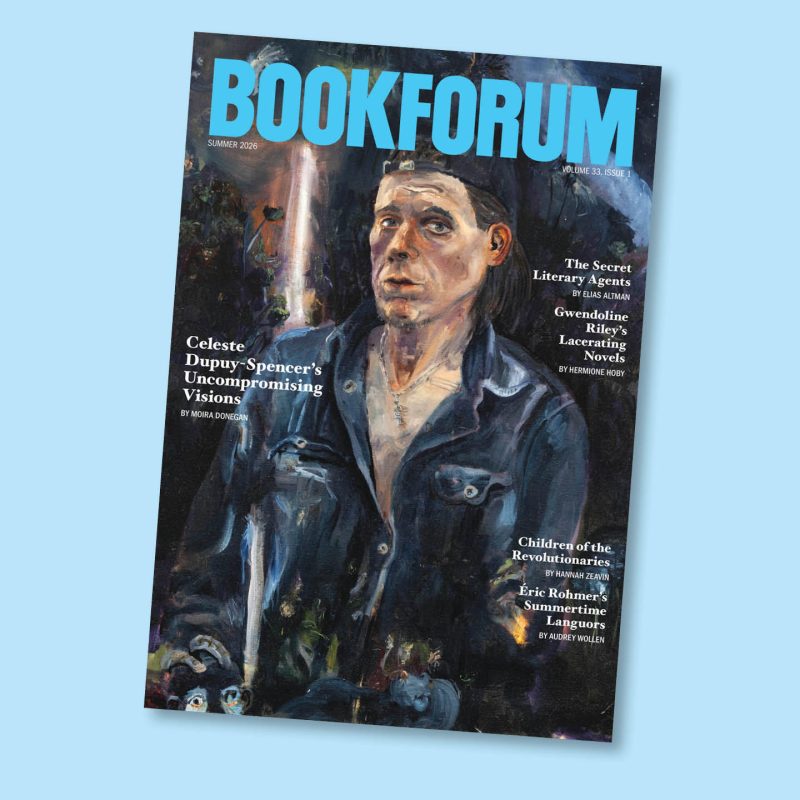
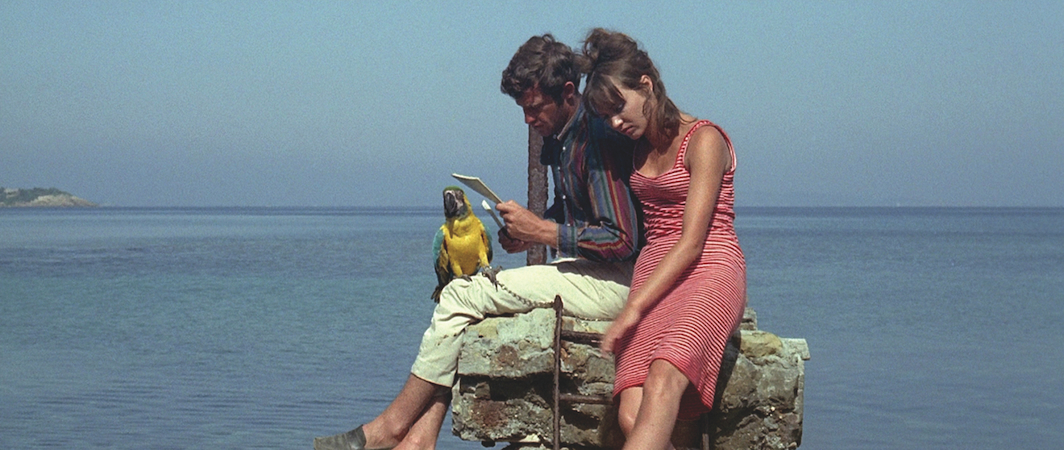
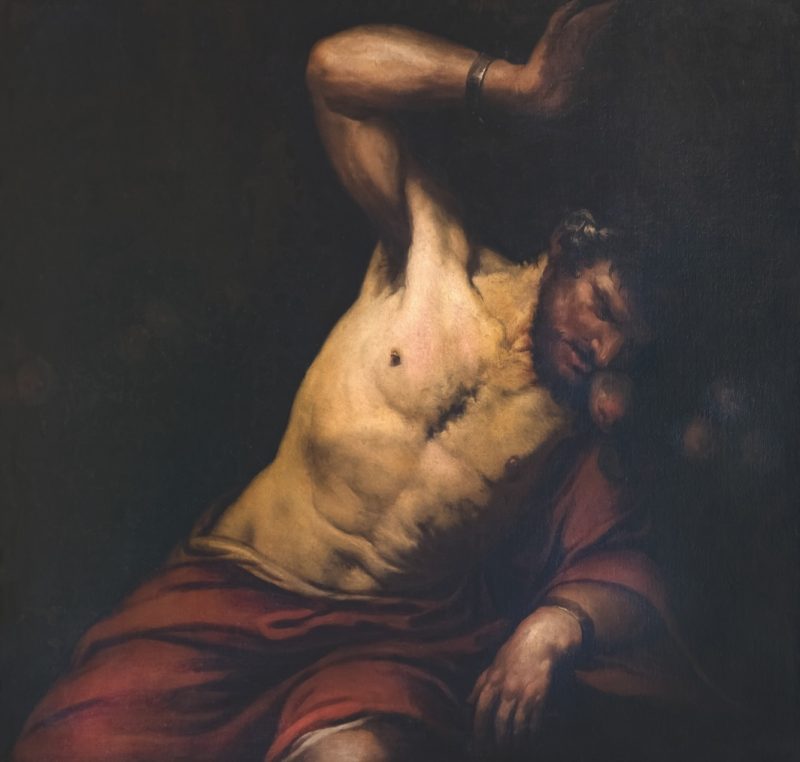
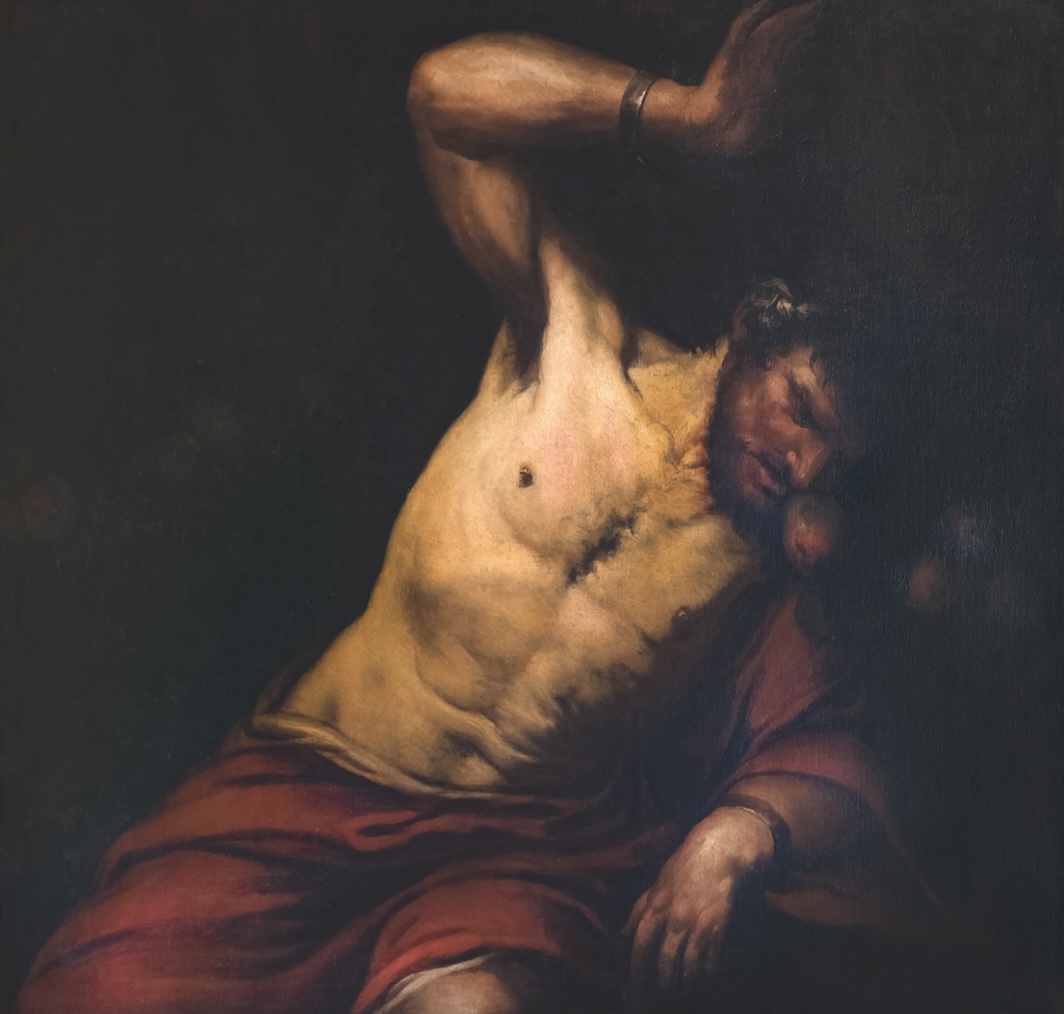
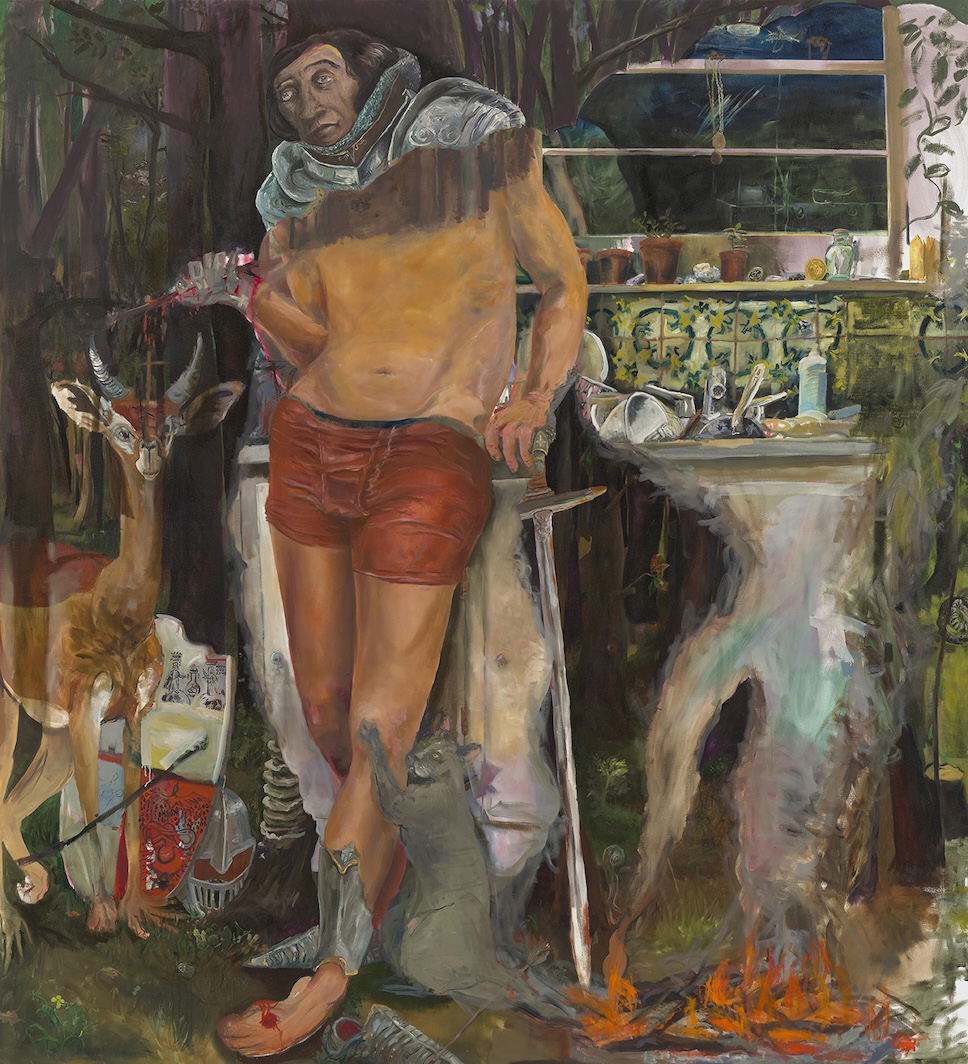
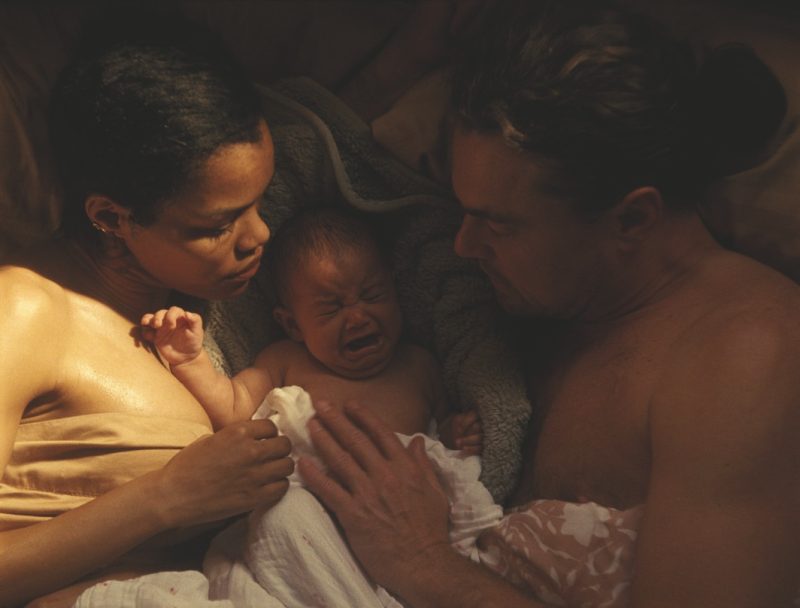
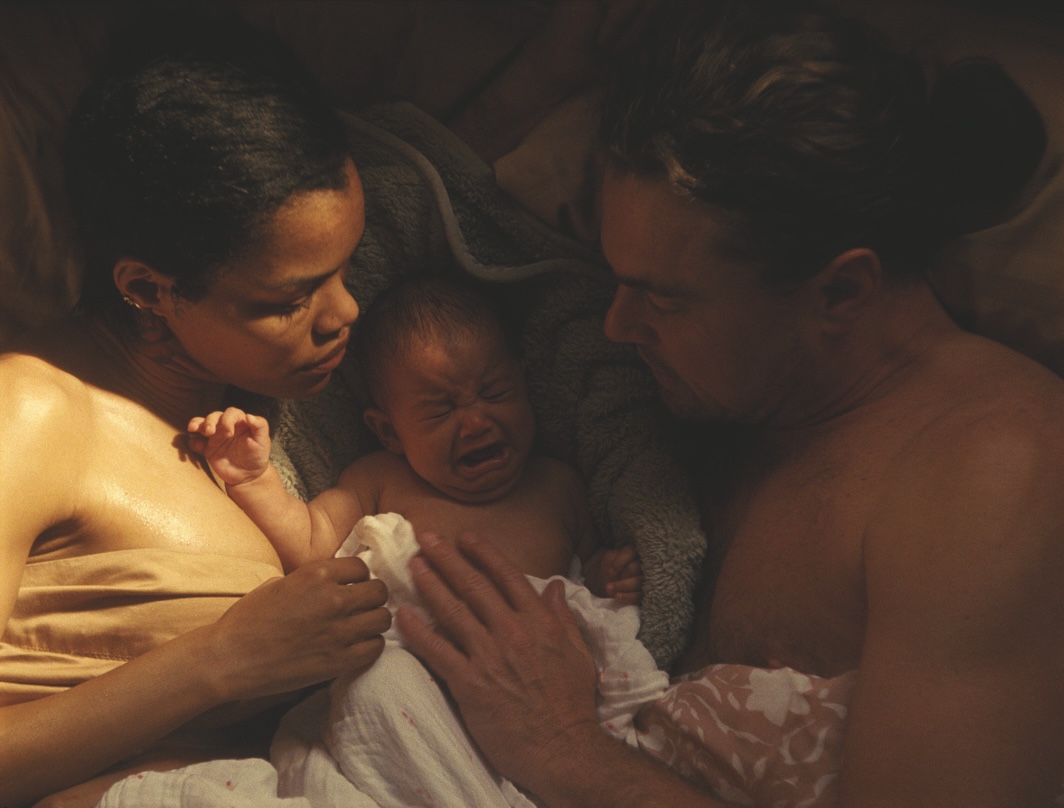
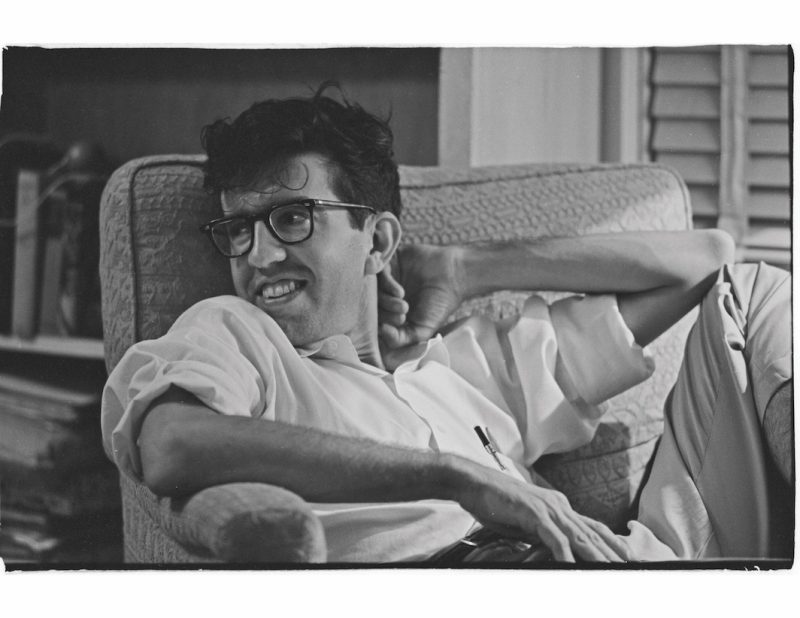
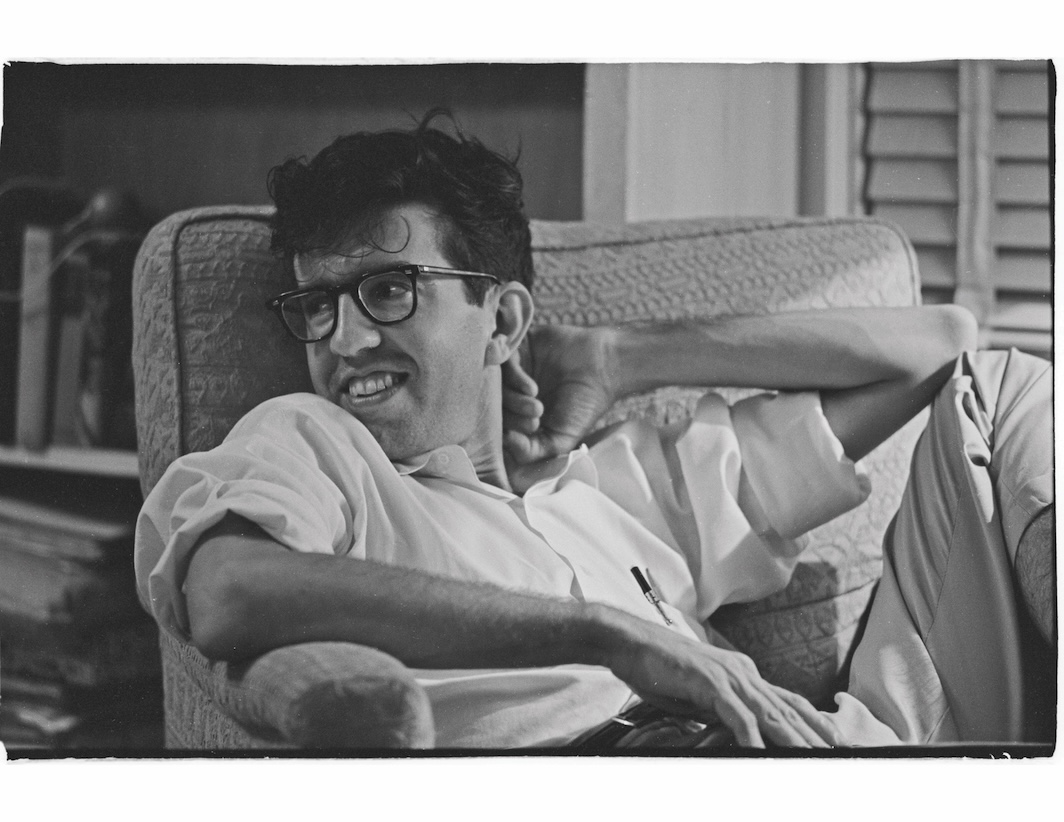
In our cover story, Moira Donegan considers the life and work of the late painter Celeste Dupuy-Spencer. Hermione Hoby looks at the incredible run of lacerating novels produced by Gwendoline Riley. Sarah Nicole Prickett posits what we can learn from William H. Gass’s hatred-ridden anti-novel The Tunnel. Haley Mlotek explores the mother-daughter divide. Audrey Wollen reads Éric Rohmer’s Elisabeth, an early novel that prefigures the director’s films. And much more!
Subscribe or renew your subscription today to receive the print issue and support Bookforum. And consider making a donation or gifting a subscription. Thank you, as ever, for reading!
PEOPLE WHO FOLLOW the teachings of Wittgenstein, whether or not they do so wittingly, find nothing more frightening—or more potentiating—than a state of wordlessness: the end of the world. We can see this clearly in the time of live-streamed genocide, when the avowal that “there are no words” is often what passes for attunement to the state of emergency. There are people for whom the breached limit or the threatened loss of language means the necessity of making a new world. For some, it is time to propagandize for the new world by deeds. These people are often called activists sometimes actionists. Others take wordlessness as a personal challenge, a demand to pry, grind, or hammer out more words. These people are usually writers. (To write and act simultaneously is classically difficult.) Among the latter group it is William H. Gass, the novelist, essayist, and sometime professor of philosophy who as a graduate student saw Wittgenstein speak at Cornell, a fact that slightly bends time for me, since Wittgenstein seems very old and Gass, though he is dead, so new. His prose is voracious, voluptuous. He refuses to find anything unsayable. This beautiful if dubious ambition reached its expressive apotheosis in his great big book The Tunnel, first published in 1995 and newly reissued by Dalkey Archive Press, which claims it will sell more copies this year than in the three decades prior.
The Tunnel is a tale by a maddening man and historian named William F. Kohler. The plot, such as it is, is very simple. Kohler sits down to write the requisite introduction for his life’s work, a Nazi history called Guilt and Innocence in Hitler’s Germany, and, blocked, instead writes what’s in his mind; he interleaves this memoir with the manuscript, hiding his story inside history. The problem is solipsism: he’s going to run out of the latter before he stops recounting the former. The Tunnel is very long for a memoir, but not very long for a book about the Holocaust, probably the most described event of all time. Gass however called The Tunnel “the ultimate anti-novel” and “the opposite of history.” He denied that the Holocaust was its subject, saying instead that the whole “Nazi period” was “the background.” (The real subject, he asseverated, was the American “fascism of the heart.”)
The most interesting reason to enter a world where mass murder is the wallpaper comes from a different philosopher, Gillian Rose. In her 1996 book Mourning Becomes the Law she wrote about the Holocaust as a “civil religion” in an America that (she didn’t say this part) had done more than any other world power to normalize Zionism. This normalization was achieved in part through the exceptionalization of the Holocaust—by making it unrelatable, sui generis, refusing to let it be historicized. Rose balked at what she called “Holocaust piety.” She said, somewhat following Nietzsche, that the purpose of the prohibition was to mystify “something we dare not understand, because we fear that it may be all too understandable, all too continuous with what we are—human, all too human.” What she wanted instead of, say, Schindler’s List was “a film in which the representation of Fascism would engage with the fascism of representation. A film, shall we say, that follows the life story of a member of the SS in all its pathos, so that we empathize with him, identify with his hopes and fears, disappointments and rage, so that when it comes to killing, we put our hands on the trigger with him, wanting him to get what he wants.”
Kohler’s first-person gamification of language allows for the Holocaust to be startlingly, sickeningly revivified. There are Germans made to sweep up bodies “like a cup of spilled rice.” There are mass graves “as large as lakes, as long as rivers.” There are mounds made of “muscle, callused skin, and organ flesh—boneless as some hams.” Gass told Arthur Saltzman, his most attentive critic, in 1991 that all great writing is “a celebration of its subject regardless”—he meant regardless of the subject, or the subjectivity, at work. In 2009, Gass reviewed a book about the Reich for Harper’s, using even wilder language to describe the most specific and brutal crimes of the Nazis, so brutal that I found myself stupefied into remembering, as if it could ever be forgotten, how bad the Holocaust was.
The near-total supersession of individual acts of remembering with the institutional memory of the Holocaust is perhaps why Kohler struggles to introduce his subject and turns the subject to himself. He has one big idea—whether the man who dictates a thing should have to answer for the one who finally puts word into flesh. This is the oldest alibi in the book, every writer’s. It is also a reactionary capitulation to exactly what Hitler et al. needed to believe, that they were enacting the will of the people. Which is to say: Who threw the first stone at Kristallnacht?
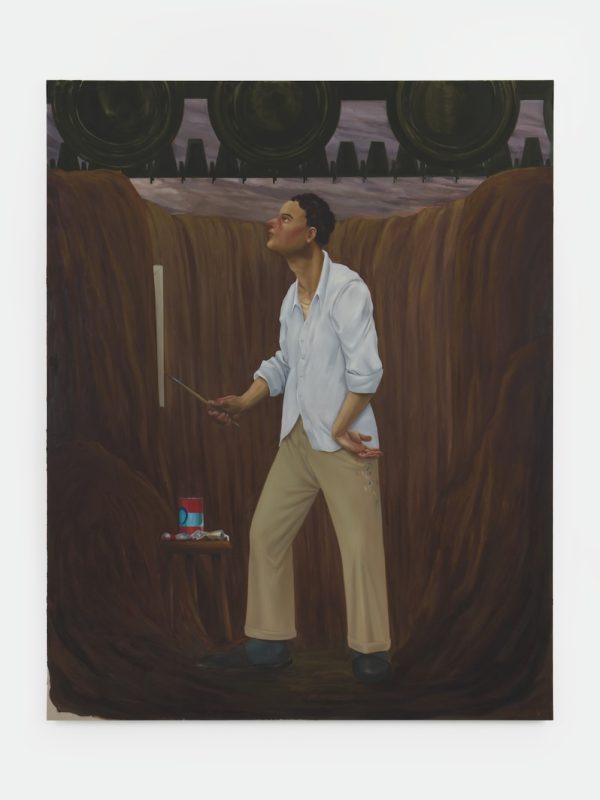
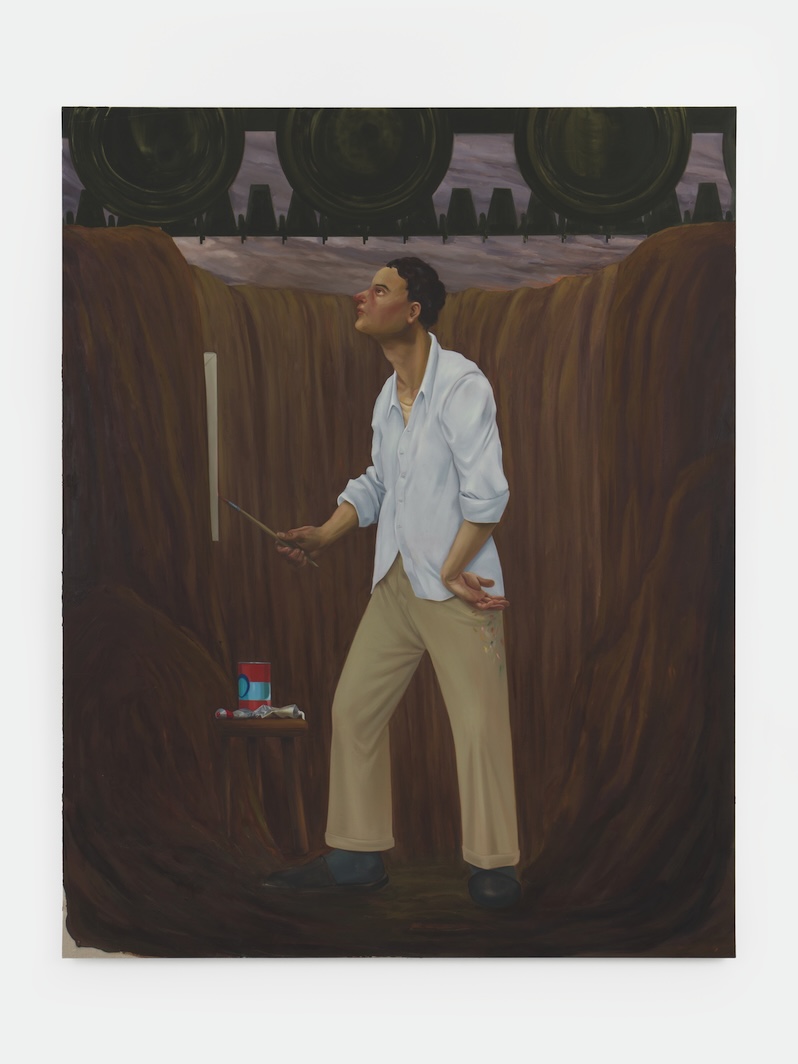
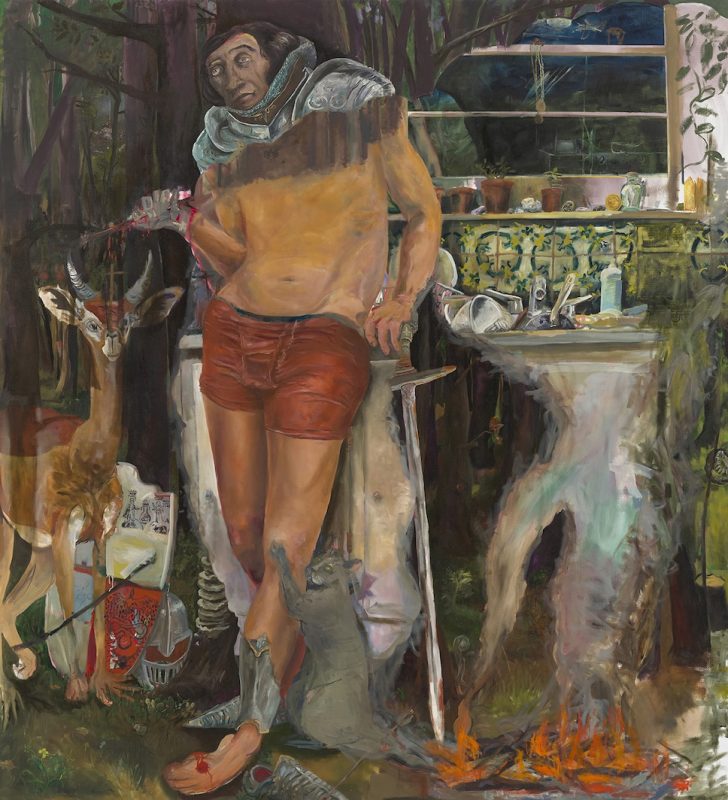
Nicole Eisenman, Fiddle V. Burns, 2024, oil on linen, 82 × 65″. Image: Courtesy of the artist.
IT GETS WORSE. Kristallnacht appears in Kohler’s story not only as a fantasy but more importantly as a figure for what Henry James, in the preface to The Portrait of a Lady, called the house of fiction. The house he says has “not one window, but a million,” and a figure stationed at every one; the apertures show nothing without “the posted presence of the watcher,” that is to say the artist’s, the author’s consciousness. Gass titled one section of The Tunnel “Why Windows Are Important to Me,” explaining that his windows “provide the frame, proscenium to stage, and everything is altered in them into art . . . or into history . . . which seems, in circumstances of my kind, the same.” Mordantly, he sets the Kristallnacht section inside this disquisition.
Several of the longest sentences in The Tunnel, like the longest sentence in all of James, which is found in The Portrait of a Lady, are about history as/in a house. James opens his on the subject:
The house had a name and a history; the old gentleman taking his tea would have been delighted to tell you these things: how it had been built under Edward the Sixth, had offered a night’s hospitality to the great Elizabeth (whose august person had extended itself upon a huge, magnificent and terribly angular bed which still formed the principal honour of the sleeping apartments), had been a good deal bruised and defaced in Cromwell’s wars, and then, under the Restoration, repaired and much enlarged; and how, finally, after having been remodelled and disfigured in the eighteenth century, it had passed into the careful keeping of a shrewd American banker, who had bought it originally because (owing to circumstances too complicated to set forth) it was offered at a great bargain: bought it with much grumbling at its ugliness, its antiquity, its incommodity, and who now, at the end of twenty years, had become conscious of a real aesthetic passion for it, so that he knew all its points and would tell you just where to stand to see them in combination and just the hour when the shadows of its various protuberances—which fell so softly upon the warm, weary brickwork—were of the right measure.
In James’s sentence, according to the computational literary scholar Jonathan Reeve, the fulcral verb, right at the center, is “passed.” The house’s history unfolds toward and through it, passing from time to time into its new custodian’s consciousness, a telescoping effect. Gass, by contrast, writes sentences in The Tunnel whose lengths spiral out as if infinitely, then stop as if randomly. Take this one, which begins as follows…
I assume we all associate, if none of us do it as well, moving along old tracks from place to place in our past like a memory-driven train; but history, as I especially feel it, deposits itself inside its surroundings . . .
…and runs to nearly 800 words. We have the “I” standing at the entrance, before the digging starts. For Kohler the house is what he is trying to escape like it were prison, by tunneling out. This private and pointless dig gives the novel its name and, often, its sentences their shape. Here the fulcral verb is the first in the sentence: “assume.” Let’s not make an ass of the reader. It’s easy to feel like one, misled as the sentence slinks down the stairs away from its impetus, going on for the sake of goings-on, through freely associated objects, things, dregs, ending on the memory of a geometry teacher who opened doors with a hankie to protect herself from her pupils’ germs, much as Gass approaches cause and effect, trying to avoid being contaminated with that dirty word, “plot,” or with the sorts of personal history to which he was no more inclined than any other kind.
He had first set down his complaint about autobiography in Finding a Form:
I do not think it should be assumed that history, which had always focused its attention upon wars and revolution, politics and money, strife of every sort (while neglecting most everything that mattered in the evolution of human consciousness, such as the discovery of the syllogism, the creation of the diatonic scale with its inventive notation, or three-legged perspective, to be for centuries the painter’s stool), had found its final relevance with the inward turn of its narrative, for it now celebrated the most commonplace and cliché-ridden awareness and handled the irrelevant with commercial hands and a pious tongue, as if it were selling silk.
His own examples, it must be noted, side with history over consciousness as a motive force. Consider the first: Aristotle’s discovery of the syllogism, the form by which a conclusion follows necessarily from a major and a minor premise, like a perfect cadence on piano. Consciousness grows in leisure time: Aristotle himself wrote that in ancient Egypt it was when the priestly caste got free time that they discovered or invented mathematics. Aristotle, of course, was arguably the most free-thinking student at Plato’s academy. Would the syllogism have taken its shape had Plato not abandoned politics in the reactionary aftermath of the Peloponnesian War? Would The Tunnel have acquired its same shape and weight without technological and ideological state apparatuses, without the fellowship year at the Getty Center and the secretaries there who, said Gass, “put the first 500 pages of the text on the computer,” or for that matter without the computer?
America after the Second World War had its own academies of enculturation, many of which were funded, if not altogether directed, by state and non-state actors working to boost Cold War liberalism. Some of these artistic and literary institutions are listed in Gass’s acknowledgments: the Guggenheim Foundation, the Rockefeller Foundation—a locus of collaboration with the State Department—and the Getty Center. Gass’s design notes propose a more radical experiment in dissociation than proved possible with Knopf, his original publisher, or now with Dalkey: he instructed that these acknowledgments be set in a different typeface from the novel’s text, since, he wrote, “they do not belong to the novel.” In both editions, however, they appear in the novel’s own type, albeit half a point smaller; placed after the opening diagram, which scans as part of Kohler’s book, Gass’s thanks read as continuous with Kohler’s rants. The acknowledgments page becomes an accidental or symptomatic comment on institutional complicity.
A writer’s relation to plot may tell you his politics. Gass hated the word: “a terrible word in English,” he wrote, “unless one is thinking of some second-rate conspiracy.” A few hundred pages into The Tunnel, Kohler takes up the tale of Herschel Grynszpan, the Polish-Jewish teenager whose 1938 shooting of Ernst vom Rath gave Goebbels his pretext for Kristallnacht. Kohler, not alone among historians, reads Grynszpan’s farewell note—“my heart bleeds at the news of 12,000 Jews’ suffering”—as a forgery. He won’t allow the assassination as an act of resistance. Even first-rate conspiracies are theoretically counterrevolutionary, since to ascribe all romantic violence perforce to state actors (the CIA, the FBI, the Mossad) is to foreclose the possibility of “autonomous action,” or action taken individually in collective defense. This is not a strictly fascist position; it is also liberal, or anti-anti-fascist.
Nineteen years after Gass started writing The Tunnel and ten years before he finished, Don DeLillo’s White Noise introduced to the intelligentsia a different professor of Hitler studies. Jack Gladney has the chairmanship of a department he, quite Americanly, invented and named Hitler studies, but speaks no German. William F. Kohler, by contrast, has the background but was denied the Commager Chair in his history department, reserved for an Americanist. (Both Kohler and Gladney are remarkably uncontradictory in their positions, as compared with the star anti-colonial or anti-fascist academics in my personal firmament who, I have to admit, are sometimes suspiciously invested in what they critique. Many enlightened historians would be content to see Gaza turned into the world’s first open-air holocaust museum. What Gass called the “fascism of the heart” thrives in a liberal body politic.) Gladney, who thinks all plots tend deathward, wants to kill his fear of the end by becoming a murderer. Kohler wants to kill his father—whom he phallically calls “a little Führer”—by, more or less tragically, becoming him.
Gass I think was a kind of Method writer. He wanted to play a villain for probably the same reasons actors do: the challenge of overcoming a complicity between audience and actor—narcissistic, perhaps, or simply self-preserving disidentification with anything (back to Rose) that we claim is unrelatable when it’s “all too continuous” with us. And, like actors, he begs a question: whether performing a thing and being one are really two different activities. Is it possible for a novel’s protagonist to think something without the author thinking it first? When Kohler contemplates jam jars and prepares his toast, savors the expression “Product of France,” observes the haze on a knife after spreading butter and thinks, after all, it’s good to be alive—is that not Gass?
Gass spent decades protesting the question I said was begged. He once boasted to an interviewer that a fact-checker from The New York Review of Books had called to ask whether Gass was actually fat. “Not when I started the book,” Gass replied—ha ha. The fact-checker must have been calling about Louis Menand’s long review, “Journey into the Dark,” in which the word “fat” appears once, in a quotation. Gass’s telling lets his interviewer, the writer John Madera, believe that Menand had argued he was Kohler in body, ipso facto that the critic was a sucker for his sovereign conceit. But Menand said otherwise: “Writers double themselves all the time in their fictions.” Readers, he added, “have . . . little trouble dissociating the author from the double. Even three-year-olds know that Dr. Seuss is not the Cat in the Hat.” He also refers to “splitting” in the psychoanalytic sense, which seems more accurate: Gass takes scenes from his own childhood and gives them to Kohler in order to make them fictions, placing across the divide what he wants to disremember or wishes never happened in life. (I love when Gass tells Madera: “I used things from my childhood, but that was it.” Oh, is that all—only the reason you write.)
What divided my reactions as I read and re-read was not the possibility that Gass wrote Kohler because he, too, secretly adores a fascist, but the problem of consciousness not being where fascism forms. If you listen to the speeches of Mussolini, you notice he calls fascism “the unity of action and thought,” whereas Bordiga, or any Leninist, speaks of unifying thought and action, or theory and action, thinking first. Word order sometimes does make all the difference in the world. Kohler admits that the tunnel is “the ultimate inactive act,” then almost brags: “I can honestly say I have accomplished Nothing.” A poet—! And not a party man. On the other hand, when Gass insists his scene is America and not Germany, he implies more of a difference than there really is, since, historically speaking, it is hard to dig under the house of American fiction without slicing through the roots of German Nazism.
Why is it always separate the art from the artist? In this case, better said the other way: separate the artist from the art. Impossible. Like the profiteer warned by the Bible, the writer who ventures to restore the whole world in prose can lose, in the bargain, his psyche (what was the Greek word for soul now means mind). “You may deliberately wish to rescue the world by putting it in language,” Gass told the scholar Ildikó Kaposi in 1995, “but you’re certainly burying yourself in it. The book’s become your tomb, you know. . . . It’s all you are, and all you will be eventually.”
IF THE NOVEL OF CONSCIOUSNESS has a prehistory, it begins on an island. Around the time of the Crusades, the Andalusian philosopher Ibn Tufayl wrote the story of Hayy ibn Yaqzan, a feral child raised not by wolves but by deer, who reasons his way out of nature: “He reached the limits of the rational world and grew lonely, yearning for the familiar world of the senses, so he took a step back and completely abandoned his body” (trans. my friend Maya Shoukri’s dad). Centuries later, the story gave Defoe his Crusoe and Spinoza a model for the soul. Marx called them the Robinsonades, and mocked them as, essentially, immaterial fantasies of self-manufacture. Consciousness, Marx and Engels wrote in The German Ideology, is only conscious existence: “Life is not determined by consciousness, but consciousness by life.” Fourteen years later, in the 1859 Preface to A Contribution to the Critique of Political Economy, Marx revised this, changing “life” to “social being.” His reading tends to prevail, acknowledged or not. Most canonical “novels of consciousness,” from Goethe to Dostoyevsky to Woolf to Ellison, are novels of social being first and foremost. But Kohler’s is a kind of inside-out Robinsonade: monad, not nomad.
The most complete definition of human consciousness comes from the novelist and philosopher Sylvia Wynter, who sees the psyche as being continually produced and reproduced through the dynamic interactions between bios and logos, or bios and mythoi. In this she could be said to be resolving a long-standing conflict between the James brothers. Henry James tried to echolocate consciousness in the heartbeat, always feeling for words like “pulse” and “throb.” William James saw it in breath. In “Does ‘Consciousness’ Exist?” the elder James let the word evaporate: consciousness was a residue of the old idea that thinking was a kind of breathing, and once it had thinned to that “estate of pure diaphaneity,” it was ready to disappear altogether. Henry kept it and all but gave it a body. In a late essay on the question of life after death, he professed disbelief that the universe meant to pluck and discard the fruit of the artist’s consciousness at its ripest, and wondered whether the mind might not survive in, essentially, a body of work.
Gass, through Kohler, says in a line of dialogue that “consciousness is what counts.” (I say it is Gass speaking because, in a radio interview at the time of The Tunnel’s publication, he told the critic Michael Silverblatt that “really what counts in history . . . is what happens to human consciousness; not just what happens—the piles of bodies—but what was lost when you piled up bodies; what was gained when you decided not to.”) Fredric Jameson, in The Political Unconscious, says “history is what hurts.” Four words each, enthymematic: each a syllogism with its premises suppressed.
Placed together on a sheet of graph paper, the two axioms supply two axes: Gass’s, through signifying; Jameson’s, through suffering. Common sense puts the idealist with the heart and the materialist with the head—but the Marxist turns out to speak for the heart and the idealist for the head, the wrong way around. (Though it makes sense in America, where nothing, not even novel-writing, is more romantic than being a communist. I mean this in every valence of the romantic.) This schema places pain orthogonal to significance, which makes it hard to plot . . . trauma.
TIME, THE SUBSTRATE of both history and consciousness, is what traumatizes. There is nothing more injurious than experiencing time all at once: time stopping is time accelerating into a crash; time slowing is time dilating unbearably. Life’s central contradiction is that you always want more time, but an excess of simultaneity usually means death—someone else’s or yours—or worse.
If the Holocaust is read as an explosion of time, it becomes more understandable why it was said to set in motion history’s end, making more poetry possible (Adorno said the opposite, but he didn’t mean it — or he meant it dialectically). Auschwitz established a piety equal to the poetry that placed the event outside history, outside humanity. Nancy Fraser, one of the more conscientious academics in the West, has written that “‘Gaza’ bids to replace ‘Auschwitz’” as our symbol for the evils that humans do. But Gaza is not homologous with Auschwitz: not architecturally, not temporally, not ethically. Gaza is not Auschwitz because unlike Auschwitz it refuses a total unlikeness. Gaza is also a symbol of ordinary life and cannot be set outside time, no matter how many charlatans write books with “after Gaza” in the title; and, from outside Gaza, one task of literature might be to never again let institutional memory supersede individual remembering.
As a professor, Gass once assigned to a group of students the task of (re)designing a public place: a “tomb for the absolute,” the “national headquarters of gay rights,” or—he was not kidding—the camps at Auschwitz. No one, he told an interviewer in 2009, chose the latter. No one wanted to try replacing their consciousness with the one they might have if they were born into the same class of people, but in a different time, different place, different set of conditions. As Kohler, he took to the limit his notion of art as a means of (temporary, but entire) consciousness replacement. There were moments when miraculously it seemed to work. I would forget why Rome fell, wonder what “chair” meant in French, or try to guess who was Hitler’s favorite novelist, and Kohler would tell me pages later: “Prohibition,” “flesh,” “Karl May” (a lie and two truths). Mostly though, it was my own thoughts I thought more than usual. I thought about consciousness and how it counts—matters? tallies?—and whether the mark of non-consciousness in LLMs is that they can’t, as far as I can tell, tell time. I thought about machines and how the new ones are training us to live in a future world with far fewer people. I thought about death machines, the same wager doubled: that human life can be replaced by human consciousness, the piles of bodies by what their loss was said to gain.
Kohler is a man whose death stops no clocks. But his mind does tick. I felt a sense of loss as regards authorial death for the first time after turning the last page and reading the short biography of Gass, written, as it wasn’t before, in the past tense. Until then, possibly because no edition of the novel I have ever read or tried to read has ever been perfect, that is to say without typographical error, there was always the feeling that while you were reading, he was still writing the book. I loved that. I hate how “finished”—dead—synthetic prose gets.
Gass modeled an enlarged language, big enough to house or bury everyone. There is between writers and readers a special complicity, enabled and necessitated by the activity of reading, in contrast to the passivity of watching. This makes the novel formally well-suited to the rehearsal of social and political complicities with various relational forces, for better and worse. The Tunnel is a masterpiece of implication. It is also a nightmare of failed escape. I say this to settle one last score: the miscarriage of this experiment can only now, against the author’s will, be historicized. When the machine was invented that allowed him to complete his work of consciousness, it became inevitable that there would be too much information, too little innocence, too much guilt. Complicity would become the general condition, and dissociation the attendant pathology, of American life. Did he know this? It doesn’t matter. The time was not yet.
Sarah Nicole Prickett is a writer living in Montreal.
EVERY WOMAN is a daughter. We begin our lives in lineage, understanding that our lives are possible only because of our mothers’ life, and that our first attachment will eventually be our first act of separation. There are many ways to understand being a woman—even more ways to misunderstand her—and then here with the label of daughter is one truth so basic, so ordinary. Some of us will also be mothers, yes, to children we give birth to or to ones we choose to love and care for, and daughters will know many mothers in many forms as long as we live, but to be a daughter is a kind of lock around our lives that has no key.
I was once a daughter. I still am, but I also was one before I was this daughter: the kind of daughter that can occasionally—usually—forget to think of myself under that term, which can become obscured by a longer list of roles and states and concepts, like sister or citizen or job. Once upon a time a daughter was born and she grew up to be me.
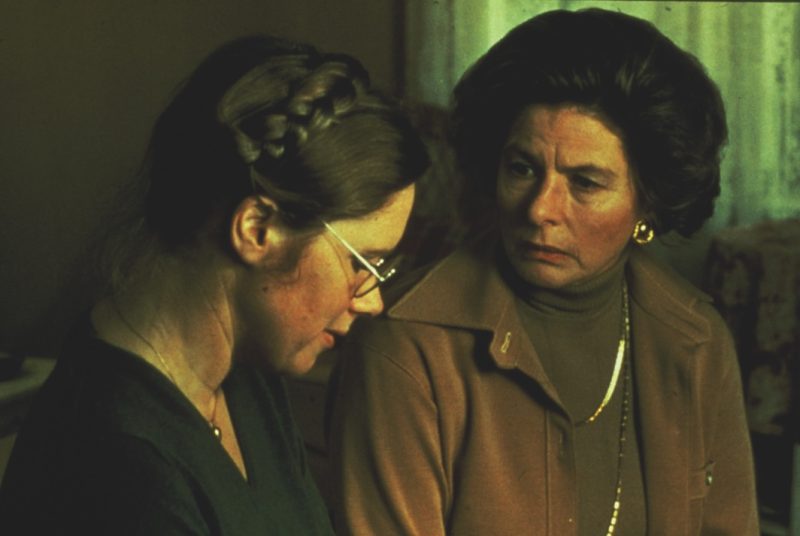
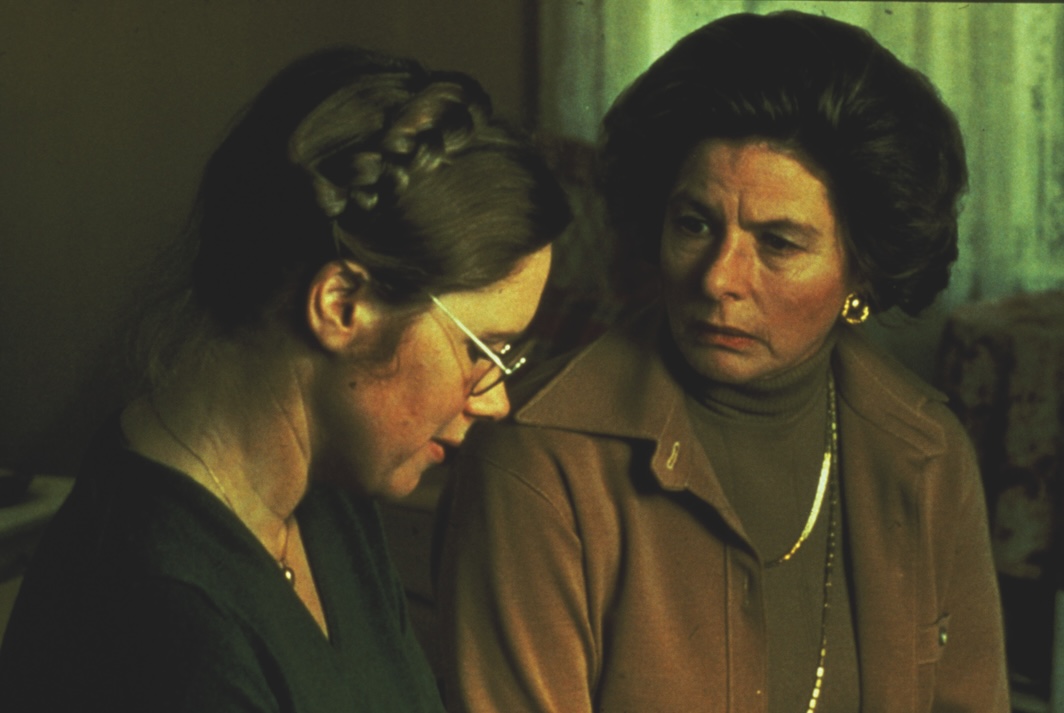
In Ingmar Bergman’s Autumn Sonata (1978),Liv Ullmann and Ingrid Bergman play a daughter and mother spending one very long night together in the daughter’s home. Ullmann’s husband and sister are also there, and they come in and out of the drama occasionally, but this is a film about the often-futile attempts of two women who made each other who they are to understand each other. “Don’t we ever stop being mother and daughter?” Ullmann asks, not rhetorically. “You had taken charge of all the words in our home,” she says to Bergman later, demanding that for once her memories be heard as she remembers, unedited and untouched by her mother’s overpowering presence in their family life. Bergman, as the charismatic and self-absorbed mother, listens all night. She explains herself with excuses, sometimes, but not all of them are attempts to deflect blame; they are also the reasons and rights she has as an imperfect person. It is unclear what, if anything, will change between them after the night ends. The question is not whether they are capable of change in themselves, but whether either of them might accept that the other can change who she is at all.
This is where we find the journalist Rachel Aviv in her new book, You Won’t Get Free of It, a collection of six essays originally published in The New Yorker, where Aviv has been a contributing writer since 2013, along with an introduction original to the book. These selections are a gathering of her reporting on stories of mothers and daughters and the ways they try to know or find each other.
All of Aviv’s writing begins with the desire to know a stranger. Her essays always come back to the possibility of learning familiarity toward people who seem too far away, either physically or psychically, to locate. Aviv’s first essay collection, Strangers to Ourselves (2022), is separated into chapters featuring a person caught between definition and diagnosis, the context of their culture and status in their community as essential to understanding them as their individual character and personal history. These are accounts of people experiencing the unbearable tension between porousness and proximity, a need for care at odds with the limits of accepting or receiving it. In that book, we meet Naomi, the young mother who, in a profound psychosis, drops her two children and herself off a bridge, believing she was offering them “a merciful death” rather than a “torturous one”; Laura, an affluent young woman who feels relieved to learn that her hopelessness and suicidal ideation could be considered bipolar II, until years on various medications left her feeling completely alienated from her own mind; and Ray, a doctor who began his treatment for depression at an institution that discouraged antidepressants and lives the rest of his life fixated on the ways it might have failed him.
Aviv’s essays in Strangers are about people close enough to see each other yet still not sure if they really know each other. None of her subjects can be considered sick or healthy in isolation. Naomi is a Black woman whose psychosis largely revolved around the hostility she experiences living in a largely white cultural environment, one that denies her humanity and punishes her vulnerability; Laura’s class and wealth give her access to treatment but not nearly enough insight into her own experiences; and Ray’s life intersects with a history of psychiatry and psychology that has been, and continues to be, constrained under the limits of what we know about the effects and possibilities of pharmaceutical treatments.
Free explores a similar idea about connection and closeness. The bond between mother and child is a physical one first, the umbilical cord easily lent to an overused but apt metaphor. Less known or used as a metaphor is the concept of the “fourth trimester,” the name given to the three months after birth when a mother and child must learn how to be alone in their bodies. The medical definition of this time is twelve weeks; probably many of us can think of mothers and children who spend their whole lives trying to understand how to live fully apart from each other, to create or maintain reciprocity without sacrificing liberty. In her introduction, Aviv states that the stories she chose originally seemed to her like they were written from a perspective that was “existentially, like a daughter,” but that she later returned to them, after having children, “with a different identification. It was as if I had failed to see the drama on mother’s side, too—her particular longings and humiliations and needs.”
Aviv’s mother wanted to be a writer, we learn in Free’s introduction. Once, as a child, Aviv called her mother from summer camp desperately unhappy, and her mother immediately went to pick her up. Aviv’s mother had planned a self-imposed writer’s retreat at a cottage, and so Aviv joined her. They spent that time, according to her mother’s journals, writing their respective works. The younger Aviv wrote about a daughter who sounds somewhat obsessed with her mother. In her short story, she wrote: “I ran up and gave my mother the biggest hug I could to get all the love for my mom into her.” In another scene, the mother and daughter characters hug so hard that she felt she needed to clarify that they did so “without turning faint from not enough oxygen.” There is so much love it feels fatal. The mother character dies that night. “It’s not hard to see my first foray into writing, which made my mother immensely proud,” Aviv reflects, “as an exercise in acting out the event that I most feared and perhaps on some level secretly wished for—an end to this overwhelming and exhausting fusion.”
Ingmar Bergman, Autumn Sonata, 1978, 35 mm, 94 minutes. Liv Ullmann and Ingrid Bergman as Eva and Charlotte Andergast. Streaming now on the Criterion Channel. Image: Courtesy of the Criterion Channel.
Aviv’s writing has a quality that makes everything she describes feel like both a mystery and an inevitability. Her stories develop in ways that her subjects (and her readers) could not have predicted; at the same time, what unfolds is revealed to be the only way things could have happened. I will begin reading an essay by her and often am at least halfway through before realizing that I am reading about a person who is dead. Her descriptions are so vivid and her details so exacting that I take for granted she must be writing about a person she met herself. The events of that person’s stories give the sense of being eternal and immovable, as though they are parables designed to impart a truth rather than just an accounting of fact, so apparently easeful in their skill and precise in their perceptions. But nothing in life, let alone in journalism, exists in stone. Here in Free, Aviv brings in her skill and precision to open up the original New Yorker essays with revisions to include more from the mother’s perspective, after Aviv realized that she had, unconsciously or otherwise, omitted something that had seemed too obvious to be considered relevant, or too concealed within what appeared to be an emotional logic to be considered worthy of attention. One such example occurs when Aviv reexamines her own life: “That my life today is the one my mom tried to have for herself is a fact so unambiguous that I have generally preferred not to allow it into awareness.”
As Aviv revisits the essays in their original form, other mothers and daughters, too, are perceived in a new light, with different aspects of their lives coming into focus. There is Linda Bishop, a woman and mother who refuses to be categorized as mentally ill and so is eventually lost inside a health care system that refuses to treat those who don’t acquiesce to their supremacy. There is Hannah Upp, a woman and daughter who periodically entered fugue states with seemingly no reason or diagnosis and would disappear from her daily life, prompting panic and searches from her friends, father, and mother. There is Elizabeth Loftus, a woman and daughter and preeminent psychologist who has frequently appeared as a paid expert witness on behalf of defendants such as Bill Cosby, Jerry Sandusky, and Harvey Weinstein, undermining testimonies of alleged victims by arguing that memory is malleable. The only defendant she ever refused was, Aviv notes, a man tried for operating a gas chamber in a concentration camp.
As Aviv reflects in her introduction, in the time between publishing these essays in The New Yorker and now in Free,she reassessed ideas she developed about her subjects, incorporating details that she either didn’t know or didn’t understand the first time around. Aviv reported on Bishop under the assumption that her psychotic break “appeared out of nowhere, after a harmonious childhood and early adulthood.” In Free, Aviv recalls an interview that complicates this analysis, noting that one of Bishop’s closest friends had candidly told her that Bishop got pregnant soon after graduating from high school and was sent away to an institution for young pregnant women, where she gave the baby up for adoption. “Apparently, at the time, I did not think losing a child was a biographical fact relevant enough to mention,” Aviv reports on herself. “I had not even asked a follow-up question.” After the story was published, Bishop’s sister told Aviv that she had only recently learned the two of them had been adopted by the people they grew up knowing as their biological parents, possibly born in the same kind of home where Linda had given birth to her own child. Linda did not live to learn this for herself, but how can we avoid wondering about the way people have forms of knowing so deep they are more cellular than subconscious? “The neglected detail seemed to open up another layer of experience,” Aviv says, “running underneath the one I’d thought I was writing about.”
In the book’s version of her essay about Upp, Aviv interviews Upp’s mother again with the intent to “redress what I saw as a kind of imbalance, a deficit of curiosity about the mother half of the couple.” Before Hannah was born, Hannah’s mother, Barbara, had a premature baby who died within a day of birth. “Hannah’s fugues had always occurred around the day that the baby was born,” Aviv says. She knew this the first time she reported the story, but “at the time I resisted a detail that seemed too symbolic, even if it was true.”
Even as Aviv admits that she feels she sometimes missed or avoided hearing what was being said in full, the painstaking quality of her attention is a potent one. Four out of the six essays chosen for this collection draw their titles from quotes given by Aviv’s subjects; sometimes it is a sentence spoken during an interview, or a snippet of an exchange between a subject and her doctor, or a sentence from a short story about a mother. The words are delicate with pain, a sliver under the skin so small in comparison to the care it demands. Even before knowing the context, one realizes that all the titles and statements express suffering and loss. The throat stitches closed at the thought of repeating them: I wish I was her for you,a woman mistaken for a missing daughter tells a mother. As if they were my daughters,a domestic worker thousands of miles away from her own children says of the ones she is paid to care for. You won’t get free of it, Alice Munro writes, describing in fiction the feeling that one could decide to choose between the love of a man over the care of a daughter.
THE BOOK TAKES ITS TITLE from Aviv’s 2025 essay about Alice Munro, a stunning examination of what happened in the life of one of the most acclaimed fiction writers of our time. Soon after Munro’s death, which was mourned deeply by her many readers and the literary institutions that venerated her, her daughter Andrea published an essay in The Toronto Star stating that Munro’s husband, who was Andrea’s stepfather, had sexually abused her in childhood, beginning when she was only nine years old. Munro had learned of this abuse during Andrea’s childhood, as had Andrea’s father, and neither parent made the decision to separate and protect their daughter from her stepfather or to report him as a predator.
We cannot know what Andrea’s parents were thinking or feeling about this violence toward their young daughter, only the accounts that remain, and the truth that Munro never left this man, remaining married to him until his death and estranged from Andrea and her other children to varying degrees for the rest of her life.
Aviv captures shocking facts about Munro, and also the shock readers felt in learning about them. But she also shows that the abuse was never really a secret, and so should not be received as a surprise. Munro did not hide or obscure her complicity, nor the fact of her husband’s violence. She told people she knew. And though her stories clearly contain artistry and skill and invention, many of them are also almost certainly cut with some jagged remnant of her reality. This is not to say that her writing is a simple echo of real life or a transcription of a well-tended memory, but that her gift, and apparently her curse, was to be able to say nothing about what the pain was, while saying a good deal about how pain lived its own life inside the people who could neither speak it nor keep it a secret. As readers and observers, we have the rare public reminder that we know such private despair can exist between daughters and their mothers.
Munro’s stories are not parables or fables, morality tales designed to impart a lesson. But what remains of Munro’s scenes in memory come to feel like they could be, in the sense that fairy tales have always been given to children with the expectation that they will help them parse and perhaps partially crack the codes of their still-new lives on earth. This is in lieu of teaching them an actual language made of words that can explain what it feels like to be both helpless and omnipotent, capable of causing or receiving harm and grace in deeply unequal measures. Like Aviv’s approach to reporting, it is writing that feels both alive and immovable.
You won’t get free of it, but you won’t die of it, is the complete sentence Munro wrote and Aviv quotes. I once heard someone say that mothers know they do not create life, exactly, that as soon as their children are born they understand they have birthed an inevitable death. The responsibility and expectations of motherhood are so extreme that the role of motherhood is, as Jacqueline Rose wrote in Mothers: An Essay on Love and Cruelty, most often the one society easily blames for its own structural failings. If a daughter is lost or sick or hungry or hurt, the mother is there to be the reason; if a mother is suffering or struggling, she is to be blamed all over again.
“Our mothers remain the strangest, craziest people we’ve ever met,” Marguerite Duras once wrote, and she was that eternal daughter who returned to the question of who her mother was, or perhaps why she was the way she was, again and again in her writing. Can a mother be known by her daughter? Can a daughter be known by her mother? I have noticed that the truth about this conundrum has been repeated so often it has become a cliché: I often hear that “no one” is talking or writing or making art about motherhood, that if they are they are not showing the “truth” of the experience, that our oppressively coded ideals of maternity and girlhood replace our ability to see them for what they really are, even sometimes to the woman experiencing it herself.
Certainly these sentiments can be considered reasonably accurate, particularly when it comes to stories about motherhood that aren’t those of white, middle-class, cis, straight women. And yet when I hear people bemoan the absence of women talking, I can’t help but want to reply: Have you asked them? I am at an age where I do know and have known mothers of all kinds, women who have children that they birthed or adopted or spent much painful time and resources using the available medical options to become pregnant. They have railed against the way their bodies betray their intentions. They have conceived painstakingly on purpose and completely accidentally, miscarried and mourned a devastating loss of a pregnancy. They feel different kinds of gratitude and grief toward their pregnancies, their children, their abortions, the general shape of their family. They have children who are infants, teenagers, adults, deceased. And if you ask them about it and listen as completely as you ever have, they’ll tell you as they breastfeed or grocery shop or suntan or watch TVor snake the sink drain. There is also so much art about motherhood that defies this idea that the only acceptable narratives are saintly, beatific: books and movies and paintings and songs that refuse a story written to replace the truth, many of them especially in recent years but also found throughout history, if you know where to look or who to ask.
Perhaps we are not at a loss for true stories about motherhood so much as we are tasked with an endless unlearning of the first stories we’re told about what it means to be a mother or a daughter. Think of the way our daughters hear and see their lessons: heroines are princesses disguised as peasants forgetting who they once were, extraterrestrial or interspecial interlopers who only want to be accepted as ordinary. They are mermaids who want two feet, diligent maidens who fall in love with a beast. A magic potion under the care of a wise woman heals them, a cursed drug from a wicked woman hurts them. They want, above all, to be kissed as proof of something, maybe anything: proof that they are pretty, wanted, safe, human. All the magic they experience is about being made real in a retelling of their life story. Here in Free there is even a Cinderella story, of Emma, a Filipino woman who left her own children at home to make more money for them in New York, and has since spent sixteen years taking care of other people’s children, and one that could be something out of a soap opera, about a woman who seemingly recovers from schizophrenic-like symptoms after being treated for cancer, like a patient in a coma that wakes up with a new personality during sweeps. “But becoming sane can also be a kind of narrative collapse,” Aviv writes.
Above all other common attributes, so many fairy tales and fables share the same plot device: daughters and other children are always there. Mothers are either absent entirely or the enemy. Our fictional characters are without one or both of their “true” parents, which is meant to be taken as genetic, and because of that they are at risk of exploitation and suffering, alienation and loneliness. That these experiences are understood to be temporary sufferings that only prove why they deserve the safety and sensuality of a romantic partnership, to replace an absence of family with the creation of their own, is an open text crafted by our conscious minds so that we can feel our own lives made real. Without narrative, there is no understanding.
Hannah Upp’s dissociative fugues were described as a symptom of trauma, whether external or “by an unbearable internal conflict.” One of her psychiatrists told journalists that he felt the comments surrounding Hannah’s condition, which were often disbelieving and cut with palpable rage, were because “there is an ineffable quality to dissociative cases. They challenge a conventional understanding of reality.” Perhaps, Aviv writes, these cases are too “mystical” for science and medicine; certainly they are fantastical, even in Aviv’s sensitive and empathetic renderings, which is why they warrant such journalistic attention. People don’t just wake up as someone new inside their old body; or, at least, we believe they don’t, and so therefore they shouldn’t.
Hannah and her mother, Barbara, didn’t speak about her fugues directly, but once Hannah sent her mother a book that was a contemporary retelling of Persephone and Demeter, the story of a mother who will search every part of earth looking for her daughter trapped in a kind of hell, condemned to return to that subterranean dimension once a year. When Hannah entered her fugues, “Barbara found more solace in what she described as ‘the archetype of the daughter descending and the mother seeking her, whatever that takes.’”
Most of us are aware that our myths and our fairy tales come from versions that have more in common with horror, as a genre, than children’s literature. There’s an entire economy built around contemporary adaptations that attempt to revert fantasy back into primal, elaborate terrors, the subtextual violence and desire made overt rather than supposedly hidden away from a child’s interpretation. But children are not strangers to violence or desire, though they are often treated in their youth as though they are—which is to say, they are treated like they are less than or not yet entirely human. Every fairy tale is supposed to end with some kind of reconciliation, but with Aviv, it is more like those precursors that tormented children into behaving: there are many ways to reconcile without really reconnecting, and some of them are lonely, painful, unbearable.
Somewhat curiously, as anyone with kids in their lives will have no doubt noticed, more and more of the contemporary fables have a pronounced angle of achieving psychological health. The princesses want to run their own kingdoms with autonomy and without compromise; youngest siblings want to uncover their family’s secret after generations of keeping it hidden. A friend who is a psychoanalyst once told me that he took his two children to see the latest Pixar movie. “What’s it about?” I asked him. “Generational trauma,” he said. I thought he was exaggerating until I saw it myself. It was definitely about generational trauma.
To be a mother, in the biological as well as the emotional sense, is to feel, cell by cell, how far away the people closest to us can go. How many daughters learn way too late that the way a woman becomes the most like her mother is in the desperate pursuit to prove that she won’t? Aviv’s mother, when she read her daughter’s work, gave comments that Aviv felt were showing signs of “delusions of reference,” the “psychiatric term used to describe the false belief that neutral signs carry targeted, personal meaning.” But Aviv notes that it “could be said that being a mother is a kind of chronic delusion of reference. In the early years, it is right to interpret every gesture or noise as a signal. When the child moves on, though, the mother remains in a state of interpretative readiness, attuned to cues that are no longer meant for her.” They are, maybe, reading a text while ignoring the words.
The true experience of a mother or daughter failing each other is rarely as damning as a children’s fairy tale—there are far fewer poisons or steep cliffs or burning flames. But defeating a villain in fantasy lacks the kind of psychic torment real life has no end of: exactly what Aviv has captured with her impeccable deconstructions and brilliant renderings of what she has found and seen and learned, what she wrote the first time she asked a question and what she learned when she returned for a second. Perhaps we already knew this, and perhaps we always need another reminder. You will learn enough about your mother to never know how to understand her. You will give your daughter to the world and then she will leave you for it. You will forgive your own mistakes and never absolve anyone else, or you will abandon your own forgiveness to allow someone else’s absolution to exist complete and pure. As long as you live, you will, depending on who is writing the story and who is reading, never get free of it.
Haley Mlotek, a writer living in Montreal, is the author of No Fault: A Memoir of Romance and Divorce (Viking, 2025).
ALL LITERARY AGENTS are liars. I am a literary agent.
A paradox both animates and undermines Laura B. McGrath’s Middlemen: Literary Agents and the Making of American Fiction, her attempt to execute the most complete portrait yet of our profession and its undersung role in literary history. While she draws upon stray papers in disparate archives, industry publications, biographies, memoirs, and her own quantitative analyses, the bulk of her book’s data set is her interviews with more than seventy-five working agents, most of whom spoke on the condition of anonymity. Take “Mark.” Early on, McGrath asks the well-established agent if he has “any strategies especially successful for pitching short story collections.” Pleasantly, Mark replies: “I don’t have any, Laura. It really all depends on the book, and on the author.” McGrath pushes; Mark holds.
To explain what’s happening when a man claims to have no tips for doing a job at which he’s manifestly successful, McGrath invokes the Thomas theorem, a foundational sociological principle from 1928: “If men define situations as real, they are real in their consequences.” “Whether or not Mark’s statement is true is less important to me than his belief in, and his reliance on, that statement,” she writes, “and what it can tell us about the profession and contemporary literature.” McGrath ends the section: “What agents say does not need to be true in order to be illustrative. I believe that Mark believes that he doesn’t have any strategies—but I do not believe that there are no strategies.”
These acrobatic hermeneutics rather obscure the scale of McGrath’s next leap. Agents are by trade unreliable narrators; yet for her account of their contribution to American letters, McGrath relies almost exclusively upon them. Does Mark really believe, as McGrath allows, that he has no strategies? Don’t get me wrong: I can appreciate William Isaac Thomas and Dorothy Swaine Thomas as much as the next guy, but both Epimenides’s paradox and Occam’s razor feel more apt here. A simpler explanation: Mark is full of shit.
MIDDLEMEN’S OPENING LINE is its argument: “No figure has been more significant, and yet more invisible, in American literature than the literary agent.” Right away, we have what I tell my writers are the preconditions for a good nonfiction book. You need to be able to answer “yes” to the following two questions. Can you state the thesis of the book in a sentence? Check. Is that thesis something not everyone would agree with? Check. More than a few editors and publishers might quibble with McGrath’s assertion—and, given the placement of those two commas, probably some writers, too. But let’s not get bogged down in elements of style. The point is: provocation is good!
McGrath goes on to elaborate that her “aim in Middlemen is to provide a new context for understanding major postwar American authors—to uncover the practices and consequences of gatekeeping, and to account for poorly understood or largely unexplained literary phenomena and the literary networks that produce them.” Her endeavor falls into a field of study broadly known as the sociology of literature or culture, its lineage including the works of Pierre Bourdieu, Franco Moretti, and Pascale Casanova, as well as James F. English’s The Economy of Prestige (2005), Mark McGurl’s The Program Era (2009), John B. Thompson’s Merchants of Culture (2010), Clayton Childress’s Under the Cover (2017), and Dan Sinykin’s Big Fiction (2023). Bourdieu, Casanova, and Moretti are the most internationally known, but it was McGurl who inaugurated an influential institution-first approach to postwar American literary studies, clear from his titular subversion of Hugh Kenner’s great-man theory of impact, The Pound Era. In essence, these works propose to deemphasize the author as the locus of creation, subordinating her importance to the superstructure sustaining the author function—institutions and industries, yes, but also informal social/professional networks and literal, symbolic, and cultural capital. On an interpretive level, the author’s work can then be read as dramatizing the forces that produced it. A former associate director of the Stanford Literary Lab, which Moretti cofounded, McGrath extends the sociological approach to literary agents, whose complex role in the system, aside from one chapter in Thompson’s Merchants of Culture and another in Childress’s Under the Cover, has not yet been the object of serious study.
McGrath explains that her title is in part a hat-tip to the 1972 memoir The Middle Man by Paul Revere Reynolds, whose father, Paul Sr., is considered the first literary agent in the United States, having started his firm in 1893. (It is also intended as an ironic nod to the fact that most literary agents are not, and almost never have been, men at all; the business is around 80 percent women.) Among the first to employ the term when referring to agents was the British publisher William Heinemann, in a broadside against the profession published the same year Reynolds Sr. opened up shop: “This is the age of the middleman,” he laments, before letting fly more colorful descriptions of our kind, notably “canker” and “parasite.” Curiously, McGrath neither quotes Heinemann’s reference to the middleman nor his diagnosis of the fundamental problem with agents. I have to imagine some publishers—despite how much has changed in the intervening hundred and thirty years or so—would find it resonant today. “On the one hand,” he writes, “every author is warned against making permanent contracts with publishers, and that certainly with more than a shade of justification; on the other hand, the moment the publisher has succeeded in launching an author successfully, the moment he has taken risks upon himself—risks sometimes which very few men in other businesses would take, considering the proportion of profit to be gained—the parasite steps in, and, by pitting one publisher against the other, squeezes out, over and above what the publisher is justified in giving the author, an absolutely illegitimate profit for himself.” (Naturally, I protest.)
McGrath confesses that she, too, held a dim view of agents before she began working on Middlemen, imagining that the “women are sour, shrewish types who chain-smoke; the men have winning smiles and a tendency to yell.” I was relieved to learn she had found that “these stereotypes could not have been further from the truth.” If anything, her subjects come off almost suspiciously well.
So, what makes literary agents so significant? And so invisible? The second issue forms a formidable obstacle to McGrath’s attempt to tackle the first. That cloak of invisibility is a by-product of historical and historiographical factors—including a paucity of well-preserved primary documents, sexist oversight, the lack of any standardized training program with an attendant curriculum to study—as well as a feature by design. Within the industry, it’s in no one’s interests (ours included) to emphasize the role of the agent in literary production. Hence the challenge of McGrath’s project, and the oddness of her decision to take so much straight from the trickster’s mouth. There’s no question that the middleman Hermes could offer excellent insight into the delivery of messages, but surely the gods and mortals would be important resources, too.
Legendary agent Amanda “Binky” Urban tells McGrath in an email that “agents are like small children, they should be seen and not heard.” It’s a great line, and one McGrath underscores as an example of the agent’s tendency to recess. But I can’t help wondering if Urban said this cheekily, in declining to go on record for a longer interview. Like Mark’s I don’t have any, Laura, there’s some truth here, and more trickery. Sure, agents avoid taking credit for what they do for their authors. But as a matter of business, they absolutely do need to be heard and seen as powerful entities by both prospective writers and publishers. That’s the brand. Urban knows when to step out of the shadows, as noted by Sinykin in Big Fiction. In the run-up to the publication of her client Bret Easton Ellis’s third and most controversial novel, American Psycho, Urban told TheNew York Times that when the manuscript first landed at Simon & Schuster, “there was some feeling of revulsion on the part of some of the younger women there.” Some of the top brass shared the sentiment, and Simon & Schuster soon canceled the book. Who could dream of better press than that? Within forty-eight hours, Urban had resold it to Sonny Mehta at Random House. The National Organization for Women called for a boycott of Mehta’s imprints, Knopf and Vintage, and Urban’s entire client roster was “heavily monitored” in what NOW called “Binky Watch.” Needless to say, American Psycho was a major success for all involved.
Still, there’s no denying that we agents are the shadiest of all the characters inside the black, or at least opaque, box of publishing. The agent is the one species in the ecosystem whose taxonomic name refuses to clearly define what she does. In the world of books, writers write, editors edit, publishers publish, and booksellers sell. What does it mean to agent?
Agents are the writer’s legal and fiduciary representative. They find writers to represent; read, edit, and submit work to editors at publishing houses, based on an understanding of houses, editors, and the work itself; manage the sale, negotiate the contract, and liaise between the writer and the publishing team up to and after the book’s release. Agents handle derivative or ancillary rights, like film/TV and often foreign, as well as place short stories or essays in magazines or literary journals. Increasingly, too, agents are a sounding board or even a collaborator, among the first to encourage or, as importantly, discourage writers in their intended line of attack for a next project. All this amounts to managing a writer’s career.
In exchange for these services, agents take a 15 percent commission on advances and royalties—any and all monies deriving from the intellectual property they’ve helped to exploit. Agents are like lawyers representing their clients’ interests on contingency: it’s “no win, no fee.” We are incentivized to tell the most convincing story about our clients and get them the best settlement for their writing troubles. But it’s not the legal metaphor that most in the industry reach for. At least not anymore.
Nowadays, the agent’s role is more often compared to that of a therapist, a coach, or a matchmaker. All creative acts entail great vulnerability on the part of the artist, and the agent is the author’s primary port of call in stormy weather, the reader of tortured first drafts or commiserator when a bad review lands. (When there’s red sky at night, the author is rightly off taking delight with her loved ones instead.) Yet these analogies don’t quite do the job, either. Over time, alongside their expanded stature on the business side, agents have, as McGrath heard repeatedly from her anonymized agents, assumed more responsibilities in the editorial realm. But the editing that agents do is not something they can speak too freely about, for fear of alienating editors or betraying clients’ trust, which accounts for why McGrath had difficulty in getting a full and vivid account of it on the record.
For the first half of the twentieth century, agents, if they were used at all, mainly handled contracts and made introductions. F. Scott Fitzgerald’s agent, Harold Ober, came on board only after Scribner’s had accepted the writer’s first novel, This Side of Paradise. And since Fitzgerald for his entire career remained a house author—working with editor Maxwell Perkins, who had threatened to quit if This Side of Paradise wasn’t published—Ober mostly negotiated the terms for his lucrative short stories in TheSaturday Evening Post. That is, until Ober stopped advancing his client money, due to Fitzgerald’s worsening alcoholism, and the writer cut him loose. Ernest Hemingway, another “son” of Perkins (Fitzgerald made the introduction), never used an agent and had his personal attorney go over paperwork. One estimate is that before World War II, 10 to 12 percent of published authors used agents; by 1960 that figure had risen to 50 percent, and by 2008 it was closing in on 100 percent of those working with the major houses.
The agent’s rise—the growth of her duties and opportunities—was concurrent with the mid-century boom in publishing and its slow-but-steady conglomeration over the next few decades. From 1939 to 1945, the industry nearly doubled and thereafter continued to swell with college-educated readers hungry to pick up mass-market books or trade paperbacks for cheap at an expanding array of independent and chain bookstores. Hollywood, too, was eager to acquire novels and nonfiction to adapt as they competed against television. The gold rush for new writing put authors and their agents in a stronger bargaining position than ever before.
A sign that the balance of power was changing: McGrath states that in 1952 Scott Meredith became the first agent to submit a book simultaneously to multiple publishers, instead of sending it to one editor and then another until a deal was brokered. (Although according to Bennett Cerf’s memoir At Random, the head of a Hearst syndication service acted as an agent for foreign correspondent Richard Tregaskis in November 1942, when he sent the manuscript for Guadalcanal Diary “to nine publishers at the same time, asking for bids—something that had never been done before.”) Today, simultaneous submissions are the norm, and when multiple publishers are interested, the agent holds an “auction,” usually over email, where editors send in their bids, either best-and-final or in rounds, and the author’s right to work with any editor at the end is reserved. Sometimes authors opt to take a smaller deal in order to work with an editor they feel a stronger connection to, or to be at a house they view as a better fit for their book. But most authors take the largest advance, not only because it’s more money but because, as one of the agents that McGrath profiles, Andrew Wylie, said in the mid-aughts, it is an “iron law” that the more a publisher has spent acquiring a book, the more resources they will put behind publishing it. In an op-ed for The Washington Post written around the same time, Robert Weil, a venerable editor of mostly nonfiction, echoed the sentiment while decrying it: “The equation is simple: A large advance, at least six figures, is required for a book to be taken seriously.”
On an individual and ongoing basis, agents fight against conglomeration’s parlous effects on their authors—less competition, fewer risks—and yet as a class we have gained power and prestige from the more capitalized system. André Schiffrin, former Pantheon editor turned critic of commercial publishing, wrote about how corporate conglomeration in the 1970s and ’80s led to a fundamental change in the relationship between editors and their authors: it was once “unusual for an established author to be told that a new book was not likely to sell enough copies to justify Knopf’s publishing it. When Alfred Knopf was sent The Black Swan by Thomas Mann, he did not respond by saying that he preferred to wait until something a little more commercial came along.” As small, independent, generally break-even houses sold themselves off into larger media empires, higher returns were expected: the average yearly profit for most houses since the 1920s had been 4 percent, but now the wished-for figure is more like 10 to 15 percent. Schiffrin noted one of the important downstream implications of this: “Agents increasingly became the fixed point in authors’ lives, the only people who they could feel sure would be there to work with them in the future.”
To be that “fixed point” in an artist’s life is no small responsibility. Likewise, the expansion of the role in more strictly editorial terms. One of McGrath’s subjects, Lynn Nesbit, tells her that editors today “expect the book to be almost perfect when they buy it. That certainly wasn’t true when I started in the business.” Anonymous agents McGrath interviewed echo and expand on this in droves: “I do a ton of editorial work”; “At least half the books I’ve sold, I do more editorial work before the sale than the editor does afterward”; “We all edit. We all edit, and we think about not just the book as a piece of art and working on it for its own sake, but also how it will be most appealing to the audience it’s intended for.” McGrath gets strong testimony on that last point. Another agent tells her: “I want to make the lines better and all of that—the kind of classic stuff—but I’m also thinking about how I’m going to pitch it, and I’m making sure the book fits the pitch.”
Agents are the earliest chokepoint of art and commerce; that’s what they really negotiate. They represent their clients, often holding their hands at anxious moments in their careers, and, at the same time, because of who pays the bills up front, they act as gatekeepers for the publishing industry, standing outside the castle and scouting the horizon. Taking McGrath’s industry-eye view, you can see how the agent, putting so much work in pre-sale, is incentivized to guarantee that work will be rewarded at auction. For the agent chasing sales, there’s the temptation to be more risk-averse than the publishers themselves. In our own minds, though, we agents are mostly Robin Hoods, trying to liberate the greatest possible bounty for artists we believe in, who would not otherwise receive it. Indeed, some acknowledgments sections suggest that without the agent, that particular book might never have come into being, partly because the author could not otherwise afford, emotionally or practically, to write it. Good agents seek to preserve an author’s creative intentions while using market knowledge to prepare the work for its best chance of sale in a competitive, profit-driven arena. It’s generally wise to keep mum about how that staging is managed and leave any sense of business considerations in the wings, the spotlight firmly on the author.
All that behind-the-scenes editing offers a good test of the inevitable slipperiness McGrath encounters in her project. “Despite the necessity and prevalence of editorial work,” she writes, “when I asked agents for specific examples, they were either unable or unwilling to talk. Typically gregarious and sociable, agents became guarded, their language circumspect, on the topic of editing.” The agent’s trick is always a disappearing act. They must sustain “the illusion that their work is more divination than calculation” and simultaneously, by handling the cash and allowing the author not to bother about such dirty business, “maintain the fictions of authorial autonomy and artistic distinction from capital in the contemporary mediascape.” This is significant stuff, but when “a magician never reveals his secrets,” the task of establishing just how significant—shedding new light, as McGrath aspires to do, on the making of postwar and contemporary American fiction—is a tall order. Here and there, the agent’s invisibility and significance bisect and reinforce each other, and readers can’t expect much help from the likes of “Mark” or Binky. It’s up to McGrath to get the goods and tell all.
TO PROSECUTE HER CASE that agents became a significant force in modern American literature, McGrath mounts each chapter as a profile of an influential agent and his or her confrontation with a specific professional obstacle—how to pitch (Paul Revere Reynolds), how to represent short-story writers (Lynn Nesbit), how to make an American writer an international one (Andrew Wylie). This allows her to zoom out and examine the same challenges in today’s industry, bringing to bear impressive qualitative and quantitative research. McGrath’s book brims with a wealth of material, much of which would be otherwise difficult for an outsider to glean.
In her chapter “The Debut,” McGrath details Sterling Lord’s effort to launch Jack Kerouac’s career with On the Road, arguing that first novels have become a crucial means for agents, alongside writers, to establish themselves. After working for two years as an editor at True, 21, and Cosmopolitan, Lord started an agency in 1951 with Stanley Colbert. Less than a year later, fresh from what Kerouac perceived to be Robert Giroux’s rejection of his book—he had presented it to the editor typed out on a 120-foot-long roll of architectural tracing paper—the writer walked into Lord’s office. Lord signed him straightaway. Over the next few years, Lord tirelessly submitted the novel to one publisher after another: all rejections. During the same period, he interestingly did something else that is detailed by Gerald Howard, one of the few editors McGrath seems to have interviewed, in his recent book The Insider. Lord sent out over a half dozen other Kerouac novels, including Doctor Sax and Desolation Angels. No dice.
While word slowly spread around town of a brilliant-but-unpublishable novel—stylistically challenging, sexually explicit, downright libelous—Kerouac was building his platform with Lord’s help. Only Lord wasn’t alone. He couldn’t have had a more powerful ally. Malcolm Cowley, the hugely influential former critic for The New Republic and book editor responsible for the career-reappraising works The Portable Ernest Hemingway (1944) and The Portable William Faulkner (1946), had been a Kerouac fan for at least as long as Lord. (According to Howard, Cowley originally read a version of On the Road before Kerouac signed with Lord, sent to him by another agent, Phyllis Jackson.) Cowley was then serving as a consulting editor at Viking and pushed for the book’s acceptance, even while he turned down the other Kerouac novels Lord offered him. Cowley was responsible for pressing Kerouac’s fiction and nonfiction into the hands of magazine editors at New World Writing, The Paris Review, and New Directions. The resulting pieces in these prestigious outlets—just as they would today—helped vet Kerouac in the eyes of publishers and create an audience for his work. McGrath notes some of Cowley’s efforts, but she has to strain to keep Lord central to the process and her chapter’s argument.
Eventually, in 1957, all the effort and waiting paid off: On the Road was a thunderous success, following the lightning strike of a New York Times review that compared its era-defining quality to The Sun Also Rises. “I awoke one morning and found myself famous,” as Lord Byron said of Childe Harold’s Pilgrimage’sreception. For Kerouac, all changed, changed utterly. So, too, McGrath argues, the public’s relation to first novels. The phrase “debut-novel” was first deployed in print in 1960 by none other than a new critic named Patricia McManus, Viking’s former genius of public relations, who had been responsible for booking Kerouac on television programs and sending On the Road to influencers like Marlon Brando and Dave Brubeck.
McGrath parses the debut phenomenon today very well, how large advances possess huge symbolic value in signaling a publisher’s belief in a book, often becoming a key facet of how the deal is spoken about within the industry and how it is announced outside of it. Daniel Petrocelli, the lead attorney for Penguin Random House during the DOJ-contested merger trial with S&S, said at one point to the judge: “But, Your Honor, when you think about it, every book starts out as an anticipated top seller in the gleam of an author’s or editor’s eye, right? Every book is a dream.” No book is dreamier than a debut. The same holds true for other industries. “Why would you go after revenue? If you show people revenue, they’ll ask, ‘How much?’ And it will never be enough,” the billionaire investor in the HBO series Silicon Valley tells the main character. “But if you have no revenue, you can say you’re pre-revenue and you’re a potential pure play.” As McGrath writes, “A debut novelist without a track record has nothing but potential.”
While debuts can command high advances, sugar plums dancing in everyone’s heads, the novelist on her third or fourth book must contend with the reality of her sales track and what those figures say about her career’s trajectory. The debut novelist with a seven-figure advance is not in the clear, far from it. If not creatively afflicted in the manner of, say, Kerouac, who was mostly wrecked by his fame—many of the books published after On the Road he had in fact been written before it, those ones Lord had on submission throughout the 1950s—then they too will face the comedown if their debut doesn’t live up to the hype. Which it rarely does. McGrath trawls Publisher’s Marketplace, the leading industry news site and deal tracker,and arrives at a sobering conclusion: “Whatever their advance, approximately 60 percent of debut novelists do not publish a second book.”
Establishing how a “debut narrative” can be utilized in the rollout of a novel, McGrath isolates the kinds of books that work especially well within the promotional machinery of book publishing: namely, ones that deal with youth and that can blend the identity of author and protagonist (“the profiles write themselves”). Our culture’s cult of youth—one form McGrath does not discuss is the “Literary It Girl” phenomenon—leads her to remark: “The literary field of the twenty-first century is defined by its immaturity.”
McGrath’s structuring of her chapters, the historical problem-solution framing intercut with the contemporary testimonies, can leave them uneven or unwieldy. Her fieldwork and publishing-industry analyses are often more convincing as to the agent’s importance than the stories about the individual agents she hopes will “provide a new context for understanding major postwar American authors.” In her chapter “The Collection,” McGrath writes: “If, as Loren Glass has argued, the story of the short story at midcentury is the story of The New Yorker, and The New Yorker’s aesthetic sensibility was most clearly encapsulated in stories by Cheever, Barthelme, and Beattie, then it is equally plausible to argue that the short story flourished thanks to Nesbit’s advocacy of the very same.” The “if,” “and,” “then,” and “equally plausible” fastening of that sentence groans like an old bridge under a forty-ton truck. In “The Debut,” there’s the fact that Kerouac’s first novel was actually the far tamer The Town and the City, published seven years earlier by Robert Giroux at Harcourt Brace. McGrath acknowledges this, but it doesn’t slow her down. And while it’s true Lord was a still new agent that fateful day Kerouac strode into his office, he had become, before On the Road was accepted at Viking, a very successful one, as he attests in his memoir Lord of Publishing. Fear Strikes Out, his client Al Hirshberg’s co-authored work with baseball player Jimmy Piersall (later a film starring Anthony Perkins), and Somebody Up There Likes Me, his client Rowland Barber’s co-authored work with boxer Rocky Graziano (later a film starring Paul Newman), were both published in 1955 to wide acclaim.
In another key chapter, McGrath writes about an agent’s taste, how important it is to develop a palate and become known for it. She selects Candida Donadio as her case study. An excellent choice. Donadio discovered Joseph Heller, Thomas Pynchon, Philip Roth, and William Gaddis; at one time or another, she represented Mario Puzo, John Cheever, Jessica Mitford, and Robert Stone, too. The chapter doubles as a portrait of “the lunch,” meetings where editors and agents meet to catch up, talk shop, and swap “gossip, so much gossip.” McGrath even joins an agent “Leila” and an editor “Tom” at the storied Michael’s—the site of the Italian Pavilion where Donadio used to keep a daily table—for a cringeworthy meal that would’ve made Donadio leave the cannoli and take the gun. “Candida did not invent the lunch, but she perfected it,” McGrath writes, elsewhere stating with dramatic flair, “American postmodernism was born over lunch.” The issue for Middlemen is, as McGrath concedes, we have no written record of the lunches, no way to prove what went on or how it affected what appeared in print. Pugnacious, self-taught, and motherly, Donadio talked a lot, over the phone and meals and drinks, but we know little about why and how she fought for what she loved or how she came to love it. Donadio was “a mine of Sicilian proverbs,” Stone once told writer Karen Hudes; she would’ve likely known (and relished) the challenges facing anyone writing about her taste. As her ancient Italian ancestors used to say: De gustibus non est disputandum.
McGrath homes in on the moment in 1962 when Pynchon’s first editor, Corlies “Cork” Smith, moved from Lippincott to Viking and Donadio suggested that Pynchon write a short novel to fulfill his contract before following Smith to the new house. While drafting what he considered a potboiler, Pynchon wrote to Donadio that it was ‘‘a short story, but with gland trouble.” It became The Crying of Lot 49. “What does a mere suggestion amount to, in the grand narratives of literary history? Does advice rise to the level of a literary event? What role did Donadio play, in the end? She did not edit, she did not write: she pitched.” Good questions, and ones we’ve come to McGrath to answer, in no small part because of her stated aims. It’s frustrating, but McGrath makes a valiant effort to close-read her way out of a tough situation: “Searching for Candida overturns nothing but the most Pynchonian of questions: Is there order here, or just chaos? . . . Or are these ‘gemlike “clues”’—a dedication here, a brief acknowledgment there, the presumption of a matchmaker—‘only some kind of compensation. To make up for having lost the direct, epileptic Word.’” This move feels all the more unsatisfying given what we do know about Donadio’s fixed place in her writers’ lives: the nights she held them weeping in her arms; the weekends they spent holed up working at her Stonington, Connecticut, house (posing, in Pynchon’s case, as a contractor, while she tenderly rolled her eyes to encourage the less established and reclusive); the ways she kept them going through life crises that could have derailed many books. The agent activities that most interest McGrath—the pitching, the lunching, the selling into foreign markets—depend upon quieter acts of sustenance and support, without which literature cannot be made. That is to say, written.
While McGrath’s chapter on Andrew Wylie and the international market for American authors is sharp, the most successful chapter is “The Advocate,” which tells the story of the Black editor-turned-agent Marie Brown. Here, McGrath shows the challenges of selling work by writers of color, and being an agent of color, in an industry well over 70 percent white and not known for devising innovative strategies to reach readers it deems “hard to find.” Tracing a professional arc that’s sadly still recognizable today, Brown slowly rose the editorial ranks at Doubleday, hired in the wake of the civil rights movement when books by Black authors or about race relations were in high demand, but felt stymied by 1981, as Ronald Reagan assumed the White House. After a stint as editor in chief at a short-lived magazine, Brown found that “none of her former coworkers or industry acquaintances would give her an interview.” She worked two seasonal years as a bookseller before her mentor at Doubleday asked if she’d agent a biography of Diana Ross by the president of her fan club. “I resisted the notion of being an agent,” Brown tells McGrath, laughing. But she wanted back in the game, and has been championing the work of Black writers ever since.
Brown has seen as much change as she has seen remain the same. “Black life and Black culture are rediscovered every 10 to 15 years,” she told TheNew York Times in late 2020 for an opinion piece about the raft of best-selling books by writers of color in the wake of the George Floyd protests. These periods of “rediscovery” are tied to the headlines: a news cycle trained for a time on Black suffering and/or resistance to racism leads to a keen interest in books by Black writers, which leads to high advances. This is bittersweet for authors on multiple levels, and of course, just like with the double-edged sword of the debut novel, it becomes hard to get anywhere near earning out a high advance, especially when the so-called media landscape changes after publication.
As for Black readers being hard to find, Brown reflects, “Editors who had no knowledge of Black history could be sold projects by agents . . . because they are new subjects to them,” but not to Black book-buyers well-versed in their own history. Naturally, not all books about Black people are interesting to all Black readers, especially if the topic or its treatment is already familiar to them. Still, sometimes these books acquire unwarranted weight within publishing houses. Then when sales figures are low, there can be confirmation bias: Black people don’t read books. (When I started as an agent over a decade ago, my boss came back one day from lunch with a publisher who had said that to him, verbatim.)
An important source for McGrath is the agent “Tasha,” who shares the straight talk she gives her clients of color, which begins: “You have to be okay with being asked to do a lot of stuff that maybe white authors would not be asked to do.” The publicity and marketing infrastructure at publishing houses, Tasha explains, is built on the assumption that “the book buyer we have to cater to is the white woman. Maybe the middle-aged white woman, over 45.” What does that mean for a writer of color in practical terms? “You are going to have to be really thick-skinned and also really determined. . . . You’re going to have to expect that the covers you see will maybe tap into really dumb clichés about your particular culture, and we have to be willing to battle for that, to get a cover that actually works for your book.” McGrath notes the pronoun shift here, from the “you” who will need to gather strength to the “we” who will go into battle together. It’s a nice distillation of a good agent-author relationship.
MCGRATH HAS CAPTURED a great deal of the profession’s strangeness and its significance in the field of cultural production. Yet something vital is missing. Toward what I take to be the end of her research for Middlemen, McGrath emailed me, having spoken to one of my partners, asking if I’d sit for an interview. I eventually replied, apologizing for my tardiness and saying it reflected my ambivalence. I added: “I’m not sure I have any special wisdom to offer.” After reading Middlemen, I feel that statement is true. Others said what I would’ve about the business, and then some. But I suppose it’s best to cut the shit and admit it was a lie at the time. I didn’t want to be interviewed because anything original I might say would be about what transpires between me and my writers—the zone between Tasha’s “you” and “we.” That’s an area I’d prefer to let writers remark on, and it’s their commentary that is sorely missing from this book.
With some notable exceptions, Middlemen doesn’t engage much with writers on the subject of agents. (The same goes for editors.) It’s an absence unexplained by McGrath’s methodology, except insofar as the sociology of literature is generally more interested in structural relations than intimate ones, demand rather than supply. In her introduction, McGrath says previous scholars “stopped short of analyzing the products of the literary agent’s labor: literature itself.” But the agent’s labor usually is poured into the writer, without whom neither literary agents nor literature itself would exist. McGrath regrets that during her anthropological adventures in publishing, “the one observational situation that eluded me was the auction,” noting that those who refused to pull back that curtain assured her it would’ve been anticlimactic: merely a series of emails. (True enough.) But the notion that that kind of scene is the only one McGrath didn’t get feels symptomatic. There’s something a little bloodless in devoting an entire chapter to the ritual performance of lunch, while conveying no real sense of what agents do with and for writers every day (or night).
In her afterword about the writing of Middlemen, McGrath mentions that back when it was a mere graduate-student dissertation, she had difficulty getting agents to speak with her. But once she signed with her own excellent agent, Alia Hanna Habib, and got a contract from Princeton University Press, “participants’ view of me changed. Agents knew my agent. . . . I was no longer simply an academic researcher but had become legible within trade publishing as a writer.” This framing around legibility is in keeping with the sociological approach, but it seems a missed opportunity, in this meta-textual section, to stay silent on what else her agent did for her throughout the process she has just written the book about. I’m fairly confident she could’ve gotten other writers out there to speak candidly about their experiences with agents, since both Childress and Thompson did so in their much less comprehensive studies, each including testimony of some unsavory behavior.
Donadio and Pynchon worked together from 1961 to 1982. They fell out over Pynchon’s romance with Donadio’s junior colleague, Melanie Jackson—now his wife and a powerhouse agent—who quit the agency and struck out on her own, taking Pynchon and a string of clients with her. Two years later, Donadio, who had been devastated by his defection, sold a collection of over 120 letters that he wrote to her over a nineteen-year period to a private collector for $45,000. When TheNew York Times quoted snippets from them following the death of their owner, Pynchon’s lawyers successfully fought to have them sealed until after the writer’s death. Pynchon lambasts critics and politicians; he speaks of a creative crisis, with four novels in process, but also speculates: “If they come out on paper anything like they are inside my head then it will be the literary event of the millennium”; he considers quitting writing, wondering if he is any good, recalling his early interest in mathematics; he compares Donadio to a guru. I wish Middlemen had more time for the spontaneous, idiosyncratic, human aspect of the job. It’s tantalizing to read the notoriously reticent Pynchon spill his well-guarded guts; and yet as most agents could tell you, having heard them sung in every key, these are the daily concerns, the extreme swings, of anyone so brave, and yet so crazy, as to call herself a writer.
Elias Altman is a partner at Massie McQuilkin & Altman Literary Agents.
TWO YEARS into writing The New Biographical Dictionary of Film, David Thomson realized that he had veered off course. The book, Thomson’s second after Movie Man (1967), was commissioned in 1971 as a simple encyclopedia on modern cinema. By 1973 he had written close to 500,000 words on cinema’s central figures—actors, directors, and producers. His editors saw it as a “kind of monster.” But it is carried by a style that, by his own admission, is “Personal, Opinionated, and Obsessive.” Readers expecting a typical reference book will be surprised by the strident career assessments and critical judgments. For Thomson, John Ford, director of over 140 films, including She Wore a Yellow Ribbon (1949) and The Man Who Shot Liberty Valance (1962), is the auteur of inebriates, whose elegant cinematic style requires “the flush of drink in the viewer before it is sufficiently lulling to disguise the lack of intellectual integrity.” The deep-focus photography of The Long Voyage Home (1940)or the painterly framing of Stagecoach (1939) cloud their scenes with beauty, a constitutive sentimentalism that reveres the vistas of Monument Valley but obscures a clear-eyed reckoning with American history.“No one has done so much to invalidate the Western as a form,” Thomson writes. Disagreement with these readings is expected, perhaps encouraged. Thomson delights in making a sharp argument and then turning to examine the consequences of that point of view. In the Biographical Dictionary,opinion is not thrown down as the last word but offered as the first premise within a logic of expansiveness: arguments that spiral out from a singular observation to reveal the spirit of a person, the style of a film, a shift in the medium of cinema. Thomson’s entry on Roberto Rossellini cites the director’s desire to see with “a depth which perhaps only the cinema can provide.” Thomson’s best writing works with a similar aim: pulling his subjects into focus like a wide-angle lens, revealing, in new shape and detail, the cinema screen and the world.
We encounter a very different Thomson in his latest book, A Sudden Flicker of Light: A Revisionist History of Movies,in which he eschews his earlier expansiveness. Here his sharp argument does not point outward so much as suggest the futility of moving forward. This is his intention: considering the shattered media of the present day, he doubts that there is any point to criticism. Surveying the history of the moving image—from the long arc of the Lumière brothers’ early cinematographic machines to the hyper-screened presidency of Donald Trump—Thomson suggests that the on-screen approximation of the real has warped our understanding of the world. The results have been disastrous: violence, misogyny, and voyeurism; spectators strung out on dull fantasies and happy endings. Today, Hollywood is in crisis. The spread of generative AI, the rise of streaming platforms, and the shuttering of movie theaters are the most obvious symptoms. But while the movies have declined, Thomson argues that so too has life “become a movie.” We are so enclosed by screens that we struggle to think beyond them. How might the role of the film critic be re-thought in this environment? Thomson “feels more than regret that over the decades he has given time to wondering which film was the greatest ever made, to distinguishing the auteurs and the artists.” He looks back with remorse on “a career of saying this film, not that one,” turning a rueful eye on his own life’s work. Reassessing the ill effects of movies—cinema’s harmful stereotypes and corrosive myths—as endemic to the moving image medium, he argues for the need to reconsider the moral stakes of criticism. But revisionism from the standpoint of pessimism risks nihilism. Thomson is in danger of denying, not least in himself, the very possibility of a critical spectator.
He didn’t always feel this way. In a 2017 interview in The White Review,Thomson described his early critical approach as indebted to the pioneer critic-directors of the French film journal Cahiers du Cinéma, founded in 1951, which celebrated auteurs including Howard Hawks, Orson Welles, and Nicholas Ray—artists who articulated a personal vision through writing with images. Cinema, for the journal’s jeunes turcs, among them Jean-Luc Godard, Claude Chabrol, and François Truffaut, was an art, and among its greatest artists were the unsung journeymen directors of the Hollywood studio system. Cahiers asserted the importance of cinematic authorship in all-out terms. In 1955 Truffaut wrote, “You can refute Hawks in the name of Ray, but to anyone who would reject them both, I would just say this: stop going to the cinema, don’t watch any more films, for you will never know the meaning of . . . a frame, a shot, an idea, a good film, the cinema.” This animated Thomson’s vision of a medium made glorious by sharpening itself against the grinding pressures of studios, censors, and the market. For Thomson, Hawks was the master of subverting cinematic genre. Thus, Only Angels Have Wings (1939)is an unsentimental melodrama, while Bringing Up Baby (1938) is a screwball that dances on the edge of madness. But within whatever convention he chose to upend, Hawks’s focus remained the same: he wanted to look at how groups—most often men—formed tight-knit communities forged through total bonds of loyalty. “Like Monet forever painting lilies, . . . Hawks made only one artwork. It is the principle of that movie that men are more expressive rolling a cigarette than saving the world.”
The force of cinematic form is what once drove Thomson’s criticism forward. The films of Samuel Fuller are marked out by the movement of the camera; visually the films are “like scenarios made from communities of rats, the camera itself a king rat, scarred and hurt, but still swooping in and out of every scuffle.” Fuller was a director who worked at a frantic pace with tiny budgets and yet perfected some of the most difficult moving-camera shots in cinema. Erich von Stroheim was spurred to greatness, but always almost to ruin, by his persistent dual concern for “epic perspectives” and “a fever for detail.” Actors, too, are authors. Peter Lorre looked “every lunatic part in the eye and transformed them into portraits of delicate, deranged kindness pushed to the point of frantic malice.”
Admittedly,whenopinion gets the better of obsession,this expansiveness can falter, narrowed by the rush to reveal the limitations of a film or the shortcomings of a career. There are only adjectives to refute in Thomson’s review of John Cassavetes’s Opening Night (1977)as “pretentious, then confused, and finally lost.” There is a too-satisfied symmetry in the statement that Judy Garland “left deep impressions on many viewers, but ruinous ones in herself.” The half-sentence review of Jacques Tati’s Playtime (1967)—“a study of the excesses of modern tourism”—may be deadpan, but it’s still deadening. Then again, Thomson can write with a romanticcast of mind that exceeds the usual bounds of cinema and biography. Chris Marker is both a traveler from the past and a “promise of a world to come.” Sterling Hayden, star of The Asphalt Jungle (1950) and Johnny Guitar (1954), is as “calm as a Melville sailor who had seen great sights and was puzzled by the need to talk of them.”
THOMSON WAS BORN in London in the year of Citizen Kane (1941). Growing up in the suburbs of south London when “people went to the pictures in the way they did to the bakers,” he wrote film reviews for his mother to practice critical thinking for an undergraduate degree at the University of Oxford, though he turned down his place there to attend the London School of Film Technique in 1960. In 1975, he moved to America to teach film studies at a liberal arts college in New Hampshire and later at Dartmouth College. When he screened Howard Hawks’s Red River (1948) for his students, he was, he recalls, “like Charles Foster Kane at the opera—I stood up alone to applaud.” The first Biographical Dictionary was published in 1975 and grew steadily in prominence. In 1980, the film director Michael Powell visited Thomson at Dartmouth and suggested that it was time to quit teaching and write more books. He has now published more than thirty, on Ingrid Bergman and Warner Bros., but also on Laurence Sterne and the 1911 race to the South Pole. In his fifty-five-year career he has written widely in the UK and America, including for The Guardian, Harper’s,and the London Review of Books. Settled in America, he encountered more of the subjects of his writing, befriending Peter Bogdanovich and Bob Rafelson. He visited the vast landscapes of the films he loved. He found he hated John Ford’s movies more than ever.
But successive editions of the Biographical Dictionary (there have now been six) testify to Thomson’s growing disillusionment: the grand passions of an auteurist sensibility ground down by the tectonic shifts in modern media’s development. The first volume was written in the early 1970s, the years of Robert Altman’s McCabe & Mrs. Miller (1971) and Terrence Malick’s Badlands (1973), both slanting critiques of an American psyche that sought to resolve the horror of Vietnam in the smoothed-over spectacle ofNixon’s presidency. But if, in the 1970s, cinema was a “medium that bristled with talent and opportunity,” the decades that followed inspired “wistful thoughts of lost grandeur.” The stars of Thomson’s beloved Golden Age were waning. Did the passing of Ingmar Bergman and Michelangelo Antonioni in 2007 herald the end of art-house cinema as a form? As a teenager, Thomson had watched films at the Granadain south London, a cinema of mirrored corridors and deep carpets, built like an Italian palazzo.As a young critic, he had holed himself up in the National Film Theatre and in the city’s repertory cinemas.But in the’90s,he began to watch more films on the television, the picturedegraded by the smaller screen. By the early 2000s, video and the internet had created what Thomson calls an “infinite openness,” and a distracted way of watching to match. His concerns for the medium were not simply technological but existential. For the digital age revealed a fundamental truth about all cinema, that “the project of looking at film always failed to grasp how much we were caught up in the process of looking at screens,” splitting the spectator from the true reality of the world through a false approximation of it. It still comes as some surprise, however, when he declares in the introduction to the fifth edition, “I love books more than films.”
Jean-Luc Godard, Pierrot le Fou, 1965, 35 mm, 110 minutes. Jean-Paul Belmondo and Anna Karina as Ferdinand Griffon and Marianne Renoir. Streaming now on the Criterion Channel. Image: Courtesy of the Criterion Channel.
THE TITLE OF Thomson’s A Flickering Light is taken from a novel, Henry James’s ThePortrait of a Lady (1881). For Thomson, James’s metaphor seems to predict the cinematic apparatus, pointing toward a glorious future for the medium in which the capacity to capture and project images of the world would reinvigorate perception. “Great God, if that was 1881, how did civilization find the patience to wait so long to have movie invented?” And Thomson describes, with loving detail, the scenes of excitement that accompanied the birth of the mass medium.Thousands gathered in 1896 at Koster & Bial’s Music Hall in New York, enchanted by the sight of a sea that was rushing in but could not wet their feet. As they watched each other watching, they became conscious of a new way of seeing. But as cinema matured, this reflexivity diminished. And while the medium developed technologically, compared to literature there were capacities that it still lacked. For Thomson, the physical placement of text on a page in a book enables “a chance to reflect, re-read, or imagine.” The white space that surrounds black type offers a literal and metaphorical location for the crucial work of critical thinking. In contrast with the “adolescent, narrow-minded intensity of film,” the layout of a novel encourages a vital mode of questioning that the locomotive of screen images rushing past may stifle. The linear narrative of a film—or at least the narrative art house and Hollywood cinema that Thomson analyzes—leaves no place for the “largeness of imagination.”
How, Thomson wonders, can filmmakers transport the “white space” of the page to the screen? This “white space” is there, he writes, in the camera’s ability to capture the fleeting first glance that unites Anna Karina and Jean-Paul Belmondo in Pierrot le Fou (1965), and it winds through the film, creating narrative shocks that disturb easy spectatorial assumptions.It is there too in the minimal movement of the Yasujirō Ozu’s camera, a restraint that encourages active watching. It is also present in the looseness of Robert Altman’s Raymond Chandler adaptation The Long Goodbye (1973) in a scene that Thomson describes. Marlowe, played by Elliott Gould,
has a cat addicted to curry-flavored food; it turns up its nose at salmon or licorice. And Altman takes his time over it. When Marlowe goes to the store, meets a clerk filling the shelves, and asks for curry-flavored cat food, the guy scoffs and says all those damn foods are the same, and tells Marlowe to get a girl instead of a cat.
As Thomson argues, Marlowe’s concern over the correct flavor of cat food doesn’t fit with Chandler’s books. Surprise at its inclusion reverberates back to memories of more faithful adaptations; to Bogart, so poised and aloof, in The Big Sleep (1946). One image, then, can comment on another. A reflexive form of filmmaking that stands in open and ironic judgment of its own development.
But what beyond its pleasures might the canon reveal about the history of cinema? In 1905, Thomas Dixon published The Clansman, the second of three novels set during the American Civil War and Reconstruction, white-supremacist epics written in response to Harriet Beecher Stowe’s Uncle Tom’s Cabin (1852). His books sold in the millions. The Clansman toured as a successful theater production. But Dixon saw that the new medium of cinema could draw bigger audiences and enlisted D. W. Griffith to transpose his vision to the silver screen. The Birth of a Nation (1915), the most expensive film made in America at the time, built Hollywood; its huge profits were invested into the first film studio in Culver City, Los Angeles, headed by Louis B. Mayer, the future head of production at Metro-Goldwyn-Mayer. It also changed cinema. When Griffith replaced the flat on-screen space of early silent films with a new system of close-ups and cross-cutting—continuity montage—it looked a lot like life.
What Thomson calls the “first fascist film” was foundational. Surveying the history that has followed, he makes a ledger of artistic gains weighed down by moral failing. “Nothing was lovelier or more surprising” than the coming of sound in the late 1920s, but, Thomson argues, the great screwballs of the 1930s gave little voice to the suffering of the Great Depression. As Josef von Sternberg built the myth of Marlene Dietrich, so the cinema framed Hitler. (Was it Chaplin that skewered Hitler, or “had Adolf tried to look like Charlie?”) Alfred Hitchcock’s films are masterpieces of control, but the violence of Psycho (1960) “unleashed a pretty damage”—stylization that distanced audiences from the real effects of force. Morality, not artistry, then, is the more pressing criterion for judgment. But moral analysis can shade into ethical reductionism, imparting too much causative power to the moving image as a destructive force in the world while reading individual films too narrowly as proof of good or evil deeds. Watching Hitchcock’s Rear Window (1954),Thomson imagines a more palatable plotline in which James Stewart turns away from the crime that he has glimpsed through his telephoto lens across the courtyard, sitting down instead to enjoy a happy breakfast with Grace Kelly. “That leaves no movie,” Thomson realizes. It leaves no criticism, either, a see-no-evil logic that stops the film and its analysis in its tracks. Safer, perhaps, to look away.
In the Biographical Dictionary, Thomson valued authorship as a way to undercut industry conventions, and A Sudden Flicker of Light stillcelebrates filmmakers who resist commercial imperatives through an openness of form and style. Thomson compares the mechanized perfectionism of Frank Capra’s studio cinema with Jean Renoir’s open-air receptiveness to disorder, attuned not only to “human nature and the ways we interact but social nature and the larger context, nature itself.” He delights in the stretched warp of historical time in the films of Terrence Malick, which suggest that it could still be “in the nature of the medium to be less tidy and more incoherent.” But these moments of critical openness—of Thomson’s continued curiosity toward the nuance of cinematic form—are increasingly outweighed by his pessimistic view of the overarching evolution of the medium. While Thomson wants “to believe in a mainstream of cinema” the book builds toward his feeling of a “drab sense of powerlessness,” a vanishing hope that artistic sensibility can overcome the problems of the moving-image form, the horror of Hollywood’s origins, and the unethical effects of the media’s development.
Both the medium and its message can corrupt, he hammers home. When the sheering noise of the El train screams to a crescendo during Michael Corleone’s first kill in Francis Ford Coppola’s The Godfather (1972), Thomson urges his reader to “Think how many murderers on-screen are effectively exonerated by us.” Is Corleone “a monster or a bleak model?” Thomson asks, perhaps the most uninteresting question one could ask about the development of this character. There is a lovely tracking shot in Goodfellas (1990), but has Martin Scorsese “yielded to the sheer pleasure of making up yards of stuff about bad guys”?Andif we delight when bad men prosper, what of the lie that they get their just deserts? Jacques Tourneur’s Out of the Past (1947) is a noir of sharp dialogue and “liquid grace,” but should it have done more to expose the ways in which the powerful escape punishment? Time and again, Thomson sounds the alarm. But this line of criticism feels one-note, the riveting complexities of these films flattened by his desire to extract what he sees as their degraded moral core.
As the bad news builds,Thomson stays light on his feet, springing back and forth through time, a fragmented structure to mirror the experience of short-form video in the attention economy. While this breaks up the history he is working to convey, the reader is rarely in doubt about the end point of the narrative. Donald Trump is a “movie man” who admires Kane and Corleone. The filibuster of Frank Capra’s Mr. Smith Goes to Washington (1939) is twinned with the daylong Senate speech of Cory Booker in 2025. Thegrimcurdling of aspiration in George Stevens’s 1951 A Place in the Sun reveals an America wanting “to be great again.” Loosened from the weight of narrative history, these films are positioned in a Trumpianteleology, corralling historical and cinematic time into a cul-de-sac of political inevitability.
But this book is a revisionist history of “movies.” Thomson expands the usual phrase “the movies” to include all categories of the moving image, a neologismtoreflect how cinema’s dominance has wanedas smaller screens have multiplied. Films are made for streaming services, Thomson argues. We watch cinema on TV. For Thomson, moreover, a Golden Age of television, beginning in the late ’90s, made shows like The Sopranos (1999–2007), Breaking Bad (2008–2013), and Babylon Berlin (2017–25) the “big movies of the last thirty years,” gigantic films that “built as if purpose and narrative were still possible.”
Television has long been central to Thomson’s thought and writing. Before he left Dartmouth in 1981, he introduced television studies there, suggesting to the faculty that the medium mattered more to his students than the threat of nuclear war. In the 1940s and ’50s, TV was notable by its novelty. For some time after, as Thomson argued in Esquire magazine in 1997, TV was even a character in the movies, anoverdrawn antagonist, “an eternal, surreal fire of libido, psychic violence, and derangement in that supposed haven—our home.” Now that television has become ubiquitous, we notice it less, but Thomson has found inventive ways to alert us to its presence.In the later editions of the Biographical Dictionary, he discerns the always “on” glow of television in the eyes of George Clooney, an ambient charm distinct from the cinematic alertness that had animated Cary Grant.
But when Thomson amalgamates the media as “movie,” he retreats from the possibility of a film language that can interrogate the spectacle of modern media, and the book’s conceptual architecture begins to buckle. Film and television become movie. Critical thinking and the art of cinematic authorship become the white space of the page. “Are you still watching?” he asks at one point, addressing the reader of his book. But it’s unclear what to see, or even how, as Thomson’s vision of the crisis collapses into a nebulousness that shocks of moral seriousness cannot reconfigure.
In this confusion, cinema’s oppositional potential is harder to distinguish. Sergei Eisenstein described his 1927 film Strike as “a revolutionary victory not merely for the work itself but also as an ideological victory in the field of form.” Thomson turns to the film’s most famous scene, the suppression of a 1903 factory strike that intercuts images of slaughter in an abattoir with the massacre of striking workers. Through rapid-fire juxtaposition, Eisenstein links animal and human death, in a dual condemnation of commoditization and class exploitation. For Thomson, while the film is “overwhelmingly lovely,” he is reluctant to relate Strike’s formal ingenuitywith Eisenstein’s political commitments: “I don’t think Eisenstein cared a damn about the workers; he reveled in the lyrical turmoil on a screen.” The opening credits of Dziga Vertov’s Man with a Movie Camera (1929) declare, “ATTENTION VIEWERS! This film is an experiment in cinematic communication,” making clear the film’s refusal to be structured by intertitles or a story, so better to demand the active participation of its audience. But while thefreeze-frames, stop-motion, and split screens with which Vertov reorganizes the modern Soviet city, reveal, for Thomson, the camera’s power to capture daily life and a neat set of cinematic tricks, the film is still, ultimately, “an advertisement for itself.” No “white space,” then, in the aftermath of the Bolshevik Revolution.
Thomson pulls politics and cinema apart. Artistry, too, can be overlooked. Reading Virginia Woolf’s 1926 essay “The Cinema,” he cites Woolf’s reflections on early newsreel footage, moving images separated by time and space from her own direct experience: a dangerous detachment, perhaps, between the lived and the perceived. But, sacrificing sustained engagement with her text to the book’s fragmentary form, Thomson skips Woolf’s conclusion, that this fledgling art might “transfix” the speed and sparkof urban life, her inkling of a cinematic modernism.
Revising the history of movies, Thomson overcorrects his own method. When pessimism threatens the expansive logic of his critical voice, he is in danger of obscuring the cinema that still turns critically to the world. For if these media are all the same, there is little sense of cinema opposed to spectacle, of a force that may give critical defeatism pause. In the 2004 edition of the Biographical Dictionary, Thomson added a long entry on the author Graham Greene.
In his written fiction, Graham Greene kept a bleak wariness for what he called “cinemas,” tawdry caves where pictures played. He did not trust their comfort or diversion, any more than he relied on consolation from their neighbors on gray streets, the churches. But in life, Greene ignored his own warnings; he loved to make himself available for the dark and its threats.
Greene wrote screenplays, among them adaptations of his own work, including Brighton Rock (1948) and The Third Man (1949). For a time, he was the film critic for TheSpectator, and he appears, briefly, in Truffaut’s Day for Night (1973). Deep into cinema, then, for a skeptic. His writing, too, he argued, was charged by a sense of movement made possible only by cinema:
When I describe a scene . . . I capture it with the moving eye of the cine-camera rather than with the photographer’s eye which leaves it frozen. . . . I work with the camera, following my characters and their movements. So the landscape moves. When I turn my head and look at the harbor my head moves, the houses move, the boats move, don’t they?
Today, Thomson watches two films a day, in and among the shards of moving images from the internet. Like Greene, it is cinema that still animates his best writing. Like Greene, he should resist the inertia of his own warnings.
SEAN HOTCHKISS’S HATING WOMEN IS A THOROUGHLY MISNAMED BOOK. Though the title suggests the dark confessions of a reformed Andrew Tate–like figure, the work contains no acts of women-hating, nor does it truly grapple with “male rage,” a feat that would require confrontation with the terrifying reality of male violence. Instead, Hating Women is a gentle self-help guide disguised as memoir. Its true intention is to mitigate the damage wrought by paternal absence and the larger phenomenon of men abandoning one another. This worthy project is sabotaged by a marketing-minded approach that renders it incoherent. “Thank you,” Hotchkiss writes to his editor in the acknowledgments, “for presenting me with a title that I initially fought, but then caused me to dig deeper.” Her counsel, however well-meant, was unwise.
The raw material of Hotchkiss’s life is a blend of privilege and sadness. When he was four, his parents divorced. Seventeen years later, his father committed suicide, which left Hotchkiss with a considerable amount of money. At twenty-six, he entered rehab. By twenty-seven, he relapsed. He landed a gorgeous girlfriend and a job writing for GQ but continued to struggle with sobriety and a persistent sense of emptiness. He experimented with nonchemical forms of distraction, like buying a house upstate, and pursued peace through meditation, talk therapy, and psychodrama. Eventually, he quit the magazine and moved from New York to Los Angeles, where he broke up with his girlfriend and devoted himself to full-time self-improvement via intimacy coaching, vision quests, and periodic celibacy. He then became a coach himself.
Hotchkiss’s personal journey is made to serve as a road map for other men. But this tactic necessitates the imposition of redemptive meaning, even when the author’s avatar treads water or regresses. Though there’s always further to go—a better self perpetually out of reach—each chapter ends with a collective first-person review that suggests the preceding events were obligatory steps toward progress. “Let’s recap our evolution so far,” Hotchkiss writes after he has a cathartic moment at group therapy during a miserable stint of porn, pill, and alcohol reliance. “What we’re beginning to do at this stage,” he writes after joining a men’s group in LA and buying a vintage convertible, is “grow up.”
From the start, Hotchkiss stresses to readers that he was a man consumed by desire. “My fascination with women owned all the corners of my mind, body, and psyche,” he explains. “Though I wouldn’t have admitted it, women had held this incredible power over me for a long time.” Attraction isn’t exactly a crime, but it’s spun into a character flaw by flipping the dominant gender script. Rather than a woman who contorts and minimizes herself in relentless pursuit of male approval, we are introduced to a man who relies too much on female validation. For Hotchkiss’s younger, unrecovered self, women were comfort food, stress valve, and validation meter, less people than painkillers.
But it’s hard to distinguish what Hotchkiss deems his “dependency” on women from his (mis)use of other drugs. Both habits are compulsive, self-soothing, and ultimately self-harming, yet only his history with women drives the story while his drug use is, disconcertingly, downplayed. On the cusp of thirty, when Hotchkiss lists “all the terrible things” he’s done in his young life, romantic transgressions are not among them. There’s no reproductive or sexual coercion, no assault or verbal abuse, no infidelity, not even a roguish instance of lying to a woman about his regard for her, stringing along one who longs to be married, or sleeping with someone before turning to her best friend. The resulting catalogue of wrongs is instead a sad standard for millions of men and women plagued by addiction: money stolen, cars crashed, special occasions ruined by getting shitfaced on whatever drugs are at hand.
Hotchkiss claims in his introduction that “men are taught, from an early age, to hate our own vulnerability. Since women tend to be more vulnerable than us, this hatred gets projected onto them.” This is a fundamental, long-standing feminist insight into the perpetuation of patriarchy, and unobjectionable as a general statement. As a self-description of Hotchkiss, a specific male person, it rings as false as a rote apology, like a recitation forced on a child. He surely made for a poor partner, especially while off the wagon, and harbored resentment when girlfriends failed to solve the problem of himself. But these are universal, misogyny-neutral troubles. We can all be selfish and unreliable and hurt people; almost all of us misdirect dissatisfaction onto our loved ones. Children do it, gay people do it, feminist separatists do it—no woman-hating required. A misogynist will always make for a bad boyfriend, but not all bad boyfriends are misogynists.
Hotchkiss also says that his former self was sexually callous, attracting “the most desperate sort of women” and “running away when things got serious,” a depiction of noncommitment complicated by a string of lived-with girlfriends and the opposing claim that he often rushed into and clung onto relationships. People contain multitudes, but such contradictions are the whole of the book. Hotchkiss insists he hated women with no behavior to support the claim; he insists he had dramatic breakthroughs but then quickly returns to old patterns. Either significant information is being withheld, or the interpretation does not align with the facts. Possibly, it’s both. The result is a death knell for the only indispensable element in self-help, which is the author’s authority. Readers looking to better themselves can excuse rhetorical carelessness and imprecision, even outright misinformation, as long as they find themselves convinced. But a narrative so muddled can hardly be persuasive.
Giambattista Langetti, The Torment of Tantalus, 1650-1676, oil on canvas, 38 1/8 × 46 1/2″. Image: Courtesy of Ca’ Rezzonico, Museo del Settecento veneziano.
Far from evincing woman-despising fury, Hotchkiss portrays himself again and again as a messy but relatively unaggressive fount of self-loathing. About halfway through the book, when he references “this vile hatred inside that existed toward women,” a typically jarring and awkward formulation, it’s delivered while he makes vague amends to ex-girlfriends “for my bad behavior and, occasionally, my very existence.” Explicit self-hatred appears in almost every chapter—“I hated that fucking weakness, that neediness inside me”; “Oh, how I hated myself”—while the only woman who earns equal ire is, on a few occasions, his mother. Girlfriends, hookups, and female friends are described in bland but effusive terms—beautiful, charismatic, wonderful, stylish—and rarely impugned as people or partners. (These sketches, perhaps rendered dimensionless by an abundance of protective caution, give the impression that even recovered Hotchkiss still doesn’t see women as full human beings.)
It’s strange to find myself, as a woman, complaining that a narrator seems to harbor no bitterness toward women. It would be world-changing for all men, however nonviolent, however “good,” to squarely face their misogynist instincts and tear out those gnarly roots. But to describe misogyny as almost a mood, an occasionally flaring personal affliction that manifests in erratic romantic conduct, instead of recognizing it as a murderous, structurally supported pathology, is trivializing in the extreme. Yes, one might “hate” women for symbolizing weakness, and yes, a man might hate women because he hates himself. But there are men who openly yearn to humiliate, control, and harm women as a class, and there are men who do it. By his own telling, Hotchkiss is not and apparently never has been among them. And nothing Hotchkiss accuses himself of enacting in his past is as disrespectful to women as the wholly gratuitous use of woman-hating as a device throughout the book.
An acutely depressing feature of today’s stalemate of the sexes is that so many straight men blame women for their every unhappiness. It’s women’s fault if a man doesn’t have a girlfriend or doesn’t have sex, doesn’t make enough money or have a better job. Such sexist whining repels women further and compounds the notorious loneliness that would be better deemed self-isolation. (The refrain “men should be lonelier” comes to mind.) Yet while women rightly reject the imperative to assume custodianship of men, we still hope for their peace and fulfillment, particularly when it comes to those we love. We want men to be happy, though that wanting is painful because the wish so rarely seems reciprocal, and our support is rarely met with gratitude. “In the absence of men to initiate other men into emotional maturity, women tend to do the job,” Hotchkiss writes. “And it’s a job we understand you do not want.” His self-improvement journey doesn’t begin in earnest until his mother gives him John Lee’s The Flying Boy: Healing the Wounded Man.
Ultimately, as Hotchkiss knows well, it is not women who are at the center of his decades of suffering. It is men, or rather one man, his father, who bears the responsibility for most of his trauma. When considering his ignominious list of misdeeds, the nearly thirty-year-old Hotchkiss concludes that it “seemed to circle back to my dad’s influence. . . . He hadn’t been there when I needed him. He had lied, cheated, stolen, given me a shit example of being a man.” Elsewhere, he correctly writes, “Most every man reading this book will have a core boyhood wound of not feeling seen or tended to in some way by his father or other men.” He is just one man among the many “left unsupported by other men (emotionally, physically, spiritually) during their formative years,” who “therefore never learn how to find safety within themselves.”
Hotchkiss is at his best when he focuses on the urgent assessment that men need other men, a revelation he makes concrete by naming the action that should follow: men must “initiate each other into deeper layers of vulnerability.” Would a title advertising this insight appeal to the demographic that needs it most? Or will men only consider the truth if it comes wrapped in woman-hating? It’s a shame that his work attracts its audience by reinforcing the mutually alienating lie that women are the locus of straight male problems, even given his eventual recalibration to how men hurt each other. The bait doesn’t seem worth the catch.
Charlotte Shane is a writer, the founder of TigerBee Press, and the cohost of the podcast Reading Writers.
CELESTE DUPUY-SPENCER KEPT ODD HOURS. Before she died in April, Dupuy-Spencer, a prominent painter—commercially successful, critically acclaimed, and about as famous as a contemporary artist gets—was habitually nocturnal. “Even at the best of times,” her father, the novelist Scott Spencer, told me, “she would go into the studio at three or four in the afternoon, and keep painting until six or seven in the morning.” Nina MacLaughlin, a writer who authored a series of essays accompanying the artist’s work in the new book Burning in the Eyes of the Maker: Celeste Dupuy-Spencer, wrote of the endeavor this way: “Celeste Dupuy-Spencer stays awake for days when deep into work on a painting. . . . Forty hours. Sixty hours. Decentered. Hallucinatory.” It was a feat of concentration and physical endurance that evoked religious mystics or marathon runners. A 2021 profile said that Dupuy-Spencer had placed shag rugs around her Los Angeles studio, so that she would fall onto something soft when she finally collapsed.
In the years before Dupuy-Spencer died, those long nights were often difficult. She received threats for months. Since 2023, as the genocide unfolded in Gaza, Dupuy-Spencer had begun to speak publicly and fervently in favor of Palestinian freedom. Her work changed, too. She started making pieces that depicted world leaders as moral grotesques, dwelling on their responsibility for the genocide. An Egon Schiele–esque drawing of an addled, open-mouthed Joe Biden shows him with a devil on each shoulder. A late painting features the Golem of Prague—a monster from Jewish folklore that destroys the community of the rabbi who created it—as an arms dealer, sitting down with politicians. She began building miniature models of the rubble in Gaza: crumbling apartment buildings and underground tunnels strewn with sand and debris. At Jeffrey Deitch, Dupuy-Spencer’s Los Angeles gallery, the Iranian-born artist Cima Rahmankhah, one of the artist’s closest friends in the last years of her life, led me into a back room to show me two of the Gaza dioramas, shocking in their realism and tiny scale. Rahmankhah plugged one model into a wall outlet, and the little plastic tank that roamed a destroyed street lit up with the red of an explosion.
In response to her stance on Gaza, Dupuy-Spencer was subject to a campaign of harassment and professional retaliation that friends say terrified her. She was placed on a public blacklist by a Zionist group calling itself “Jew Hate Database,” which in 2025 posted her name, social media profiles, and photo to its 140,000 followers on Instagram under the caption “ENABLER OF JEW HATRED.” The post featured a (thankfully incorrect, she would tell friends) claim about where Dupuy-Spencer lived. The fallout was swift. In the comments below the post, the major art collector Scott Lorinsky called Dupuy-Spencer a “miserable anti-Semite.” Another prominent collector, Carole Server, called for “deasession” [sic] of her work—an apparent reference to deaccession, the effort to remove art from museum and private collections and dump it at auction, tanking its value.
Advocates for Palestine are understandably reluctant to emphasize their own suffering at the hands of the Zionists who aim to make their views unspeakable. “Celeste would always bring it back to Palestinians,” said the artist Stanya Kahn, a friend who shared Dupuy-Spencer’s dismay at the art world’s complicity in the genocide, when I asked about the harassment. But it remains true that opposition to the Israeli genocide in Gaza is an opinion that you can ruin your life by having. Dupuy-Spencer was punished for her outspokenness. In the final months of her life, she was alienated by major art institutions, increasingly socially isolated, wounded by harassment, and worried about money. Meanwhile, she had also been watching what we all were watching: video after video of bombed homes, maimed grandmothers, and barefoot children in plastic tents, pleading to the camera for food.
Some people can compartmentalize this unfolding horror; Dupuy-Spencer couldn’t. Friends told me that she felt a sense of profound responsibility regarding Gaza, one that compelled her to watch every video of the genocide that appeared on her phone. “I would tell her, an hour, two hours, then you have to put it down,” Rahmankhah said. “But she couldn’t.” When friends speak of Dupuy-Spencer’s politics, they emphasize that she felt moral pain in a physical register. “It lodged in her body,” Mariah Garnett, Dupuy-Spencer’s lifelong best friend, told me; she, and several others who spoke of this pain, clutched at their torsos, miming a wound. Dupuy-Spencer’s health deteriorated. According to her father, she had been in the midst of a flare-up of her long-dormant multiple sclerosis. Her legs were painfully swollen; it was hard to get out of bed; at times she couldn’t even hold a paintbrush. One of her final paintings is of a skull-like face in grayish blues, surrounded by flying shrapnel, staring down at the fiery-orange screen of an iPhone. You can think of it as her last self-portrait.
Dupuy-Spencer died at her home in Los Angeles on April 10. In the initial aftermath, the Deitch gallery, which announced her passing to the press, did not disclose a cause. As a result, many assumed that Dupuy-Spencer, who had struggled with heroin in her youth, had overdosed. I learned of the painter’s death when I saw a New York–based video artist post a picture of her to their Instagram story. “Another life lost to addiction” was the caption. Except that it wasn’t. “Celeste,” a friend of the artist corrected, “chose to leave.” She was forty-six.
Celeste Dupuy-Spencer, And the Dawn Don’t Rescue Me No More, 2020, oil on linen, 105 ½ × 97 ½”. Image: Courtesy of the Estate of Celeste Dupuy-Spencer and Galerie Max Hetzler, Berlin, Paris, London, Marfa. Photo: def image.
FOR ALL THE RETALIATION that she had faced for her support for Palestine, Dupuy-Spencer was on the brink of a new professional peak. A solo show, “Burning in the Eyes of the Maker,” was just eight days away from opening at Jeffrey Deitch; the book of her work with the same title, featuring MacLaughlin’s essays, was set to be published by the Monacelli Press just a few weeks later. She was considered one of the most important painters of her generation, with works like Father, Don’t You See That I Am Burning—a massive, dreamlike, and terrifying painting of the January 6 riot—demonstrating a relentless, politically radical moral vision and a willingness to implicate her audience.
But Dupuy-Spencer was ambivalent about her success, unnerved by the disjoint between her political commitments and the realities of the art market. “The art world is an economy first, a social sorting mechanism second, and a meaning-making structure only when convenient,” she wrote in an essay that doubled as a press release for the Jeffrey Deitch show, included in the book. “Whatever I thought my paintings could be, it collapsed as an idea under the weight of transaction.” This discomfort was part of what led her to eschew the traditional roster of art critics and historians and instead select MacLaughlin—a prose writer she hadn’t previously met—as the author of her book.
MacLaughlin is the author of the memoir Hammer Head: The Making of a Carpenter, the long, lyric essays Summer Solstice and Winter Solstice, and Dupuy-Spencer’s favorite, Wake, Siren, a feminist retelling of Ovid. She is a verbally virtuosic and intellectually serious writer whose work, like Dupuy-Spencer’s, is morally ambitious and frequently mythic in scale. “When I encountered her writing, it wasn’t just admiration, it was clear recognition,” Dupuy-Spencer wrote of MacLaughlin. Her prose, she said, was written in “the exact same register that was coming off my walls.”
Part biography of Dupuy-Spencer, part meditation on her work, and part guide to the painter’s oeuvre, Burning in the Eyes of the Maker traces Dupuy-Spencer’s evolving relationship to politics and myth. It is a deeply felt collaboration between MacLaughlin and the painter, with pieces sometimes narrated by the figures on the canvases, exploring the narratives they find themselves in, and sometimes told from MacLaughlin’s point of view, recounting her experience confronting the works. By design, MacLaughlin’s writing is more of an encounter with the paintings than a statement about them. Her great virtue as a writer is a clear-eyed moral realism, a willingness to see her own complicity in the histories of violence and systems of exploitation that Dupuy-Spencer’s work depicts—a challenge inherent in the paintings for which not all viewers are prepared. MacLaughlin and Dupuy-Spencer alike seem alert to the burdens of this kind of knowledge: many people, after all, respond to this analysis of American life by trying to excuse their own role in it. “The great theme of her work,” MacLaughlin writes of the painter, “is denial.”
BORN IN 1979 TO BOHEMIAN PARENTS, Dupuy-Spencer grew up in Rhinebeck, New York, in a pre-gentrification Hudson Valley. Dupuy-Spencer first met Garnett, both age three, at a local day care. Garnett, now a filmmaker, describes their friendship as the kind that structures a life. “It was like a third person emerged when we were together,” she told me, flipping through a stack of photographs of her and Celeste as chubby-faced teenagers. Later, when they were both twenty-nine, Garnett hooked up with someone who had a best friend tattoo, and when she told Dupuy-Spencer about it, the painter was seized by a kind of fraternal chauvinism. “She was like, ‘That’s bullshit. No one is better friends than us,’” Garnett told me. “And she marched me down to a tattoo parlor.” The pair were inked with each other’s names; Garnett pulled up her sleeve to show me the blurring “Celeste!” in cursive on her wrist.
As teens, Dupuy-Spencer and Garnett used to spend evenings at the Rhinecliff Hotel. Now a pristine wedding venue, back in the 1990s it was a dive bar on the banks of the Hudson, with live music and an indulgent attitude toward underage drinking. Dupuy-Spencer’s younger brother, Jacobin magazine publisher Asher Dupuy-Spencer, remembers the bar as “an economic cross section” of the Hudson Valley, where the area’s old-money gentry and artists displaced from the city mixed easily with drifters and the downwardly mobile. Celeste reveled in this company. In 2017, she would make a painting of the bar, a glowing basement in a teetering Victorian under moonlight, with patches of melting early-season snow in blobs on the ground.
In adolescence, Celeste fell into heroin addiction. Her teens and twenties were spent working odd jobs, hitchhiking, and dropping out of art school. In 2003, she enrolled in the art program at Bard, just up the road from Rhinebeck. Broke and estranged from her parents, she wound up homeless and was briefly sleeping in the boiler room of her student studio building. But Dupuy-Spencer’s teacher, the painter Nicole Eisenman, saw promise in her. One day, Eisenman and another teacher, the abstract painter Amy Sillman, pulled Dupuy-Spencer aside. “They were like, ‘What the fuck? You’re a really good painter and you’re queer and you’re a feminist. It’s your responsibility to take this seriously,’” Dupuy-Spencer recounted to Los Angeles magazine in 2021. “No one had ever spoken to me like I had potential.” In 2007, Dupuy-Spencer left Bard and moved to New York; through Eisenman, she was introduced to a milieu of queer artists working in Williamsburg. Dupuy-Spencer felt ill at ease in the scene, maybe because her addiction was careening toward its final bottom. As MacLaughlin writes, heroin “took her over, and put her in its dim feathered cave.” She was lying, stealing to finance her habit, and fighting with her friends. It is painful to see yourself acting this way; it is scary to realize that you can’t stop. After a suicide attempt in 2012, Eisenman brought Dupuy-Spencer to the hospital. Celeste’s father called his children’s mother, the artist Coco Dupuy, who was living in Louisiana. “I said, ‘Coco, she needs her mom.’” Dupuy brought Celeste to a rehab in New Orleans, and she stayed there for eight months.
Like many in recovery, Dupuy-Spencer worked in the rehab she had attended after completing her own treatment, answering phones in the men’s halfway house. There she was surrounded by Southern men of hardscrabble backgrounds and unpretentious dispositions, the kind whose company she had found formative at the Rhinecliff Hotel. She developed a respect for what she saw as the honesty of Southern rural life—for its pragmatism and guilelessness, for its unglamorous suffering, and for its clear-eyed proximity to America’s original sin. By then, Garnett was living in Los Angeles; in 2014, Dupuy-Spencer moved out there, too.
Sobriety seems to have loosed something in Dupuy-Spencer. Her work became more original, more ambitious, and more acutely observed. Critics compared her to Eisenman less and started citing names like Kerry James Marshall and David Hockney. But Dupuy-Spencer was developing a style and set of preoccupations all her own. When Trump came into office, she was forced to confront the clash between the world of Trump-supporting white rural poor, among whom she felt such affinity, and the coastal liberals—like the denizens of the art world—among whom she made her living.
Soon, Dupuy-Spencer was painting the political upheavals that accompanied Trump’s ascent. The painting Durham, August 14, 2017, shows a crowd gathering around the Confederate monument that they have just pulled to the ground, their legs and sneakers in the background before the crumpled metal. Not Today Satan shows a cop car in profile, speeding through a city at night, a dense crowd of demons above the cruiser’s decal reading “Protect and Serve.” In the context of this moment, Dupuy-Spencer’s political radicalism led her to quick and dramatic commercial success. One standout was her 2016 painting Veterans Day, a meditation on war; the painting is a still life that shows what appears to be the home of an old man. Images of romantic or noble encounters with violence have been tacked up against the floral wallpaper—a framed newspaper cutting announcing Muhammad Ali’s refusal to go to Vietnam; a portrait of the Abraham Lincoln Brigade from the Spanish Civil War; what looks to be a taped-up postcard of Picasso’s Guernica. In 2017, the painting was one of several of Dupuy-Spencer’s works included in the Whitney Biennial, where it was so striking that it managed to cut through the controversy over Dana Schutz’s Emmett Till painting, Open Casket.
Often it was the white poor that Dupuy-Spencer chose to depict. In 2016’s Trump Rally (And Some of Them I Assume Are Good People), a pair of Klansmen smile goofily in their hoods behind a white crowd grinning and giving thumbs-up signs to the viewer. In St. Tammany Parish, also from 2016, Louisiana rednecks stand outside their homes on a flat and swampy back road. Two women fight while onlookers stare; MacLaughlin writes that one of the women, a figure in blue shorts, is based on someone Dupuy-Spencer met in rehab, a young addict who had been sexually abused by her father. In the foreground, a shirtless man is covered in tattoos; across his chest, one reads, “Family Over Everything.”
In the late 2010s, Dupuy-Spencer stood out for the unique moral posture her work assumed toward Trump’s base. She refused to separate herself—or her fine-art audience—from the moral pathologies of Trump and his supporters. Instead, Dupuy-Spencer offered an anxious, shamed, even compassionate identification with the Trump voter, where others could only muster mockery or disgust. Dupuy-Spencer was never smug or distancing in her depictions of American whiteness, even when she unambiguously condemned its pathologies. Her project, she told MacLaughlin, was to make sure she was “not stuck thinking I’m one of the good guys.” “It is deeply moral, not to look away,” MacLaughlin writes of this impulse, “not to disown or deny or dissociate, but to look . . . and not to cower under the false protection of but not me.” An uncanny feature of Dupuy-Spencer’s work in this era was her use of skewed perspective. In her paintings, it’s often difficult to tell precisely where the viewer is standing in relation to the figures on the canvas. It’s difficult to know where we’re looking at them from, how far away we really are.
Not long after the Biennial, Dupuy-Spencer had a solo show at Marlborough gallery, her first in New York.One of the works included there was Sarah, a 2017 self-portrait in which the artist reclines, mostly nude—a few pubes stray from her tighty-whities—in the lap of her then-girlfriend, who massages her head atop a mussed bed. The couple wear calmly delighted expressions. In the art world of the late 2010s, which was preoccupied with identity, maybe it was inevitable that this subject matter would lead some to pigeonhole Dupuy-Spencer. Amid the show’s success, it served to classify her almost immediately as not merely an artist but a queer artist, a distinction Dupuy-Spencer found discomfiting. “I don’t think about myself as a queer person when I’m painting,” she said. “To look at my work through only that lens is presumptuous, even kind of violent.”
Dupuy-Spencer used she/her pronouns professionally but avoided being referred to by gendered terms like “sister” or “woman.” Years ago, she injected testosterone for a period before quitting it. She identified as trans but seemed content to leave it in question precisely what that meant. This, too, could be a political stance: Dupuy-Spencer once called identity politics “narcissistic.” But it might be more precise to say that the impulse to reject her label as a queer painter was part of Dupuy-Spencer’s relentless drive to cast her lot in with the mainstream of humanity, and to avoid any of the hierarchies or taxonomies that divide people into us and them. To look at Sarah as a lesbian painting would be to miss, after all, the universality of what it depicts, which is less about anything bound by the particularities of identity than a kind of mute, creaturely happiness.
Sarah is an easy painting. Others are harder. Success created a sense of conflict and obligation for Dupuy-Spencer, an ambivalence about making work that critiqued hierarchy and exploitation, only to have it be bought and sold by wealthy collectors who were agents and profiteers of that violence. After the Whitney Biennial, her compositions became denser and more allegorical; she seems to have become more habituated to depicting brutality. A typical painting of this era is 2021’s When You’ve Eaten Everything Below You, You’ll Devour Yourself/Except in Dreams You’re Never Really Free. The artwork, set in a penthouse atop a flooding, dystopian Manhattan, shows a billionaire being robbed, a golden gun to his head, facing down death in the form of a floating skull with a single glowing eye. Behind him, lining his walls, Dupuy-Spencer placed famous paintings: Lady Butler’s Balaclava, from 1876, depicting the Crimean War; Théodore Géricault’s 1819 The Raft of the Medusa, showing the grisly aftermath of a French naval shipwreck; and George Bellows’s 1918 Bacchanale, in which German World War I soldiers drink themselves into a stupor after bayoneting children.
It was this sense of political urgency that fueled the works that composed her last show at Jeffrey Deitch gallery. Like much of Dupuy-Spencer’s work, the paintings in “Burning” are minutely detailed and heavy with references. They reward prolonged study and second looks. Backgrounds that are at first overlooked can change a painting’s narrative; little figures, hidden in a shadow or overlooked beneath a larger figure, reveal commentary, caveats, or little jokes.
They are not happy paintings; they depict a world of great suffering, great guilt, and very little mercy. In 2024’s Back to Where the Start Ended (“A Greeting to You from the Mud”), a painting of the genocide, history circles in on itself, as Israeli soldiers on the march in Gaza are greeted by a giant figure of a Zionist militia member from the Nakba, facing them down with a flamethrower that was used to burn a Palestinian village. In 2025’s My Daughter! My Gilda! Ella mi tolse il fulmine di mano, a scene from the opera Rigoletto, a court jester, his face contorted into a bellow of pain, holds the dying body of his daughter, accidentally killed by an assassin he had hired. One galloping deer tears out the throat of another; the Tower of Babel collapses into a mass of blood and viscera. You don’t see these paintings so much as endure them. The best works of Dupuy-Spencer’s career depict the horror of a fallen world not only with a steady gaze but also with wisdom and humor. Many of these later works have lost that. In light of Dupuy-Spencer’s suicide, it is difficult for me not to see the distress in these last paintings, impossible not to read them as foreshadowing for what she was going to do.
But if Dupuy-Spencer’s late work represents her descent into an unremitting darkness, this descent is in no way an artistic decline. For all their grief and anger, they are extraordinary paintings. At the center of the show is an altarpiece, The Shape of the Rock That’s Hurling Towards the Sea. Across four panels, Dupuy-Spencer summarizes the whole history and destruction of the earth, and the grief, terror, and rage are acute. A kaleidoscopic array of plants and animals evolve and bloom on the left, contrasted with scenes of climate destruction and human greed on the right. In the center, an apocalyptic scene unfolds, presided over by a demon with the face of Aileen Wuornos, the rape-revenge serial killer who was executed in 2002. Nearby, an accompanying canvas shows the bloody face of Christ, staring into the dead eyes of Judas, blue and stiff from his suicide in the gospel of Matthew.
Staring down the altarpiece, I was reminded of something MacLaughlin had told me over the phone: that Dupuy-Spencer’s work was difficult to write about in part because the scale and brutality of its assessments exceed language. “It lands on the nervous system,” she said. After looking at the piece for a while, I began to feel hot, then dizzy. I became aware that my heart was beating hard and fast. I stepped outside to collect myself and blinked into the traffic on a shadeless Santa Monica Boulevard. It is among the most accomplished and undeniable paintings of her career.
Like all suicides, Dupuy-Spencer leaves behind people who loved her deeply, for whom her death has made a crater in their lives. In my interviews, the grieving veered wildly between laughter and tears. Everyone spoke of the expansiveness of Celeste’s mind; her shocking capacity to study something to exhaustion and to remember everything she read; the way that they would drop by her house and would wind up talking for hours, losing track of time, realizing with a shock that it was 4 am. They were eager to spend time with her then; they are broken and diminished now. Many of them seem very, very tired. Leafing through a box of Dupuy-Spencer’s things at her home in Los Feliz, Garnett appeared liable to shattering, like she was made of glass. Distracted, she told me that she’d taken a leave of absence from her job, and then a few minutes later, she told me again. On the phone, telling me about the collectors who had turned on her friend, Kahn’s voice brimmed with a rage I could hear her trying to control. Rahmankhah, a woman with her hair in a triangle of curls around her ears, spoke with a kind of frantic awe at Celeste’s intellect, her generosity, her gentleness—and then stopped abruptly as a gasp of tears caught in her throat. Each of them had the distant air of someone who is not quite paying attention to you. A part of them was wherever Celeste has gone.
Death does not end the suicide’s pain so much as transfer it to those who loved her. Rahmankhah copped to resentment. “I’m so angry at her for leaving,” she told me of Dupuy-Spencer’s suicide. “I needed her.” You can think of the suicide as selfish, maiming her loved ones with grief. But you can also think of those loved ones as generous, taking on the pain she could not carry on her own. Like nearly everyone I talked to, Rahmankhah also spoke of trying to make peace with Dupuy-Spencer’s choice. “My task now,” Celeste’s father told me with stiff determination, “is to maintain my respect for her decision.” “I guess I have to respect that she knows what’s best for her better than I do,” said Garnett, shaking her head as if at the grim ridiculousness of the task. All of them refused to let Celeste’s death become a verdict on her life.
When I saw the show at Jeffrey Deitch, I was struck that the things Celeste’s friends say that she exemplified—compassion, humor, mercy—were conspicuously absent from the work. You can’t say that Dupuy-Spencer was wrong in the assessment that these final paintings make of the world. You can’t say that she was wrong about its brutality or its injustice; you can’t say she was wrong about its violence; you can’t say she was wrong about the way history repeats itself, the way people do not atone for their cruelties, do not learn from their mistakes. But you can say—indeed, Celeste’s own life seemed to show—that this view was incomplete. When I said as much to Rahmankhah in the gallery, she gestured at the walls with a hopeless expression. “She couldn’t see it,” she said.
ONE OF MY FAVORITE PAINTINGS of Dupuy-Spencer’s is And the Dawn Don’t Rescue Me No More, from 2020. A figure in red boxer briefs stands between two worlds. On the left, in a fantasy forest, a deer emerges from the darkness of the wood; a shield decorated with a coat of arms stands upright on the forest floor, propped against a metal knight’s helmet. A suit of armor stretches across the person’s shoulders before fading into the flesh of their chest; one hand holds a bloody dagger, and the other leans against an upright sword. On the right, the scene fades into the unmistakable mess of a Los Angeles kitchen. There’s a tiled backsplash in blue and yellow, a sink full of dirty dishes, a windowsill with succulents. A gray cat reaches up toward the figure’s knee. Outside, the sky is beginning to take on the turquoise color that means the sunrise is coming.
When they were kids, Garnett told me, she and Dupuy-Spencer used to play in another world. Their fantasies were darkly allegorical and vaguely medieval, influenced by movies like The Secret of NIMH and Labyrinth. In these games, Dupuy-Spencer would evoke a recurring character she called the Knight with the Broken Arm. “He would greet us at the gates of this fantasyland,” Garnett explained. “And he was kind of a tragic figure.” I began to think of this character as a stand-in for Dupuy-Spencer—wounded but lucid and courageous, ushering the uninitiated into a stranger and more consequential world than the one they thought they had been living in. In And the Dawn Don’t Rescue Me No More,the figure seems at ease between two worlds, leaning on the counter of the LA kitchen, shrugging at the sword beneath their palm. But it must have been taxing, too, to be this kind of emissary. Sometimes, Celeste told MacLaughlin of addiction, “There’s no choice but to find solace on the other side of the veil.”
Moira Donegan is a columnist at The Guardian and a writer-in-residence at Stanford’s Michelle R. Clayman Institute for Gender Research.
SOMETIMES IT FEELS LIKE THERE ARE THREE TRUE OUTCOMES FOR MILITANTS. You run, you’re imprisoned, or you die. Sometimes it’s all three. The Weather Underground (WU), perhaps the most notorious of the late-1960s American radicals, met all these fates—including, most famously, accidentally blowing up three of their own.
Born locally out of the violent splits in the Students for a Democratic Society (SDS), and internationally in the wider context of “global ’68,” the Weathermen announced themselves in Chicago in 1969. They broke from the larger student movement after getting fed up with the apparent futility of every legal mechanism of protest. In the words of Weather Underground member David Gilbert, “We petitioned, we demonstrated, we sat in.” From 1966, when Gilbert and his comrades had joined SDS, until 1969, when the WU broke from it, nothing material had changed about the issue the Weathermen thought mattered most: extraordinary, inhuman violence at home and abroad.
These two fronts—the racist violence in the streets of the United States and the American War in Vietnam—would condition the core politics of the WU, with the idea that the Black Panther Party (BPP) was the vanguard that should lead the way. WU cofounder Bernardine Dohrn argued for a “fucking white revolutionary movement” to perform concerted aid, drawing heat away from their comrades. Dedicated to what they called “Bringing the War Home,” the WU began a program of “extreme vandalism,” making a spectacle out of property destruction, including the bombing of the Capitol and Pentagon buildings. For many of the Weathermen, this meant enduring the consequences of their commitment: living on the run, and going, as it were, underground.
Around the time most members hit age thirty in the mid-’70s, with the American War in Vietnam finally over but racism no less entrenched at home, the children of the revolution found love in a hopeless place. They partnered, and many had children of their own. One by one the women of these interlocked but distinct groups—the Weathermen and the Panthers—got pregnant, giving birth to the “Weather Kids and Panther Cubs.”
Tupac Shakur, born to Panther parents Afeni and Lumumba Shakur, is the most famous of these children (Billy Garland, another Panther, was later discovered to be Tupac’s biological father). Assata Shakur and Kamau Sadiki decided to have a baby when they were held together in prison. Jennifer Dohrn, Bernardine’s sister and the aboveground spokesperson for the WU, was next; when she visited Assata, held behind prison glass, both were eight months pregnant. With both his parents locked up, Kathy Boudin’s son, Chesa, was raised by Underground comrades Bernardine Dohrn and Bill Ayers. He later returned to the legacy of his grandfather—a civil rights lawyer who had represented Fidel Castro—becoming a progressive district attorney for San Francisco (as if that’s not a contradiction in terms). The Weather Underground was a family, and it was more than family.
Some of these new parent-revolutionaries decided they didn’t want to be underground anymore. They felt that their tactics no longer worked or mattered and made plans to come up for air. Others had no choice but to stay inside; they were captives of the state. The most committed kept at it: yes, they had not succeeded in changing the material reality of racial capitalism, but that meant there was still work to do. Many of these remaining militants formed new groups from the splinters of the old and the new sparks lit along the way: the Black Liberation Army, the May 19th Communist Organization (M19CO), and Prairie Fire. Form followed content: all of these groups placed a primacy on feminist inclusion of parents in radical activities and on children as a site of revolution, providing collective childcare at events, making children’s coloring books, and offering other forms of child-centered popular education and organizing initiatives.
This chapter of radical history—from SDS to the Underground, from M19CO to Prairie Fire—has been retold time and time again: as an icon of when it all went from groovy and hopeful to scary and criminal, or in heroic portrayals of the collective in which white student militants put their money where their mouths were. The cycle commenced with the 1976 documentary Underground, before it was digested in Hollywood as the 1988 film Running on Empty, itself immediately followed by Thomas Pynchon’s Vineland (which was adapted as One Battle After Another last year). Long after the final, painful, violent instances of WU tactics, or perhaps because of them, the WU retained a kind of charisma in the American public imagination. Perhaps, as the militants aged, got locked up, and died, it was finally safe to celebrate them.
This time, our guides to the underground are not the children of the revolution but the children’s children. Now grown up, their parents either dead or freed, they’re writing new books on what it is to be raised for a revolution. This past May, just two weeks apart, Zayd Ayers Dohrn, son of Bernardine Dohrn and Bill Ayers, published Dangerous, Dirty, Violent, and Young: A Fugitive Family in the RevolutionaryUnderground, an extension of his beloved podcast Mother Country Radicals, and Harriet Clark, daughter of WU and M19CO member Judith Clark, published, after a decade of work, her debut novel, The Hill. Both address the meanings of collective solidarity and its possible limits, of who and what should be called “family.”
THE WU MADE THEIR DEBUT in June 1969 with the leaflet “You Don’t Need a Weatherman to Know Which Way the Wind Blows,” taking the title from Bob Dylan’s “Subterranean Homesick Blues.” Little did these young activists know that, within a year, they would be living underground. Or perhaps they did know. Bill Ayers once said to a room full of college-age protesters, “Bring the revolution home. Kill your parents.”
No patterns hold in the stories of the members’ early lives; there is no psychical algorithm for radicalization. Some members, like Ayers Dohrn’s parents, Bernardine and Bill, were the children of right-wing, even McCarthyite parents. Others were the children of leftists who just went further than their parents had. Two at least were born red diaper babies: Kathy Boudin, a child of civil rights lawyers, and Judith Clark, the daughter of Communist Party USA (CPUSA) veterans, whose father was an early contributor and editor at Dissent. (Some of these parents had left the Party in ’56 and ’57 after the revelations of Stalin’s crimes.) This form of vertical inheritance—negative or positive—was, sometime in the late ’60s, exchanged for the welcome influence of the horizontal. Comrades became family. This is most obvious in the case of the chosen surname of Shakur, which many of the New York chapter of the Panthers took, and in the Black Liberation Army’s becoming known simply as “The Family.” The WU had this kind of filial piety, too: to each other, to their comrades more broadly in the movement, and to their aims.
To arrive at this level of devotion, they had to be battle tested, first from without and then from within. Even in June 1969, when the WU formalized, it was clear the police had gotten around to bringing the war home first. In 1967 the FBI began monitoring and infiltrating the Black Panthers; as soon as the Weathermen announced themselves, they too were put under surveillance.
As the Panthers fractured into factions under the strain of constant COINTELPRO interference and horrific, often fatal, state violence, the Weathermen were repeatedly arrested and stalked in their homes, pistol-whipped, dangled from windows, and interrogated while cops held loaded guns in their mouths. One of the most active and far-left members, Terry Robbins, decided it was time to escalate. He and his comrades checked out a pertinent textbook and got to work. Their first bomb tore the Haymarket Affair memorial to the police in two. The Days of Rage, in which the Weathermen took to the streets of Chicago, facing off with the police, soon followed. Shortly after, Panther Fred Hampton was assassinated by those same police. Hampton had been the Panther comrade—and friend—of Dohrn and the other Underground members. The WU decided to escalate further.
Paul Thomas Anderson, One Battle After Another, 2025, 35 mm, 162 minutes. Teyana Taylor and Leonardo DiCaprio as Perfidia Beverly Hills and Bob Ferguson. Image: Warner Bros. / Ghoulardi Film Company / Album.
For Christmas 1969, many of the Weathermen traveled home to see their parents for what they presumed would be the last time. Ayers Dohrn recounts these meetings between his mother, down to visit her parents in Florida, and his father, back home in Chicago. In a way, this is the moment his life begins, even if he was nine years away from being born. Or perhaps it’s fairer to say that in saying goodbye to their families of origin, his parents, still years from getting together romantically, said hello to their new family: the recently renamed Weather Underground Organization. From their homes around the country, one hundred Weathermen descended on Flint, Michigan, for their “War Council” in a ballroom where a nightclub shooting had just taken place. After an ultraleft orgy to celebrate the New Year (both calendrically and politically), they left Flint and scattered across the nation: Bernardine to California, Bill to Detroit with his then-girlfriend Diana Oughton, and, fatefully, Cathy Wilkerson, Kathy Boudin, Terry Robbins (Bill’s best friend), and several others to New York City. There they stayed at Cathy’s family’s town house while her father was on vacation (she pretended she had the flu and needed to recover at his digs). Ayers Dohrn tells us that Terry and Bill began a long-distance contest—part political, part competitive best friendship—to see who could bring the war home first. Bill almost succeeded, planting a bomb at a Detroit police station. When the bomb failed to go off, the Midwest office dispersed into the wind.
In New York, Terry’s crew began to plot an attack on Fort Dix’s dance for soldiers and their girlfriends. With spring break coming to an end, the New York Weather Underground had to get out of the town house and clean it up (Ayers Dohrn comically compares this to kids trying to hide the keg before mom and dad return home). The group also had to finish their self-assignment: building a bomb that might actually go off. They succeeded, but too soon. Terry was in the subbasement when the explosion occurred, dying immediately with Diana and Ted Gold (a Columbia University pal of David Gilbert) next to him. Upstairs, Kathy Boudin was in the shower; Cathy Wilkerson was ironing sheets. These two survived and fled the house.
In Ayers Dohrn’s hands, this is the story of his father’s trauma before he was born: both Ayers’s girlfriend and his best friend perished in that bombing. His father made him go annually to place a rose at the town house location, even while they were still underground. It was also a collective trauma for the group: The Weather Underground Organization, having gone, by their own estimation, too far and having failed, would now need to develop a program that kept the spectacle and pyrotechnics of bombings but with none of the death. They put the nation on notice by taping a Declaration of a State of War. On June 9, 1970, minutes after a warning was called in giving notice for evacuation, a police station blew up. The next day, the Underground claimed responsibility. The following six months saw target after target hit, all following this same pattern of warning, evacuation, and explosion. The WUO continued to evade capture, learning a technique they had picked up from the FLN in Algeria: send in a woman, dressed as a secretary, have her place the bomb, get out, and then send the warning call.
By fall 1970, Bernardine Dohrn was America’s Most Wanted, alongside Angela Davis and H. Rap Brown. The Feds made the notorious individuals of the group famous, not yet seeming to understand that a WANTED poster would produce, in the counterculture, a WELCOME sign. And indeed, as Ayers Dohrn points out, the Underground could only stay so successfully hidden because the overground blended with and aided those below. Rather than only being a spectacular aberration on the left, they were an edge of it, protected by it, hidden by it.
Alongside the bombings, the Underground learned the art of the prison break—first on behalf of Timothy Leary, who had been busted with a small amount of pot and sentenced to twenty years in California. In exchange for $25,000, Dohrn agreed to break Leary out; Ayers Dohrn tells us that, though she did not appreciate Leary’s politics, she hoped that it would teach the Underground how to free the political prisoners they actually cared about. (Later, when Leary was arrested again, he would turn on the Weather Underground Organization and provide information to help the Feds build their case against them.)
The revolutionary art of the bomb was only deployed more spectacularly thereafter, and often in direct solidarity with the Black Panther Party turned Black Liberation Army. Ayers Dohrn understands that the WUO’s story cannot be told without that of the BPP and the BLA. From Ayers Dohrn’s embedded perspective, we quickly learn that this is not just the story of two political families (“The Family” and the Underground), but of their families of blood and affinity who aided them for more than a decade. It is telling that leftists use the sibling formation (brother, sister) interchangeably with comrade—comrades are siblings, but sometimes siblings (and parents) can be comrades, too.
Soon, the babies started to arrive, or else activists joined the movement with kids in tow. These children had uses in the underground. One child Ayers Dohrn knew, Delia, aka Sunflower, would walk alone as the adults observed her, making sure she and they weren’t being followed before collecting her. She sometimes served as a beard, to make a pair of scouts seem like “an All-American Family, just out for a stroll.” Delia made Bernardine want a baby, and the times, they were a-changing: it was 1975. Soon, the United States would withdraw from Vietnam. If the two cornerstones of the Underground’s politics were to stop the war abroad and stop the war on Black people at home, the first had become somewhat obviated. Although the Underground kept bombing, the spectacle those bombs created was diminished.
ANOTHER OUTCOME FOR THE REVOLUTIONARY IS NORMALIZATION. Normalization can happen slowly (history stops happening, and you become history) or all at once, as a decision made, as in becoming a snitch. Both paths were open to the members of the Underground and both were taken.
As Ayers Dohrn tells it, across 1976, the Underground began to fracture, while his mother decorated his nursery with images of Che and Ho Chi Minh. Eventually, Bernardine Dohrn and Bill Ayers were extruded from the group they had helped build for supporting an “inversion plan” to surface from the Underground, which was deemed counterrevolutionary. Within four months, those who were still Underground were mostly captured.
With the WUO seemingly at their backs, and normal family life as their future, Bernardine, who had just given birth, and the family left the San Francisco scene. Ayers Dohrn remembers his mother, from the jump, as profoundly unhappy. He doesn’t think she had postpartum depression but “postrevolutionary” depression. She had been kicked out of the group she had started and, in the process, turned on many of her comrades, self- and other-denouncing. The Ayers-Dohrns broke up for a time; eventually they came back together. Along the way, Zayd was trained for life on the run.
Being on the run makes, apparently, easy sense to a child: “We were part of a rebel alliance, like Luke Skywalker and Han Solo, fighting an evil empire. . . . We were bandits and outlaws, stealing from the rich and giving to the poor, like Robin Hood.” Ayers Dohrn’s parents drew on the culture of the very empire they were fighting to impart the particular political education they had to give their child—not just the whys but the hows of being on the run: “In our circle, pretty much everyone we knew was a fugitive.” That his mother changed names at least six times, that his parents changed cars and jobs, that Ayers Dohrn himself knew how to identify undercover cops and lose them before most children know how to read was, in essence, unremarkable.
These stories are, for those who have wanted to find them, largely known, but Ayers Dohrn still might have contributed to a deeper understanding of childhood on the left as it was lived. But he falls short by adjudicating the WU members’ errors—as parents and militants. Like Lady Justice, he weighs the purported success of their actions over and against the strain on their domestic life. Ayers Dohrn reminds the reader, periodically, from his liberal-progressive vantage, not to have too much fun with the charismatic stories of his parents: there were costs. Fair enough. Those costs become the emotional core of the book.
Because the book is not a history but a son’s chronicle, there are moments when the telling seems by turns proud and disapproving—the way many grown kids might feel about the activities of their own parents’ youths. Ayers Dohrn isn’t trying to analyze his parents on the couch of this double genre, but he does want to make sense of what he experienced as a fundamental betrayal: his parents’ dual loyalty to their children and to the revolution. Ayers Dohrn wonders if this duality is even possible to negotiate. Often, it seems the answer is no.
If, as Ayers Dohrn asserts, the Weather Underground is his inheritance, he certainly did not inherit their politics. Instead, he took the so-called revolution personally. With the reversal of that famous axiom, he has turned to the lives of his parents and their comrades, which were determined by a devotion to insurrection, to make sense of his own life, but his own politics remain uninterrogated. At the height of the George Floyd uprisings (which he glosses as marching against violence in Charlottesville and in Ferguson, which were three and six years before, respectively), he began interviewing his parents, scared rightfully by the specter of COVID (soon Bernardine Dohrn would be diagnosed with Alzheimer’s). The following year, Ayers Dohrn and his father debated the relationship between insurrectionary groups like the Weather Underground and the fascists that stormed the Capitol building—the same place his mother bombed—on January 6, 2021. Bill describes these two formations as having opposing politics; Ayers Dohrn sees them as united by violence. During another such interview, Bill offers that they are now living through an insurrectionist “peak,” and Ayers Dohrn again expresses ambivalence: “revolutionary change just brings us back around to where we began. . . . If nothing ever truly changes, what’s the point of fighting at all?”
IN 1979, AYERS DOHRN’S FAMILY SETTLED IN HARLEM, now getting ready for Malik, Bernardine and Bill’s second son, to be born. Bill worked at Zayd’s preschool under a false name. Bernardine was a salesclerk at a bougie Upper West Side children’s boutique. That’s when the BLA came calling asking for aid, as did clandestine members from a Weather quasi-offshoot, associated with what was now called the M19CO. Kathy Boudin, herself pregnant with her first son, Chesa, would visit with Bernardine, and take all the information of the expectant and young mother customers from her at work to forge fake IDs for her comrades. In turn, those IDs were used to rent a series of cars deployed in bank robberies and heists in the tristate area.
As the BLA and armed clandestine organizations associated with the M19CO began to perform principled expropriations of assets, these IDs helped them avoid capture for a while. No one thought that the rental cars connected to these rich new mothers could possibly have anything to do with bank robberies conducted by what M19CO called “the white edge” of a panracial resistance. Meanwhile, Bill Ayers was tapped for driving one of the getaway cars in the 1979 prison break of Assata Shakur, who was liberated without a single casualty. After this success, the M19CO and the BLA would soon be back on the front page, but this time for a spectacular, violent failure: what is simply referred to as the Brink’s robbery. On October 20, 1981, the BLA, with the M19CO acting again as the white edge, stopped a Brink’s armored truck carrying cash. For the first time, one of these expropriation attempts ended in death. First, that of the Brink’s security guard, and then later, when the M19CO getaway drivers were stopped, two police officers in Nyack, New York. Sam Brown, who had only recently connected with the BLA, long-standing WUO members David Gilbert and Kathy Boudin, and M19CO organizer Judith Clark were arrested before an hour had passed. Soon, two more BLA members were pursued, with one dying as he fled the scene and the other surrendering. The police tortured all political prisoners but saved the worst violence for the members of the BLA. This was only the beginning: many others were arrested—including Bernardine Dohrn. For seven months, Dohrn refused to testify against her comrades. Eventually, she was released. She was one of the few lucky ones. When she got out, she adopted the child of her comrades, Chesa Boudin, and raised him as her own. This itself might be a lesson of the revolutionary family.
The Brink’s robbery left nine children orphaned—and many of the children of the revolutionaries now had incarcerated parents. This included Chesa, who had just been left with a babysitter for the day; Bernardine Dohrn, who had aided but not abetted, was home with her two sons, who soon lost their mother for nearly a year. And Judith Clark, too, left her baby daughter Harriet at home, before walking out, never to return, or at least not for nearly forty years. As historian Dan Berger puts it in his masterful book, Outlaws of America: The Weather Underground and the Politics of Solidarity, “To say that it is difficult to write about ‘Brinks’ is like calling the Grand Canyon a pothole. . . . People died that day, and three days later, and others received long prison sentences. Personally, politically, it was a disaster.”
Rather than take on the Brink’s robbery, or the militant activities of her mother, it is that decades-long separation that becomes the backdrop for Harriet Clark’s stunning debut novel, The Hill, which is told over a decade of visits between Suzanna and her mother (whom we can take to be a fictionalized Judith Clark), in a women’s prison called Hillcrest (a fictionalized Bedford Hills, where Clark and Boudin were held). From the beginning, the novel—flush with minute particulars—is invested in offering up an individual not for its own sake but to further solidarity with political prisoners in the United States and with the children separated from them by the state.
Clark opens her novel with a catalogue of those who get out “in strange ways. No stranger, I suppose, than the ways they got in.” Likewise, she notes those who stop being visited, and thus disappear, the guards who change jobs, the babies wrested from their mothers, and even the stray cats who are there one day and gone the next. Suzanna observes, “To stay or to go, that is a question. But on the Hill it wasn’t a question. Anyone who could leave left.” “To stay or go” is the revolutionary’s question of nerve, before that nerve lands you in jail; on the Hill, that question is in the past tense for the incarcerated. For those who climb the Hill, the live question is how to maintain a family when the state tries to make it impossible.
Suzanna becomes a child-ethnographer of a place she has grown up visiting to see her mother (her father is absent and basically never discussed). Raised by her grandparents, former CPUSA members, Suzanna is highly attuned to the fact that visiting is a collective endeavor: children cannot get up the Hill without aid. At first, supervising these visits falls to her grandfather, who takes Suzanna weekly. While his daughter and granddaughter visit, he sits and waits nearby. Suzanna’s grandparents have disavowed their own daughter’s actions. Suzanna is finally told, in a roundabout way, what her mother did one day as she and her grandfather drive away from the prison:
A misguided attempt, he called it, to steal from the rich and give to the poor. Then an elaborate explanation of the insurance mechanisms of banks and further clarification that many people had money in banks, not just the rich. When this lecture got into the weeds, he shifted gears into another, regarding imperialism, racism, militarism, also materialism—all the things, he said, that he and my mother opposed, and that, he assured me, I opposed as well.
Three generations agreed politically, but only one took up arms. As the grandfather puts it glumly, “She took it too far.” Although he preserves the link between his daughter and his granddaughter, his wife (Suzanna’s grandmother) refuses to support the visits to the Hill. The grandfather covers their visits in meaningless errands; the two drive and run out the day. Clark writes,
when he could think of nowhere else to go, we pulled off the road and I climbed into the trunk and pretended to be locked in. . . . I could hear him say, “Now where did she just go? Wasn’t she just here?” and “Oh Suzanna, why won’t you come to me?” This used up a fair amount of our time together: simulations of my disappearance and reappearance, simulations of his concern and great relief.
This is the fort/da game of the child whose mother is incarcerated for driving a getaway car. As Suzanna literally pretends to be smuggled, to go underground, or to vanish from family, grandfather and granddaughter playact the very disappearance of Suzanna’s mother. The car, formerly the scene of the crime, becomes the conduit of connection and the space of playing through the separation toward repair (after all, Suzanna’s last name is Klein, perhaps after Melanie, that great theorist of repair).
Once Suzanna’s grandfather dies, she no longer has a ride. Suzanna’s grandmother declares: “What’s done is done and can never be undone,” and refuses to visit. What remains undoable is the Brink’s robbery, and before that the radicalization of her mother. Suzanna’s unwavering commitment to her mother and to the ritual of visiting her on the Hill is both filial devotion and a site of her own resistance to a state that would keep her apart from her mother. To make sense of it, the child turns to mythological and biblical allusion. Clark writes, “At the prison considerable fanfare surrounded departures. But to not depart, it struck me then, was as great a feat as any. To stay by choice, not by curse. To return each week and rise again, to do this forever and ever. This was a feat I saw nowhere applauded and this was the challenge I set now for myself.” One must imagine Sisyphus as a mother and child.
Suzanna’s grandmother attempts to break this vow, not just by declining to drive her granddaughter to the prison but by trying to horrify Suzanna out of wanting to visit at all. Her grandmother takes her to the scene of the mother’s bank robbery under a strange pretext: depositing checks from a network of elderly CPUSA veterans. Suzanna is told to gather all the checks she can find (most are issued by dead comrades from the CPUSA). She drops Suzanna off and leaves her there. Eventually, when she returns, the grandmother unleashes her anguish:
I’d help her get any job—she knew that. All the time I said, “You have a baby now, no more fucking around, no more revolution. How will you eat? How will you afford a doctor?
What about piano lessons?” Like I was an idiot, a joke. That’s how she looked at me when I asked about piano lessons. You were only a baby, but still. One day you wouldn’t be a baby, you’d be you, and then what?
The “and then what” is Suzanna’s life. Her mother did not get a job, did not give her piano lessons. She refused to have mothering separate her from her work as a revolutionary—and she and her daughter and her parents paid the price. Suzanna’s life is marked by this constitutive absence: how one is shaped by someone who is there, and then someone who isn’t, but also by what it means to fight that absence, to find presence where one is instructed to relinquish it. In her grandmother’s telling, that absence is also an instruction in what it means to fight injustice. Soon, the grandmother delimits Suzanna’s world further, blocking her visits and pulling her out of school: “I became for my classmates what I’d become for my mother: someone who was there, then wasn’t.”
Suzanna finally gets back to that cohort, that ever-shifting collective of child visitors, and back to her mother. She does so via yet another devoted collective: the nuns who ferry children up and down the Hill to see their mothers (so it is at the real Bedford Hills as well). The sisters too have taken up vows, ones that the grandmother similarly belittles. These nuns come and go, as do the service dogs that her mother eventually trains while Suzanna grows from child to teenager (Suzanna is ambivalent about her mom’s dog; it draws from the limited reservoir of attention). Suzanna learns that the only people who stay right there on the Hill are the incarcerated, and sometimes their children, even when they move from the special children’s room to the normal, surveilled space of adult visitation.
As Suzanna gets absorbed into her grandmother’s world, she is able to study two generations of militants. She learns that this missing generation—her mother’s—only comes to “terrible woes.” This was the dropout generation—dead by misadventure or their own hands. Suddenly, it makes sense why Suzanna is the only grandchild among the aged communists.
Suzanna’s present-tense life narrows: less school, fewer friends. Instead, we see the expansion onto the forever past (of the prison, which holds you to the person you were for eternity) and the dying future (the sickbed, the plans the widows make with their pensions). All Suzanna has that is properly her own is the present tense of observation, a tense, she admits, with which she has never “been particularly enthralled.”
The future comes to the now. Her grandmother, dying, demands that Suzanna burn all of her effects. A letter comes from the prison, a final attempt to reunite before death. But this is not to be: the grandmother seeks to erase herself, to destroy time, to undo the chain of generational evidence and, thus, the very inheritance left for Suzanna. Now, her grandmother hopes, she will be only herself. On their little balcony, history is what burns.
After the grandmother dies, Suzanna can’t imagine a future lest it take her from her first vow: to visit her mother and never stop inhabiting the dailiness of family within the carceral context. Clark writes, “There were times still when the prison was extraordinary to me but my mother and I were ordinary to each other and if I left, we wouldn’t be.”
Suzanna soon goes to see her mother for a two-night visit, their first overnight since Suzanna was a baby. Clark is at her very best in these scenes: the story of someone rolling back time, making breakfast for a grown child, watching that child sleep, enjoying the banality of the childcare of which she was deprived. The mother says to her daughter, “I never know what I did to you and what’s just you.” This statement is both so ordinary—what many parents feel when looking at their children—and immense. What the mother did was more than mothering: she acted against the state and ended up in prison, there and not there. Annoying, cloying, exasperating—as mothers tend to be to teenagers—but only on Saturdays and only in an observed room. One day, the train fails to take her there. Like all infrastructure, it announces itself in disrepair. Not long after, another, greater breakdown: the prison is closed. Her mother is reduced to a letter, sent to prison after prison in the middle of the country she tried to end.
ALL CHILDREN ARE COMRADES, but children, once grown, may not remain so. Zayd Ayers Dohrn writes, “Over and over, you can see this same pattern, repeated: asked to choose between solidarity and family, revolution and romantic or familial love, my parents and their comrades chose the cause every time.” This would be unremarkable if he too were on the inside of it, but Ayers Dohrn is ambivalent about this; “it still bothers me,” he writes, “as a son and as a father.” But, like a good progressive, he also understands, from the revolutionaries’ point of view, that the revolution was also for all children everywhere. And we can understand why, from the near side of revolution, this might hurt a child: to have sibling rivalry extended past one’s brothers, biological and adopted, to every real and abstract child on the planet. To lose a parent—by choice—rather than for that parent to lose a comrade.
Losing your parents—even momentarily—is a pain no child should experience. So is losing a child. The Underground fought to stop the latter and accepted that their own children would suffer the former. For some children contending with that result, joining with their parents politically would be a way out of this ambivalence and the wound beneath it. The Hill is a clear-eyed defense of the collective that won’t suppress the pain of separation, the violence of the state in keeping children apart from their parents, but Clark does not spectacularize her own fate, even in fictionalized form. If most political writings focus on the doing—the clandestine meeting, the bomb—and stop the action at the point of splinter, death, or capture, The Hill chooses to tell the story of the unhappily ever after when one becomes a political prisoner, tracking radicality through its consequences and the demands they make on everyone involved, by choice and by birth.
For Ayers Dohrn, despite invoking and speaking to the many other children of the underground, the focus remains decidedly on what he and his brothers went through in its specificities. Every childhood memory seems to be doubled—an early camping trip with cousins was really a stakeout at the Federal Prison Camp at Alderson, where Assata Shakur was held after her confrontation with the police that left the author’s namesake (Zayd Shakur) dead. These events—what he thought was happening, and what was also happening—are not simply evidence of an adult revising his own personal history in the light of new facts. Instead, they express a conjunction of the domestic and the insurrectionary that the author sees as a betrayal. In researching the book, Ayers Dohrn discovered that while his parents had said they were done fighting the government after his birth in 1978 (although necessarily still underground due to their status as wanted fugitives), this was an outright lie. He had accompanied them to perform the earliest labor that led to jailbreaking Assata. He glosses this as “Bill and Bernardine were still desperate to be part of something larger than themselves. Larger than their relationship. Larger, even, than our family.”
These concentric circles of commitment extend too far: Ayers Dohrn had been told that his parents had settled down when he was born, but “my brother, my friends, and I were not just born into the underground, but into the midst of an ongoing guerilla war.” One imagines that enough time has passed to give some level of detail (without saying everything) about political actions of the preceding century, although there is no statute of limitations on arson in the first degree: property is king. But the immense pain of those actions for the author crystallizes around the time Bernardine Dohrn served; however comparatively brief her sentence, it was too long for a child. That pain extends also to his adoptive brother Chesa, who was not reunited with his parents until he was fully grown. Ayers Dohrn’s book is about struggling to understand how his mother and her friends could love the struggle as much as or more than their kin. We might hear Ayers Dohrn’s early description of writing up his family’s history anew: “My own little rebellion—petty and insignificant, maybe, compared to theirs, but still primal and painful, still potentially destructive.” Ayers Dohrn tries to have it both ways: to make this a personal recounting of growing up on the run and a political accounting of the Weather Underground—did they succeed enough in their aims to justify their commitment to trying (itself an ouroboros)? Given how we’re living now, and what we’re up against, there’s something almost perverse about this question, which implies that only the ends justify the means rather than the moment justifying a wide swath of tactics.
The Hill gets out of this trap—not because Suzanna, as a fictional proxy for the child of the political prisoner, didn’t suffer, but because the novel is ultimately for all children of all prisoners in the United States. As of this writing, that’s something like 14 percent of all children in the nation. By going to structure, by understanding where the violence is, Clark’s political novel never loses sight of what, rather than who, caused the pain.
Revolution and reproduction are often held out as antonymic. There is no good reason for this, even as the proximity of children (“innocents”) to calculated acts of violence or expropriation might make some queasy, to say the least. For many revolutionaries, there are no “strangers”: loving someone you don’t know is an extension of loving those you do, and vice versa. Children in Vietnam witnessed mass destruction and were killed. Children in the United States witnessed their parents being gunned down or arrested. The Weather Underground and the M19CO saw how these fates were connected. This is what is meant, most basically, by solidarity. And yes, that cost was borne by their own children, who could not and did not elect into their politics.
The stories of the Weather Underground are often told as fringe, without wider support, born and then dead by the middle of the ’70s. We know that is not the case: that it takes a whole movement to protect its edge. Today, saboteurs and arsonists have returned to these tactics, once again bent on stopping the war at home and the colonial genocide abroad. As with the Underground, many are meeting the hardest edge of repression, are captured, on the run, or dead. From Prairie Fire to Prairieland, it may be time to go back underground, and to sit, however uncomfortably, with the costs and contradictions of the revolutionary moments behind this one.
Hannah Zeavin is an associate professor of history at UC Berkeley. She is at work on her third book, All Freud’s Children: A Story of Inheritance for Penguin Press, for which she won a 2026 Guggenheim Fellowship.
My introduction to the original edition of Flyboy in the Buttermilk came not long out of college, when I moved into a scuzzy rooming house in downtown Toronto with the student-journalism compadre who’d also go to punk and jazz shows with me. The first day, I was semi-competitively eyeballing Doug’s bookshelves, as you do when you’re hungry young culturati, and the words “greg tate” in lowercase red ink jumped out from a black paperback spine. “Wait!” I thought. “There’s a book?!” I probably fronted to Doug that I already knew. Flyboy would have been out just around then, the summer of 1992.
Greg Tate was primarily a music critic, though he delved into literature and film, too, and sounded off on current events when he felt community leaders and his fellow Black-nationalist activists were whiffing on key points. He wrote the manifesto for the anti-racist musicians’ alliance the Black Rock Coalition and would later become a performing guitarist and bandleader himself. But it was his writing that gave him such stature that when he died—prematurely, like many of the artists he wrote about, of a heart attack at age sixty-four in December 2021—the legendary Apollo in Harlem put his name up on the marquee. To me in 1992 he was literally the hippest of the hip, the most brain-melting of all the mind-blowing voices in the culture pages of the era’s Village Voice, like C. Carr, J. Hoberman, Gary Indiana, Donna Gaines, Erik Davis, Carol Cooper, Vince Aletti, Nelson George, and James Wolcott, to name a few. Music editor Robert Christgau spotted Tate’s aura as soon as a Nona Hendryx live review came over the transom in 1981 from DC, where Tate lived after graduating from Howard University. Christgau didn’t print that one, but said he was eager for more like it, and Tate moved to NYC in an eyeblink.
Dubbing himself “Ironman” after both the Marvel comics character and the Eric Dolphy album, Tate machine-gunned gold nuggets across the page in what-the-fuck sentences with the cadences of rap—of which he was the first crucial theoretician—plus the cognitive dissonances of free jazz, a fat bassline of moral clarity, and a syncopated shuffle of cultural-political thought set in spin as if Stuart Hall and Roland Barthes were tag-teaming it behind the turntables. Sample for instance the notorious linguistic Molotov that Tate lobbed Michael Jackson’s way in 1987 for his deracinating cosmetic surgeries as well as his musical regressions on Bad: “As a black American success story the Michael Jackson of Thriller is an extension of the Motown integrationist legacy. But the Michael Jackson as skin job represents the carpetbagging side of black advancement in the affirmative action era. . . . In this sense Jackson’s decolorized flesh reads as the buppy version of Dorian Gray, a blaxploitation nightmare that offers this moral: Stop, the face you save may be your own.”
Until that day in front of Doug’s bookcase, I assumed that if you wanted to hold on to any of what Tate was laying down, you’d better scissor the articles out and stick them in a folder (as we did thenadays) because otherwise they’d all soon be fish wrap. That kind of ephemeral elusiveness felt like part of the deal, that every piece was a happening in time and space, a shuttle briefly alighting before heading back to the mothership, and you either caught it or got caught short. If they were going to collect Tate’s work, it ought to have been via some William Gibson–esque virtual-reality headset or in a hologram that you could only access at an after-hours joint behind a bodega with a password like, “Funkadelic was too wacky for the souled-out splibs and too black for the spazz whiteys who believed hard rock only came in Caucasoid.” A bookseemed so pedestrian—but it also seemed like a miracle that some suit at Simon & Schuster greenlit it.
I imagine they’d have preferred the title and subtitle to be more like the cheesy copy they blew up on the back cover: “Are You Ready for the Hiphop Nation?” The actual title, taken from Tate’s posthumous essay on Jean-Michel Basquiat, had to be decoded to convey that, like the painter, Tate was a rare Black infiltrator in white-controlled cultural spheres, and from the hip-hop generation to boot. It came with a subtitle befitting the book’s true heft: Essays on Contemporary America. It also racked up more uses of the word “motherfuckers” than any text I’d ever read before, though often in mutations like “muhfukuhs” or “furthermuckers.” Clearly one needed to grab this thing and guard it like a sacred tablet dug out from the desert sands. I stole Doug’s for a while till I got my own, which across the decades has become one of a handful of books I regularly pull off the shelf just to soak in a few paragraphs and juice the brain up into writing mode.
Yet for a long time I underestimated its impact. In my own mostly pinkskinned rockcrit orbits, the writers most pathologically mimicked by rookies tended to be Lester Bangs (also an influence on Tate) and, by the later ’90s, David Foster Wallace. I picked up my own mild infections there, too, but Tate was the one who truly got the envy burning. Thankfully I couldn’t do much about it, as I didn’t have personal access to the cultural sources of his scansion and would have sounded like an offensively deluded wanksta wannabe if I’d tried. Still, I was sometimes surprised one didn’t spot the marks of Tate’s trail more often. It was only as the broader music press got less segregated (not to say truly desegregated) that I realized how rife Tate discipleship was among BIPOC cultural writers and thinkers in the media and the academy alike. Some even jokingly called themselves “Tater Tots,” making Tate maybe the only music writer ever cool enough to have his own “Beyhive”-style fan-army sobriquet. But unlike with Bangs, you couldn’t copycat the Ironman on style and attitude alone, because so much of the style was in the array of knowledge and references he juggled even as the sentences made their syllabic head-spins. If you wanted to sound like him, you’d have to do some heavyweight homework, and by the time you’d put in those hours you probably were closer to gestating a genuine voice of your own. And anyway it was the unjust case that as in many realms of American endeavor, if you were going to critic while Black, you’d have to do it to a higher standard than (hi!) the average white boy. Greg Tate was that standard.
Nisha Sondhe, G, 2013. Photo: nisha sondhe
Nevertheless, Flyboy was allowed to go out of print, which generates icky feelings as does the fact that the Pulitzer Prize committee granted him recognition with a special citation only in 2024, several years after his death. It took twenty-four years for the first collection finally to get a sequel, which came from Duke University Press in 2016, titled Flyboy 2,almost as if this were the Star Wars franchise of cultural criticism, to which I’d say hell yeah—to quote Tate’s frequent subject Public Enemy, “The Empire Strikes Black.”That volume hoovered up more of the writing Tate continued to do for the Voice into the 2000s, his long-running “Black Owned” column for Vibe in the ’90s, and occasionals for other publications and institutions. But as Tate himself acknowledged, his style mellowed some with maturity, though the substance was never watered down. So for the hardcore torrential face-smacking tang of Tate, the first Flyboy remains the debut album, the mother lode.
Now, in the fifth year past his death, here it is resurrected by Auwa Books, an imprint of FSG directed by drummer/writer/film producer/cultural uplifter Questlove, who in his foreword says, “Greg was the first person who validated the art that I loved and made it intellectually viable. I never heard anyone speak of hip-hop in those terms before him.” There’s also an introduction by the poet and critic Hanif Abdurraqib, likely the current most widely read Tate inheritor in print, who rhapsodizes on “the many ways that Greg Tate loved Black people”—enough to praise but also enough to challenge, and especially enough to write in a diction true to the culture. We also still get the original foreword by Henry Louis Gates Jr., who to his credit grasped Tate’s importance even though he’d taken some lumps from Tate in print, as seen here in 1985’s “Yo, Hermeneutics!” Gates makes that the very occasion of his praise: “What Tate understands is that culture, Afro-American culture in particular, is never a matter of either-or. He can both celebrate the energizing pull of cultural nationalism and register its limitations, moral and intellectual.” Gates always knew when to curry favor instead of starting a bun-fight, which both justifies the side-eye Tate gave to some of Gates’s strategic maneuvering and is why Gates gets to host PBS series and you don’t.
Tate didn’t either, though they would have made for much more electrifying television. I’d rather have his version of the history of jazz than Ken Burns’s more doctrinaire one (though one surprising thing about revisiting Flyboy is how relatively gentle he was on Burns collaborator Wynton Marsalis’s conservative take on the music in the ’80s). I’d also take, please and thank you, Tate’s documentary series on the Harlem Renaissance, on the Black Arts Movement, and on the genesis of hip-hop, too (covering all five elements, natch). No doubt such works would have been too disruptive in both form and content for producers and funders. Tate’s spiritual cinematic siblings were many, such as Julie Dash and early Spike Lee (in the moment he thought She’s Gotta Have It represented a “coup of staggering proportions . . . a populist black post-structuralist’s dream”), but his nearest and dearest in the film fraternity was the cinematographer Arthur Jafa, whose video essays Love Is the Message, the Message Is Death (2016) and The White Album (2018) are the nearest things to a Tate essay come to full audiovisual life. They are not coming soon to a pledge drive near you.
As much as Tate’s sentences still crackle and pop off the page, the new Flyboy edition does carry the baggage of being a collection of pieces mostly written for a weekly bolt of newsprint roughly thirty-five to forty-five years ago. They inevitably have lost a lot of immediacy—especially in the final section of commentary on several racially charged killings and trials in ’80s New York, but even with some of the cultural subjects. This is hopefully not the case with Public Enemy, Don DeLillo, De La Soul, Basquiat, Funkadelic, Samuel R. Delany, Bad Brains, Santana, or even (debatable) Ice-T. It is surely not the case with Miles Davis, one of Tate’s lodestars, though some current jazzheads may be bemused by how hard he goes in on defending Davis’s funk-rock fusion records like On the Corner and Bitches’ Brew, which are pretty much universally beloved and influential today—not realizing that’s in no small part because of the irresistible cases Tate mounted for them in his two-part 1983 essay “The Electric Miles” in Downbeat, against a near monolith of jazz-purist skepticism. A lot more of us could still stand to listen closer to Tate favorites like Pangea and Agharta (both 1975), if only to grasp the nuances of the writer’s paeans to Davis sideman Pete Cosey, whom he calls the Cecil Taylor of the electric guitar. Guitar mattered to Tate—he played Strat himself, and if there was a nucleus around which his taste revolved it was probably Jimi Hendrix, the subject of his one and only full-length book, Midnight Lightning: Jimi Hendrix and the Black Experience (2003).
Contemporary readers might find a few of Tate’s other picks here curious, not recalling e.g. the brief passionate affair between music criticdom at large and the Black British “dreampop” duo A. R. Kane, who get a few pages along with the even obscurer likes of R&B artists Aveda and Marc Anthony Thompson. Right-thinking poptimistic types might also be taken aback by the few withering words Tate has for disco: “On black radio [Parliament-Funkadelic] functioned as active opposition to a form of record industry sabotage dubbed ‘disco’—or as I like to pun it, dis-COINTELPRO, since it destroyed the self-supporting black band movement which P-Funk (jes) grew out of.”
I might count that as one case of this book’s low-key straight-male-centrism, in its choice of subjects and arguably somewhat in style and theoretical framework. The only women creators dealt with in depth, aside from Aveda, are the filmmakers in the 1991 piece “Cinematic Sisterhood,” and while it’s done with loving dedication, I can’t help but note that it’s in a list/survey format, quite unlike the lionizing focus of most of Tate’s essays. Careful, now—this is very far from me saying Tate was sexist. On the contrary, he was one of the first critics to call male rap artists loudly out on their animus towards women, famously making it one of his reasons (along with their flashes of anti-Semitism) to withhold full approval from Public Enemy at their peak. He delivers the barb the way he knew it would sting most: “By my homegirl’s reckoning all the misogyny is the result of PE suffering from LOP: lack of pussy. She might have a point.” Tate also doesn’t hesitate to end his Miles Davis obituary by condemning the musician’s unabashed abuse of women: “Miles may have swung like a champion but on that score he went out like a roach.” And he stirringly concludes the whole collection with the essay “Love and the Enemy,” where he ranks machismo first among causes for the failings of the Black-nationalist movement in which he’d invested his hopes, and makes a plea to follow the examples of Toni Morrison, bell hooks, and other women writers in how to think about “the pain and trauma beneath the rage.” I’m simply saying that in this phase Tate’s critical praxis had not quite caught up with his feminist and queer-positive principles. In the work in Flyboy 2, that’s all fully integrated.
Less consequentially, today’s readers might also be jolted by some of Tate’s early mixed feelings on Prince. In 1984 he positioned the Purple One among a “Treacherous Three” with Eddie Murphy and Wynton Marsalis as creatures of crossover and careerism who “managed to merge their Stagolee sides with their Proper Negro profiles. . . . All of which is cool until you realize what’s won America’s heart isn’t the designer original but the reasonable facsimile—not crazed black genius but black subterfuge.” Not to worry, Tate came around, writing likely the single greatest appreciation of Prince after his death in 2016, as he also did for David Bowie that year—both in the brief span when MTV News was the most happening music website under the stewardship of Jessica Hopper, and both now vanished from the online archive due to corporate ownership machinations. Those two pieces alone are reason enough to call for a Flyboy 3: Return of the JET-Eye to preserve the rest of the oeuvre, including various liner notes, lectures, interviews, and other uncollected miscellany. Every great pop-culture blockbuster deserves a trilogy.
What this reissue of the first Flyboy lacks is some structural furniture to buttress against that creeping threat of datedness. Insightful tributes from known names like Questlove and Abdurraqib are well and good, but limited compared to what a lively biographical and historical preface by a Black cultural scholar would do for the uninitiated. It would cover matters like Tate’s origins in a civil rights and pan-African activist family, first in Dayton, Ohio, and then in DC, where his mother, Florence, became the press secretary on Marion Barry’s mayoral campaign and administration and then on Jesse Jackson’s 1984 presidential bid. It would give some sense of Tate’s HBCU education and social life, as well as the Black cultural nationalist activism he was responding to (how many young readers now know that much about Louis Farrakhan, much less the Five Percenters?) and the Black-bohemian milieu Tate moved in—“Cult Nats Meet Freaky-Deke,” as he calls it in the title of one of the most manifesto-like Flyboy pieces, from 1986.
Beyond that, an intro should probably have offered some notes about where Tate stands in the timeline of Black arts criticism—both ancestors and descendants—and some basic explanations of what The Village Voice even was, likewise the Black Rock Coalition, and for instance Tate’s own efforts to launch literary-cultural journals of his own design such as B. Culture and Coon Bidness.The reader can cobble most of this together from Tate’s own robust intro to Flyboy 2, from Tricia Romano’s fine 2024 oral history of the Voice, The Freaks Come Out to Write (Tate gave her the title), and online. But for this new edition to serve as both springboard for the uninitiated and lasting archival document, that stuff belongs here, with some kind of external temporizing eye. There also should be (as in Flyboy 2) a list of exactly where and when the original pieces ran, again for the permanent record, which at this juncture is the stakes of the game.
One thing this edition gets completely right is its timing, since for the past year we’ve collectively been revisiting the culture wars of the ’80s with only the mildest revisions, and with an ’80s tabloid dinosaur at the top. While ICE acts out the Purge on the streets, baby tech bros have been set loose with AI-powered chainsaws to hack the “DEI”—reduced to a euphemism for any non-white influence at all—out of federal and cultural institutions. As Tate wrote of the white art establishment’s backlash against Basquiat and others, “This might be understandable if they didn’t already own every fucking thing under the sun and make no bones of dehumanizing the rest of us to maintain hegemony.” With its re-humanizing sprezzatura that always unveils the power grid beneath the everyday as well as the personal stakes in the systemic, Flyboy is a handbook for preserving your own wild sanity under the terrordome. You should pilfer it from your best friend’s bookshelf posthaste.
Carl Wilson is the music critic at Slate and publishes his own newsletter, “Crritic!,” via https://carlwilson.substack.com.
THREE HUNDRED and twenty-three pages into Lonesome Dove, the eight-hundred-and-fifty-eight-page Western epic that propelled Larry McMurtry to a level of literary celebrity that’s hard to imagine today, his two principal characters ride into San Antonio for the first time in many years. The era is the late 1870s, the twilight of the American frontier. The players are Woodrow Call and Gus McCrae, two former Texas Rangers once celebrated for their bravery and straight shooting, men who did as much as any to tame the Wild West. On their approach to the city, Gus marvels at the new settlements springing up on its outskirts, early signs of the urbanization and sprawl that had long since transformed McMurtry’s home state and muse by 1985, the year he published his most enduring work. “Now look at that,” Gus remarks to Call. “The dern people are making towns everywhere. It’s our fault, you know.” When his partner balks, Gus presses the point. “Does it ever occur to you that everything we done was probably a mistake? . . . Me and you done our work too well. We killed off most of the people that made this country interesting to begin with.” Call doesn’t answer. “It was one of Gus’s favorite themes,” McMurtry’s narrator explains, “and if given a chance he would expound it for hours.”
It was one of McMurtry’s favorite themes, too, and he expounded on it not only across the vastness of Lonesome Dove but also its sequel, two prequels, and many other books. Call and Gus have retired as Rangers by the time the first installment begins. The Comanches and Kiowas have mostly been “licked,” as the cowboys like to say, the buffalo hunted near to extinction. The two spend their days doing not much at all until Call gets the romantic notion to drive a herd of cattle from their home on the Rio Grande all the way up to Montana, motivated by some mixture of boredom and pioneer spirit. Life has gotten comfortable in Lonesome Dove, the border town that gives the novel its name—too comfortable. Call has heard that the Montana plains aren’t settled yet, and he’d like to be the first to try. As the old-timers head north, encountering tragedy after tragedy along the way, Gus constantly reminds Call and the reader of the journey’s futility. Call fails to see the irony: they’re roaming the West in search of wild freedom, and wherever they settle, they’ll begin the slow process of snuffing it out.
Western Star: The Life and Legends of Larry McMurtry, by David Streitfeld, a friend of McMurtry’s and a Pulitzer-winning reporter, is billed as the definitive biography of the great Texas novelist. Its arrival is well timed. Lonesome Dove has experienced an unlikely surge in zeitgeisty energy over the past year: pieces in Esquire and the New York Post purporting to explain why everyone is suddenly reading this gargantuan forty-one-year-old cowboy novel, and why thousands of enthusiastic reviews are proliferating on TikTok. At the time of this writing, it’s the seventh-best-selling paperback in the US, right behind Heated Rivalry.Maybe readers are drawn to the book’s deflation of American exceptionalism at a time when our national avarice and hypocrisy are on full display; maybe they just like spending time with Gus and Call. Lonesome Dove is McMurtry’s most thematically purposeful book, but at the end of the day, he cared more about people than ideas. “For me the novel is character creation,” McMurtry once wrote to his friend Ken Kesey. “Style is nice, plot is nice, structure is okay, social significance is okay, symbolism worms its way in, timeliness is okay too, but unless the characters convince and live the book’s got no chance.”
Born in 1936, McMurtry spent his earliest years on a ranch outside Archer City, Texas, a grandson of nineteenth-century settlers much like the ones Gus sees outside San Antonio. The cabin where he lived with his parents and paternal grandparents had no electricity until he turned three. His father began teaching him to drive cattle a year later. In Walter Benjamin at the Dairy Queen,a casually erudite 1999 memoir about his childhood and early call to storytelling, he proudly identified himself as “one of the few American writers who can still claim to have had prolonged and intimate contact with first-generation pioneers.” He published Horseman, Pass By,his first novel, in 1961; two years later, it became the Paul Newman vehicle Hud, the first of several classic film adaptations of his work. Soon enough, he was about as famous as it was possible for a contemporary American novelist to be: hobnobbing with movie stars, being quoted in presidential speeches, getting rich.
By the time he died of congestive heart failure in 2021, his profession had nearly gone the way of the cowboy. He fought harder than most novelists to preserve the book’s status as a cultural totem, but also dabbled more than most with writing for film and TV, sometimes with art in mind and others for a quick buck. (Like the heroes of Lonesome Dove, he may have had a hand, however small, in the undoing of his own vocation.) He liked to point out that the Old West, an era he demarcated with the 1804 Lewis and Clark expedition on one side and the 1890 Wounded Knee Massacre on the other, the foundation of so many American myths, could have been spanned by a single lifetime. Considering his own remarkable life has a similarly narrowing effect on the myths of the twentieth century: it just doesn’t seem right that a guy who lived through The Grapes of Wrath should go on to write a Heath Ledger movie.
Larry McMurtry, 1966. Photo: Courtesy of James Baker Hall Photographic Archive.
In Western Star, Streitfeld occasionally shares a sweet personal remembrance of McMurtry, whose orbit he first entered as a regular customer at Booked Up, the palatial bookstore that the novelist opened in Archer City in 1988. He quotes from a voicemail that McMurtry left him after an early screening of 2005’s Brokeback Mountain, whose screenplay was the triumph of McMurtry’s later career, expanded significantly with his cowriter Diana Ossana from a rawboned short story by Annie Proulx. There had been a long battle to get the film made, and McMurtry had little faith in director Ang Lee’s ability to make it well. He’d convinced himself he was going to hate it. “I think I’m probably more affected by it than anybody in the world,” he told Streitfeld over the phone. “I sobbed helplessly through the whole thing. Nobody saw that because I was sitting by myself. Ang was very nervous, didn’t know if I was going to hug him or slug him, but I hugged him.”
These moments are a window on a different sort of book that Western Star might have been, a quiet reflection on Streitfeld’s friendship with a writer who could be elusive if not outright hostile to the public eye. Instead, Streitfeld opted for a more traditional biography, albeit one that seems subtly colored by that friendship even when it isn’t addressed directly. He draws on correspondence, interviews, and extensive archival research, with a particular focus on a few key works: Lonesome Dove; The Last Picture Show, McMurtry’s 1966 third novel, a frank and atmospheric tale of sex and desperation in a thinly disguised Archer City, as well as its masterful 1971 film adaptation by Peter Bogdanovich; Horseman, Pass By and Hud; and Brokeback Mountain.For a Lonesome Dove fan, Streitfeld’s sleuthing out of details from McMurtry’s family history that are echoed in the novel is delightful. His long examinations of Hud and TheLast Picture Show make the persuasive if implicit argument that McMurtry’s work was as important to New Hollywood as it was to mid-century popular American literature. (He quotes Paul Schrader on Newman’s role in Hud: “Probably the most important performance in the history of cinema. . . . It’s the first time that an American bad guy has been presented without excuse or remorse.”)
Still, Streitfeld’s quest to tell McMurtry’s story once and for all turns out to be nearly as quixotic as Gus and Call’s trek to Montana. In his case, the grand territory up north has already been settled. Finding something new to say about McMurtry is an unenviable task: Walter Benjamin at the Dairy Queen, just one of his six memoirs, does a fine job on its own at charting the influence of his ancestry and upbringing on his literary preoccupations, one of Streitfeld’s primary concerns with Western Star.Of course, a fiction writer may be prone to exaggerating or altering events in accordance with his idea of the larger truth, leaving room for a scrupulous biographer to swoop in with the real story. More to the point, then: the definitive biography of Larry McMurtry has already been written. Larry McMurtry: A Life, by the seasoned literary biographer Tracy Daughtery, was a Pulitzer finalist in 2024. It is a comprehensive and compulsively readable examination of McMurtry’s life and work, filled with gossipy revelation, shrewd criticism, and convincing suggestions of the ways that his relationships and preoccupations inflected his novels. It also gives a lively sense of McMurtry the man—warmhearted but ornery, swaggering on the page but shy in person, party to a striking number of unconsummated or otherwise chastely distanced romances—that is curiously hard to come by in the book by his friend. Western Star informs us tersely of McMurtry’s “interest in erotica.” From A Life, we learn about the entire room devoted to pornography in his house in 1960s Houston, and what sorts of smut he hung on the walls.
It’s not that Streitfeld is reluctant to make McMurtry look bad. He establishes the author’s weakness for self-mythologizing early on, and corrects the record frequently and with clear relish. McMurtry carried deep sadness and anger about his Texas forebears’ brutal subjugation of Native Americans, and late in life took to repeating an old family legend that some Cherokee or Choctaw or Sioux blood had mingled in the McMurtry line. Streitfeld devotes a brief chapter to dispelling this fallacy through a DNA test that the author’s younger brother consented to take for the book. This sort of fact-checking has clear merit. But too often, Streitfeld gets hung up on minor points at the expense of the big picture. No fib or misremembered fact is too small to catch his carefully demythologizing eye: in one early passage, he chides his subject for a 2005 interview in which he said the first McMurtry family reunion had happened in 1919, when in fact it was two years earlier.
Sometimes, Streitfeld seems to forget that the reader doesn’t already know McMurtry well, like he does. As Western Star draws to a close, he informs us that the author worked on the Brokeback Mountain screenplay “in his usual fashion: five pages every morning, no more, no less.” This lifelong habit had an obvious impact on McMurtry’s literary legacy, a huge and sometimes maddeningly inconsistent oeuvre produced with workmanlike regularity and apparent disregard for the question of whether inspiration was flowing. Streitfeld alludes to McMurtry’s dutiful creative approach early, drawing a parallel to his upbringing on the ranch, but it’s not until this late and offhanded mention about Brokeback that he describes it directly. Western Star can sometimes feel like a conversation at a bar with a friend who lets their stories get away from them, arriving at the punch line before they finish the setup. Wait,you want to interrupt, go back and explain that part.
The bookopens with a vivid scene that could have been drawn from one of McMurtry’s own bustling novels about contemporary Texas. “In a strip mall near the San Antonio Airport,” Streitfeld writes, “across from Margaritas to Go, the personal possessions of the most famous writer in Texas are about to be auctioned in three hundred lots.” “The history of Larry McMurtry is being reinvented” at the estate sale, Streitfeld continues: copies of his novels touted as belonging to him personally are missing the stirrup bookplate he used to mark his extensive library; there’s a pinstripe suit, despite the deceased’s well-known devotion to blue jeans, so total that he even wore them to the Oscars.
“This is where he based so much of his life, so much of his best work,” says the narrator of a promotional video of McMurtry’s hometown. “It’s also where he died. Right here in Archer City.” But McMurtry didn’t die in Archer City, Streitfeld reveals in a highly satisfying bit of myth-busting. He did return to live there as an adult, but he spent his last moments in Arizona. Streitfeld asked Diana Ossana, one of McMurtry’s closest friends, why the video was wrong. “Even if I die in Tucson, let’s just say I died in Texas,” McMurtry had told her. Streitfeld draws a poignant connection between this dying wish and the ending of Lonesome Dove: Gus, having been shot almost immediately upon arriving in Montana, asks Call from his deathbed to take his body back home.
McMURTRY WROTE MORE than thirty novels, thirteen books of nonfiction, and dozens of scripts for film and TV—thousands and thousands of pages, filled dutifully every morning for half a century. He wrote about love, sex, loneliness; book collecting; parents and children; Hollywood; women ignored by their men. His narrative voice is relaxed and plainspoken, often with a note of wry amusement. He is beloved for his characters, the chattiest and most affable bunch of cowboys, diner waitresses, and bumbling writers you’re likely to encounter in American fiction. Even a dispassionate reader might find themselves arguing with Patsy Carpenter, the brilliant and temperamental protagonist of Moving On, or wishing they could share a glass of wine with Aurora Greenway, the iron-willed widow who rules benevolently over Terms of Endearment.It was his genius for imagining people you feel like you really know that helped him become the rare literary novelist who also made regular appearances on bestseller lists. It certainly wasn’t his plots. He wrote realistic stories that conform to the ideals of the nineteenth-century literature he gobbled up as a young man, except that they take little interest in cause and effect, tension and release, setup and resolution. Events meander from one to the next with hardly any narrative propulsion to guide them, rather like they do in real life. Editors nagged him about his weak storylines enough that he swore off working with them after his second novel; critics took up the job from there.
In McMurtry’s best work, this aimlessness is not a bad thing. 1970’s Moving On, his first attempt at telling a contemporary story, is sprawling and panoramic, full of layabout grad students and fast-talking rodeo cowboys, cheeseburgers and six-packs of Lone Star—like a Richard Linklater film in the form of an eight-hundred-page novel. It’s one of my favorite books, and even I would have a hard time telling you what it’s about. But drop in on this party scene and tell me you can’t taste the lukewarm booze on your tongue:
Patsy drank more punch. She felt lighter still, and happier. Hank was stroking the inside of her hand with one finger. Lee Duffin looked quiet and thoughtful. Peter lay stretched out on the floor with his head in her lap. Lee stroked his forehead. Patsy suddenly found herself liking Lee enormously, for her poise, for her courage, for her kindness to Peter. She found herself liking everyone enormously: Emma, who went on morning after morning feeding her boys cereal; Flap, who went on day after day studying for prelims, and who drank well at parties; Kenny, for having the party; even the stocky girlfriend, for being so tolerant of Kenny. She had not been to a party in a long time and had forgotten the feelings that swept over her; she had a strong sense of being involved with everyone else in the ruin of something. What was being ruined scarcely mattered: a civilization, a generation, or only the summer, or only an evening, or perhaps only themselves. What seemed important was that they were all in it together. No one seemed unhappy, and yet no one was likely to be spared. She drank some more and peeled her wet blouse loose from her chest. “The humidity is getting worse,” she said.
The spare, penetrating style on display in this passage lapsed not infrequently into bagginess. Sometimes, McMurtry seems to be revising on the fly without reaching for the backspace key, as in a sentence from Lonesome Dove that makes me smile fondly whenever I think of it: “He shut his eyes for a moment, and when he opened them he saw a surprising sight—or two sights, really.” Call and Gus were two sides of McMurtry’s character, both expressed in his prose: the no-nonsense hard worker, pounding out pages come hell or high water; and the charismatic slacker, shrugging off the responsibility of editing, confident that his charm will carry him through.
In Larry McMurtry: A Life, the 2023 biography, Daugherty draws from correspondence between the author, his agent, and his editor to show how the latter pushed McMurtry to restructure his first two novels for more traditionally suspenseful storylines. McMurtry fought the interventions bitterly, and regretted his eventual acquiescence for the rest of his career. Daugherty writes movingly in defense of McMurtry’s preference for free-ranging observation over plot, which places his stories “in the thick of life’s long, muddy texture: all is passing, and will pass. Nothing suspenseful about it; all we have is the richness of specificity as our short lives unfold.” He also argues that this openness played a role in McMurtry’s celebrated attention to his women characters, who might have been shackled to stock roles in more conventional tales.
Lonesome Dove is remembered as McMurtry’s masterpiece in part because it allowed him to turn an apparent flaw into a virtue. Finally, he had a story whose whole point was its pointlessness. Two old-timers lead their ragtag crew on a spectacular journey for no real reason; when they get to the promised land, one of them dies and the other goes back home. McMurtry was disappointed that readers didn’t understand the book as a parable about the bloody futility of manifest destiny, and came to regard it as something of a failure: “I thought I had written about a harsh time and some pretty harsh people, but to the public at large, I had produced something nearer to an idealization,” he wrote in the preface to the 2000 edition. “Instead of a poor man’s Inferno, filled with violence, faithlessness and betrayal, I had actually delivered a kind of Gone with the Wind of the West.” Lonesome Dove also turned a virtue into a flaw: Gus, Call, and the gang are so real, so absorbing, so much fun to hang out with, that it’s easy to miss the weighty themes the novel wears on its denim sleeve.
WESTERN STAR IS INSIGHTFUL about Lonesomea Dove, which Streitfeld suggests was McMurtry’s attempt to understand his father, a loving but hard man born in 1900, the youngest of nine children—too young, he felt, to taste the glories of the unsettled West. “Larry did not have to look far to feel a sense of vanished horizons and missed chances,” his friend and biographer points out. In exhaustive early chapters about the novel’s inspirations from history and McMurtry’s familial lineage, Streitfeld identifies the legendary nineteenth-century cowboy and Texas Ranger Charles Goodnight, a man who “mourned the very things he helped finish off,” as a key figure. Books with less connection to the Old West get shorter shrift. “Larry wrote that he was frustrated that his rural books were more celebrated than Terms of Endearment, even though he felt Terms was a better novel,” Streitfeld acknowledges, but gives one of McMurtry’s most deeply felt stories barely more than passing mention himself.
Streitfeld, a less industrious literary critic than Daugherty, occasionally quotes from user reviews on Goodreads and IMDb in lieu of his own analysis—a dispiriting habit, especially because he often hits the nail on the head when he makes his own attempts. His diagnosis of Lonesome Dove’s famously baffling final sentence neatly conveys the balance of taut command and easygoing slackness that animates McMurtry’s work. The book ends on a quote from one minor character about another who has committed suicide: “They say he missed that whore.” “If you read very deeply you could make an argument that this underscores one last time Larry’s thesis that these men were less heroes than deeply wounded creatures, and that if women had been equal partners in the settling of the West the body count would have been a lot lower,” Streitfeld writes. “If you read less deeply, you probably thought Larry figured it was time to turn off the typewriter, and this was as good a point as any. Both conclusions probably have equal merit.”
In the end, Streitfeld seems less interested in McMurtry’s prose than in the stories he told about himself. His frequent quibbles with established facts large and small seem at times like implicit arguments for his book’s existence in the wake of A Life and McMurtry’s own extensive autobiographical writing. Late in Western Star he writes that the novelist’s memoirs are “modestly entertaining, but . . . illustrate the perils of writing from memory and then declining to do any fact-checking. Woe to any biographer who relies on them.” Without mentioning Daugherty by name, he writes repeatedly about McMurtry’s hostility to other biographers, suggesting that the novelist trusted him alone to get the story right. There is a note of defensiveness, to be sure—Daugherty’s primary-source research is every bit as thorough as Streitfeld’s—but also of touching devotion. Streitfeld is determined that the legacy of a writer so concerned with diffusing old myths not be clouded by his own tall tales.
Here is another poignant echo of Lonesome Dove’s final scenes: a man on a trek to preserve his friend’s memory, carrying on despite many obstacles and a nagging sense that his quest may be misguided. McMurtry’s books are full of doomed and ridiculous journeys, characters setting off in search of meaning or satisfaction from towns that offer little of either, only to find that the open frontier is even less hospitable than home. The decision to press on in the face of good sense is what lends his heroes their dignity and their absurd humanity, qualities that in the author’s eyes added up to the same thing. As Call drags Gus’s remains across the country, he drops in on Clara Allen, the love of his old buddy’s life, who scolds him for the foolishness of upending his life to honor a dead man’s request. “I can’t forget no promise to a friend,” he tells her. “Though I agree it’s foolish and I told him so myself.” Then he rides off toward Texas.
Andy Cush is a writer and musician living in New York.
You are currently browsing the archives for the Culture category.