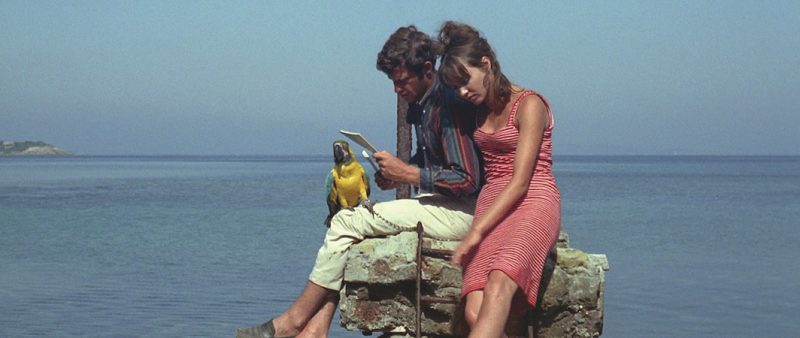
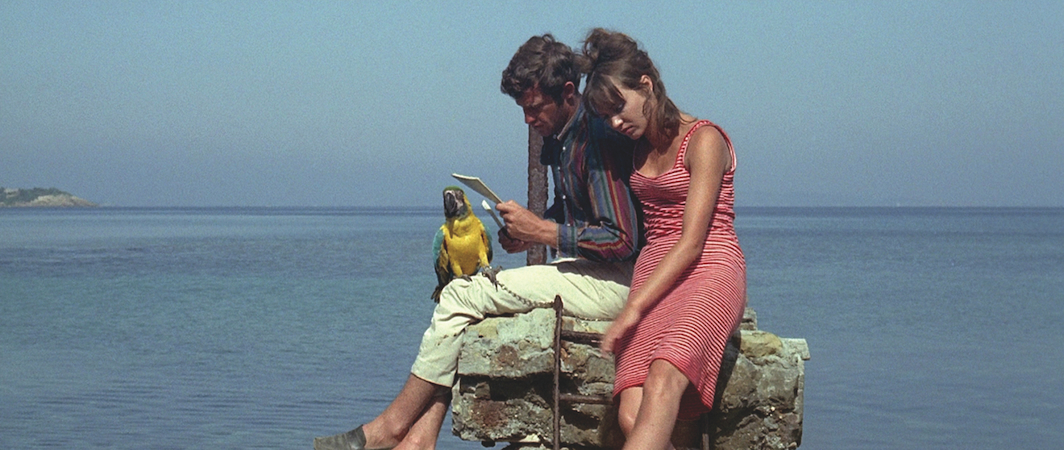
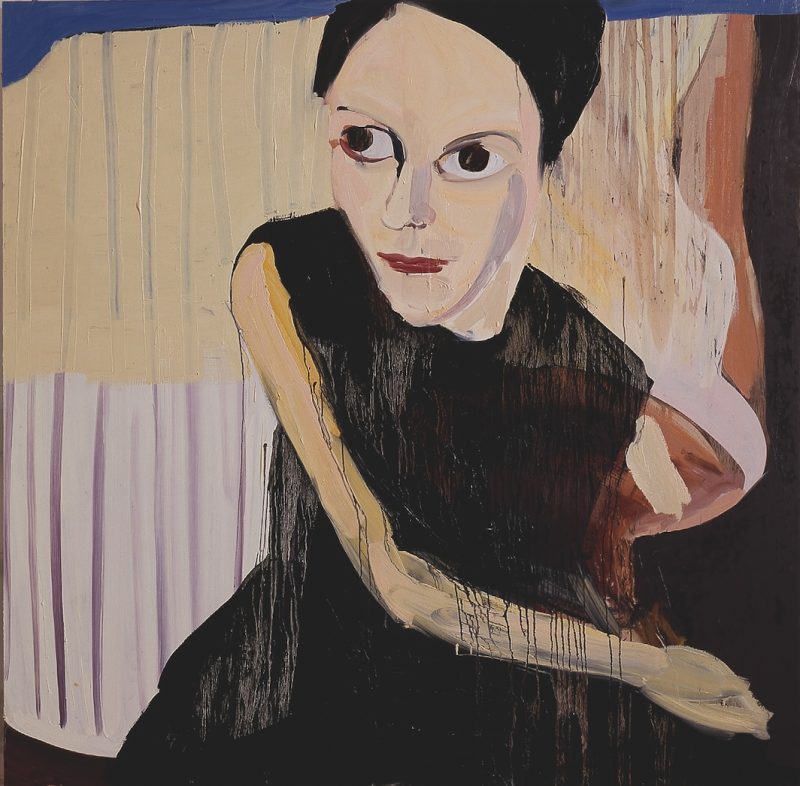
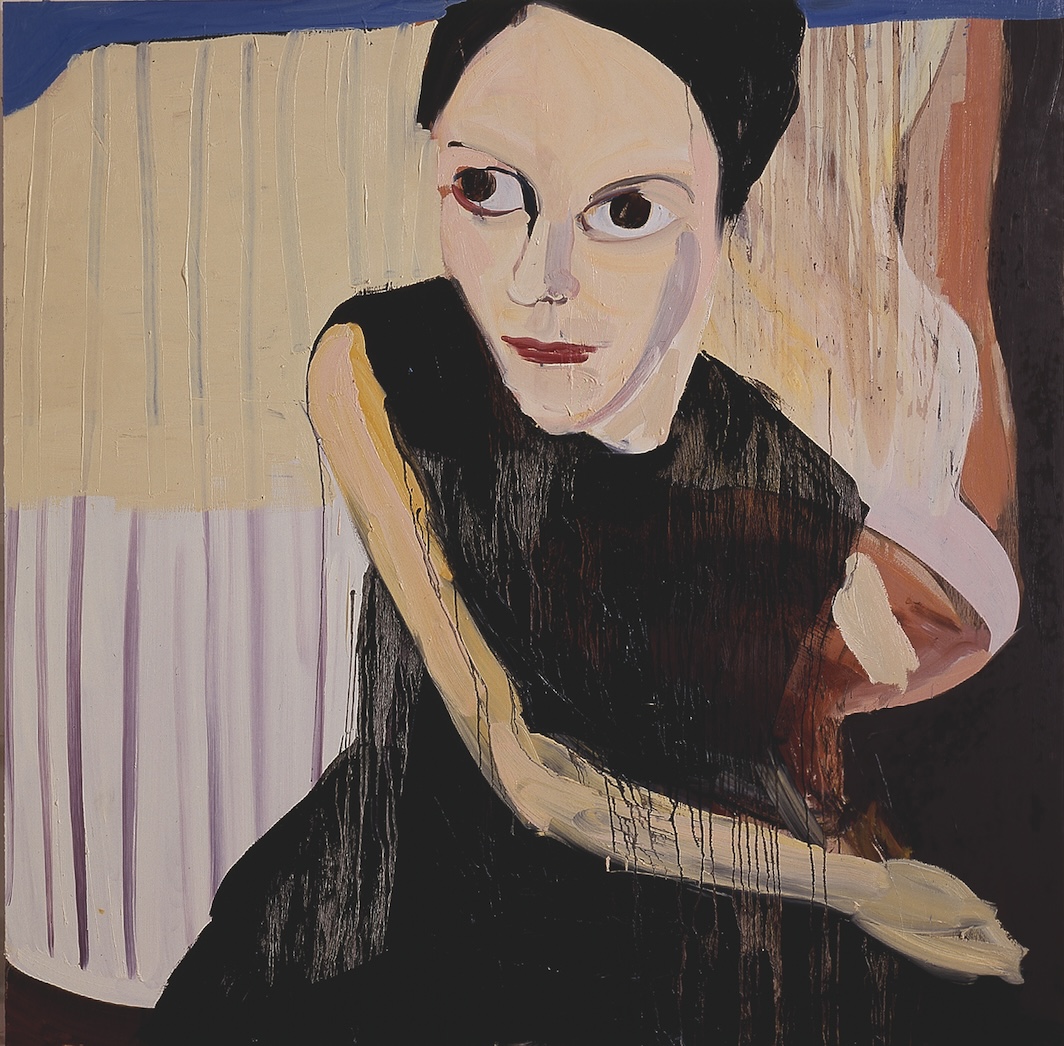
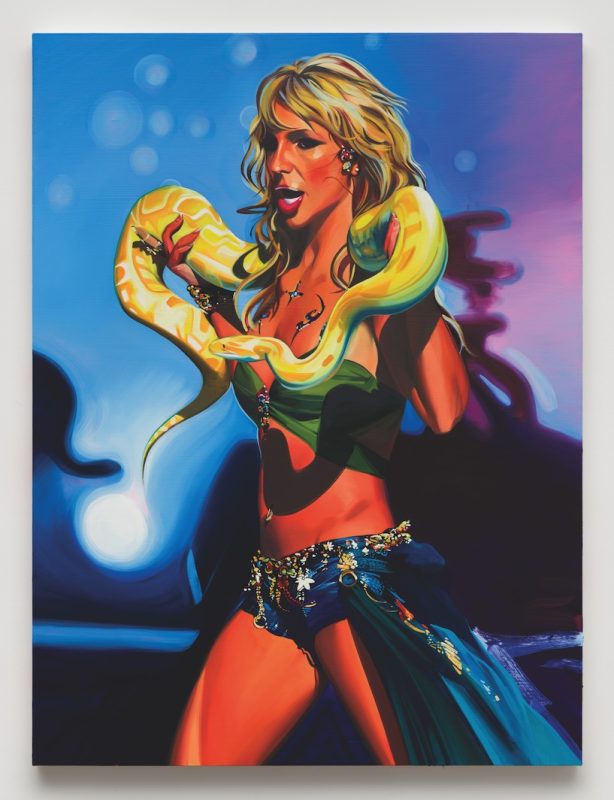
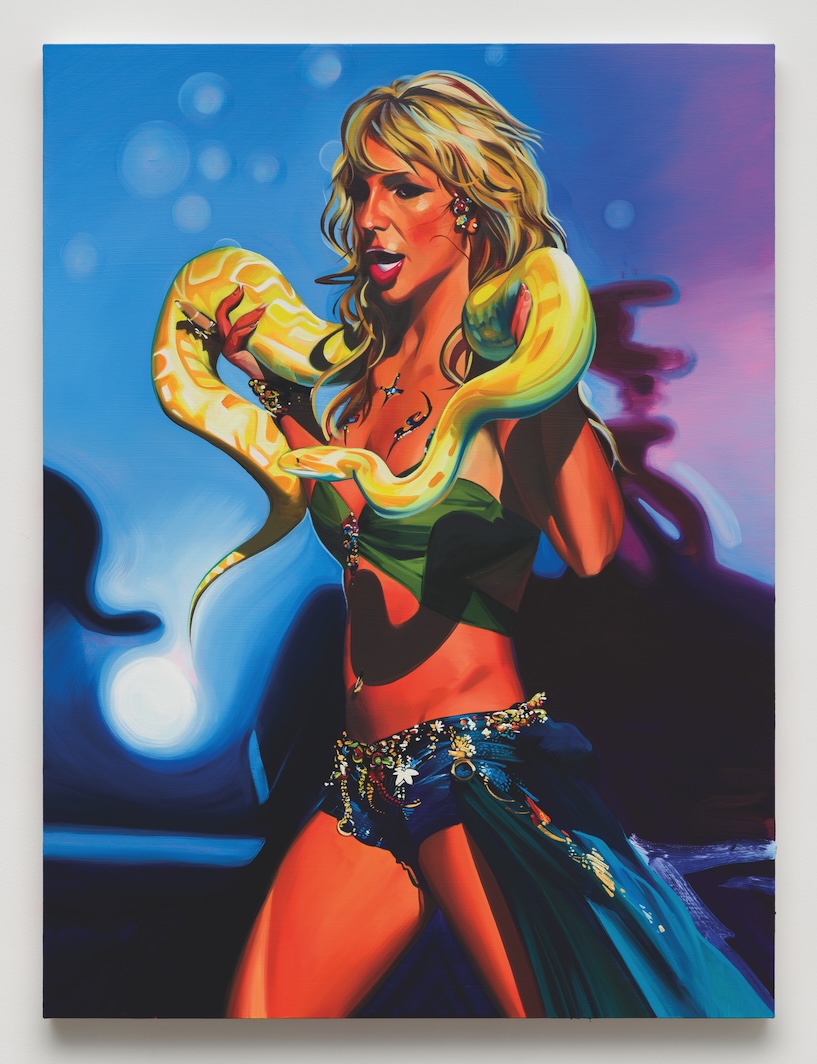
In our cover story, Moira Donegan considers the life and work of the late painter Celeste Dupuy-Spencer. Hermione Hoby looks at the incredible run of lacerating novels produced by Gwendoline Riley. Sarah Nicole Prickett posits what we can learn from William H. Gass’s hatred-ridden anti-novel The Tunnel. Haley Mlotek explores the mother-daughter divide. Audrey Wollen reads Éric Rohmer’s Elisabeth, an early novel that prefigures the director’s films. And much more!
Subscribe or renew your subscription today to receive the print issue and support Bookforum. And consider making a donation or gifting a subscription. Thank you, as ever, for reading!
PEOPLE WHO FOLLOW the teachings of Wittgenstein, whether or not they do so wittingly, find nothing more frightening—or more potentiating—than a state of wordlessness: the end of the world. We can see this clearly in the time of live-streamed genocide, when the avowal that “there are no words” is often what passes for attunement to the state of emergency. There are people for whom the breached limit or the threatened loss of language means the necessity of making a new world. For some, it is time to propagandize for the new world by deeds. These people are often called activists sometimes actionists. Others take wordlessness as a personal challenge, a demand to pry, grind, or hammer out more words. These people are usually writers. (To write and act simultaneously is classically difficult.) Among the latter group it is William H. Gass, the novelist, essayist, and sometime professor of philosophy who as a graduate student saw Wittgenstein speak at Cornell, a fact that slightly bends time for me, since Wittgenstein seems very old and Gass, though he is dead, so new. His prose is voracious, voluptuous. He refuses to find anything unsayable. This beautiful if dubious ambition reached its expressive apotheosis in his great big book The Tunnel, first published in 1995 and newly reissued by Dalkey Archive Press, which claims it will sell more copies this year than in the three decades prior.
The Tunnel is a tale by a maddening man and historian named William F. Kohler. The plot, such as it is, is very simple. Kohler sits down to write the requisite introduction for his life’s work, a Nazi history called Guilt and Innocence in Hitler’s Germany, and, blocked, instead writes what’s in his mind; he interleaves this memoir with the manuscript, hiding his story inside history. The problem is solipsism: he’s going to run out of the latter before he stops recounting the former. The Tunnel is very long for a memoir, but not very long for a book about the Holocaust, probably the most described event of all time. Gass however called The Tunnel “the ultimate anti-novel” and “the opposite of history.” He denied that the Holocaust was its subject, saying instead that the whole “Nazi period” was “the background.” (The real subject, he asseverated, was the American “fascism of the heart.”)
The most interesting reason to enter a world where mass murder is the wallpaper comes from a different philosopher, Gillian Rose. In her 1996 book Mourning Becomes the Law she wrote about the Holocaust as a “civil religion” in an America that (she didn’t say this part) had done more than any other world power to normalize Zionism. This normalization was achieved in part through the exceptionalization of the Holocaust—by making it unrelatable, sui generis, refusing to let it be historicized. Rose balked at what she called “Holocaust piety.” She said, somewhat following Nietzsche, that the purpose of the prohibition was to mystify “something we dare not understand, because we fear that it may be all too understandable, all too continuous with what we are—human, all too human.” What she wanted instead of, say, Schindler’s List was “a film in which the representation of Fascism would engage with the fascism of representation. A film, shall we say, that follows the life story of a member of the SS in all its pathos, so that we empathize with him, identify with his hopes and fears, disappointments and rage, so that when it comes to killing, we put our hands on the trigger with him, wanting him to get what he wants.”
Kohler’s first-person gamification of language allows for the Holocaust to be startlingly, sickeningly revivified. There are Germans made to sweep up bodies “like a cup of spilled rice.” There are mass graves “as large as lakes, as long as rivers.” There are mounds made of “muscle, callused skin, and organ flesh—boneless as some hams.” Gass told Arthur Saltzman, his most attentive critic, in 1991 that all great writing is “a celebration of its subject regardless”—he meant regardless of the subject, or the subjectivity, at work. In 2009, Gass reviewed a book about the Reich for Harper’s, using even wilder language to describe the most specific and brutal crimes of the Nazis, so brutal that I found myself stupefied into remembering, as if it could ever be forgotten, how bad the Holocaust was.
The near-total supersession of individual acts of remembering with the institutional memory of the Holocaust is perhaps why Kohler struggles to introduce his subject and turns the subject to himself. He has one big idea—whether the man who dictates a thing should have to answer for the one who finally puts word into flesh. This is the oldest alibi in the book, every writer’s. It is also a reactionary capitulation to exactly what Hitler et al. needed to believe, that they were enacting the will of the people. Which is to say: Who threw the first stone at Kristallnacht?
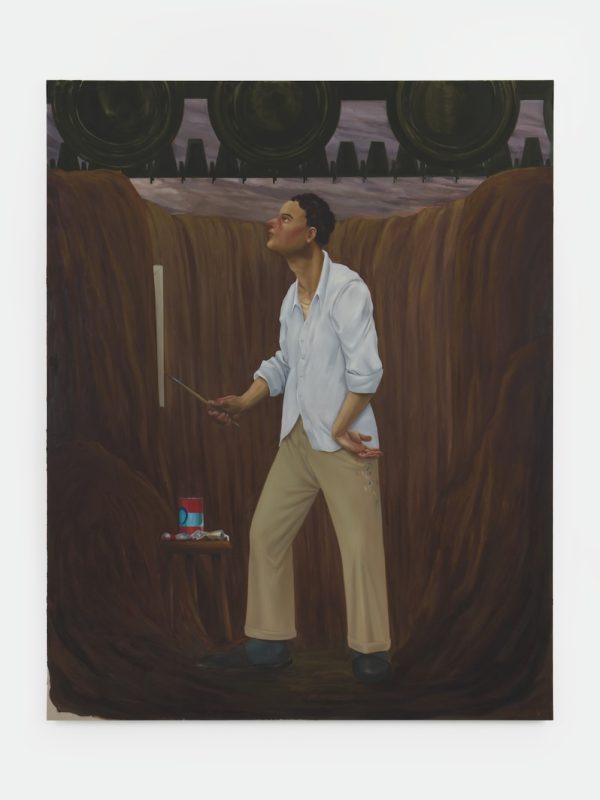
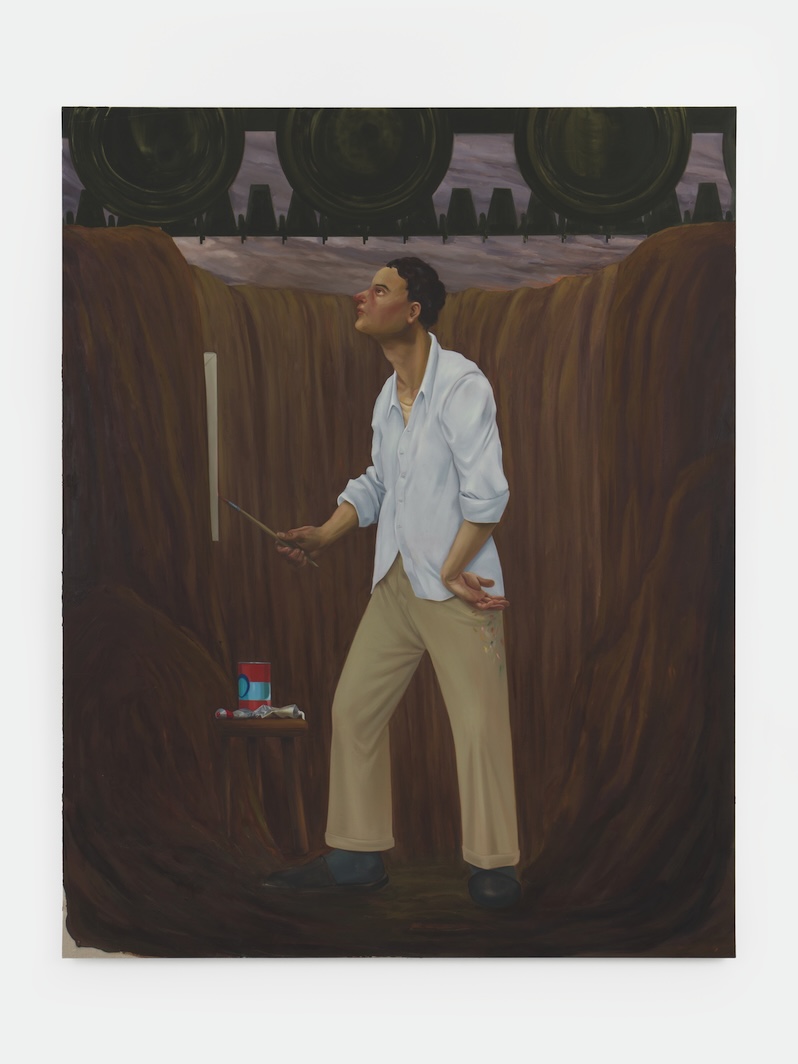
Nicole Eisenman, Fiddle V. Burns, 2024, oil on linen, 82 × 65″. Image: Courtesy of the artist.
IT GETS WORSE. Kristallnacht appears in Kohler’s story not only as a fantasy but more importantly as a figure for what Henry James, in the preface to The Portrait of a Lady, called the house of fiction. The house he says has “not one window, but a million,” and a figure stationed at every one; the apertures show nothing without “the posted presence of the watcher,” that is to say the artist’s, the author’s consciousness. Gass titled one section of The Tunnel “Why Windows Are Important to Me,” explaining that his windows “provide the frame, proscenium to stage, and everything is altered in them into art . . . or into history . . . which seems, in circumstances of my kind, the same.” Mordantly, he sets the Kristallnacht section inside this disquisition.
Several of the longest sentences in The Tunnel, like the longest sentence in all of James, which is found in The Portrait of a Lady, are about history as/in a house. James opens his on the subject:
The house had a name and a history; the old gentleman taking his tea would have been delighted to tell you these things: how it had been built under Edward the Sixth, had offered a night’s hospitality to the great Elizabeth (whose august person had extended itself upon a huge, magnificent and terribly angular bed which still formed the principal honour of the sleeping apartments), had been a good deal bruised and defaced in Cromwell’s wars, and then, under the Restoration, repaired and much enlarged; and how, finally, after having been remodelled and disfigured in the eighteenth century, it had passed into the careful keeping of a shrewd American banker, who had bought it originally because (owing to circumstances too complicated to set forth) it was offered at a great bargain: bought it with much grumbling at its ugliness, its antiquity, its incommodity, and who now, at the end of twenty years, had become conscious of a real aesthetic passion for it, so that he knew all its points and would tell you just where to stand to see them in combination and just the hour when the shadows of its various protuberances—which fell so softly upon the warm, weary brickwork—were of the right measure.
In James’s sentence, according to the computational literary scholar Jonathan Reeve, the fulcral verb, right at the center, is “passed.” The house’s history unfolds toward and through it, passing from time to time into its new custodian’s consciousness, a telescoping effect. Gass, by contrast, writes sentences in The Tunnel whose lengths spiral out as if infinitely, then stop as if randomly. Take this one, which begins as follows…
I assume we all associate, if none of us do it as well, moving along old tracks from place to place in our past like a memory-driven train; but history, as I especially feel it, deposits itself inside its surroundings . . .
…and runs to nearly 800 words. We have the “I” standing at the entrance, before the digging starts. For Kohler the house is what he is trying to escape like it were prison, by tunneling out. This private and pointless dig gives the novel its name and, often, its sentences their shape. Here the fulcral verb is the first in the sentence: “assume.” Let’s not make an ass of the reader. It’s easy to feel like one, misled as the sentence slinks down the stairs away from its impetus, going on for the sake of goings-on, through freely associated objects, things, dregs, ending on the memory of a geometry teacher who opened doors with a hankie to protect herself from her pupils’ germs, much as Gass approaches cause and effect, trying to avoid being contaminated with that dirty word, “plot,” or with the sorts of personal history to which he was no more inclined than any other kind.
He had first set down his complaint about autobiography in Finding a Form:
I do not think it should be assumed that history, which had always focused its attention upon wars and revolution, politics and money, strife of every sort (while neglecting most everything that mattered in the evolution of human consciousness, such as the discovery of the syllogism, the creation of the diatonic scale with its inventive notation, or three-legged perspective, to be for centuries the painter’s stool), had found its final relevance with the inward turn of its narrative, for it now celebrated the most commonplace and cliché-ridden awareness and handled the irrelevant with commercial hands and a pious tongue, as if it were selling silk.
His own examples, it must be noted, side with history over consciousness as a motive force. Consider the first: Aristotle’s discovery of the syllogism, the form by which a conclusion follows necessarily from a major and a minor premise, like a perfect cadence on piano. Consciousness grows in leisure time: Aristotle himself wrote that in ancient Egypt it was when the priestly caste got free time that they discovered or invented mathematics. Aristotle, of course, was arguably the most free-thinking student at Plato’s academy. Would the syllogism have taken its shape had Plato not abandoned politics in the reactionary aftermath of the Peloponnesian War? Would The Tunnel have acquired its same shape and weight without technological and ideological state apparatuses, without the fellowship year at the Getty Center and the secretaries there who, said Gass, “put the first 500 pages of the text on the computer,” or for that matter without the computer?
America after the Second World War had its own academies of enculturation, many of which were funded, if not altogether directed, by state and non-state actors working to boost Cold War liberalism. Some of these artistic and literary institutions are listed in Gass’s acknowledgments: the Guggenheim Foundation, the Rockefeller Foundation—a locus of collaboration with the State Department—and the Getty Center. Gass’s design notes propose a more radical experiment in dissociation than proved possible with Knopf, his original publisher, or now with Dalkey: he instructed that these acknowledgments be set in a different typeface from the novel’s text, since, he wrote, “they do not belong to the novel.” In both editions, however, they appear in the novel’s own type, albeit half a point smaller; placed after the opening diagram, which scans as part of Kohler’s book, Gass’s thanks read as continuous with Kohler’s rants. The acknowledgments page becomes an accidental or symptomatic comment on institutional complicity.
A writer’s relation to plot may tell you his politics. Gass hated the word: “a terrible word in English,” he wrote, “unless one is thinking of some second-rate conspiracy.” A few hundred pages into The Tunnel, Kohler takes up the tale of Herschel Grynszpan, the Polish-Jewish teenager whose 1938 shooting of Ernst vom Rath gave Goebbels his pretext for Kristallnacht. Kohler, not alone among historians, reads Grynszpan’s farewell note—“my heart bleeds at the news of 12,000 Jews’ suffering”—as a forgery. He won’t allow the assassination as an act of resistance. Even first-rate conspiracies are theoretically counterrevolutionary, since to ascribe all romantic violence perforce to state actors (the CIA, the FBI, the Mossad) is to foreclose the possibility of “autonomous action,” or action taken individually in collective defense. This is not a strictly fascist position; it is also liberal, or anti-anti-fascist.
Nineteen years after Gass started writing The Tunnel and ten years before he finished, Don DeLillo’s White Noise introduced to the intelligentsia a different professor of Hitler studies. Jack Gladney has the chairmanship of a department he, quite Americanly, invented and named Hitler studies, but speaks no German. William F. Kohler, by contrast, has the background but was denied the Commager Chair in his history department, reserved for an Americanist. (Both Kohler and Gladney are remarkably uncontradictory in their positions, as compared with the star anti-colonial or anti-fascist academics in my personal firmament who, I have to admit, are sometimes suspiciously invested in what they critique. Many enlightened historians would be content to see Gaza turned into the world’s first open-air holocaust museum. What Gass called the “fascism of the heart” thrives in a liberal body politic.) Gladney, who thinks all plots tend deathward, wants to kill his fear of the end by becoming a murderer. Kohler wants to kill his father—whom he phallically calls “a little Führer”—by, more or less tragically, becoming him.
Gass I think was a kind of Method writer. He wanted to play a villain for probably the same reasons actors do: the challenge of overcoming a complicity between audience and actor—narcissistic, perhaps, or simply self-preserving disidentification with anything (back to Rose) that we claim is unrelatable when it’s “all too continuous” with us. And, like actors, he begs a question: whether performing a thing and being one are really two different activities. Is it possible for a novel’s protagonist to think something without the author thinking it first? When Kohler contemplates jam jars and prepares his toast, savors the expression “Product of France,” observes the haze on a knife after spreading butter and thinks, after all, it’s good to be alive—is that not Gass?
Gass spent decades protesting the question I said was begged. He once boasted to an interviewer that a fact-checker from The New York Review of Books had called to ask whether Gass was actually fat. “Not when I started the book,” Gass replied—ha ha. The fact-checker must have been calling about Louis Menand’s long review, “Journey into the Dark,” in which the word “fat” appears once, in a quotation. Gass’s telling lets his interviewer, the writer John Madera, believe that Menand had argued he was Kohler in body, ipso facto that the critic was a sucker for his sovereign conceit. But Menand said otherwise: “Writers double themselves all the time in their fictions.” Readers, he added, “have . . . little trouble dissociating the author from the double. Even three-year-olds know that Dr. Seuss is not the Cat in the Hat.” He also refers to “splitting” in the psychoanalytic sense, which seems more accurate: Gass takes scenes from his own childhood and gives them to Kohler in order to make them fictions, placing across the divide what he wants to disremember or wishes never happened in life. (I love when Gass tells Madera: “I used things from my childhood, but that was it.” Oh, is that all—only the reason you write.)
What divided my reactions as I read and re-read was not the possibility that Gass wrote Kohler because he, too, secretly adores a fascist, but the problem of consciousness not being where fascism forms. If you listen to the speeches of Mussolini, you notice he calls fascism “the unity of action and thought,” whereas Bordiga, or any Leninist, speaks of unifying thought and action, or theory and action, thinking first. Word order sometimes does make all the difference in the world. Kohler admits that the tunnel is “the ultimate inactive act,” then almost brags: “I can honestly say I have accomplished Nothing.” A poet—! And not a party man. On the other hand, when Gass insists his scene is America and not Germany, he implies more of a difference than there really is, since, historically speaking, it is hard to dig under the house of American fiction without slicing through the roots of German Nazism.
Why is it always separate the art from the artist? In this case, better said the other way: separate the artist from the art. Impossible. Like the profiteer warned by the Bible, the writer who ventures to restore the whole world in prose can lose, in the bargain, his psyche (what was the Greek word for soul now means mind). “You may deliberately wish to rescue the world by putting it in language,” Gass told the scholar Ildikó Kaposi in 1995, “but you’re certainly burying yourself in it. The book’s become your tomb, you know. . . . It’s all you are, and all you will be eventually.”
IF THE NOVEL OF CONSCIOUSNESS has a prehistory, it begins on an island. Around the time of the Crusades, the Andalusian philosopher Ibn Tufayl wrote the story of Hayy ibn Yaqzan, a feral child raised not by wolves but by deer, who reasons his way out of nature: “He reached the limits of the rational world and grew lonely, yearning for the familiar world of the senses, so he took a step back and completely abandoned his body” (trans. my friend Maya Shoukri’s dad). Centuries later, the story gave Defoe his Crusoe and Spinoza a model for the soul. Marx called them the Robinsonades, and mocked them as, essentially, immaterial fantasies of self-manufacture. Consciousness, Marx and Engels wrote in The German Ideology, is only conscious existence: “Life is not determined by consciousness, but consciousness by life.” Fourteen years later, in the 1859 Preface to A Contribution to the Critique of Political Economy, Marx revised this, changing “life” to “social being.” His reading tends to prevail, acknowledged or not. Most canonical “novels of consciousness,” from Goethe to Dostoyevsky to Woolf to Ellison, are novels of social being first and foremost. But Kohler’s is a kind of inside-out Robinsonade: monad, not nomad.
The most complete definition of human consciousness comes from the novelist and philosopher Sylvia Wynter, who sees the psyche as being continually produced and reproduced through the dynamic interactions between bios and logos, or bios and mythoi. In this she could be said to be resolving a long-standing conflict between the James brothers. Henry James tried to echolocate consciousness in the heartbeat, always feeling for words like “pulse” and “throb.” William James saw it in breath. In “Does ‘Consciousness’ Exist?” the elder James let the word evaporate: consciousness was a residue of the old idea that thinking was a kind of breathing, and once it had thinned to that “estate of pure diaphaneity,” it was ready to disappear altogether. Henry kept it and all but gave it a body. In a late essay on the question of life after death, he professed disbelief that the universe meant to pluck and discard the fruit of the artist’s consciousness at its ripest, and wondered whether the mind might not survive in, essentially, a body of work.
Gass, through Kohler, says in a line of dialogue that “consciousness is what counts.” (I say it is Gass speaking because, in a radio interview at the time of The Tunnel’s publication, he told the critic Michael Silverblatt that “really what counts in history . . . is what happens to human consciousness; not just what happens—the piles of bodies—but what was lost when you piled up bodies; what was gained when you decided not to.”) Fredric Jameson, in The Political Unconscious, says “history is what hurts.” Four words each, enthymematic: each a syllogism with its premises suppressed.
Placed together on a sheet of graph paper, the two axioms supply two axes: Gass’s, through signifying; Jameson’s, through suffering. Common sense puts the idealist with the heart and the materialist with the head—but the Marxist turns out to speak for the heart and the idealist for the head, the wrong way around. (Though it makes sense in America, where nothing, not even novel-writing, is more romantic than being a communist. I mean this in every valence of the romantic.) This schema places pain orthogonal to significance, which makes it hard to plot . . . trauma.
TIME, THE SUBSTRATE of both history and consciousness, is what traumatizes. There is nothing more injurious than experiencing time all at once: time stopping is time accelerating into a crash; time slowing is time dilating unbearably. Life’s central contradiction is that you always want more time, but an excess of simultaneity usually means death—someone else’s or yours—or worse.
If the Holocaust is read as an explosion of time, it becomes more understandable why it was said to set in motion history’s end, making more poetry possible (Adorno said the opposite, but he didn’t mean it — or he meant it dialectically). Auschwitz established a piety equal to the poetry that placed the event outside history, outside humanity. Nancy Fraser, one of the more conscientious academics in the West, has written that “‘Gaza’ bids to replace ‘Auschwitz’” as our symbol for the evils that humans do. But Gaza is not homologous with Auschwitz: not architecturally, not temporally, not ethically. Gaza is not Auschwitz because unlike Auschwitz it refuses a total unlikeness. Gaza is also a symbol of ordinary life and cannot be set outside time, no matter how many charlatans write books with “after Gaza” in the title; and, from outside Gaza, one task of literature might be to never again let institutional memory supersede individual remembering.
As a professor, Gass once assigned to a group of students the task of (re)designing a public place: a “tomb for the absolute,” the “national headquarters of gay rights,” or—he was not kidding—the camps at Auschwitz. No one, he told an interviewer in 2009, chose the latter. No one wanted to try replacing their consciousness with the one they might have if they were born into the same class of people, but in a different time, different place, different set of conditions. As Kohler, he took to the limit his notion of art as a means of (temporary, but entire) consciousness replacement. There were moments when miraculously it seemed to work. I would forget why Rome fell, wonder what “chair” meant in French, or try to guess who was Hitler’s favorite novelist, and Kohler would tell me pages later: “Prohibition,” “flesh,” “Karl May” (a lie and two truths). Mostly though, it was my own thoughts I thought more than usual. I thought about consciousness and how it counts—matters? tallies?—and whether the mark of non-consciousness in LLMs is that they can’t, as far as I can tell, tell time. I thought about machines and how the new ones are training us to live in a future world with far fewer people. I thought about death machines, the same wager doubled: that human life can be replaced by human consciousness, the piles of bodies by what their loss was said to gain.
Kohler is a man whose death stops no clocks. But his mind does tick. I felt a sense of loss as regards authorial death for the first time after turning the last page and reading the short biography of Gass, written, as it wasn’t before, in the past tense. Until then, possibly because no edition of the novel I have ever read or tried to read has ever been perfect, that is to say without typographical error, there was always the feeling that while you were reading, he was still writing the book. I loved that. I hate how “finished”—dead—synthetic prose gets.
Gass modeled an enlarged language, big enough to house or bury everyone. There is between writers and readers a special complicity, enabled and necessitated by the activity of reading, in contrast to the passivity of watching. This makes the novel formally well-suited to the rehearsal of social and political complicities with various relational forces, for better and worse. The Tunnel is a masterpiece of implication. It is also a nightmare of failed escape. I say this to settle one last score: the miscarriage of this experiment can only now, against the author’s will, be historicized. When the machine was invented that allowed him to complete his work of consciousness, it became inevitable that there would be too much information, too little innocence, too much guilt. Complicity would become the general condition, and dissociation the attendant pathology, of American life. Did he know this? It doesn’t matter. The time was not yet.
Sarah Nicole Prickett is a writer living in Montreal.
EVERY WOMAN is a daughter. We begin our lives in lineage, understanding that our lives are possible only because of our mothers’ life, and that our first attachment will eventually be our first act of separation. There are many ways to understand being a woman—even more ways to misunderstand her—and then here with the label of daughter is one truth so basic, so ordinary. Some of us will also be mothers, yes, to children we give birth to or to ones we choose to love and care for, and daughters will know many mothers in many forms as long as we live, but to be a daughter is a kind of lock around our lives that has no key.
I was once a daughter. I still am, but I also was one before I was this daughter: the kind of daughter that can occasionally—usually—forget to think of myself under that term, which can become obscured by a longer list of roles and states and concepts, like sister or citizen or job. Once upon a time a daughter was born and she grew up to be me.
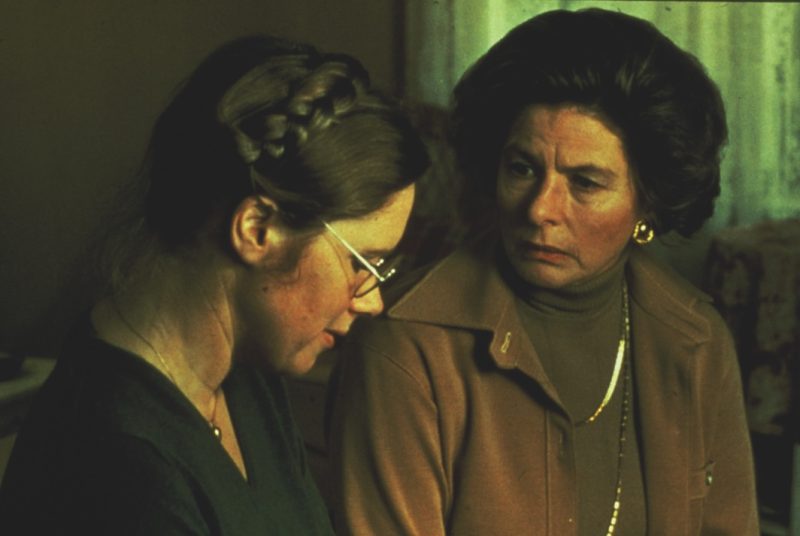
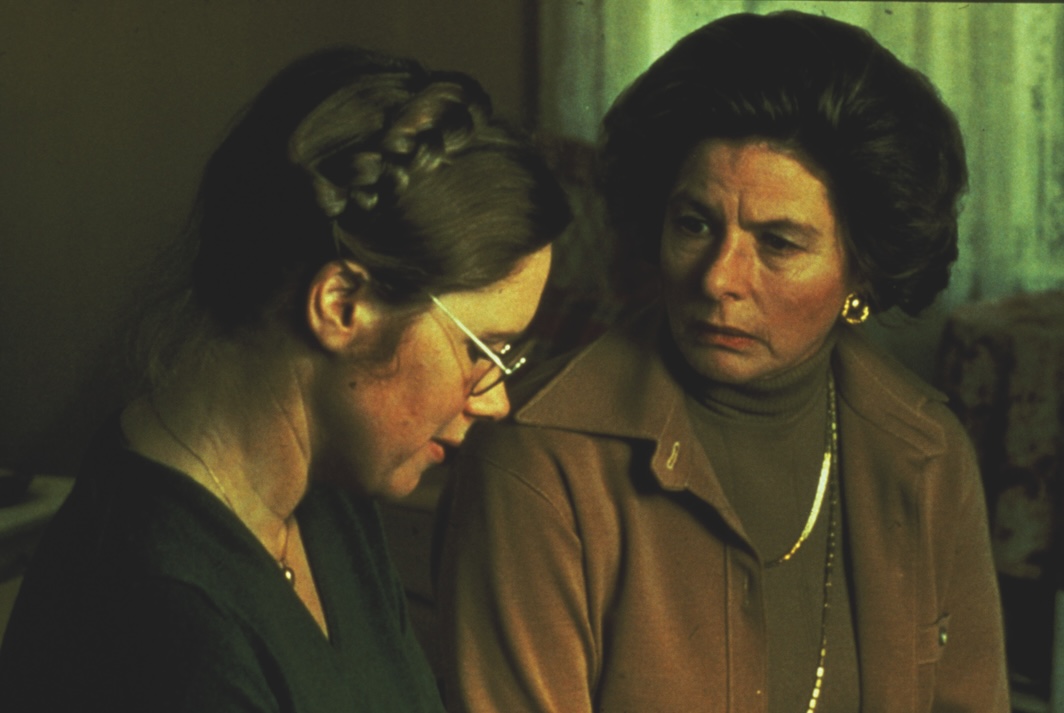
In Ingmar Bergman’s Autumn Sonata (1978),Liv Ullmann and Ingrid Bergman play a daughter and mother spending one very long night together in the daughter’s home. Ullmann’s husband and sister are also there, and they come in and out of the drama occasionally, but this is a film about the often-futile attempts of two women who made each other who they are to understand each other. “Don’t we ever stop being mother and daughter?” Ullmann asks, not rhetorically. “You had taken charge of all the words in our home,” she says to Bergman later, demanding that for once her memories be heard as she remembers, unedited and untouched by her mother’s overpowering presence in their family life. Bergman, as the charismatic and self-absorbed mother, listens all night. She explains herself with excuses, sometimes, but not all of them are attempts to deflect blame; they are also the reasons and rights she has as an imperfect person. It is unclear what, if anything, will change between them after the night ends. The question is not whether they are capable of change in themselves, but whether either of them might accept that the other can change who she is at all.
This is where we find the journalist Rachel Aviv in her new book, You Won’t Get Free of It, a collection of six essays originally published in The New Yorker, where Aviv has been a contributing writer since 2013, along with an introduction original to the book. These selections are a gathering of her reporting on stories of mothers and daughters and the ways they try to know or find each other.
All of Aviv’s writing begins with the desire to know a stranger. Her essays always come back to the possibility of learning familiarity toward people who seem too far away, either physically or psychically, to locate. Aviv’s first essay collection, Strangers to Ourselves (2022), is separated into chapters featuring a person caught between definition and diagnosis, the context of their culture and status in their community as essential to understanding them as their individual character and personal history. These are accounts of people experiencing the unbearable tension between porousness and proximity, a need for care at odds with the limits of accepting or receiving it. In that book, we meet Naomi, the young mother who, in a profound psychosis, drops her two children and herself off a bridge, believing she was offering them “a merciful death” rather than a “torturous one”; Laura, an affluent young woman who feels relieved to learn that her hopelessness and suicidal ideation could be considered bipolar II, until years on various medications left her feeling completely alienated from her own mind; and Ray, a doctor who began his treatment for depression at an institution that discouraged antidepressants and lives the rest of his life fixated on the ways it might have failed him.
Aviv’s essays in Strangers are about people close enough to see each other yet still not sure if they really know each other. None of her subjects can be considered sick or healthy in isolation. Naomi is a Black woman whose psychosis largely revolved around the hostility she experiences living in a largely white cultural environment, one that denies her humanity and punishes her vulnerability; Laura’s class and wealth give her access to treatment but not nearly enough insight into her own experiences; and Ray’s life intersects with a history of psychiatry and psychology that has been, and continues to be, constrained under the limits of what we know about the effects and possibilities of pharmaceutical treatments.
Free explores a similar idea about connection and closeness. The bond between mother and child is a physical one first, the umbilical cord easily lent to an overused but apt metaphor. Less known or used as a metaphor is the concept of the “fourth trimester,” the name given to the three months after birth when a mother and child must learn how to be alone in their bodies. The medical definition of this time is twelve weeks; probably many of us can think of mothers and children who spend their whole lives trying to understand how to live fully apart from each other, to create or maintain reciprocity without sacrificing liberty. In her introduction, Aviv states that the stories she chose originally seemed to her like they were written from a perspective that was “existentially, like a daughter,” but that she later returned to them, after having children, “with a different identification. It was as if I had failed to see the drama on mother’s side, too—her particular longings and humiliations and needs.”
Aviv’s mother wanted to be a writer, we learn in Free’s introduction. Once, as a child, Aviv called her mother from summer camp desperately unhappy, and her mother immediately went to pick her up. Aviv’s mother had planned a self-imposed writer’s retreat at a cottage, and so Aviv joined her. They spent that time, according to her mother’s journals, writing their respective works. The younger Aviv wrote about a daughter who sounds somewhat obsessed with her mother. In her short story, she wrote: “I ran up and gave my mother the biggest hug I could to get all the love for my mom into her.” In another scene, the mother and daughter characters hug so hard that she felt she needed to clarify that they did so “without turning faint from not enough oxygen.” There is so much love it feels fatal. The mother character dies that night. “It’s not hard to see my first foray into writing, which made my mother immensely proud,” Aviv reflects, “as an exercise in acting out the event that I most feared and perhaps on some level secretly wished for—an end to this overwhelming and exhausting fusion.”
Ingmar Bergman, Autumn Sonata, 1978, 35 mm, 94 minutes. Liv Ullmann and Ingrid Bergman as Eva and Charlotte Andergast. Streaming now on the Criterion Channel. Image: Courtesy of the Criterion Channel.
Aviv’s writing has a quality that makes everything she describes feel like both a mystery and an inevitability. Her stories develop in ways that her subjects (and her readers) could not have predicted; at the same time, what unfolds is revealed to be the only way things could have happened. I will begin reading an essay by her and often am at least halfway through before realizing that I am reading about a person who is dead. Her descriptions are so vivid and her details so exacting that I take for granted she must be writing about a person she met herself. The events of that person’s stories give the sense of being eternal and immovable, as though they are parables designed to impart a truth rather than just an accounting of fact, so apparently easeful in their skill and precise in their perceptions. But nothing in life, let alone in journalism, exists in stone. Here in Free, Aviv brings in her skill and precision to open up the original New Yorker essays with revisions to include more from the mother’s perspective, after Aviv realized that she had, unconsciously or otherwise, omitted something that had seemed too obvious to be considered relevant, or too concealed within what appeared to be an emotional logic to be considered worthy of attention. One such example occurs when Aviv reexamines her own life: “That my life today is the one my mom tried to have for herself is a fact so unambiguous that I have generally preferred not to allow it into awareness.”
As Aviv revisits the essays in their original form, other mothers and daughters, too, are perceived in a new light, with different aspects of their lives coming into focus. There is Linda Bishop, a woman and mother who refuses to be categorized as mentally ill and so is eventually lost inside a health care system that refuses to treat those who don’t acquiesce to their supremacy. There is Hannah Upp, a woman and daughter who periodically entered fugue states with seemingly no reason or diagnosis and would disappear from her daily life, prompting panic and searches from her friends, father, and mother. There is Elizabeth Loftus, a woman and daughter and preeminent psychologist who has frequently appeared as a paid expert witness on behalf of defendants such as Bill Cosby, Jerry Sandusky, and Harvey Weinstein, undermining testimonies of alleged victims by arguing that memory is malleable. The only defendant she ever refused was, Aviv notes, a man tried for operating a gas chamber in a concentration camp.
As Aviv reflects in her introduction, in the time between publishing these essays in The New Yorker and now in Free,she reassessed ideas she developed about her subjects, incorporating details that she either didn’t know or didn’t understand the first time around. Aviv reported on Bishop under the assumption that her psychotic break “appeared out of nowhere, after a harmonious childhood and early adulthood.” In Free, Aviv recalls an interview that complicates this analysis, noting that one of Bishop’s closest friends had candidly told her that Bishop got pregnant soon after graduating from high school and was sent away to an institution for young pregnant women, where she gave the baby up for adoption. “Apparently, at the time, I did not think losing a child was a biographical fact relevant enough to mention,” Aviv reports on herself. “I had not even asked a follow-up question.” After the story was published, Bishop’s sister told Aviv that she had only recently learned the two of them had been adopted by the people they grew up knowing as their biological parents, possibly born in the same kind of home where Linda had given birth to her own child. Linda did not live to learn this for herself, but how can we avoid wondering about the way people have forms of knowing so deep they are more cellular than subconscious? “The neglected detail seemed to open up another layer of experience,” Aviv says, “running underneath the one I’d thought I was writing about.”
In the book’s version of her essay about Upp, Aviv interviews Upp’s mother again with the intent to “redress what I saw as a kind of imbalance, a deficit of curiosity about the mother half of the couple.” Before Hannah was born, Hannah’s mother, Barbara, had a premature baby who died within a day of birth. “Hannah’s fugues had always occurred around the day that the baby was born,” Aviv says. She knew this the first time she reported the story, but “at the time I resisted a detail that seemed too symbolic, even if it was true.”
Even as Aviv admits that she feels she sometimes missed or avoided hearing what was being said in full, the painstaking quality of her attention is a potent one. Four out of the six essays chosen for this collection draw their titles from quotes given by Aviv’s subjects; sometimes it is a sentence spoken during an interview, or a snippet of an exchange between a subject and her doctor, or a sentence from a short story about a mother. The words are delicate with pain, a sliver under the skin so small in comparison to the care it demands. Even before knowing the context, one realizes that all the titles and statements express suffering and loss. The throat stitches closed at the thought of repeating them: I wish I was her for you,a woman mistaken for a missing daughter tells a mother. As if they were my daughters,a domestic worker thousands of miles away from her own children says of the ones she is paid to care for. You won’t get free of it, Alice Munro writes, describing in fiction the feeling that one could decide to choose between the love of a man over the care of a daughter.
THE BOOK TAKES ITS TITLE from Aviv’s 2025 essay about Alice Munro, a stunning examination of what happened in the life of one of the most acclaimed fiction writers of our time. Soon after Munro’s death, which was mourned deeply by her many readers and the literary institutions that venerated her, her daughter Andrea published an essay in The Toronto Star stating that Munro’s husband, who was Andrea’s stepfather, had sexually abused her in childhood, beginning when she was only nine years old. Munro had learned of this abuse during Andrea’s childhood, as had Andrea’s father, and neither parent made the decision to separate and protect their daughter from her stepfather or to report him as a predator.
We cannot know what Andrea’s parents were thinking or feeling about this violence toward their young daughter, only the accounts that remain, and the truth that Munro never left this man, remaining married to him until his death and estranged from Andrea and her other children to varying degrees for the rest of her life.
Aviv captures shocking facts about Munro, and also the shock readers felt in learning about them. But she also shows that the abuse was never really a secret, and so should not be received as a surprise. Munro did not hide or obscure her complicity, nor the fact of her husband’s violence. She told people she knew. And though her stories clearly contain artistry and skill and invention, many of them are also almost certainly cut with some jagged remnant of her reality. This is not to say that her writing is a simple echo of real life or a transcription of a well-tended memory, but that her gift, and apparently her curse, was to be able to say nothing about what the pain was, while saying a good deal about how pain lived its own life inside the people who could neither speak it nor keep it a secret. As readers and observers, we have the rare public reminder that we know such private despair can exist between daughters and their mothers.
Munro’s stories are not parables or fables, morality tales designed to impart a lesson. But what remains of Munro’s scenes in memory come to feel like they could be, in the sense that fairy tales have always been given to children with the expectation that they will help them parse and perhaps partially crack the codes of their still-new lives on earth. This is in lieu of teaching them an actual language made of words that can explain what it feels like to be both helpless and omnipotent, capable of causing or receiving harm and grace in deeply unequal measures. Like Aviv’s approach to reporting, it is writing that feels both alive and immovable.
You won’t get free of it, but you won’t die of it, is the complete sentence Munro wrote and Aviv quotes. I once heard someone say that mothers know they do not create life, exactly, that as soon as their children are born they understand they have birthed an inevitable death. The responsibility and expectations of motherhood are so extreme that the role of motherhood is, as Jacqueline Rose wrote in Mothers: An Essay on Love and Cruelty, most often the one society easily blames for its own structural failings. If a daughter is lost or sick or hungry or hurt, the mother is there to be the reason; if a mother is suffering or struggling, she is to be blamed all over again.
“Our mothers remain the strangest, craziest people we’ve ever met,” Marguerite Duras once wrote, and she was that eternal daughter who returned to the question of who her mother was, or perhaps why she was the way she was, again and again in her writing. Can a mother be known by her daughter? Can a daughter be known by her mother? I have noticed that the truth about this conundrum has been repeated so often it has become a cliché: I often hear that “no one” is talking or writing or making art about motherhood, that if they are they are not showing the “truth” of the experience, that our oppressively coded ideals of maternity and girlhood replace our ability to see them for what they really are, even sometimes to the woman experiencing it herself.
Certainly these sentiments can be considered reasonably accurate, particularly when it comes to stories about motherhood that aren’t those of white, middle-class, cis, straight women. And yet when I hear people bemoan the absence of women talking, I can’t help but want to reply: Have you asked them? I am at an age where I do know and have known mothers of all kinds, women who have children that they birthed or adopted or spent much painful time and resources using the available medical options to become pregnant. They have railed against the way their bodies betray their intentions. They have conceived painstakingly on purpose and completely accidentally, miscarried and mourned a devastating loss of a pregnancy. They feel different kinds of gratitude and grief toward their pregnancies, their children, their abortions, the general shape of their family. They have children who are infants, teenagers, adults, deceased. And if you ask them about it and listen as completely as you ever have, they’ll tell you as they breastfeed or grocery shop or suntan or watch TVor snake the sink drain. There is also so much art about motherhood that defies this idea that the only acceptable narratives are saintly, beatific: books and movies and paintings and songs that refuse a story written to replace the truth, many of them especially in recent years but also found throughout history, if you know where to look or who to ask.
Perhaps we are not at a loss for true stories about motherhood so much as we are tasked with an endless unlearning of the first stories we’re told about what it means to be a mother or a daughter. Think of the way our daughters hear and see their lessons: heroines are princesses disguised as peasants forgetting who they once were, extraterrestrial or interspecial interlopers who only want to be accepted as ordinary. They are mermaids who want two feet, diligent maidens who fall in love with a beast. A magic potion under the care of a wise woman heals them, a cursed drug from a wicked woman hurts them. They want, above all, to be kissed as proof of something, maybe anything: proof that they are pretty, wanted, safe, human. All the magic they experience is about being made real in a retelling of their life story. Here in Free there is even a Cinderella story, of Emma, a Filipino woman who left her own children at home to make more money for them in New York, and has since spent sixteen years taking care of other people’s children, and one that could be something out of a soap opera, about a woman who seemingly recovers from schizophrenic-like symptoms after being treated for cancer, like a patient in a coma that wakes up with a new personality during sweeps. “But becoming sane can also be a kind of narrative collapse,” Aviv writes.
Above all other common attributes, so many fairy tales and fables share the same plot device: daughters and other children are always there. Mothers are either absent entirely or the enemy. Our fictional characters are without one or both of their “true” parents, which is meant to be taken as genetic, and because of that they are at risk of exploitation and suffering, alienation and loneliness. That these experiences are understood to be temporary sufferings that only prove why they deserve the safety and sensuality of a romantic partnership, to replace an absence of family with the creation of their own, is an open text crafted by our conscious minds so that we can feel our own lives made real. Without narrative, there is no understanding.
Hannah Upp’s dissociative fugues were described as a symptom of trauma, whether external or “by an unbearable internal conflict.” One of her psychiatrists told journalists that he felt the comments surrounding Hannah’s condition, which were often disbelieving and cut with palpable rage, were because “there is an ineffable quality to dissociative cases. They challenge a conventional understanding of reality.” Perhaps, Aviv writes, these cases are too “mystical” for science and medicine; certainly they are fantastical, even in Aviv’s sensitive and empathetic renderings, which is why they warrant such journalistic attention. People don’t just wake up as someone new inside their old body; or, at least, we believe they don’t, and so therefore they shouldn’t.
Hannah and her mother, Barbara, didn’t speak about her fugues directly, but once Hannah sent her mother a book that was a contemporary retelling of Persephone and Demeter, the story of a mother who will search every part of earth looking for her daughter trapped in a kind of hell, condemned to return to that subterranean dimension once a year. When Hannah entered her fugues, “Barbara found more solace in what she described as ‘the archetype of the daughter descending and the mother seeking her, whatever that takes.’”
Most of us are aware that our myths and our fairy tales come from versions that have more in common with horror, as a genre, than children’s literature. There’s an entire economy built around contemporary adaptations that attempt to revert fantasy back into primal, elaborate terrors, the subtextual violence and desire made overt rather than supposedly hidden away from a child’s interpretation. But children are not strangers to violence or desire, though they are often treated in their youth as though they are—which is to say, they are treated like they are less than or not yet entirely human. Every fairy tale is supposed to end with some kind of reconciliation, but with Aviv, it is more like those precursors that tormented children into behaving: there are many ways to reconcile without really reconnecting, and some of them are lonely, painful, unbearable.
Somewhat curiously, as anyone with kids in their lives will have no doubt noticed, more and more of the contemporary fables have a pronounced angle of achieving psychological health. The princesses want to run their own kingdoms with autonomy and without compromise; youngest siblings want to uncover their family’s secret after generations of keeping it hidden. A friend who is a psychoanalyst once told me that he took his two children to see the latest Pixar movie. “What’s it about?” I asked him. “Generational trauma,” he said. I thought he was exaggerating until I saw it myself. It was definitely about generational trauma.
To be a mother, in the biological as well as the emotional sense, is to feel, cell by cell, how far away the people closest to us can go. How many daughters learn way too late that the way a woman becomes the most like her mother is in the desperate pursuit to prove that she won’t? Aviv’s mother, when she read her daughter’s work, gave comments that Aviv felt were showing signs of “delusions of reference,” the “psychiatric term used to describe the false belief that neutral signs carry targeted, personal meaning.” But Aviv notes that it “could be said that being a mother is a kind of chronic delusion of reference. In the early years, it is right to interpret every gesture or noise as a signal. When the child moves on, though, the mother remains in a state of interpretative readiness, attuned to cues that are no longer meant for her.” They are, maybe, reading a text while ignoring the words.
The true experience of a mother or daughter failing each other is rarely as damning as a children’s fairy tale—there are far fewer poisons or steep cliffs or burning flames. But defeating a villain in fantasy lacks the kind of psychic torment real life has no end of: exactly what Aviv has captured with her impeccable deconstructions and brilliant renderings of what she has found and seen and learned, what she wrote the first time she asked a question and what she learned when she returned for a second. Perhaps we already knew this, and perhaps we always need another reminder. You will learn enough about your mother to never know how to understand her. You will give your daughter to the world and then she will leave you for it. You will forgive your own mistakes and never absolve anyone else, or you will abandon your own forgiveness to allow someone else’s absolution to exist complete and pure. As long as you live, you will, depending on who is writing the story and who is reading, never get free of it.
Haley Mlotek, a writer living in Montreal, is the author of No Fault: A Memoir of Romance and Divorce (Viking, 2025).
ALL LITERARY AGENTS are liars. I am a literary agent.
A paradox both animates and undermines Laura B. McGrath’s Middlemen: Literary Agents and the Making of American Fiction, her attempt to execute the most complete portrait yet of our profession and its undersung role in literary history. While she draws upon stray papers in disparate archives, industry publications, biographies, memoirs, and her own quantitative analyses, the bulk of her book’s data set is her interviews with more than seventy-five working agents, most of whom spoke on the condition of anonymity. Take “Mark.” Early on, McGrath asks the well-established agent if he has “any strategies especially successful for pitching short story collections.” Pleasantly, Mark replies: “I don’t have any, Laura. It really all depends on the book, and on the author.” McGrath pushes; Mark holds.
To explain what’s happening when a man claims to have no tips for doing a job at which he’s manifestly successful, McGrath invokes the Thomas theorem, a foundational sociological principle from 1928: “If men define situations as real, they are real in their consequences.” “Whether or not Mark’s statement is true is less important to me than his belief in, and his reliance on, that statement,” she writes, “and what it can tell us about the profession and contemporary literature.” McGrath ends the section: “What agents say does not need to be true in order to be illustrative. I believe that Mark believes that he doesn’t have any strategies—but I do not believe that there are no strategies.”
These acrobatic hermeneutics rather obscure the scale of McGrath’s next leap. Agents are by trade unreliable narrators; yet for her account of their contribution to American letters, McGrath relies almost exclusively upon them. Does Mark really believe, as McGrath allows, that he has no strategies? Don’t get me wrong: I can appreciate William Isaac Thomas and Dorothy Swaine Thomas as much as the next guy, but both Epimenides’s paradox and Occam’s razor feel more apt here. A simpler explanation: Mark is full of shit.
MIDDLEMEN’S OPENING LINE is its argument: “No figure has been more significant, and yet more invisible, in American literature than the literary agent.” Right away, we have what I tell my writers are the preconditions for a good nonfiction book. You need to be able to answer “yes” to the following two questions. Can you state the thesis of the book in a sentence? Check. Is that thesis something not everyone would agree with? Check. More than a few editors and publishers might quibble with McGrath’s assertion—and, given the placement of those two commas, probably some writers, too. But let’s not get bogged down in elements of style. The point is: provocation is good!
McGrath goes on to elaborate that her “aim in Middlemen is to provide a new context for understanding major postwar American authors—to uncover the practices and consequences of gatekeeping, and to account for poorly understood or largely unexplained literary phenomena and the literary networks that produce them.” Her endeavor falls into a field of study broadly known as the sociology of literature or culture, its lineage including the works of Pierre Bourdieu, Franco Moretti, and Pascale Casanova, as well as James F. English’s The Economy of Prestige (2005), Mark McGurl’s The Program Era (2009), John B. Thompson’s Merchants of Culture (2010), Clayton Childress’s Under the Cover (2017), and Dan Sinykin’s Big Fiction (2023). Bourdieu, Casanova, and Moretti are the most internationally known, but it was McGurl who inaugurated an influential institution-first approach to postwar American literary studies, clear from his titular subversion of Hugh Kenner’s great-man theory of impact, The Pound Era. In essence, these works propose to deemphasize the author as the locus of creation, subordinating her importance to the superstructure sustaining the author function—institutions and industries, yes, but also informal social/professional networks and literal, symbolic, and cultural capital. On an interpretive level, the author’s work can then be read as dramatizing the forces that produced it. A former associate director of the Stanford Literary Lab, which Moretti cofounded, McGrath extends the sociological approach to literary agents, whose complex role in the system, aside from one chapter in Thompson’s Merchants of Culture and another in Childress’s Under the Cover, has not yet been the object of serious study.
McGrath explains that her title is in part a hat-tip to the 1972 memoir The Middle Man by Paul Revere Reynolds, whose father, Paul Sr., is considered the first literary agent in the United States, having started his firm in 1893. (It is also intended as an ironic nod to the fact that most literary agents are not, and almost never have been, men at all; the business is around 80 percent women.) Among the first to employ the term when referring to agents was the British publisher William Heinemann, in a broadside against the profession published the same year Reynolds Sr. opened up shop: “This is the age of the middleman,” he laments, before letting fly more colorful descriptions of our kind, notably “canker” and “parasite.” Curiously, McGrath neither quotes Heinemann’s reference to the middleman nor his diagnosis of the fundamental problem with agents. I have to imagine some publishers—despite how much has changed in the intervening hundred and thirty years or so—would find it resonant today. “On the one hand,” he writes, “every author is warned against making permanent contracts with publishers, and that certainly with more than a shade of justification; on the other hand, the moment the publisher has succeeded in launching an author successfully, the moment he has taken risks upon himself—risks sometimes which very few men in other businesses would take, considering the proportion of profit to be gained—the parasite steps in, and, by pitting one publisher against the other, squeezes out, over and above what the publisher is justified in giving the author, an absolutely illegitimate profit for himself.” (Naturally, I protest.)
McGrath confesses that she, too, held a dim view of agents before she began working on Middlemen, imagining that the “women are sour, shrewish types who chain-smoke; the men have winning smiles and a tendency to yell.” I was relieved to learn she had found that “these stereotypes could not have been further from the truth.” If anything, her subjects come off almost suspiciously well.
So, what makes literary agents so significant? And so invisible? The second issue forms a formidable obstacle to McGrath’s attempt to tackle the first. That cloak of invisibility is a by-product of historical and historiographical factors—including a paucity of well-preserved primary documents, sexist oversight, the lack of any standardized training program with an attendant curriculum to study—as well as a feature by design. Within the industry, it’s in no one’s interests (ours included) to emphasize the role of the agent in literary production. Hence the challenge of McGrath’s project, and the oddness of her decision to take so much straight from the trickster’s mouth. There’s no question that the middleman Hermes could offer excellent insight into the delivery of messages, but surely the gods and mortals would be important resources, too.
Legendary agent Amanda “Binky” Urban tells McGrath in an email that “agents are like small children, they should be seen and not heard.” It’s a great line, and one McGrath underscores as an example of the agent’s tendency to recess. But I can’t help wondering if Urban said this cheekily, in declining to go on record for a longer interview. Like Mark’s I don’t have any, Laura, there’s some truth here, and more trickery. Sure, agents avoid taking credit for what they do for their authors. But as a matter of business, they absolutely do need to be heard and seen as powerful entities by both prospective writers and publishers. That’s the brand. Urban knows when to step out of the shadows, as noted by Sinykin in Big Fiction. In the run-up to the publication of her client Bret Easton Ellis’s third and most controversial novel, American Psycho, Urban told TheNew York Times that when the manuscript first landed at Simon & Schuster, “there was some feeling of revulsion on the part of some of the younger women there.” Some of the top brass shared the sentiment, and Simon & Schuster soon canceled the book. Who could dream of better press than that? Within forty-eight hours, Urban had resold it to Sonny Mehta at Random House. The National Organization for Women called for a boycott of Mehta’s imprints, Knopf and Vintage, and Urban’s entire client roster was “heavily monitored” in what NOW called “Binky Watch.” Needless to say, American Psycho was a major success for all involved.
Still, there’s no denying that we agents are the shadiest of all the characters inside the black, or at least opaque, box of publishing. The agent is the one species in the ecosystem whose taxonomic name refuses to clearly define what she does. In the world of books, writers write, editors edit, publishers publish, and booksellers sell. What does it mean to agent?
Agents are the writer’s legal and fiduciary representative. They find writers to represent; read, edit, and submit work to editors at publishing houses, based on an understanding of houses, editors, and the work itself; manage the sale, negotiate the contract, and liaise between the writer and the publishing team up to and after the book’s release. Agents handle derivative or ancillary rights, like film/TV and often foreign, as well as place short stories or essays in magazines or literary journals. Increasingly, too, agents are a sounding board or even a collaborator, among the first to encourage or, as importantly, discourage writers in their intended line of attack for a next project. All this amounts to managing a writer’s career.
In exchange for these services, agents take a 15 percent commission on advances and royalties—any and all monies deriving from the intellectual property they’ve helped to exploit. Agents are like lawyers representing their clients’ interests on contingency: it’s “no win, no fee.” We are incentivized to tell the most convincing story about our clients and get them the best settlement for their writing troubles. But it’s not the legal metaphor that most in the industry reach for. At least not anymore.
Nowadays, the agent’s role is more often compared to that of a therapist, a coach, or a matchmaker. All creative acts entail great vulnerability on the part of the artist, and the agent is the author’s primary port of call in stormy weather, the reader of tortured first drafts or commiserator when a bad review lands. (When there’s red sky at night, the author is rightly off taking delight with her loved ones instead.) Yet these analogies don’t quite do the job, either. Over time, alongside their expanded stature on the business side, agents have, as McGrath heard repeatedly from her anonymized agents, assumed more responsibilities in the editorial realm. But the editing that agents do is not something they can speak too freely about, for fear of alienating editors or betraying clients’ trust, which accounts for why McGrath had difficulty in getting a full and vivid account of it on the record.
For the first half of the twentieth century, agents, if they were used at all, mainly handled contracts and made introductions. F. Scott Fitzgerald’s agent, Harold Ober, came on board only after Scribner’s had accepted the writer’s first novel, This Side of Paradise. And since Fitzgerald for his entire career remained a house author—working with editor Maxwell Perkins, who had threatened to quit if This Side of Paradise wasn’t published—Ober mostly negotiated the terms for his lucrative short stories in TheSaturday Evening Post. That is, until Ober stopped advancing his client money, due to Fitzgerald’s worsening alcoholism, and the writer cut him loose. Ernest Hemingway, another “son” of Perkins (Fitzgerald made the introduction), never used an agent and had his personal attorney go over paperwork. One estimate is that before World War II, 10 to 12 percent of published authors used agents; by 1960 that figure had risen to 50 percent, and by 2008 it was closing in on 100 percent of those working with the major houses.
The agent’s rise—the growth of her duties and opportunities—was concurrent with the mid-century boom in publishing and its slow-but-steady conglomeration over the next few decades. From 1939 to 1945, the industry nearly doubled and thereafter continued to swell with college-educated readers hungry to pick up mass-market books or trade paperbacks for cheap at an expanding array of independent and chain bookstores. Hollywood, too, was eager to acquire novels and nonfiction to adapt as they competed against television. The gold rush for new writing put authors and their agents in a stronger bargaining position than ever before.
A sign that the balance of power was changing: McGrath states that in 1952 Scott Meredith became the first agent to submit a book simultaneously to multiple publishers, instead of sending it to one editor and then another until a deal was brokered. (Although according to Bennett Cerf’s memoir At Random, the head of a Hearst syndication service acted as an agent for foreign correspondent Richard Tregaskis in November 1942, when he sent the manuscript for Guadalcanal Diary “to nine publishers at the same time, asking for bids—something that had never been done before.”) Today, simultaneous submissions are the norm, and when multiple publishers are interested, the agent holds an “auction,” usually over email, where editors send in their bids, either best-and-final or in rounds, and the author’s right to work with any editor at the end is reserved. Sometimes authors opt to take a smaller deal in order to work with an editor they feel a stronger connection to, or to be at a house they view as a better fit for their book. But most authors take the largest advance, not only because it’s more money but because, as one of the agents that McGrath profiles, Andrew Wylie, said in the mid-aughts, it is an “iron law” that the more a publisher has spent acquiring a book, the more resources they will put behind publishing it. In an op-ed for The Washington Post written around the same time, Robert Weil, a venerable editor of mostly nonfiction, echoed the sentiment while decrying it: “The equation is simple: A large advance, at least six figures, is required for a book to be taken seriously.”
On an individual and ongoing basis, agents fight against conglomeration’s parlous effects on their authors—less competition, fewer risks—and yet as a class we have gained power and prestige from the more capitalized system. André Schiffrin, former Pantheon editor turned critic of commercial publishing, wrote about how corporate conglomeration in the 1970s and ’80s led to a fundamental change in the relationship between editors and their authors: it was once “unusual for an established author to be told that a new book was not likely to sell enough copies to justify Knopf’s publishing it. When Alfred Knopf was sent The Black Swan by Thomas Mann, he did not respond by saying that he preferred to wait until something a little more commercial came along.” As small, independent, generally break-even houses sold themselves off into larger media empires, higher returns were expected: the average yearly profit for most houses since the 1920s had been 4 percent, but now the wished-for figure is more like 10 to 15 percent. Schiffrin noted one of the important downstream implications of this: “Agents increasingly became the fixed point in authors’ lives, the only people who they could feel sure would be there to work with them in the future.”
To be that “fixed point” in an artist’s life is no small responsibility. Likewise, the expansion of the role in more strictly editorial terms. One of McGrath’s subjects, Lynn Nesbit, tells her that editors today “expect the book to be almost perfect when they buy it. That certainly wasn’t true when I started in the business.” Anonymous agents McGrath interviewed echo and expand on this in droves: “I do a ton of editorial work”; “At least half the books I’ve sold, I do more editorial work before the sale than the editor does afterward”; “We all edit. We all edit, and we think about not just the book as a piece of art and working on it for its own sake, but also how it will be most appealing to the audience it’s intended for.” McGrath gets strong testimony on that last point. Another agent tells her: “I want to make the lines better and all of that—the kind of classic stuff—but I’m also thinking about how I’m going to pitch it, and I’m making sure the book fits the pitch.”
Agents are the earliest chokepoint of art and commerce; that’s what they really negotiate. They represent their clients, often holding their hands at anxious moments in their careers, and, at the same time, because of who pays the bills up front, they act as gatekeepers for the publishing industry, standing outside the castle and scouting the horizon. Taking McGrath’s industry-eye view, you can see how the agent, putting so much work in pre-sale, is incentivized to guarantee that work will be rewarded at auction. For the agent chasing sales, there’s the temptation to be more risk-averse than the publishers themselves. In our own minds, though, we agents are mostly Robin Hoods, trying to liberate the greatest possible bounty for artists we believe in, who would not otherwise receive it. Indeed, some acknowledgments sections suggest that without the agent, that particular book might never have come into being, partly because the author could not otherwise afford, emotionally or practically, to write it. Good agents seek to preserve an author’s creative intentions while using market knowledge to prepare the work for its best chance of sale in a competitive, profit-driven arena. It’s generally wise to keep mum about how that staging is managed and leave any sense of business considerations in the wings, the spotlight firmly on the author.
All that behind-the-scenes editing offers a good test of the inevitable slipperiness McGrath encounters in her project. “Despite the necessity and prevalence of editorial work,” she writes, “when I asked agents for specific examples, they were either unable or unwilling to talk. Typically gregarious and sociable, agents became guarded, their language circumspect, on the topic of editing.” The agent’s trick is always a disappearing act. They must sustain “the illusion that their work is more divination than calculation” and simultaneously, by handling the cash and allowing the author not to bother about such dirty business, “maintain the fictions of authorial autonomy and artistic distinction from capital in the contemporary mediascape.” This is significant stuff, but when “a magician never reveals his secrets,” the task of establishing just how significant—shedding new light, as McGrath aspires to do, on the making of postwar and contemporary American fiction—is a tall order. Here and there, the agent’s invisibility and significance bisect and reinforce each other, and readers can’t expect much help from the likes of “Mark” or Binky. It’s up to McGrath to get the goods and tell all.
TO PROSECUTE HER CASE that agents became a significant force in modern American literature, McGrath mounts each chapter as a profile of an influential agent and his or her confrontation with a specific professional obstacle—how to pitch (Paul Revere Reynolds), how to represent short-story writers (Lynn Nesbit), how to make an American writer an international one (Andrew Wylie). This allows her to zoom out and examine the same challenges in today’s industry, bringing to bear impressive qualitative and quantitative research. McGrath’s book brims with a wealth of material, much of which would be otherwise difficult for an outsider to glean.
In her chapter “The Debut,” McGrath details Sterling Lord’s effort to launch Jack Kerouac’s career with On the Road, arguing that first novels have become a crucial means for agents, alongside writers, to establish themselves. After working for two years as an editor at True, 21, and Cosmopolitan, Lord started an agency in 1951 with Stanley Colbert. Less than a year later, fresh from what Kerouac perceived to be Robert Giroux’s rejection of his book—he had presented it to the editor typed out on a 120-foot-long roll of architectural tracing paper—the writer walked into Lord’s office. Lord signed him straightaway. Over the next few years, Lord tirelessly submitted the novel to one publisher after another: all rejections. During the same period, he interestingly did something else that is detailed by Gerald Howard, one of the few editors McGrath seems to have interviewed, in his recent book The Insider. Lord sent out over a half dozen other Kerouac novels, including Doctor Sax and Desolation Angels. No dice.
While word slowly spread around town of a brilliant-but-unpublishable novel—stylistically challenging, sexually explicit, downright libelous—Kerouac was building his platform with Lord’s help. Only Lord wasn’t alone. He couldn’t have had a more powerful ally. Malcolm Cowley, the hugely influential former critic for The New Republic and book editor responsible for the career-reappraising works The Portable Ernest Hemingway (1944) and The Portable William Faulkner (1946), had been a Kerouac fan for at least as long as Lord. (According to Howard, Cowley originally read a version of On the Road before Kerouac signed with Lord, sent to him by another agent, Phyllis Jackson.) Cowley was then serving as a consulting editor at Viking and pushed for the book’s acceptance, even while he turned down the other Kerouac novels Lord offered him. Cowley was responsible for pressing Kerouac’s fiction and nonfiction into the hands of magazine editors at New World Writing, The Paris Review, and New Directions. The resulting pieces in these prestigious outlets—just as they would today—helped vet Kerouac in the eyes of publishers and create an audience for his work. McGrath notes some of Cowley’s efforts, but she has to strain to keep Lord central to the process and her chapter’s argument.
Eventually, in 1957, all the effort and waiting paid off: On the Road was a thunderous success, following the lightning strike of a New York Times review that compared its era-defining quality to The Sun Also Rises. “I awoke one morning and found myself famous,” as Lord Byron said of Childe Harold’s Pilgrimage’sreception. For Kerouac, all changed, changed utterly. So, too, McGrath argues, the public’s relation to first novels. The phrase “debut-novel” was first deployed in print in 1960 by none other than a new critic named Patricia McManus, Viking’s former genius of public relations, who had been responsible for booking Kerouac on television programs and sending On the Road to influencers like Marlon Brando and Dave Brubeck.
McGrath parses the debut phenomenon today very well, how large advances possess huge symbolic value in signaling a publisher’s belief in a book, often becoming a key facet of how the deal is spoken about within the industry and how it is announced outside of it. Daniel Petrocelli, the lead attorney for Penguin Random House during the DOJ-contested merger trial with S&S, said at one point to the judge: “But, Your Honor, when you think about it, every book starts out as an anticipated top seller in the gleam of an author’s or editor’s eye, right? Every book is a dream.” No book is dreamier than a debut. The same holds true for other industries. “Why would you go after revenue? If you show people revenue, they’ll ask, ‘How much?’ And it will never be enough,” the billionaire investor in the HBO series Silicon Valley tells the main character. “But if you have no revenue, you can say you’re pre-revenue and you’re a potential pure play.” As McGrath writes, “A debut novelist without a track record has nothing but potential.”
While debuts can command high advances, sugar plums dancing in everyone’s heads, the novelist on her third or fourth book must contend with the reality of her sales track and what those figures say about her career’s trajectory. The debut novelist with a seven-figure advance is not in the clear, far from it. If not creatively afflicted in the manner of, say, Kerouac, who was mostly wrecked by his fame—many of the books published after On the Road he had in fact been written before it, those ones Lord had on submission throughout the 1950s—then they too will face the comedown if their debut doesn’t live up to the hype. Which it rarely does. McGrath trawls Publisher’s Marketplace, the leading industry news site and deal tracker,and arrives at a sobering conclusion: “Whatever their advance, approximately 60 percent of debut novelists do not publish a second book.”
Establishing how a “debut narrative” can be utilized in the rollout of a novel, McGrath isolates the kinds of books that work especially well within the promotional machinery of book publishing: namely, ones that deal with youth and that can blend the identity of author and protagonist (“the profiles write themselves”). Our culture’s cult of youth—one form McGrath does not discuss is the “Literary It Girl” phenomenon—leads her to remark: “The literary field of the twenty-first century is defined by its immaturity.”
McGrath’s structuring of her chapters, the historical problem-solution framing intercut with the contemporary testimonies, can leave them uneven or unwieldy. Her fieldwork and publishing-industry analyses are often more convincing as to the agent’s importance than the stories about the individual agents she hopes will “provide a new context for understanding major postwar American authors.” In her chapter “The Collection,” McGrath writes: “If, as Loren Glass has argued, the story of the short story at midcentury is the story of The New Yorker, and The New Yorker’s aesthetic sensibility was most clearly encapsulated in stories by Cheever, Barthelme, and Beattie, then it is equally plausible to argue that the short story flourished thanks to Nesbit’s advocacy of the very same.” The “if,” “and,” “then,” and “equally plausible” fastening of that sentence groans like an old bridge under a forty-ton truck. In “The Debut,” there’s the fact that Kerouac’s first novel was actually the far tamer The Town and the City, published seven years earlier by Robert Giroux at Harcourt Brace. McGrath acknowledges this, but it doesn’t slow her down. And while it’s true Lord was a still new agent that fateful day Kerouac strode into his office, he had become, before On the Road was accepted at Viking, a very successful one, as he attests in his memoir Lord of Publishing. Fear Strikes Out, his client Al Hirshberg’s co-authored work with baseball player Jimmy Piersall (later a film starring Anthony Perkins), and Somebody Up There Likes Me, his client Rowland Barber’s co-authored work with boxer Rocky Graziano (later a film starring Paul Newman), were both published in 1955 to wide acclaim.
In another key chapter, McGrath writes about an agent’s taste, how important it is to develop a palate and become known for it. She selects Candida Donadio as her case study. An excellent choice. Donadio discovered Joseph Heller, Thomas Pynchon, Philip Roth, and William Gaddis; at one time or another, she represented Mario Puzo, John Cheever, Jessica Mitford, and Robert Stone, too. The chapter doubles as a portrait of “the lunch,” meetings where editors and agents meet to catch up, talk shop, and swap “gossip, so much gossip.” McGrath even joins an agent “Leila” and an editor “Tom” at the storied Michael’s—the site of the Italian Pavilion where Donadio used to keep a daily table—for a cringeworthy meal that would’ve made Donadio leave the cannoli and take the gun. “Candida did not invent the lunch, but she perfected it,” McGrath writes, elsewhere stating with dramatic flair, “American postmodernism was born over lunch.” The issue for Middlemen is, as McGrath concedes, we have no written record of the lunches, no way to prove what went on or how it affected what appeared in print. Pugnacious, self-taught, and motherly, Donadio talked a lot, over the phone and meals and drinks, but we know little about why and how she fought for what she loved or how she came to love it. Donadio was “a mine of Sicilian proverbs,” Stone once told writer Karen Hudes; she would’ve likely known (and relished) the challenges facing anyone writing about her taste. As her ancient Italian ancestors used to say: De gustibus non est disputandum.
McGrath homes in on the moment in 1962 when Pynchon’s first editor, Corlies “Cork” Smith, moved from Lippincott to Viking and Donadio suggested that Pynchon write a short novel to fulfill his contract before following Smith to the new house. While drafting what he considered a potboiler, Pynchon wrote to Donadio that it was ‘‘a short story, but with gland trouble.” It became The Crying of Lot 49. “What does a mere suggestion amount to, in the grand narratives of literary history? Does advice rise to the level of a literary event? What role did Donadio play, in the end? She did not edit, she did not write: she pitched.” Good questions, and ones we’ve come to McGrath to answer, in no small part because of her stated aims. It’s frustrating, but McGrath makes a valiant effort to close-read her way out of a tough situation: “Searching for Candida overturns nothing but the most Pynchonian of questions: Is there order here, or just chaos? . . . Or are these ‘gemlike “clues”’—a dedication here, a brief acknowledgment there, the presumption of a matchmaker—‘only some kind of compensation. To make up for having lost the direct, epileptic Word.’” This move feels all the more unsatisfying given what we do know about Donadio’s fixed place in her writers’ lives: the nights she held them weeping in her arms; the weekends they spent holed up working at her Stonington, Connecticut, house (posing, in Pynchon’s case, as a contractor, while she tenderly rolled her eyes to encourage the less established and reclusive); the ways she kept them going through life crises that could have derailed many books. The agent activities that most interest McGrath—the pitching, the lunching, the selling into foreign markets—depend upon quieter acts of sustenance and support, without which literature cannot be made. That is to say, written.
While McGrath’s chapter on Andrew Wylie and the international market for American authors is sharp, the most successful chapter is “The Advocate,” which tells the story of the Black editor-turned-agent Marie Brown. Here, McGrath shows the challenges of selling work by writers of color, and being an agent of color, in an industry well over 70 percent white and not known for devising innovative strategies to reach readers it deems “hard to find.” Tracing a professional arc that’s sadly still recognizable today, Brown slowly rose the editorial ranks at Doubleday, hired in the wake of the civil rights movement when books by Black authors or about race relations were in high demand, but felt stymied by 1981, as Ronald Reagan assumed the White House. After a stint as editor in chief at a short-lived magazine, Brown found that “none of her former coworkers or industry acquaintances would give her an interview.” She worked two seasonal years as a bookseller before her mentor at Doubleday asked if she’d agent a biography of Diana Ross by the president of her fan club. “I resisted the notion of being an agent,” Brown tells McGrath, laughing. But she wanted back in the game, and has been championing the work of Black writers ever since.
Brown has seen as much change as she has seen remain the same. “Black life and Black culture are rediscovered every 10 to 15 years,” she told TheNew York Times in late 2020 for an opinion piece about the raft of best-selling books by writers of color in the wake of the George Floyd protests. These periods of “rediscovery” are tied to the headlines: a news cycle trained for a time on Black suffering and/or resistance to racism leads to a keen interest in books by Black writers, which leads to high advances. This is bittersweet for authors on multiple levels, and of course, just like with the double-edged sword of the debut novel, it becomes hard to get anywhere near earning out a high advance, especially when the so-called media landscape changes after publication.
As for Black readers being hard to find, Brown reflects, “Editors who had no knowledge of Black history could be sold projects by agents . . . because they are new subjects to them,” but not to Black book-buyers well-versed in their own history. Naturally, not all books about Black people are interesting to all Black readers, especially if the topic or its treatment is already familiar to them. Still, sometimes these books acquire unwarranted weight within publishing houses. Then when sales figures are low, there can be confirmation bias: Black people don’t read books. (When I started as an agent over a decade ago, my boss came back one day from lunch with a publisher who had said that to him, verbatim.)
An important source for McGrath is the agent “Tasha,” who shares the straight talk she gives her clients of color, which begins: “You have to be okay with being asked to do a lot of stuff that maybe white authors would not be asked to do.” The publicity and marketing infrastructure at publishing houses, Tasha explains, is built on the assumption that “the book buyer we have to cater to is the white woman. Maybe the middle-aged white woman, over 45.” What does that mean for a writer of color in practical terms? “You are going to have to be really thick-skinned and also really determined. . . . You’re going to have to expect that the covers you see will maybe tap into really dumb clichés about your particular culture, and we have to be willing to battle for that, to get a cover that actually works for your book.” McGrath notes the pronoun shift here, from the “you” who will need to gather strength to the “we” who will go into battle together. It’s a nice distillation of a good agent-author relationship.
MCGRATH HAS CAPTURED a great deal of the profession’s strangeness and its significance in the field of cultural production. Yet something vital is missing. Toward what I take to be the end of her research for Middlemen, McGrath emailed me, having spoken to one of my partners, asking if I’d sit for an interview. I eventually replied, apologizing for my tardiness and saying it reflected my ambivalence. I added: “I’m not sure I have any special wisdom to offer.” After reading Middlemen, I feel that statement is true. Others said what I would’ve about the business, and then some. But I suppose it’s best to cut the shit and admit it was a lie at the time. I didn’t want to be interviewed because anything original I might say would be about what transpires between me and my writers—the zone between Tasha’s “you” and “we.” That’s an area I’d prefer to let writers remark on, and it’s their commentary that is sorely missing from this book.
With some notable exceptions, Middlemen doesn’t engage much with writers on the subject of agents. (The same goes for editors.) It’s an absence unexplained by McGrath’s methodology, except insofar as the sociology of literature is generally more interested in structural relations than intimate ones, demand rather than supply. In her introduction, McGrath says previous scholars “stopped short of analyzing the products of the literary agent’s labor: literature itself.” But the agent’s labor usually is poured into the writer, without whom neither literary agents nor literature itself would exist. McGrath regrets that during her anthropological adventures in publishing, “the one observational situation that eluded me was the auction,” noting that those who refused to pull back that curtain assured her it would’ve been anticlimactic: merely a series of emails. (True enough.) But the notion that that kind of scene is the only one McGrath didn’t get feels symptomatic. There’s something a little bloodless in devoting an entire chapter to the ritual performance of lunch, while conveying no real sense of what agents do with and for writers every day (or night).
In her afterword about the writing of Middlemen, McGrath mentions that back when it was a mere graduate-student dissertation, she had difficulty getting agents to speak with her. But once she signed with her own excellent agent, Alia Hanna Habib, and got a contract from Princeton University Press, “participants’ view of me changed. Agents knew my agent. . . . I was no longer simply an academic researcher but had become legible within trade publishing as a writer.” This framing around legibility is in keeping with the sociological approach, but it seems a missed opportunity, in this meta-textual section, to stay silent on what else her agent did for her throughout the process she has just written the book about. I’m fairly confident she could’ve gotten other writers out there to speak candidly about their experiences with agents, since both Childress and Thompson did so in their much less comprehensive studies, each including testimony of some unsavory behavior.
Donadio and Pynchon worked together from 1961 to 1982. They fell out over Pynchon’s romance with Donadio’s junior colleague, Melanie Jackson—now his wife and a powerhouse agent—who quit the agency and struck out on her own, taking Pynchon and a string of clients with her. Two years later, Donadio, who had been devastated by his defection, sold a collection of over 120 letters that he wrote to her over a nineteen-year period to a private collector for $45,000. When TheNew York Times quoted snippets from them following the death of their owner, Pynchon’s lawyers successfully fought to have them sealed until after the writer’s death. Pynchon lambasts critics and politicians; he speaks of a creative crisis, with four novels in process, but also speculates: “If they come out on paper anything like they are inside my head then it will be the literary event of the millennium”; he considers quitting writing, wondering if he is any good, recalling his early interest in mathematics; he compares Donadio to a guru. I wish Middlemen had more time for the spontaneous, idiosyncratic, human aspect of the job. It’s tantalizing to read the notoriously reticent Pynchon spill his well-guarded guts; and yet as most agents could tell you, having heard them sung in every key, these are the daily concerns, the extreme swings, of anyone so brave, and yet so crazy, as to call herself a writer.
Elias Altman is a partner at Massie McQuilkin & Altman Literary Agents.
THE DANISH WRITER Tove Ditlevsen divorced her fourth husband, the tabloid mogul Victor Andreasen, in 1973. They’d been together for twenty-two years. Andreasen was then in his second stint as editor in chief of Ekstra Bladet, the tabloid he’d saved from financial ruin. Soon after their divorce, Ditlevsen published the following anonymous personal ad in the paper:
Having escaped a long, unhappy marriage, I feel lonely in this world where everyone is coupled up. I am 52 years old, 172 centimetres tall, slender and blonde. I have an eight-room apartment in Copenhagen and a lovely summerhouse. I have no lack of money, only love. I’ve made a name for myself in literature, but what good is that when I am missing a loyal and loving companion of a suitable age, preferably a motorist. Interests: literature, theatre, people and domestic bliss. Please supply a photograph and details of personal circumstances.
Everyone knew who had written the ad. Ditlevsen had been in the public eye since she’d published her first poetry collection, Pigesind (Girl Soul), in 1939, when she was twenty-two. Believing, sensibly, that working held her inner chaos at bay, she never stopped. From 1939 until her death in 1976, she wrote thirty books—mostly poetry—and countless articles in Danish magazines and newspapers, including a weekly advice column called “Small Everyday Problems” in the women’s magazine Familie Journal. She was one of Denmark’s most photographed writers. Her memoirs, published between 1967 and 1971, catapulted Ditlevsen to a new level of fame.
Her troubles—opioid-accelerated breakdowns, hospitalizations, suicide attempts—were fodder for the press. So was her turbulent marriage. Andreasen had multiple affairs, which he would “leak” to the media; another inspired act of cruelty saw him start a smear campaign against state-awarded prizes for artists—shortly after Ditlevsen won the Søren Gyldendal.
If the idea of a “private life” was a privilege awarded only to other people, she would at least have her say. Moralists labeled the ad undignified; feminists claimed it as . . . feminist; literary critics deemed it clever. I know the strategy: most of my friends are divorced writers. Better to get ahead of the story, even at the expense of becoming a joke.
THE PERSONAL AD is a tried-and-true deus ex machina for novelists who write about desperate figures. In Ditlevsen’s final novel, Vilhelm’s Room (1975), written in the last year of her life, it’s more of a McGuffin. More than any of her previous fiction, the novel steers very close to the facts of the author’s life. (Fiction being the version of the story that is easier to look at.) Its narrator, Lise Mundus, is a famous poet married to a philandering newspaper editor. Vilhelm has recently left Lise for Mille, an old friend of Lise’s, after which Lise half-heartedly swallows some pills and is admitted to a psychiatric unit. (“The role of the patient satisfied so many of her infantile needs.”)
There she meets a fellow patient, Greta, and it’s Greta who writes the personal, on the premise that if a man leaves you, it’s your responsibility to find another. The ad appears in Vilhelm’s newspaper, where it’s seen by the widow who lives above Lise, who pushes her meek lodger, Kurt, to write a response. We see the ad through Kurt’s eyes as he scans for signs of financial security: “household literary name,” “summerhouse,” “large flat in the city center.” Arguably, “temporarily incapacitated by a nervous breakdown” also signals wealth. Lise and Kurt meet in a café and decide he will move into Vilhelm’s former room.
Out of the hospital, Lise grants an exclusive to Vera Lindblom, a journalist at a rival newspaper looking to make a name for herself. The profile runs with the headline “It’s Wonderful to Be Alone!” and a wide photograph of a wan Lise. The ensuing frenzy prompts the editor in chief’s wife to suggest that he ask Lise to write about her marriage, since “people can’t get enough of celebrities’ candid confessions.” The editor is taken by the idea, which he immediately absorbs as his own, as he despises Vilhelm, who has “a unique talent for making me feel like an idiot.” (Ditlevsen’s firm grip on the clubbiness and pettiness of the journalist tribe grants Vilhelm’s Room a place as one of the great newspaper novels.) He has little trouble getting her to agree: that same morning, Lise had received a letter from the tax authorities; she owes fifty thousand in back taxes.
Lise’s articles appear in full in the novel, introduced tabloid-style:
Follow this gripping account of a renowned author whose world is upended when her husband abandons her and their son after 22 years of marriage. Candidly and without rancor, Lise Mundus lays bare the tumultuous events that led to a mental breakdown, a stay in a psychiatric facility, and the bold marriage advertisements she placed in Denmark’s biggest newspaper—where none other than her husband is the editor-in-chief. Officially, they remain married, but the contentious editor-in-chief has moved to a new address.
What follows grants a firsthand view of Lise and Vilhelm’s domestic debris. Her account begins a few years before their separation, when Vilhelm’s admiration for her has begun to yellow with envy. He needles her about her lack of education, her hubris, and, most insultingly, ascribes her success to his influence: “You couldn’t have written that had I not opened your eyes to the poetry of Rilke!” On her end, she fears him and yet feels she has to help him, to maintain his equilibrium. (Which isn’t to say she’s Esther Perel: when he paces the flat, burdened with self-doubt, she asks why being married to herisn’t proof enough of his worth.) We witness Lise becoming a detective of her own life, impelled to retroactively collect evidence of the betrayal that was to come. They each start seeing an analyst. There are fights so major that they become part of the couple’s lore: the “Encyclopaedia Crisis,” the “Russian Crisis.” But their marriage ends with the hard-won understanding that there can be no showdown, no vanquishing, only an extrication.
Like Annie Ernaux’s A Simple Passion and Vigdis Hjorth’s If Only, this is about a woman driven almost to madness by heartache. But unlike those novels’ heroines, Ditlevsen doesn’t allow hers to survive. Lise lays out a plan to take her life. This is presented as both philosophical (“I have no freedom left but one: the freedom to die when I please”) and matter-of-fact (“Lise had never intended to wait for a natural death, or as people liked to call it nowadays, a dignified end”).
With “uncharacteristic meticulousness,” Lise packs her bag with a bottle of sleeping pills, “two half-litre cartons of milk as well as two fizzy drinks, . . . two beer glasses in case one broke, a pack of cigarettes, a big box of matches and a torch in case she unexpectedly found herself in the dark.” (She also packs a lipstick.) From there we switch to the future tense. She will hail a taxi to be driven to a street that borders a forest. The rest, she thinks to herself, will be easy. She adjusts her hat and gathers her bags. She closes the front door.
Vilhelm Hammershøi, Sunbeams or Sunlight, 1900, oil on canvas, 27 3/5 × 23 1/5″. Image: Ordrupgaard. Photo: Anders Sune Berg.
TO LOOK AT ONE’S LIFE with steadfastness and merciless acuity is a quality we (mostly) admire in others and (mostly) defer and reroute in ourselves. Who could bear to look at all that? Possibly Ditlevsen knew she wouldn’t have to. Ten months after the publication of Vilhelm’s Room, she committed suicide with an overdose of sleeping pills.
She had also planned her afterlife. In 1973, she penned “My Obituary,” which begins with cackling fatalism: “Before her untimely death, Tove Ditlevsen was able to write a score of books, of which the most important are her memoirs.” History proved her right. Her reputation rests on her memoirs, which have vaulted her to a belated recognition in the English-speaking world with their translation in 2021.
The Copenhagen Trilogy begins when Tove is just shy of six. We follow her tenement girlhood, her unhesitant sense of purpose, the beginnings of literary stardom, and the narcotic thralldom of her middle years. We encounter a brilliant poetic mind with a frightening impulse to find out what there is in this world to care about, and to understand herself without special pleading.
Born in 1917, Tove grows up during the 1920s recession in Copenhagen, a cramped world she imbues with storybook enchantment: the golden-haired Rapunzel, whose parents beat her nightly; the fleeting appearances of the prostitute Ketty, who looks like Snow White in her white fur, silver high heels, and yellow silk dress; the courtyard pervert who lingers in the shadows. In the thirty-square-meter apartment lives her father, Ditlev, a frequently unemployed stoker and trade unionist; her beautiful and volatile mother, Alfrida; and her brother, Edvin, the golden child who seems destined to have a future as a skilled worker.
Tove has an easy rapport with her father; it is her relationship with her “inscrutable” mother that rules her life. Tove fears her (her mother hits her “often and hard”), but the fear is tethered to a crushing too-closeness (and its concomitant terrifying alienation). Like all sentimental educations, it warps her: through her mother Tove develops her capacity to observe herself as if from a distance.
Dissociation brings her into close communion with language. The young Tove learns to soothe herself with the rhythms of songs or hymns: “Inside of me long, mysterious words began to crawl across my soul like a protective membrane. . . . When these light waves of words streamed through me, I knew that my mother couldn’t do anything else to me because she had stopped being important to me.” At nine she begins writing poems that she hides under her mattress. Her coping mechanism becomes her ambition.
She attends school until the age of fourteen, when she is made to stop by her parents, and takes on all kinds of jobs—nanny, stock clerk, switchboard operator. She leaves home but finds an apartment that is no less oppressive, renting a freezing room with tissue-thin walls from Mrs. Suhr, a member of the Danish Nazi Party, who likes to rhapsodize under the portrait of Hitler hung in the living room. Beyond her evening writing being interrupted by shouts of “Heil!” at party meetings held in the apartment, Tove takes little notice of the oncoming drumbeat of war. (When England declares war on Germany, her first thought is “Will my poetry collection come out now?”) She marries an editor, Vigo F. Møller, thirty-some years her senior, who introduces her to the literary world she’s dreamed of. “It probably wasn’t necessary to marry him to move up in the world,” she would later say, “but no one had ever told me that a girl could make something of herself on her own.” That passionless marriage ends in 1942; the same year, she marries the political-science student Ebbe Munck and has a daughter, Helle.
In the Liberation Summer of 1945, Ditlevsen meets Carl Theodor Ryberg, a physician and scientist who is “a little crazy” as he tells her at their second meeting. This is understatement: at that meeting he administers an abortion for a child that may or may not be his and introduces her to the painkiller that would derail her life. “Demerol,” Tove thinks dreamily, in the afterglow of her first injection. “It sounds like a birdsong.” With that, her mind becomes a host to addiction. “I decide to never let go of this man who can give me such an indescribable blissful feeling.” She leaves Ebbe and almost immediately marries Carl. They have a son, Michael, and she takes in an infant child fathered by Carl thinking that if she does so, he can’t leave her. To keep her supply coming, she feigns an earache, a lie she maintains even as an operation for the fictional ailment leaves her deaf in one ear. “It was worth it,” she says. “No price was too high to be able to keep away intolerable real life.” Carl introduces her to methadone. “The yearning for small white pills” grows inside her “like a rot in a tree, or like an embryo growing all on its own.” For five years, her path hugs the brim of the abyss. She has to inject herself in the foot because she has no viable veins. She can’t write, but lays in bed letting her fingers move “as if they were typing.”
Some instinct for life has her call her psychiatrist from her first marriage. Ditlevsen is admitted to rehab weighing sixty-six pounds, no more than her six-year-old. She describes the agony of the hospital in language so stark it sets ice in the veins. The walls move in when she rests her head. Sweat pours from her body; “the watch ticks against my ear to my frantic heartbeat.” The gothic nightmare of her withdrawal is the subject of the third volume of her memoirs, translated as “Dependency.” (In Danish its title is Ungdom (Gift)—a homonym that means both “marriage” and “poison.”) In time the doctor tells her that she has stabilized, but that she will need to learn how to live a “bare, unaffected life.”
In the final pages, she recounts meeting Andreasen, who would become her final husband: how he adored her poetry, had wanted to meet her for years; how she saw him as perfect, beautiful. She now believes in love at first sight, but rather than ending the memoirs on this note of romantic triumph, she writes plainly about the shadow of addiction: “It will never disappear completely for as long as I live.”
DITLEVSEN WROTE BOTH her penultimate novel The Faces (1968) and the first two volumes of her memoirs during a lengthy stay at a psychiatric hospital. Moving between memoir and fiction produced a queasy sensation, like that of staring at something from two incompatible planes, very far and very near. Her work had always drawn on the same material—her life—but in her late novels the parallels shift from abstracted generalizations to highly specific: Lise Mundus (Mundus was Ditlevsen’s mother’s maiden name) first appears as the heroine of The Faces and returns in Vilhelm’s Room.In both, she’s a famous writer who suffers from marital problems, an inability to work, and an inability to live in her own mind.
Neither novel carries the same charge as The Copenhagen Trilogy, which has the velocity of a thriller. Ditlevsen’s voice is strained, keyed up; the plotting is artificial and the metaphors often heavy-handed. But the lethal absurdity is a kind of feint: madness and fame have produced the subject—Ditlevsen and the book. In her memoirs, Tove described the “sad comfort” of taking on the role of the clown when her classmates or family laughed at her oddness. Here, she takes on a different kind of mask, or feint, replicating the hyperbolic, artificial style of madness and tabloid to undermine its effect.
While the memoirs were of course written to be published, they speak to the author herself rather than to an audience. They are a way to revisit the family configuration, turning it every which way, like a Rubik’s Cube, in the hopes of finding a cohesion in all the decisions she has made since childhood. But in the novel, the narrator speaks directly to the readers, inviting them to become an audience to her life. It sounds crass to use the word “mischevious” to describe a suicide plot, but there is a kind of impishness to it here, like taking a car for a test drive before having a license. What is she doing? I asked at every turn. But because the book treats readers as needed companions, it refuses to answer that question.
FOR MUCH OF HER LIFE, Ditlevsen lived close to the edge. Her last work was a prelude to her suicide, in which she asked for compassion, as if guarding her legacy. But she needn’t have worried. Photographs of the funeral processions show that thousands of women followed her coffin through the streets.
WHEN THE WORLD ENDS, what will you miss most? I’ll miss running in the woods, and the buttery, grassy smell of a horse’s cheek. In Earth 7, Deb Olin Unferth’s third novel, characters miss what they never knew: Earth in her prime. From their perspective, the golden age of Earth includes our own current moment, everything you and I can still experience: mountains, skateboards, dogs, trees, amusement parks, fireflies.
In Earth 7, Unferth introduces Dylan, a child who lives with her mother, Rosemary, in a pod beneath the ocean’s surface. Dylan’s life in the pod is cramped and stultifying. She has one toy, a stuffed snake. Eventually she places the snake in the “grower” that produces the lettuce Dylan and her mother eat. In Dylan’s mind, the snake and the lettuce are friends. Rosemary doesn’t like to talk, and so Dylan listens to the ceaseless churn of the nuclear generator, the glug of the ocean, the rumbling of distant pods. Her childhood passes while she stands by the window, hoping to see fish. The fish, extinct, never come. Dylan and her mother may be the last fish in the sea, trapped in their transparent dome.
Earth 7 is, in part, a mother-daughter story, its themes familiar: the mother’s longing to protect and control the child, the child’s resentment of her mother’s rule. Rosemary herself is an orphan refugee who survived the previous generation’s attempt at “depopulation.” (Unferth spares us the details of genocide; the novel displays a merciful disinterest in the logistics of dystopia.) As a child fleeing death, Rosemary was guided across the ocean by “an alien from another realm,” then adopted by researchers for whom she still works—albeit very remotely. Officially, Rosemary’s job is to record and preserve DNA sequences. Her secret ambition is to separate consciousness from the human body. She longs for awareness, without all the excretions and decay.
Radically antisocial, Rosemary opts not to connect her pod to other pods by underwater corridor. As a result, Dylan has no easy access to their neighbors, nor, later, to the ecotourists exploring the all-but-abandoned Sea Garden. Rosemary trains Dylan to wear headphones and to speak softly, rewarding her daughter’s silence with occasional “talking sessions.” Dylan plots to leave the pod—at first on sanctioned field trips with other pod children, on which they ogle ancient shipwrecks and the sunk corpses of extinct species. During one such outing, Dylan stages an unsuccessful mutiny, demanding the class be taken to shore. Rosemary finds her daughter’s restlessness frustrating. She fantasizes about putting her child “in stasis.”
Dylan hits puberty, and she gets louder, unleashing “a new, ferocious variety of tantrum.” She tells her mother she hates “living in a vat at the bottom of the fucking ocean!” and that “fish are lucky to be extinct.” Rosemary explains that she and Dylan are not at the bottom of the ocean, they’re clinging to a shelf, and that Dylan will inherit the pod when she turns twenty-one. Dylan screams she’d rather die. As she matures, Dylan takes the shape of a classic rebellious heroine, rejecting society’s rules—or the only rule that survives societal collapse, the rule of the mother.
As the novel’s villain, Rosemary is perfect. She’s a techno-optimist, certain that progress relies on scientific advancement. She pines for outer space (much of Earth’s population has, by now, decamped to Mars) and hates her home planet for its noises, lights, and gravity. She resents the “trivial, complex, difficult psychologies” of other people. As she works on her consciousness project, humanity strikes her as a strange theater. She scoffs at people, with their units of measurement, their toys and music and romance, their repulsive bodies, their insistence on giving names to arbitrary collections of cells. Dylan, born nameless, named herself.
Tektite II Habitat, US Virgin Islands, 1970. Image: Cecil W. Stoughton, Public domain, via Wikimedia Commons.
ONE OF THE NOVEL’S more intriguing mysteries is Dylan’s origin. Rosemary, however emotionally sterile, managed to have a daughter—a living, breathing, slouching daughter. Dylan doesn’t know whether she has a father. It is almost impossible to imagine flesh-phobic Rosemary having sex. It is easier to imagine Dylan as the result of a maternal science experiment, another data point for her mother’s research. Would a character as misanthropic as Rosemary create life on purpose? Would she, a ward of a dystopian research facility, have been allowed to reproduce? And if Dylan is a clone, from whom was she copied? Earth is running out of DNA. There are only so many possibilities. Rebellion may be a genetic trait.
Only by leaving these questions unanswered—and, for the most part, conspicuously unasked—does the novel elicit them at all. Dylan doesn’t dwell on what might have inspired her mom to make her. As all parents eventually discover, our reproductive motivations do nothing to satisfy the needs of our flesh-and-blood progeny. Rosemary’s neglect of her daughter is not hypothetical; it’s the condition in which Dylan is raised, even as she’s raised in inescapable proximity to her mother. Between these creatures of the deep, tensions are sky high—until Dylan grows up and leaves the pod for an internship. Paradoxically, Dylan’s freedom causes the novel to lose momentum. In the pod, the stakes are obvious: Dylan wants out. Once she’s out, washed up on the shore of what used to be civilization, it’s unclear there’s anything left to want. That a ruined planet may be unworthy of preservation is Unferth’s point, but she makes it at the expense of her story’s urgency.
THE ABSURDITY OF A TEENAGER landing an internship in the aftermath of myriad climate catastrophes, unspeakable genocides, and mass exodus to Mars is part of the novel’s sly humor and charm. Much like the eighteen-year-olds of earlier generations, Dylan discovers that the world for which she has yearned is indifferent to her. She returns to her birthplace, a molecular collections lab in the desert, where researchers maintain vast heaps of DNA with the hope that Earth, or some facsimile of it, might one day be reconstructed. The lab, which continues to employ Dylan’s mother from afar, is a sterile, industrial environment composed of “cubes and rectangles blasted so white, they looked like they had dropped out of the sky.” Grounds are serviced by inept robots, populated by scientists in identical lab coats. Does Dylan miss her horrible mother? (Do you miss yours?)
Having struck out on her own, our heroine falls in love twice: first with sand, then with Melanie. One is the most authentic, natural matter Dylan has ever known. The other is a woman so augmented and modified by plastic surgery and experimental procedures that she’s commonly understood to be a robot.
Initially, Dylan’s relationship to sand is Sisyphean. Unmoved by the lab’s preservation efforts, and turned off by connections to her mother, Dylan reimagines her internship as a janitorial position. She spends her days sweeping sand away from the facility. She pushes against the sand; the sand pushes back. She prefers this practice to pretending to save the planet and imagines that her futile sweeping is “perhaps not so different from most jobs since the beginning of the world.” Gradually, the sand seduces the scientist in Dylan: “When dry, it moved like water. When wet, a solid.” Dylan becomes fascinated by “the motion of sand . . . its great project of sweeping around Earth with the wind and tides. Its endgame, its deep settling at the bottom of the ocean, only to be thrown upward in great planetary disturbances.” Sand is what remains of the dry land Dylan dreamed about—all those mountains on which she never laid eyes. “Especially sand like this, beat up by the wind, dragged up and down Earth’s layers five times since being shaved from its shale rock at the beginning of the world.”
Placed under a microscope, the sand reveals skeletons, entire animals “desiccated and preserved.” Almost by accident, Dylan continues her mother’s research and conceives of a way to store DNA on the backs of dormant micro-animals entombed in the sand, so that whole species might eventually be reborn. Perhaps this storage process is analogous to what Rosemary imagined she would be doing by putting her daughter “in stasis”: keeping Dylan safe, until a distant future, when life would be worth living.
THE DYSTOPIAN NOVEL is a kind of flex for the twenty-first-century writer: How convincing is the specificity of my apocalypse? (And how literary?) At its most tiresome, the genre replaces world-building with world-deconstruction, defaulting to elaborate, itemized descriptions of how it all goes to shit. In Earth 7, annihilation is the setting rather than the action. Catastrophe is the water these characters swim in—or used to.
Unferth is smart to take the world’s demise for granted. The choice allows her to shine as a literary portraitist. Dylan is a fully realized protagonist who carries herself with an adolescent awkwardness, a rank discomfort that, in her sci-fi context, is profoundly humanizing and sort of sweet. She wants to be normal, but she isn’t normal: she was raised in a vat at the bottom of the ocean. Her desperation for other people clashes with her horror of unfamiliar bodies. In her room at the lab, she grows “sick with disgust and desire.” When she masturbates, she thinks of rubbing herself against “sentient AI trapped in metal.” No wonder, then, that she falls in love with a pseudo-robot.
Melanie is a bartender at Vacationland for Singles, a resort where Dylan, at the insistence of her colleagues, celebrates her birthday. The resort is real, in that it has a physical location. It’s fake in all the ways that count: fake ocean, fake trees. A fake blue screen masks the sulfur in the real gray sky. When Dylan ventures past the resort’s digital barrier, she finds herself back in the trash-strewn desert at the end of the world.
Melanie, too, is beautiful and fake. Another depopulation refugee, she was chosen as a child by reality television producers who promised her fame (and survival) in exchange for submitting to experimental cosmetic procedures on camera. Now, decades later, she’s stuffed with plastic and fiberglass, saddled with a face full of microbeads that already have exploded in a third of recipients. Melanie has “permanent alloys, acrylics, nanomaterials—filler implants that were almost as old as she was and that anchored onto disintegrating bone.” To keep her artificial insides intact, she moves with a robot’s “economical right-angle precision.” Melanie hopes to die before the beads in her face explode. “She might get lucky: cellular disintegration. Life, then death.” She fears immortality: long ago, she overheard a surgeon bragging about having isolated the trait for unending consciousness, just before slicing her open. Scientists have altered her body in the most fundamental way, rejiggering her DNA.
Does Dylan love Melanie for Melanie’s irrepressible humanity or for her robotic body and designer DNA, her intelligence that may be as much artificial as natural? Raising the question with Melanie almost costs Dylan the relationship. Melanie has embraced life as a robot. She’s unsure she wants to be recognized as human by humans—in part because they’ve only ever done her dirty, and in part because her body is a ticking time bomb.
When Melanie abandons her job at the semi-fake resort and finds Dylan at the molecular collections lab, she makes no promises to stay. But she also never leaves. The couple grows old together in a built-out storage container, “old” being a wildly subjective term when one person has lived with unmitigated exposure to radiation, contamination, artificial light and air and food, and the other is immortal.
By falling in love, by sharing lives, Unferth’s characters appear to tap a well of hope amid global despair. On the level of the plot, though, the story never totally recovers the momentum it lost when Dylan fled Sea Garden. Gradually, the storage container in which Dylan and Melanie live fills with sand: dry and deep, difficult to move through. As a metaphor, sand often represents time; here it can’t help but evoke the narrative action as well.
DYLAN’S FINAL ACT OF REBELLION is to eschew every imaginable intervention and die at age forty-four. Melanie, herself ageless, buries the novel’s protagonist in the sand. Meanwhile, Dylan’s mother has uploaded her consciousness onto a microchip and launched her digital remains into outer space. Melanie lives long enough to receive, on Dylan’s behalf, long, rambling voicemails from the orbital consciousness of Rosemary, delayed by hundreds of years. In time—vast quantities of time, enough to turn rock into sand and to count the grains—Melanie’s body decomposes, and her “soul globules” sink into the earth and witness the interminable death of the planet we once called home. In time, time itself breaks down as a meaningful, linear metric, and Melanie is revealed as the mysterious alien who once guided Dylan’s mother across the ocean. Isn’t it pretty to think that, when blessed and cursed with eternal, time-warping consciousness, your first order of business would be to prevent your dead lover’s young mother from drowning?
Unferth’s narrative outlasts Dylan by a good fifty pages. Arguably, there’s a conflict between Unferth’s subject—space and time on a cosmic scale, unending—and the form of the novel, which ought to end around the time its tensions break or its protagonist dies. Unferth lingers in the world she’s built, reluctant to let it go, ready as the reader may be to say goodbye. The writer’s attachment to her story suggests sympathy with the generations of human Martians who never set foot on Earth but nonetheless cling to hazy, inherited memories of their homeland. Using a salvaged molecular collection—Dylan’s life’s work, shlepped to Mars and abandoned in a disorganized storage room, untouched for generations—future Martians clone the creatures who once roamed Earth. At least, the creatures who might do all right in space. Bugs, mostly. Cockroaches are resurrected. Grasshoppers leap around the station. These insects are the end result of Dylan’s sand-preserved DNA project, titled Earth 7, like the final draft of an undergraduate’s term paper. Is Earth 7 a shoddy imitation of the real thing? Are we already living on a degenerative iteration of Earth? What would our terrestrial ancestors think of our polluted skies and oceans, our atomized and fractured communities, our declining biodiversity, our devastated literacy and attention? We hope they’d grasp the fall. Then again, maybe only the denizens of a later Earth, like Earth 7, can trace the slide from Earth 1 to Earth 2. The destruction may have to be total before it’s self-evident.
Earth 7, in its speculations about the environment and the cosmos, veers into science fiction. But Unferth goes beyond the tropes and conventions of the genre. She has honed her playful, idiosyncratic prose over a long career as a short story writer. She fully realizes the vulnerability of her semi-immortal characters. Her political and philosophical reflections on the Anthropocene and the entire universe push past the usual limits of the novel, for better or worse. Ultimately, Unferth addresses a genuinely romantic love letter to a dying planet. Of the novel’s characters, only one is granted a bodily death and a final resting place in dust and sand; by no coincidence, she’s our story’s hero. That the narrative itself resists such finality can be read as an offering of hope—or as a warning. The world will end, but don’t expect to be neatly annihilated, nor reconstituted for a post-Earth future. We’ll go on like this. We’re at home in the rubble.
Emily Adrian’s most recent book is the novel Seduction Theory (Little, Brown, 2025).
TWO YEARS into writing The New Biographical Dictionary of Film, David Thomson realized that he had veered off course. The book, Thomson’s second after Movie Man (1967), was commissioned in 1971 as a simple encyclopedia on modern cinema. By 1973 he had written close to 500,000 words on cinema’s central figures—actors, directors, and producers. His editors saw it as a “kind of monster.” But it is carried by a style that, by his own admission, is “Personal, Opinionated, and Obsessive.” Readers expecting a typical reference book will be surprised by the strident career assessments and critical judgments. For Thomson, John Ford, director of over 140 films, including She Wore a Yellow Ribbon (1949) and The Man Who Shot Liberty Valance (1962), is the auteur of inebriates, whose elegant cinematic style requires “the flush of drink in the viewer before it is sufficiently lulling to disguise the lack of intellectual integrity.” The deep-focus photography of The Long Voyage Home (1940)or the painterly framing of Stagecoach (1939) cloud their scenes with beauty, a constitutive sentimentalism that reveres the vistas of Monument Valley but obscures a clear-eyed reckoning with American history.“No one has done so much to invalidate the Western as a form,” Thomson writes. Disagreement with these readings is expected, perhaps encouraged. Thomson delights in making a sharp argument and then turning to examine the consequences of that point of view. In the Biographical Dictionary,opinion is not thrown down as the last word but offered as the first premise within a logic of expansiveness: arguments that spiral out from a singular observation to reveal the spirit of a person, the style of a film, a shift in the medium of cinema. Thomson’s entry on Roberto Rossellini cites the director’s desire to see with “a depth which perhaps only the cinema can provide.” Thomson’s best writing works with a similar aim: pulling his subjects into focus like a wide-angle lens, revealing, in new shape and detail, the cinema screen and the world.
We encounter a very different Thomson in his latest book, A Sudden Flicker of Light: A Revisionist History of Movies,in which he eschews his earlier expansiveness. Here his sharp argument does not point outward so much as suggest the futility of moving forward. This is his intention: considering the shattered media of the present day, he doubts that there is any point to criticism. Surveying the history of the moving image—from the long arc of the Lumière brothers’ early cinematographic machines to the hyper-screened presidency of Donald Trump—Thomson suggests that the on-screen approximation of the real has warped our understanding of the world. The results have been disastrous: violence, misogyny, and voyeurism; spectators strung out on dull fantasies and happy endings. Today, Hollywood is in crisis. The spread of generative AI, the rise of streaming platforms, and the shuttering of movie theaters are the most obvious symptoms. But while the movies have declined, Thomson argues that so too has life “become a movie.” We are so enclosed by screens that we struggle to think beyond them. How might the role of the film critic be re-thought in this environment? Thomson “feels more than regret that over the decades he has given time to wondering which film was the greatest ever made, to distinguishing the auteurs and the artists.” He looks back with remorse on “a career of saying this film, not that one,” turning a rueful eye on his own life’s work. Reassessing the ill effects of movies—cinema’s harmful stereotypes and corrosive myths—as endemic to the moving image medium, he argues for the need to reconsider the moral stakes of criticism. But revisionism from the standpoint of pessimism risks nihilism. Thomson is in danger of denying, not least in himself, the very possibility of a critical spectator.
He didn’t always feel this way. In a 2017 interview in The White Review,Thomson described his early critical approach as indebted to the pioneer critic-directors of the French film journal Cahiers du Cinéma, founded in 1951, which celebrated auteurs including Howard Hawks, Orson Welles, and Nicholas Ray—artists who articulated a personal vision through writing with images. Cinema, for the journal’s jeunes turcs, among them Jean-Luc Godard, Claude Chabrol, and François Truffaut, was an art, and among its greatest artists were the unsung journeymen directors of the Hollywood studio system. Cahiers asserted the importance of cinematic authorship in all-out terms. In 1955 Truffaut wrote, “You can refute Hawks in the name of Ray, but to anyone who would reject them both, I would just say this: stop going to the cinema, don’t watch any more films, for you will never know the meaning of . . . a frame, a shot, an idea, a good film, the cinema.” This animated Thomson’s vision of a medium made glorious by sharpening itself against the grinding pressures of studios, censors, and the market. For Thomson, Hawks was the master of subverting cinematic genre. Thus, Only Angels Have Wings (1939)is an unsentimental melodrama, while Bringing Up Baby (1938) is a screwball that dances on the edge of madness. But within whatever convention he chose to upend, Hawks’s focus remained the same: he wanted to look at how groups—most often men—formed tight-knit communities forged through total bonds of loyalty. “Like Monet forever painting lilies, . . . Hawks made only one artwork. It is the principle of that movie that men are more expressive rolling a cigarette than saving the world.”
The force of cinematic form is what once drove Thomson’s criticism forward. The films of Samuel Fuller are marked out by the movement of the camera; visually the films are “like scenarios made from communities of rats, the camera itself a king rat, scarred and hurt, but still swooping in and out of every scuffle.” Fuller was a director who worked at a frantic pace with tiny budgets and yet perfected some of the most difficult moving-camera shots in cinema. Erich von Stroheim was spurred to greatness, but always almost to ruin, by his persistent dual concern for “epic perspectives” and “a fever for detail.” Actors, too, are authors. Peter Lorre looked “every lunatic part in the eye and transformed them into portraits of delicate, deranged kindness pushed to the point of frantic malice.”
Admittedly,whenopinion gets the better of obsession,this expansiveness can falter, narrowed by the rush to reveal the limitations of a film or the shortcomings of a career. There are only adjectives to refute in Thomson’s review of John Cassavetes’s Opening Night (1977)as “pretentious, then confused, and finally lost.” There is a too-satisfied symmetry in the statement that Judy Garland “left deep impressions on many viewers, but ruinous ones in herself.” The half-sentence review of Jacques Tati’s Playtime (1967)—“a study of the excesses of modern tourism”—may be deadpan, but it’s still deadening. Then again, Thomson can write with a romanticcast of mind that exceeds the usual bounds of cinema and biography. Chris Marker is both a traveler from the past and a “promise of a world to come.” Sterling Hayden, star of The Asphalt Jungle (1950) and Johnny Guitar (1954), is as “calm as a Melville sailor who had seen great sights and was puzzled by the need to talk of them.”
THOMSON WAS BORN in London in the year of Citizen Kane (1941). Growing up in the suburbs of south London when “people went to the pictures in the way they did to the bakers,” he wrote film reviews for his mother to practice critical thinking for an undergraduate degree at the University of Oxford, though he turned down his place there to attend the London School of Film Technique in 1960. In 1975, he moved to America to teach film studies at a liberal arts college in New Hampshire and later at Dartmouth College. When he screened Howard Hawks’s Red River (1948) for his students, he was, he recalls, “like Charles Foster Kane at the opera—I stood up alone to applaud.” The first Biographical Dictionary was published in 1975 and grew steadily in prominence. In 1980, the film director Michael Powell visited Thomson at Dartmouth and suggested that it was time to quit teaching and write more books. He has now published more than thirty, on Ingrid Bergman and Warner Bros., but also on Laurence Sterne and the 1911 race to the South Pole. In his fifty-five-year career he has written widely in the UK and America, including for The Guardian, Harper’s,and the London Review of Books. Settled in America, he encountered more of the subjects of his writing, befriending Peter Bogdanovich and Bob Rafelson. He visited the vast landscapes of the films he loved. He found he hated John Ford’s movies more than ever.
But successive editions of the Biographical Dictionary (there have now been six) testify to Thomson’s growing disillusionment: the grand passions of an auteurist sensibility ground down by the tectonic shifts in modern media’s development. The first volume was written in the early 1970s, the years of Robert Altman’s McCabe & Mrs. Miller (1971) and Terrence Malick’s Badlands (1973), both slanting critiques of an American psyche that sought to resolve the horror of Vietnam in the smoothed-over spectacle ofNixon’s presidency. But if, in the 1970s, cinema was a “medium that bristled with talent and opportunity,” the decades that followed inspired “wistful thoughts of lost grandeur.” The stars of Thomson’s beloved Golden Age were waning. Did the passing of Ingmar Bergman and Michelangelo Antonioni in 2007 herald the end of art-house cinema as a form? As a teenager, Thomson had watched films at the Granadain south London, a cinema of mirrored corridors and deep carpets, built like an Italian palazzo.As a young critic, he had holed himself up in the National Film Theatre and in the city’s repertory cinemas.But in the’90s,he began to watch more films on the television, the picturedegraded by the smaller screen. By the early 2000s, video and the internet had created what Thomson calls an “infinite openness,” and a distracted way of watching to match. His concerns for the medium were not simply technological but existential. For the digital age revealed a fundamental truth about all cinema, that “the project of looking at film always failed to grasp how much we were caught up in the process of looking at screens,” splitting the spectator from the true reality of the world through a false approximation of it. It still comes as some surprise, however, when he declares in the introduction to the fifth edition, “I love books more than films.”
Jean-Luc Godard, Pierrot le Fou, 1965, 35 mm, 110 minutes. Jean-Paul Belmondo and Anna Karina as Ferdinand Griffon and Marianne Renoir. Streaming now on the Criterion Channel. Image: Courtesy of the Criterion Channel.
THE TITLE OF Thomson’s A Flickering Light is taken from a novel, Henry James’s ThePortrait of a Lady (1881). For Thomson, James’s metaphor seems to predict the cinematic apparatus, pointing toward a glorious future for the medium in which the capacity to capture and project images of the world would reinvigorate perception. “Great God, if that was 1881, how did civilization find the patience to wait so long to have movie invented?” And Thomson describes, with loving detail, the scenes of excitement that accompanied the birth of the mass medium.Thousands gathered in 1896 at Koster & Bial’s Music Hall in New York, enchanted by the sight of a sea that was rushing in but could not wet their feet. As they watched each other watching, they became conscious of a new way of seeing. But as cinema matured, this reflexivity diminished. And while the medium developed technologically, compared to literature there were capacities that it still lacked. For Thomson, the physical placement of text on a page in a book enables “a chance to reflect, re-read, or imagine.” The white space that surrounds black type offers a literal and metaphorical location for the crucial work of critical thinking. In contrast with the “adolescent, narrow-minded intensity of film,” the layout of a novel encourages a vital mode of questioning that the locomotive of screen images rushing past may stifle. The linear narrative of a film—or at least the narrative art house and Hollywood cinema that Thomson analyzes—leaves no place for the “largeness of imagination.”
How, Thomson wonders, can filmmakers transport the “white space” of the page to the screen? This “white space” is there, he writes, in the camera’s ability to capture the fleeting first glance that unites Anna Karina and Jean-Paul Belmondo in Pierrot le Fou (1965), and it winds through the film, creating narrative shocks that disturb easy spectatorial assumptions.It is there too in the minimal movement of the Yasujirō Ozu’s camera, a restraint that encourages active watching. It is also present in the looseness of Robert Altman’s Raymond Chandler adaptation The Long Goodbye (1973) in a scene that Thomson describes. Marlowe, played by Elliott Gould,
has a cat addicted to curry-flavored food; it turns up its nose at salmon or licorice. And Altman takes his time over it. When Marlowe goes to the store, meets a clerk filling the shelves, and asks for curry-flavored cat food, the guy scoffs and says all those damn foods are the same, and tells Marlowe to get a girl instead of a cat.
As Thomson argues, Marlowe’s concern over the correct flavor of cat food doesn’t fit with Chandler’s books. Surprise at its inclusion reverberates back to memories of more faithful adaptations; to Bogart, so poised and aloof, in The Big Sleep (1946). One image, then, can comment on another. A reflexive form of filmmaking that stands in open and ironic judgment of its own development.
But what beyond its pleasures might the canon reveal about the history of cinema? In 1905, Thomas Dixon published The Clansman, the second of three novels set during the American Civil War and Reconstruction, white-supremacist epics written in response to Harriet Beecher Stowe’s Uncle Tom’s Cabin (1852). His books sold in the millions. The Clansman toured as a successful theater production. But Dixon saw that the new medium of cinema could draw bigger audiences and enlisted D. W. Griffith to transpose his vision to the silver screen. The Birth of a Nation (1915), the most expensive film made in America at the time, built Hollywood; its huge profits were invested into the first film studio in Culver City, Los Angeles, headed by Louis B. Mayer, the future head of production at Metro-Goldwyn-Mayer. It also changed cinema. When Griffith replaced the flat on-screen space of early silent films with a new system of close-ups and cross-cutting—continuity montage—it looked a lot like life.
What Thomson calls the “first fascist film” was foundational. Surveying the history that has followed, he makes a ledger of artistic gains weighed down by moral failing. “Nothing was lovelier or more surprising” than the coming of sound in the late 1920s, but, Thomson argues, the great screwballs of the 1930s gave little voice to the suffering of the Great Depression. As Josef von Sternberg built the myth of Marlene Dietrich, so the cinema framed Hitler. (Was it Chaplin that skewered Hitler, or “had Adolf tried to look like Charlie?”) Alfred Hitchcock’s films are masterpieces of control, but the violence of Psycho (1960) “unleashed a pretty damage”—stylization that distanced audiences from the real effects of force. Morality, not artistry, then, is the more pressing criterion for judgment. But moral analysis can shade into ethical reductionism, imparting too much causative power to the moving image as a destructive force in the world while reading individual films too narrowly as proof of good or evil deeds. Watching Hitchcock’s Rear Window (1954),Thomson imagines a more palatable plotline in which James Stewart turns away from the crime that he has glimpsed through his telephoto lens across the courtyard, sitting down instead to enjoy a happy breakfast with Grace Kelly. “That leaves no movie,” Thomson realizes. It leaves no criticism, either, a see-no-evil logic that stops the film and its analysis in its tracks. Safer, perhaps, to look away.
In the Biographical Dictionary, Thomson valued authorship as a way to undercut industry conventions, and A Sudden Flicker of Light stillcelebrates filmmakers who resist commercial imperatives through an openness of form and style. Thomson compares the mechanized perfectionism of Frank Capra’s studio cinema with Jean Renoir’s open-air receptiveness to disorder, attuned not only to “human nature and the ways we interact but social nature and the larger context, nature itself.” He delights in the stretched warp of historical time in the films of Terrence Malick, which suggest that it could still be “in the nature of the medium to be less tidy and more incoherent.” But these moments of critical openness—of Thomson’s continued curiosity toward the nuance of cinematic form—are increasingly outweighed by his pessimistic view of the overarching evolution of the medium. While Thomson wants “to believe in a mainstream of cinema” the book builds toward his feeling of a “drab sense of powerlessness,” a vanishing hope that artistic sensibility can overcome the problems of the moving-image form, the horror of Hollywood’s origins, and the unethical effects of the media’s development.
Both the medium and its message can corrupt, he hammers home. When the sheering noise of the El train screams to a crescendo during Michael Corleone’s first kill in Francis Ford Coppola’s The Godfather (1972), Thomson urges his reader to “Think how many murderers on-screen are effectively exonerated by us.” Is Corleone “a monster or a bleak model?” Thomson asks, perhaps the most uninteresting question one could ask about the development of this character. There is a lovely tracking shot in Goodfellas (1990), but has Martin Scorsese “yielded to the sheer pleasure of making up yards of stuff about bad guys”?Andif we delight when bad men prosper, what of the lie that they get their just deserts? Jacques Tourneur’s Out of the Past (1947) is a noir of sharp dialogue and “liquid grace,” but should it have done more to expose the ways in which the powerful escape punishment? Time and again, Thomson sounds the alarm. But this line of criticism feels one-note, the riveting complexities of these films flattened by his desire to extract what he sees as their degraded moral core.
As the bad news builds,Thomson stays light on his feet, springing back and forth through time, a fragmented structure to mirror the experience of short-form video in the attention economy. While this breaks up the history he is working to convey, the reader is rarely in doubt about the end point of the narrative. Donald Trump is a “movie man” who admires Kane and Corleone. The filibuster of Frank Capra’s Mr. Smith Goes to Washington (1939) is twinned with the daylong Senate speech of Cory Booker in 2025. Thegrimcurdling of aspiration in George Stevens’s 1951 A Place in the Sun reveals an America wanting “to be great again.” Loosened from the weight of narrative history, these films are positioned in a Trumpianteleology, corralling historical and cinematic time into a cul-de-sac of political inevitability.
But this book is a revisionist history of “movies.” Thomson expands the usual phrase “the movies” to include all categories of the moving image, a neologismtoreflect how cinema’s dominance has wanedas smaller screens have multiplied. Films are made for streaming services, Thomson argues. We watch cinema on TV. For Thomson, moreover, a Golden Age of television, beginning in the late ’90s, made shows like The Sopranos (1999–2007), Breaking Bad (2008–2013), and Babylon Berlin (2017–25) the “big movies of the last thirty years,” gigantic films that “built as if purpose and narrative were still possible.”
Television has long been central to Thomson’s thought and writing. Before he left Dartmouth in 1981, he introduced television studies there, suggesting to the faculty that the medium mattered more to his students than the threat of nuclear war. In the 1940s and ’50s, TV was notable by its novelty. For some time after, as Thomson argued in Esquire magazine in 1997, TV was even a character in the movies, anoverdrawn antagonist, “an eternal, surreal fire of libido, psychic violence, and derangement in that supposed haven—our home.” Now that television has become ubiquitous, we notice it less, but Thomson has found inventive ways to alert us to its presence.In the later editions of the Biographical Dictionary, he discerns the always “on” glow of television in the eyes of George Clooney, an ambient charm distinct from the cinematic alertness that had animated Cary Grant.
But when Thomson amalgamates the media as “movie,” he retreats from the possibility of a film language that can interrogate the spectacle of modern media, and the book’s conceptual architecture begins to buckle. Film and television become movie. Critical thinking and the art of cinematic authorship become the white space of the page. “Are you still watching?” he asks at one point, addressing the reader of his book. But it’s unclear what to see, or even how, as Thomson’s vision of the crisis collapses into a nebulousness that shocks of moral seriousness cannot reconfigure.
In this confusion, cinema’s oppositional potential is harder to distinguish. Sergei Eisenstein described his 1927 film Strike as “a revolutionary victory not merely for the work itself but also as an ideological victory in the field of form.” Thomson turns to the film’s most famous scene, the suppression of a 1903 factory strike that intercuts images of slaughter in an abattoir with the massacre of striking workers. Through rapid-fire juxtaposition, Eisenstein links animal and human death, in a dual condemnation of commoditization and class exploitation. For Thomson, while the film is “overwhelmingly lovely,” he is reluctant to relate Strike’s formal ingenuitywith Eisenstein’s political commitments: “I don’t think Eisenstein cared a damn about the workers; he reveled in the lyrical turmoil on a screen.” The opening credits of Dziga Vertov’s Man with a Movie Camera (1929) declare, “ATTENTION VIEWERS! This film is an experiment in cinematic communication,” making clear the film’s refusal to be structured by intertitles or a story, so better to demand the active participation of its audience. But while thefreeze-frames, stop-motion, and split screens with which Vertov reorganizes the modern Soviet city, reveal, for Thomson, the camera’s power to capture daily life and a neat set of cinematic tricks, the film is still, ultimately, “an advertisement for itself.” No “white space,” then, in the aftermath of the Bolshevik Revolution.
Thomson pulls politics and cinema apart. Artistry, too, can be overlooked. Reading Virginia Woolf’s 1926 essay “The Cinema,” he cites Woolf’s reflections on early newsreel footage, moving images separated by time and space from her own direct experience: a dangerous detachment, perhaps, between the lived and the perceived. But, sacrificing sustained engagement with her text to the book’s fragmentary form, Thomson skips Woolf’s conclusion, that this fledgling art might “transfix” the speed and sparkof urban life, her inkling of a cinematic modernism.
Revising the history of movies, Thomson overcorrects his own method. When pessimism threatens the expansive logic of his critical voice, he is in danger of obscuring the cinema that still turns critically to the world. For if these media are all the same, there is little sense of cinema opposed to spectacle, of a force that may give critical defeatism pause. In the 2004 edition of the Biographical Dictionary, Thomson added a long entry on the author Graham Greene.
In his written fiction, Graham Greene kept a bleak wariness for what he called “cinemas,” tawdry caves where pictures played. He did not trust their comfort or diversion, any more than he relied on consolation from their neighbors on gray streets, the churches. But in life, Greene ignored his own warnings; he loved to make himself available for the dark and its threats.
Greene wrote screenplays, among them adaptations of his own work, including Brighton Rock (1948) and The Third Man (1949). For a time, he was the film critic for TheSpectator, and he appears, briefly, in Truffaut’s Day for Night (1973). Deep into cinema, then, for a skeptic. His writing, too, he argued, was charged by a sense of movement made possible only by cinema:
When I describe a scene . . . I capture it with the moving eye of the cine-camera rather than with the photographer’s eye which leaves it frozen. . . . I work with the camera, following my characters and their movements. So the landscape moves. When I turn my head and look at the harbor my head moves, the houses move, the boats move, don’t they?
Today, Thomson watches two films a day, in and among the shards of moving images from the internet. Like Greene, it is cinema that still animates his best writing. Like Greene, he should resist the inertia of his own warnings.
GWENDOLINE RILEY, THE FEROCIOUSLY TALENTED forty-seven-year-old British novelist, is deeply and rightly admired—by younger female readers in particular—for a body of work that now comprises eight increasingly sophisticated novels, all of them short and lacerating. Riley’s oeuvre, in other words, has become an object of widespread readerly love even as her books themselves can seem scoured of fondness. Fandom has been around since the advent of mass media, but with that old world dying and the new one (bluntly summarized, its main features are social media plus the tyranny of the algorithm) very much born, now is the time of fangirls. And fangirling—loving a stranger madly and blindly—essentially means voluntarily replacing your own vision with a pair of heart-eye emojis. The guarded, intelligent, and relentlessly scrutinizing female narrators of Riley’s novels see through whatever the opposite of heart-eye emojis are; the astringent pleasure of her work comes from a sense that its author is vigilantly undeceived and would rather die than swoon over anyone or anything. In both the precision of its prose and in the sometimes cruel, often sordid human realities it depicts, a Gwendoline Riley novel is phobic of sentimentality. You can love Riley’s work, you can certainly admire it, but I don’t think you can fangirl over it.
Riley’s remarkable (and ongoing) run began with Cold Water, published in the UK in 2002. Set in Manchester, like much of her work, the debut is narrated by a restive, discontented, and shrewd young woman. This is Carmel, who bartends while dreaming, with touching modesty, of escape to Cornwall and its somewhat balmier climate. Cold Water, as well as each Riley book that’s followed, eschews the warm conventions of the middlebrow realist novel. Her novels entail no character development to speak of, no grand narrative arc, no contrivances of suspense or instances of transformative events. Cold Water is instead built from a set of sharp fragments—striking scenes arranged in a chronological jumble. Stylistically, Riley is terse and controlled—even costive—but formally her novels rove and ramble with inscrutable logic, seeming to obey involuntary memory rather than the calendar. The potency of her “plots,” such as they are, comes from the acuity of the observations from which they’re made: “I watch people,” Carmel thinks to herself, “that’s what I am.” Note that watching is not what she proclaims to do, but rather what she is—as though observing were more vocation than habit. And so it appears to be for every one of Riley’s narrators. These gimlet-eyed women see keenly, horrified by the threats of self-delusion, self-flattery, or a tendency to cliché. They can also be appalled by these traits in others. As Esther, the narrator of Riley’s second novel, Sick Notes, thinks: “People who seem to be cowards or martyrs bring out the ugliest feelings in me: blasts of scorn which I can feel flashing in my eyes. I think they’re being cheap with their lives, that’s why.”
You could call Riley’s mode unlyrical realism—a sensibility that can turn even blooming flowers into emblems of wretchedness, as when Carmel clocks “ragged carnations the colour of evaporated milk and tongue.” This is a world of cramped flats, sodden streets (I’d read a Riley “novel” that was simply a compendium of her descriptions of rain), straining Tesco shopping bags, and dimly lit pubs, all somewhat redeemed from banality or misery by being so acutely rendered.
Cold Water was followed by Sick Notes (2004), also set in Manchester, also narrated by a severe and cerebral young woman, who returns to her old flat and flatmate and doesn’t do much with her days but read, write in her notebook, and drink heavily. Introspective, psychologically sophisticated, and somewhat feral, Esther is a magnetic if somewhat terrifying consciousness. She recalls a period in which she “kept pissing on my bedroom carpet—like an angry cat.” With commendable English understatement, she refers to her mad loneliness in the wake of a failed relationship as “a downswing.” Later, she’ll be more explicit, telling her flatmate, “I feel so romantic and furious all the bloody time,” and “I have this monstrous self-pity in me and this monstrous self-love.” By “self-love” she can’t possibly mean the salutary compassion that mindfulness gurus urge us to nurture for ourselves. Would a self-loving being refer to herself as “a rancid Ophelia”? Riley’s narrator seems instead to allude to something contemptible. What is it that’s so monstrous in her? Her own grandiosity? This, after all, is a person who claps back at a man asking her whether she’s lonely (of course she is!) with a line worthy of a Cormac McCarthy desperado—“I told him: ‘This world has enough fevered egos on the loose without me letting mine out there on some ravenous love quest.’” Then she wonders why she said such a “ridiculous” thing.
Both Cold Water and Sick Notes, as well as Riley’s third novel, Opposed Positions (2012), are Künstlerromans only in the slyest and most subdued sense; you intuit that the exacting consciousness on display is that of the artist as a young woman. There’s a subterranean, writerly stirring within each of these almost-interchangeable narrators that is not corroborated by outward actions, but takes place instead within the confines of a mind speaking to itself. Cold Water’s Carmel, for example, insists on the dignity of introversion and containment: “Your feelings can seem so fragile and unlikely, why not keep them strange and beautiful instead of sharing them with anyone who’ll listen.” (No question mark!) Futhermore: “People should learn to spend more time in their own heads, they should come to their own terms.” Similarly, toward the end of Sick Notes, Esther is lying in a damp garden at the public library in the small hours (a situation of squalid romanticism befitting a rancid Ophelia) when she experiences a waking dream of disembodied authorial consciousness:
Dawn stretches in the clouded sky while the dew soaks through my dress. I try to relax and not shiver. If only I could get that under control then I feel like I could stay here a long time, watching the days leaking into the nights, swilling over the buildings, bleeding back again. I could lie and not think of anything but ways to describe the sky, the clouds, the light.
Chantal Joffe, Black Sleeveless Dress, 2005, oil on board, 72 1/8 × 72 1/8 × 2 3/8″.
Esther’s reverie involves a fascinating imbrication of author and character: here is the writer’s creation fantasizing about describing things—that is to say writing them, even if only mentally—that she is already, through her author, describing. After all, Riley herself can depict sky, clouds, and light with great economy and style. (“I remember: the sky’s cold threat. Dishrag clouds, leaking light”; “Windblown rain hangs a murky gauze around the dim streetlights”; “a dark yellow sky—like iodine—and brownish clouds, mounted in flat, extravagant, painterly puffs.”) And perhaps doing so came to seem too easy; in her later work—which ventures more confidently beyond the self and its impressionistic register and into the world of others—there are still deft, painterly landscape notations (the last one above, the iodine sky, comes from Riley’s most recent novel, The Palm House), but they’re outshone by her true forte: dialogue.
Riley has a formidable talent, as displayed at full strength in First Love (2017) and My Phantoms (2021), for rendering the way a person’s particular compound of vanities, insecurities, and sadism is revealed through speech. Her dialogue has a cumulative power that makes it hard to effectively quote; it works over the course of pages rather than by line. This fine-tuned ear—ostensibly a passive instrument—can be wielded as a weapon, as it often is against the father character in First Love and the mother character in both that novel and My Phantoms. The father in question is a cheerful and unrepentant sadist, while both iterations of the mother are weak, fussing, vain, prone to prattling on in what Riley describes as “that doll’s-tea-party voice: self-enclosed, self-chivvying.” The filial hatred rises off the page. As a pair, these novels represent the apotheoses of the bastard-dad and pathetic-mum archetypes that recur throughout Riley’s work. The books were also the first of hers to be published in the US (in 2022, by NYRB Classics), winning her a devoted American readership.
RILEY’S NOVELS ARE PREOCCUPIED particularly with filial attachments and sexual relationships—but just as notable is that successful love, that is to say mutually salutary and rewarding commitment, barely exists in her fictional universe. Her work belongs to a lineage of doggedly anti-romantic and disenchanted British writing, which includes the dyspeptic verse of Philip Larkin (a Riley narrator would likely roll her eyes at the staggering obviousness of the truth that “they fuck you up, your mum and dad”), the sour swagger of Amis pater et filius, or the crafty, incidental wickedness of Muriel Spark. As such, the title First Love drips with mockery. The novel is mostly a portrait of a marriage between Neve, the narrator, and Edwyn, an older man capable of tenderness but also prone to foul self-pity and misogynistic rages. Edwyn’s sexism can take flight in antique, indeed Shakespearean language: at one point he calls Neve “a fishwife shrew with a face like a fucking arsehole that’s had . . . green acid shoved up it.” Except this “shrew” already seems horribly tamed: “It continued to be frightening, panic-making, to hear the low, pleading sounds I’d started making, whenever he was sharp with me. This wasn’t how I spoke. (Except it was.) This wasn’t me, this crawling, cautious creature. (Except it was.)” Edwyn will not forgive Neve for having once got drunk enough to throw up in “his” (he invited her to move in) house. He’s one of two hideous men who dominate First Love, the other being of course Neve’s father—the bullying, vulgar, fatuous Barry. The two male characters become thematically associated when Edwyn’s disgust at one of his wife’s bodily fluids, her drunken vomit, calls to mind an earlier passage involving a similar disgust on the part of her father. Barry humiliates her in front of his mate by ordering his daughter back upstairs to the bathroom “to go and clean up, up there.” She is mystified. The bathroom is spotless, the toilet is flushed, clean. But when she lifts the seat she sees “two drops of dried blood, both tiny, barely more than pinheads.” As she comes back down, both chastened and insulted, her father turns to his friend and says, with evident satisfaction, “Women just aren’t naturally clean, are they?”
Another grim link between the two men arises when Neve notes that her father died of a myocardial infarction, the same affliction Edwyn has suffered. But to posit that, in pop-psychology parlance, she married her dad would no doubt repulse this narrator (and her author) in its baseness and crude symmetry. I think of Aislinn, in Opposed Positions, reflecting on her cruel father, whose name is Brian Kelly but who might as well be Barry O’Donnell of First Love, or indeed Lee Grant of My Phantoms, or the unnamed father who leaves the narrator’s mother bruised and cowering on the floor in Cold Water. Aislinn says:
I went through a phase as a teenager where I thought he’d frightened himself with the way he’d behaved towards [my mother] and made a decision to retreat. Hadn’t he had a violent father himself, who he’d hated? That came to seem a rather revolting theory, though. A rather ingratiating idea, really, for me to have been so wistfully espousing to myself. (It makes me angry to think about that now, that I could have had such a lapse of taste. And am I still having them I wonder.)
This reflection—on a violent father’s emotional inheritance from his own violent father—seems haunted by that trite little adage that “hurt people hurt people.” A lapse of taste, if ever there was one! But could it also be true? Riley’s horror of cliché and of intellectual or emotional squishiness is part of her fierce commitment to seeing the world as it truly is. The problem is that clichés tend to have reached their fate by being true: hurt people, alas, do indeed hurt people.
While First Love invites reflections on generational violence and damage, the reader is nonetheless loath to take the same position as petulant, vindictive Edwyn, who accuses his wife of only understanding one kind of relationship, the one with her despised father: “A man being horrible to you and you being vicious back. So that’s what you’re recreating here. I am not your father.” Edwyn’s diagnosis would be more credible if Neve showed any signs of “viciousness.” When she calmly insists that she is in fact respectful (“warm, attentive, mild. Rigorously so, in fact”), there’s no evidence to the contrary. Unless, of course, the evidence has been omitted or concealed. That possibility takes on more force when Neve—who, like all Riley’s women, is perfectly capable of turning her excoriating gaze on herself—recalls an attempt to show her dad affection as a small child and being callously rebuffed. “After that—nothing. Extreme inhibition, that was all. . . . And that contempt, perhaps, that Edwyn has noted (and he isn’t wrong); I suppose that must have started to make itself at home in me, during those weekends. How horrible. What a legacy.” In other words, a father’s cruelty may well have engendered a daughter’s constitutional contempt. But the horrible possibility can only be admitted within the tight containment of parentheses: “(and he isn’t wrong).” Later, Neve reflects:
Considering one’s life requires a horribly delicate determination, doesn’t it? To get to the truth, to the heart of the trouble. You wake and your dreams disband, in a mid-brain void. At the sink, in the street, other shadows crowd in: dim thugs (they are everywhere) who’d like you never to work anything out.
The passage suggests an artist’s credo—this artist’s credo: Riley and her horribly delicate determination do indeed strive to get to the heart of the trouble. But can anything ever truly be worked out? Can Neve, or any other of Riley’s narrators, get free? Free from memory and compulsion, so they might gain access to self-determination or even, god, happiness? (“Could I trust myself? Not to make my life a lair.”)
Read en masse, Riley’s novels present something like a map, drawn and redrawn, of the same obsessively reconnoitered psychic territory. Her self-interrogating women are conscious of, and often exasperated by, their own compulsive remembering and replaying. In First Love: “Finding out what you already know. Repeatingly. That’s not sane, is it?” And: “There clearly was something that I couldn’t let go. Something I insisted on, for all that it crowded out.” In Opposed Positions the mother writes to her daughter, chiding her to get a job, in part to “take you away from endless introspection and obsessing over your childhood.” “What exactly,” she goes on peevishly, mockingly, “were the terrible things in your childhood that have ‘ruined’ your life?” And in Sick Notes: “I don’t know why I’m remembering all this, deliberately beating this path backwards. I’m being as bad as her with her nose in that bin bag, poking around, I know I am, but I can’t seem to help myself.” The sneering “her with her nose” refers to none other than the narrator’s own mother, rooting through a bag that her daughter’s filled with the rotting contents of her mother’s fridge. The metaphor announces itself quietly: not even willfully cleared out spoilage can be properly expelled. Your rubbish is hard to get rid of; it keeps coming back. Here is something like the definition of the unconscious.
Throughout Riley’s work, specific archetypes recur, albeit differently shaded. In fact, while working on this essay, I found it necessary to write out a dramatis personae so as to distinguish each book’s personnel from the others. After a while, the many variations of feckless American musician boyfriends, bullying dads who abruptly die, and cowed, pathetic mums trailing a series of hopeless partners all start to blend into one another. This is not the gripe it might sound like. Doing pretty much the same thing over and over needn’t make for stultifying work, even if a shrink (rather than an admiring critic) might label it repetition compulsion. In the artist, unlike the neurotic personality, stuckness can be hard to distinguish from integrity.
But now, with her eighth novel, Riley might finally have broken free of her phantoms. Or at least partially so. In the coolly observed and exquisitely controlled The Palm House, a new type of Riley character presents himself. This novelty is Putnam (with bluff, British remove, the narrator refers to him by his surname: only the other characters address him as “Ed” or “Edmund”), a forty-nine-year-old editor at a once-venerable London magazine called Sequence, which, as with all print media, is now under siege. Putnam is mild, intelligent, and fundamentally decent, and the narrator’s interest in him seems devoid of the erotic. Other familiar Riley archetypes remain, however. Once again, there’s an irritating and contemptible mother, once again a father who likes to humiliate his daughter and who abruptly dies. And, once again, the novel is narrated by a watchful, thoughtful woman. Unlike her predecessors, though, she possesses some measure of equanimity. Laura is an occasional contributor to Sequence who’s now found a steady paycheck and a modicum of contentment working for a history magazine of the kind you see at the checkout. She also seems truly fond of Putnam.
The magazine’s witless new editor—Simon Halfpenny, who for some reason is known as “Shove”—calls to mind the feast of terms that British English lays for an idiot man. Shove is a pillock, a wassock, a tosser, a plonker, a muppet, a numpty, and a prat of the highest order. Katherine, an older editor at the magazine and also Putnam’s significant ex has christened him “Shouty Bumcrack” since “everyone had got to know that part of him, whether they wanted to or not, due to the way he wore his jeans.” The guy also seems afflicted by some kinetic strain of ADHD. He “could not stop bellowing,” and “he could not sit still. In fact, he would literally travel around the room on his chair, propelling himself from desk to desk, as if the room were a screen and he himself a restive cursor.” Shove, as his thuggish syllable of a nickname suggests, is a caroming embodiment of the imbecilic, click-chasing, degraded world of contemporary journalism. Riley has never been funnier than she is in The Palm House, but, as if warning the reader against too much comic indulgence, she has Putnam insist that “Shove is not a comic character.” Wanker the man may be, but, as Putnam says darkly, “wankers do a lot of damage.”
When Putnam quits the magazine in despair (push comes to Shove, or Shove comes to push), ending his twenty-five-year stint, Laura is effectively enlisted in an impossible task: to console a man who both demands and refuses consolation. “His real decision, it seemed to me, was to suffer. Nobody understood. Everybody fell short. Surrounded by friends and goodwill, it was as if he were a half-mad prospector, shaking a pan full of silt.” For once, the person who seems most ensnared in their own suffering is not the Riley narrator but her friend.
Not that Laura is without her own pain. A Riley novel will often lurch violently backward in time for no discernible narrative reason, and such is the case here. What, exactly, is this section doing, in which Laura recounts her teenage obsession with a famous and seedy stand-up comic, Chris Patrick? While Shove is an unwitting clown, the passages involving this professional comedian are some of the most deeply unfunny, that is to say unbearably abject, that Riley’s ever written. Surely no character will give a reader the ick quite as intensely as Chris Patrick. This grown man’s audience is mostly made up of young girls, and in interviews he likes to allude to other “artists” who “started out playing to screaming girls.” Like, for instance, The Beatles. What Patrick doesn’t mention, but something that perhaps his wily author is conscious of, is the fact that the screams of Beatlemaniacs were so deafening that they drowned out the music itself, causing John, Paul, George, and Ringo to give up touring altogether in 1966. This seems to offer itself up as piquant fable—or at least a canonical example of the way in which fandom taken to its limits (love curdling into lunacy) becomes obliterating to artists and their art, a form of aggression that wants to consume or destroy its object. Young Laura doesn’t scream; rather, in her naive worry that Patrick is lonely, she sends him cassette tapes of her talking. Today, we might call her a fangirl, but it’s more accurate to describe her teenage self as a groupie. A fangirl has a community (the massing joyful horde of Swifties, or Lanatics, or the BeyHive), but Laura belongs only to a sad little sorority of two. One night, Laura meets Anna (“She was nineteen. I was fifteen.”) outside the stage door and the girls bond over their mutual object of obsession. Soon, twenty-nine-year-old Patrick has sex with first one of these teenagers, then the other, though in the case of Laura, it would be more accurate to say he statutorily rapes her. At his flat, he instructs her to undress him, then herself, and then maneuvers her into a gynecological position, examines her, and tells her, “And them’s your labia.” She finds herself in this same pretty abject position—legs up, knees apart—days later when self-administering a pessary to counteract the painful case of thrush she’s contracted. “In the morning there was chalk-white slurry on the sheet.” She buys a second pessary the following week. “At last, by degrees, the pain and burning subsided.”
This line captures something of the mood of the novel as a whole. In short, the pain and burning (Esther’s “so romantic and furious all the bloody time”) do, eventually, subside—and in time are replaced by the more muted, mellow emotional currents of middle age. There is melancholy here, but also humor, fellowship, peaceableness. One of Laura’s friends, Craig, even pronounces himself happy! Or at least, kind of happy: “I mean, I’m miserable, obviously, but I am happy, because I see a bigger picture, and I know I’m not alone.” Unlike those of previous Riley works, the personages of The Palm House are more absurd than monstrous, especially the foppish actor Lawrence Wells, with whom Laura has a fling. Craig describes Lawrence as “a lovely man” and “a fucking great actor” but also: “I’ll put it like this—sometimes, when he’s talking, you would not be astonished to look down and see a spinning bowtie around his neck.” As is so often the case with Riley’s characters, I felt I’d met this man—oh yes, I knew exactly what Craig meant.
The title of The Palm House is an allusion to the grand and lovely Victorian greenhouse at Kew Gardens in West London, where tropical plants are tended by experts and enjoyed by paying visitors. But the novel contains another, more modest palm house. In the sunless well of the courtyard below Putnam’s flat, his downstairs neighbor Liv has transformed “a dead, dank space,” indeed an almost prisonlike zone, into a Rousseauian fantasia—“an abundance of glossy green leaves and eight-foot-tall feathery ferns. There were huge monsteras; there was a camellia tree: those were the ones I can identify.” Practical Liv is a doer, not an artist, and, as well as lush plants, this oasis also includes the less tasteful “mirrors and whirligigs”—“lawn spinners,” in American English. Putnam appreciates the garden as a totality. Laura likes it, too. A little enchantment is possible, after all.
I laughed when I read Riley quoted in a recent New York Times profile. She’s asked if she’s seen Hamnet. “I cannot imagine,” she responds acidly, magnificently, “anything more ignominious than watching Hamnet.” The implication being that Chloe Zhao’s acclaimed movie about the death of Shakespeare’s young son is a work of such irredeemable mawkishness as to be beneath contempt. But my laugh was kind of sad. Hamnet does indeed make one or two sentimental missteps, but it’s mostly, and more importantly, a moving work of real cinematic beauty. Not everything can be exclusively grand monsteras and glossy ferns; most artworks come muddled with the tat of mirrors and whirligigs, too. Loving something enthusiastically—a person, or an artist and their art—always risks embarrassment and the loss of dignity. To indulge in sentimentality or blind devotion is to be self-deceived, but to pathologically gird oneself against the threat of sentimentality is its own form of deception—it, too, can prevent a person from seeing properly. There are worse things in this world than lapses of taste. Isn’t it better to risk the ignominy of mirrors and whirligigs so you don’t miss out on the beauty of monsteras and ferns?
Hermione Hoby is the author of the novels Virtue (Riverhead, 2021) and Neon in Daylight (Catapult, 2018).
SOMEWHERE IN THE MIDDLE of Crime and Punishment, Raskolnikov, Dostoyevsky’s antihero, gives himself one of many pep talks about why he might have been right to have murdered an elderly woman. There are naturally two types of man, he tells himself: the inferior, who can only reproduce what already is, and he who has the ability to bring forth something new. If the latter kind of man, Raskolnikov reasons, “is forced for the sake of his ideas to step over a corpse or wade through blood,” he can surely find in his conscience a sanction for stepping over corpses or wading through blood.
Toward the end of Constance Debré’s autofictional trilogy of novels comprising Playboy, Love Me Tender, and Name, the French writer and former criminal defense lawyer presents us with a similar logic and language: “The hero’s life is full of corpses,” she declares. “Not everyone is up to it. My sister isn’t. That’s why she got married and has three kids and a dog. Most people aren’t. I am.”
That trilogydetailed Debré’s abandonment of heterosexuality and marriage, her estrangement from her child after a grim custody case, her exit from the legal profession, and her attempt to disavow the trappings of an aristocratic upbringing. Between completing these books and writing Offenses, her latest novel to be published in English, Debré maintained her shaved head and minimalist lifestyle, but did not, to public knowledge, produce any literal corpses. For her Dostoyevskian novel she needs a new protagonist. Offenses concerns a working-class man from the banlieue of Paris, who, as in Crime and Punishment, has stabbed an old woman and robbed her. He wants to pay off his debt to a dealer, leave town with his girlfriend and son. Instead, he waits to be caught, which doesn’t take long. He goes to court; we hear the particulars of his case.
While Raskolnikov constructs himself as a hero, comparing his transgression of law to the lawmaking bloodshed of Napoleon and Solon, Crime and Punishment builds to Raskolnikov’s buckling under the weight of his own bad faith. At the time of writing, Dostoyevsky had been sobered by his own run-in with the law, a sham execution, and four years of hard Siberian labor, and wanted to repent of his own utilitarian justifications for violence. In his diaries, he reflected on the folly of once having thought himself a martyr for his preparedness to kill. “The possibility of considering oneself . . . an honourable person while committing obvious and undeniable villainy—that is our whole affliction today!” he wrote in 1873.
The narrator of Offenses has no such realization. The “perp,” as the killer is called throughout the book, is often compared to Christ. The perp is pure in his defiance of expectations, the one, we are told, who has rejected the world’s lies, and will “receive all the punishment as a baptism.” Rather than losing its nerve as Raskolnikov does, Offenses holds tight to this thought. Toward the end of its ninety-one pages, we hear that the perp is “guilty, yes, but he is guilty in our stead. Because someone has to bear the cross. Because someone has to bear the burden.” The killer affirms, “I am guilty, yes, but I am guilty in your stead. Because someone has to bear the cross, because someone has to bear the burden.” This is only the most literal instance of the idea’s repetition, unexamined, until the book ends.
There is a kind of reparative impulse at play here. What vexes Debré is not the delusional minds of murderers, but the delusions of those who presume to judge them. The prosecutor, for example, dressed for the job in what the narrator calls, derisively, his “medieval costume.” Here is a man who, for all his education, cannot fathom a more meaningful context for the murder than the 450 stolen euros he deems a “paltry motive.” Unlike the perp, who was raised in a world of foster care and drug-related violence, this man has been to lycée, passed an exam, and every month since been paid a salary. The problem, Debré writes, is the “judges . . . specially chosen not to know what injustice is.” The point is elegantly put, as is Debré’s observation that men like the perp serve an important social function as scapegoats, excuses for maintaining an order that immiserates the poor. “I killed her to let you judge us,” says the perp, “because this is the way of the world in need of endless victims.”
If these are the mechanics of a world that is ordered by hierarchy, exploitation, and a superficial rhetoric of morals, Debré is less interested than, say, Dostoyevsky in any alternative mechanics. Debré would simply like to see the wretched get their flowers, the hierarchy rhetorically inverted. From the bulletproof dock, the perp muses that judges ought to be judging him at ground level in tracksuits like his own. He imagines himself on high in their regalia as he is punished: “The state should do its punishing on its knees.”
If it sounds like I am conflating the narrator and Debré, the perp and Debré, the novel and Debré, I am. I have my reasons. When interviewed recently about Offenses, three years after writing it in French, Debré affirmed it was a novel she still “agrees with.” This might sound like an odd way to talk about fiction, which typically sits in a more complex relation to truth claims, yet Offenses all but demands to be read as a statement of opinion.
This is not immediately obvious from literary technique. The narration darts without warning, sometimes mid-paragraph, between a third-person voice, the killer himself, and on one occasion his brother. This might have been a novelistic way to test the distinctions and continuities between the perspectives of various parties affected by murder. Distinctions between narrators, however, are limited more or less to the pronouns used to mark them. In their tone, their narrative style, and their idées fixes, the assorted voices that constitute Offenses seem almost identical to those of the Constance Debré who narrates the Playboy trilogy.
Constance Debré in her apartment in Paris, 2026. Photo: @axel_aurejac.
The ugliness of things is a major theme in all of Debré’s work: lawmakers and aristocrats, the everyday act of eating. Reflecting in Playboy on when her bourgeois life began to go wrong, Debré proposes that it might have been the third mouth to feed. It stopped working, she says, “Because of the food, I think. Going to the store on Saturdays to fill the fridge up with all that crap. All that time wasted preparing something that would only end up as shit.” In Offenses, the perp comes to us first with a disquisition on the ugliness of the world. He would call the world atrocious, in fact, were it not all so insignificant. “The old lady’s body wasn’t a pretty sight either,” he notes. “Maybe it’s food, maybe it’s all the ugliness around that ends up getting into our bodies.”
The “insignificance,” too, of other people’s lives is paradigmatic Debré. In Name, Debré wonders why violence happens so rarely among the poor given their “awful, pointless lives.” In Offenses, the old woman is “heavy with her whole worthless life.”
So I hope you won’t mind if I continue to write about Offenses as though it were a statement of belief. And at its core is a belief in the value of acts of self-purification. In Love Me Tender, Debré lists the clothes she has kept after quitting her job as a lawyer, moving out of her marital home and getting rid of almost all her belongings: the two pairs of jeans, three T-shirts, old leather jacket, and Rolex “just for a laugh.” For Debré, this is an act of clarity, an act of freedom. “You have to escape,” she insists. “From wherever, however. Escape.” Vilified in divorce court, she sees the attack as an affirmation of her transgressive status. Here it is herself she compares to Jesus, like Socrates before him and Oscar Wilde after––“No great life is complete without a trial,” she says. And in Offenses, she repeats that it is only in “total defiance” and its punishment––that baptism––that purity is achieved.
Offenses makes clear that the cost of this purity is rather high for the working class, just as the scope for legal “escape” is rather narrow. If escaping your life means selling your clothes but keeping your Rolex and your highly tradable name, there’s absolutely none of that here. The best anyone manages in the world of the perp is the brother who has escaped the family home by getting a job stacking supermarket shelves between midnight and four. But the violence and the punishment of “purity,” if you’re poor, seem to Debré to be the best expression of truth in an intractably evil world. “There needs to be some act of violence,” she writes, “or else nothing makes sense anymore.”
Debré has not historically been interested in making sense of the world. In Name, she tells us directly that what interests her is “existence itself, not the conditions of existence.” If she writes entire books about her upper-class past, it is only in the effort to shed it, to live in the present where all that she is is writing in Starbucks, going swimming, sitting around, reading books, fucking women, and walking nowhere. Offenses doesn’t drop the writerly interest in what critics tend to call the texture of life. The perp smokes, plays video games, goes to bed, gets up, feeds his daughter, changes her diaper. But here, texture does more than evoke a life for the reader’s entertainment; it shows us the conditions of a murder. Unlike Debré’s sparse existence—which she chose for herself in adulthood—the perp’s stretches back into a childhood of mere and unpleasant survival, under the tyranny of dealers and of a mother who herself has been tyrannized by dealers, among various other kinds of tyrants.
As for making sense of poverty, of social injustice itself, Offenses very quickly dismisses any such effort. There are some lines toward the middle about capitalism, which the narrator––who at this point is supposed to be the perp––aptly describes as offloading risk, from drug dealer to nanny, from boss to worker, from coke-sniffing lawyer (destined at worst for rehab) to the hash-dealing youth (destined at best for prison). But rather than an ideological system––one whose history has been shaped by the interests, passions, intellectual maneuvers, investments, and revolts both of its victims and its beneficiaries—Debré’s chorus of univocal narrators sees only a black box. In this sense, they are no more insightful than a lawyer is asked to be. “A working system is impossible to dismantle,” Debré writes. “Men cannot do anything about it.” Everything “has been decreed long in advance . . . what’s to be done about that, nothing.”
Debré seems to take this as grounds for rejecting sociological language, choosing instead to describe the world through a series of cosmic, religious, and mythological tropes. In place of the system’s “losers,” we get the “damned,” who are also the “saints.” Their sins become the sins of “all humanity.” Because, as the narrator tells us, the protocol for imprisonment is “chosen not by any single person, but by multiple people, a totality of things for which no single person is responsible,” the conclusion drawn is that no one is responsible: that this is simply “the order of things,” that the world’s vertical geography works a little like Dante’s circles of hell.
Rather than viewing this kind of discourse as a lack of curiosity concerning either the social order or the history of political change, critics have long admired Debré’s “directness” about how fucked everything is, how ugly everyone is, except Debré. Every blurb on the back of my copy of Offenses is in praise of the author’s style and not one mentions what is being styled—themes, ideas. Her “voice is Camusian, relentless”; her “voice is in full command”; this is “one of the most compulsive voices [the reviewer has] read in years.” This makes sense if you can admire a voice without worrying too much about what that voice is saying; admire a meaningless sentence, as long as it gets to its meaninglessness directly. A sentence like “I am preserving the sanity of the world with my life,” or “A junkie is an incredibly moral person.”
And to be fair, statements like these had a certain kind of charm in the lower-stakes autofictional trilogy. I would go so far as to say I delighted in those books and would still very much recommend them. There you could plausibly understand the narrator’s exasperated glibness as the point. There was a person, as vulnerable as any, driven to adolescent ranting by the scourge of bourgeois morals, a vindictive ex-husband, grief for a son, sheer boredom. There was a person amusing and imaginative enough to call a piece of cheese stupid, to call a coffin stupid, to speak of “the sluttishness of books.” We would be justified in paying no attention to the narrator’s claim, in Name, that she was writing “to explain what’s happening and how we should live.” This Debré was very clearly not in the business of analysis or explanation; her business was the business of sounding off.
I use the word “business” intentionally. Debré’s gift has never been changing the reader’s mind, or how they live, but in trolling them for their own titillation, which usually sells. An instructive passage can be found in the middle of Playboy, where the narrator recalls a certain memory from high school. She and her fellow students had produced some graffiti asserting that their teacher was a whore:
The beauty was in the gratuitousness, the absurdity. It had nothing to do with the teacher, no one gave a shit about her. When she cried we all felt ashamed. Not of ourselves. Of her. We wanted to be caught in the act, we wanted her to yell, we wanted her to get even, to give us bad grades. We wanted her to tell us she wasn’t a whore instead of crying. She left after fall break, we never saw her again, we found other games to play.
A good forty years on, Debré has at least perfected this game of calling people names for the right reaction. Addressing the bourgeois reader, the perp declaims: “I’m telling you what you don’t want to see in yourselves.” He lists, for example, our flab, our fear, our falsity, our foulness. Without belief in the possibility of change, the call is not for sacrifice or effort, but simply for us readers to acknowledge how filthy we already are. That our lives are no worthier than the perp’s or his mum’s––that all our bigger apartments have the same crumbling walls, our perfumed skin the same rot. That spending all one’s wealth on oneself isn’t even a sin, just a sickness. You can see the appeal for readers who are used to being told they should do something about the world’s problems. The pleasure of reading Debré has the quality of kink—a series of heavy spanks you can forget all about the second it is over.
But the truth is, of course, that a bigger apartment is still a bigger apartment. A life of spiritual compromise is still somewhat easier to enjoy than a life in and out of actual prison. No amount of bourgeois-baiting rhetoric is going to settle the score and, probably, no divine judgment. That would take political commitment.
Buried in Offenses is an important truth about the state’s distribution of “crime.” A murder is a specific kind of crime, which can only be investigated after it has actually happened. It is a crime with a victim who must pay with their life, even if someone else considers it “worthless.” But there are indeed crimes decreed long in advance, in service of the existing social order, preserving in the process its hierarchies of class, race, ability, sexuality, and gender. I am talking about the criminalization of nonprescription drugs, which yield no profit for the state; of weapons found in impoverished neighborhoods; of vehicles whose owners cannot afford their maintenance needs but can’t conduct their multiple jobs without them. Decisions are made well in advance of any actual action to stop and search the “right” kinds of people, with a view to incarcerating the “wrong” ones. Without, in other words, the need for anyone to wade through blood.
If Debré was keen to demonstrate the persecution of poverty, why not write about this more directly? Why not write about the life-ruining punishment of broken headlights or unpayable debt from piled-up parking fines? Why choose murder, other than for the case’s superficial resemblance to a story once told by a Russian master? At the end of Playboy, we find a clue. Here Debré describes receiving a phone call from “some guy,” when she is still a working lawyer. The guy’s brother had killed an old woman. Reading now, we can assume he is the man we will come to meet in Offenses. Why did the Debré of Playboy take the case? She needed to keep hold of her Rolex. “Either way their lives are fucked,” she says. “Shake down the poor to make them cough up their cash.”
Amber Husain is the author of Tell Me How You Eat, Meat Love, and Replace Me. Her essays have been published in Granta, The New York Times, The Baffler, and more.
NEARLY EVERY MILLENNIAL WOMAN I KNOW carries with her a bone-deep knowledge of the same frightening folktale: a girl-child, blonde and beautiful, is born in Nowhere, USA, and becomes public property by virtue of her talent. She turns sixteen, and as the clock strikes midnight a transmogrification occurs, turning her into a plastic thing, an idol—a symbolic, hollow effigy of sex, all tits and abs and white, bared teeth. At the same time, she is asked to insist on her own purity, a modern vestal virgin with the weight of America’s morality resting on her shoulders. This strange and contradictory bind, like a curse or a spell, warps her very understanding of herself, making her crazier and crazier, more and more disconnected from the world. She is further deranged by the influence of a bogeyman or bogeymen—a daddy, a manager, a boyfriend, a husband, a blogger, an invasive paparazzo, who despite their different faces are all representatives of the same unfeeling, masculine force—and breaks down like a malfunctioning machine. She attempts to escape by destroying her image: she gains weight, snarls, shaves her head, and turns into that scariest of monsters, an un-fuckable woman. She is subsequently captured and trapped, like a beast in a zoo, or a princess in a castle. She can no longer choose what to do, who to be, or which handsome prince to marry. Her children are snatched away, as if by Rumpelstiltskin. She must work, and work, and work, bitch, executing the same routines and rituals night after night, in a city built on cash and made of gold.
What is the lesson we are meant to absorb from this story? Not to let our daughters grow up to be pop stars, for one. The legend of Britney Jean Spears is one of a meteoric rise to success, swiftly followed by a one-two punch of media hazing and imprisonment so cruel that court transcripts from the legal case surrounding her ordeal have an air of the slasher film about them. It is in some ways a stylized fable about womanhood itself: a warning from extremely recent history about the maddening impossibility of playing both the virgin and the whore, and the perils of believing that men in positions of influence are capable of seeing a girl who makes them money as a real human being. “Do you think you were destined to become a star?” a journalist from V magazine asked Spears in 2011. “If not,” Spears replied, “then God definitely has a strange sense of humor.” It is somewhat surprising that by 2011, three years into the crushing conservatorship that forced her to surrender almost all financial, bodily, and professional autonomy, Spears would mention God at all, since one has to assume it must have felt as if more sinister forces were at work. Her survival has made her the Final Girl of pop: bruised, terrified, honed by her trauma into something as off-putting and jagged as a weapon.
A new novel by Candice Wuehle, Ultranatural, takes the Britney Spears story and dials up the horror factor, making an already harrowing narrative into something nastier still. Our heroine has a new tripartite birth name, with the same buoyant scansion as her predecessor’s: Lacey Dove Bart, those first three syllables destined to be shortened to “Love” once she mutates from a girl into a brand. “Most stories are tragedies,” Love tells the reader in the book’s first sentence. “This one isn’t, but it does start on the steps of an abandoned asylum for the insane.” Abandonment, madness, and imprisonment will quickly become prominent themes in Ultranatural, but for now, we remain safely in the realm of the tabloid origin story: Love and Carrie-Anne, two adolescent girls who are best friends and soulmates, are practicing a song-and-dance routine, fantasizing about stardom. That they are rehearsing the steps in the courtyard of an empty mental health facility is an early indication of Wuehle’s interest in gothic symbolism and fate. A poet as well as a novelist, she has a natural feel for the cruel edge of beauty—the rot at the heart of the teen-girl American dream. When Love sells out for a chance at success, leaving Carrie-Anne behind, their paths diverge. Carrie-Anne, a witchy philosopher with a mad, woo-woo mother, does not get to be a pop star, though she does go on to be something just as sexy and exciting: a poet, critic, and essayist, who occasionally produces cool, highfalutin prose about Love and her music. Here, Wuehle—who also maintains a pop-culture theory Substack called, what else, Bimbo Summit—pokes a little fun not only at herself, but at highbrow poptimism in general, the result at once familiar and deeply embarrassing for those of us who also earn a living by, e.g., comparing the lyrics of a brain-dead pop song to the contents of Das Kapital. In a sense, this distant professional relationship between Love and Carrie-Anne is every bit as symbiotic as their childhood friendship, the critic and the artist bound together by each one’s need for the other. (One party, of course, tends to be better compensated than the other. “Carrie-Anne had gone to graduate school in New York, where she’d gotten a degree in poetry,” Love notes. “When I saw that, I knew that Carrie-Anne still did not understand money.” Reader, I laughed—primarily to keep myself from crying.)
When Love is riding high in the charts, Wuehle plays with celebrity cliché in a way that is often dryly funny, with many of the more conventional beats of the novel suggesting a Lifetime movie about a musician—a villainous super-producer, for instance, is given the name “Jimmy Coins,” so that when Love eventually marries him, the sly suggestion that her name is now “Love Coins” hangs unspoken in the air. Love is not really in it for the money, but like Spears in real life, she is a cash cow for others, a resource to be mined, drained, and divvied up for parts. Her appearance is constantly shifting, embodying several archetypes whose inauthenticity will feel, paradoxically, all-too-authentic to a pop-literate reader. She has a Marilyn phase, à la Madonna, her hair bleached platinum and swept into waves; later, she undergoes a “G.I. Jane” reinvention, the better to telegraph her fashionable desire to be strong rather than skinny. She’s a remix of a remix, a pastiche of a pastiche, and Wuehle has a dark kind of fun with this, too: the titles of Love’s singles, for instance, are full of amusing, extremely 2000s parentheses: “I Got It (U Take It),” “I’m Your Property (Baby),” and so on. “While onstage in Japan,” Love observes, flatly, “I see a middle-aged white guy, his bald head shiny and obvious amongst the sea of black hair and neon wigs. I think of the chicken-skin white of a flaccid penis tip, fumbling against a zipper.” If she is a pop star marketed to teenage girls, she is also a product designed by—and surveilled by and fetishized by—fully grown men. When a male assailant with a knife storms the stage at another of her concerts, she is pilloried for smiling and waving at the cameras as instructed, instead of looking adequately scared. “I couldn’t even fucking get attacked the right way,” she spits—a perfect nod to the media’s perpetual requirement for famous female victims to be victims correctly.
Ultranatural, in effect, presents fame the way that Don DeLillo describes it in the opening lines of his 1973 novel, Great Jones Street: as an inescapable process of being “absorbed into the public’s total madness.” As Love’s world is made smaller and smaller by those who treat her body, her face, and her soul as a commodity, the nature of this destruction becomes literal, even surgical: like Spears, she is held captive in her home, and as was the case for Spears, too, her reproductive capacity is judged to be a company concern, with results that tip over into outright body horror. Too late, we realize we are also the monsters in the story—spectators, co-conspirators, and gossip consumers, well versed enough in the beats of the real-life tragedy her story is based on to appreciate its terrible nuances. Like I said, the actual Spears biography has always suggested an evil and paranoid myth. Little wonder that it makes good material for a book that leaves you shivering with horror and prickling with feminist rage. Spookily—one might even say fatefully—I myself have threatened for years to write a novel inspired by the mysterious death of the actress Brittany Murphy, in the very same house where Spears once lived: a fable with a similar spirit, offering a divergent take on the same dread cautionary tale about women and stardom, men and power, commerce and the cunt. Perhaps now I will have to come up with a different idea; or, perhaps, the elevation and subsequent cannibalistic destruction of the female star is the defining women’s story of the age, meant to be repeated and tweaked in the same way that a campfire story changes shape as it leaps from mouth to mouth.
Philippa Snow is a critic and essayist who lives in England. Her books include It’s Terrible the Things I Have to Do to Be Me: On Femininity and Fame (Virago, 2025), Trophy Lives: On the Celebrity as an Art Object (Mack, 2024), and Which as You Know Means Violence: On Self-Injury as Art and Entertainment (Repeater, 2023).